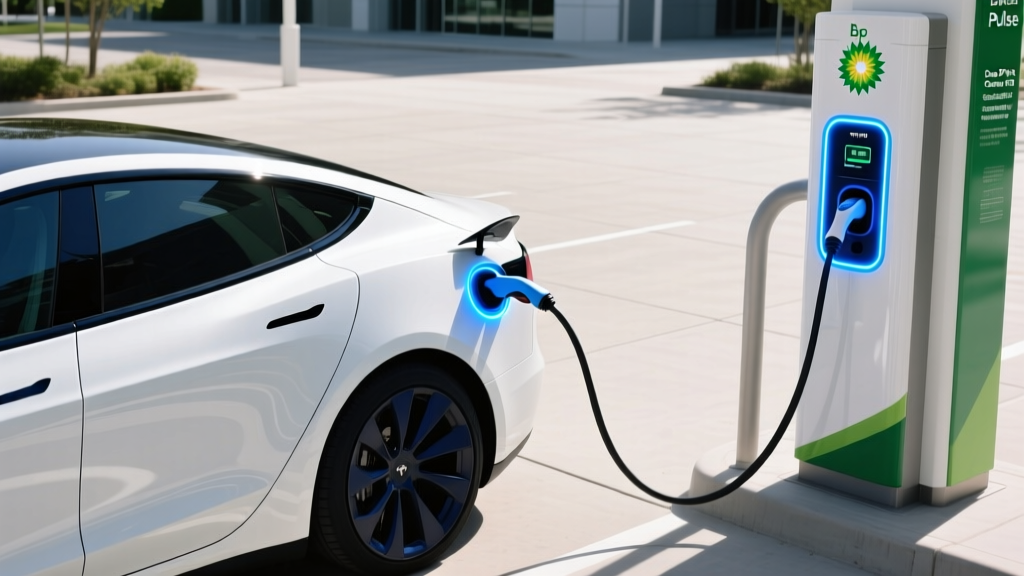
If you own a Tesla or are shopping for one, you already know the Supercharger network is the gold standard for DC fast charging. But what happens when you're nowhere near a Supercharger and a BP Pulse station is your closest option? The short answer to "does BP Pulse charge Tesla" is yes — but with important caveats depending on your Tesla model, the connector type at the station, and whether you have the right adapter.
This guide breaks down exactly how Tesla vehicles interface with BP Pulse's growing U.S. charging network in 2026, what speeds you can expect, what it costs, and how the experience compares to plugging into a Supercharger. We'll also cover the broader charging picture for the current Tesla lineup so you know exactly what you're working with.
BP Pulse and Tesla: The Connector Situation in 2026
BP Pulse operates one of the largest public EV charging networks in the United States, with a mix of DC fast chargers (ranging from 50 kW to 350 kW) and Level 2 destination chargers. Historically, BP Pulse stations were equipped with CCS1 connectors and, at older locations, CHAdeMO connectors. Tesla vehicles use the North American Charging Standard (NACS) connector — a proprietary design that Tesla opened to the industry in late 2022.
Here's where things stand in 2026:
- Tesla vehicles (all model years): Ship with a NACS charge port. No adapter is needed at NACS-equipped stations.
- BP Pulse NACS rollout: BP Pulse has been adding native NACS cables to new and retrofitted stations since 2024. By 2026, a growing share of BP Pulse DC fast chargers offer NACS connectors, but many legacy stations still carry CCS1 only.
- Tesla CCS Adapter: Tesla sells a CCS1-to-NACS adapter (approximately $175 through Tesla's shop) that allows Tesla vehicles to charge at any CCS-equipped station, including BP Pulse locations without native NACS cables.
| BP Pulse Connector | Tesla Native? | Adapter Needed? | Max Speed on BP Pulse |
|---|---|---|---|
| NACS (native) | Yes — direct plug | No | Up to station max (150–350 kW) |
| CCS1 | No | Yes — Tesla CCS Adapter (~$175) | Up to station max, limited by vehicle |
| CHAdeMO | No | Not supported (no adapter available) | N/A |
| J1772 (Level 2) | No | Yes — Tesla J1772 adapter (included with vehicle) | Up to 11.5 kW (44 mi/hr) |
Bottom line: Yes, BP Pulse can charge a Tesla in 2026 — either directly at NACS-equipped stations or via the CCS adapter at CCS1 stations. Before you drive to a specific BP Pulse location, check the station details in the BP Pulse app or on PlugShare to confirm which connectors are available.
Charging Speeds: What to Expect at BP Pulse vs. Superchargers
Connector compatibility is only half the story. The other half is how fast your Tesla will actually charge on a BP Pulse DC fast charger compared to a Tesla Supercharger. The answer depends on three variables: the station's maximum output (kW), your Tesla model's peak charge acceptance rate, and the state of charge (SoC) at which you plug in.
| Model | Battery (kWh usable) | Chemistry | Peak DC kW | 10–80% Time | Level 2 Rate |
|---|---|---|---|---|---|
| Model 3 RWD | ~57 kWh | LFP | 170 kW | ~30 min | 11.5 kW (44 mi/hr) |
| Model 3 Long Range AWD | ~75 kWh | NMC | 250 kW | ~25 min | 11.5 kW (44 mi/hr) |
| Model Y Long Range AWD | ~75 kWh | NMC | 250 kW | ~27 min | 11.5 kW (44 mi/hr) |
| Model S Dual Motor | ~95 kWh | NMC | 250 kW | ~30 min | 11.5 kW (44 mi/hr) |
| Model X Dual Motor | ~95 kWh | NMC | 250 kW | ~32 min | 11.5 kW (44 mi/hr) |
| Cybertruck AWD | ~123 kWh | NMC | 350 kW | ~25 min | 11.5 kW (37 mi/hr) |
Most BP Pulse DC fast chargers in the U.S. max out at 150 kW or 350 kW. At a 350 kW BP Pulse station, a Model 3 Long Range will peak around 250 kW (its vehicle-side cap) and taper as SoC climbs — a typical 10–80% session takes roughly 25 minutes. At a 150 kW BP Pulse charger, that same Model 3 will be limited by the station and take closer to 35–40 minutes for the same 10–80% session.
Charging curve reality check: No EV sustains its peak kW for the entire session. Tesla's thermal management is excellent, but expect the charge rate to taper noticeably above 60% SoC and more aggressively above 80%. This is physics — lithium-ion cells accept charge more slowly as they fill. For road-trip efficiency, charge to 80% and go rather than waiting for 100%.
Range and Efficiency: What the EPA Says vs. Real-World Driving
Whether you're charging at BP Pulse or a Supercharger, how far you can drive between stops is what really matters. Here are the current EPA range estimates for the 2026 Tesla lineup, along with the real-world adjustments you should plan for.
| Model / Trim | EPA Range | Real-World Highway (~75 mph) | Cold Weather (below 32°F) | MPGe (combined) |
|---|---|---|---|---|
| Model 3 RWD | 272 mi | ~230–245 mi | ~190–215 mi | 132 MPGe |
| Model 3 Long Range AWD | 363 mi | ~300–320 mi | ~250–275 mi | 132 MPGe |
| Model Y Long Range AWD | 320 mi | ~270–290 mi | ~220–245 mi | 122 MPGe |
| Model S Dual Motor | 402 mi | ~340–360 mi | ~280–310 mi | 124 MPGe |
| Model X Dual Motor | 335 mi | ~280–300 mi | ~230–255 mi | 103 MPGe |
| Cybertruck AWD | 340 mi | ~280–300 mi | ~230–255 mi | ~85 MPGe (est.) |
Sources: fueleconomy.gov, Tesla spec sheets. Real-world figures are estimates based on aggregated owner data and independent testing; actual results vary with driving style, temperature, elevation, and tire condition.
Why the gap? EPA range testing includes a significant city-driving component where regenerative braking recaptures energy. Sustained highway driving at 75+ mph eliminates most regen opportunities and increases aerodynamic drag, which scales with the square of speed. Cold weather adds resistive cabin heating loads (even with Tesla's heat pump) and slows electrochemical reactions in the battery, reducing usable capacity by 15–30%. Always plan road trips around real-world numbers, not the sticker.
Tesla Pricing, Tax Credits, and Total Cost in 2026
Tesla's pricing has shifted multiple times over the past few years. Here's where the 2026 lineup stands at base MSRP, along with federal tax credit eligibility under IRS §30D.
| Model / Trim | Base MSRP | §30D Credit Eligible? | Est. After Credit |
|---|---|---|---|
| Model 3 RWD | $38,990 | Yes — up to $3,750 (partial sourcing) | ~$35,240 |
| Model 3 Long Range AWD | $45,240 | Yes — up to $3,750 | ~$41,490 |
| Model Y Long Range AWD | $44,990 | Yes — up to $7,500 (full sourcing) | ~$37,490 |
| Model S Dual Motor | $79,990 | No — exceeds $55,000 sedan MSRP cap | $79,990 |
| Model X Dual Motor | $79,990 | No — exceeds $80,000 SUV cap in some configs | $79,990 |
| Cybertruck AWD | $79,990 | Check current sourcing rules | Varies |
§30D eligibility caveats: The federal clean vehicle credit has multiple requirements that change frequently. As of 2026, key rules include:
- MSRP caps: $55,000 for sedans (Model 3); $80,000 for SUVs/pickups (Model Y, Model X, Cybertruck)
- Buyer income caps: AGI ≤ $150,000 (single), $225,000 (head of household), $300,000 (joint)
- Battery sourcing: The $7,500 credit splits into two $3,750 halves — one for critical minerals sourcing, one for battery component manufacturing. Vehicles meeting only one requirement receive $3,750.
- Point-of-sale transfer: Eligible buyers can transfer the credit to the dealer at purchase, reducing the purchase price directly rather than waiting for a tax refund.
Always verify current eligibility on IRS.gov before purchasing — battery sourcing compliance can shift model-by-model and quarter-by-quarter.
Performance and Drivetrain Specs Across the Tesla Lineup
Tesla's performance figures remain some of the quickest in the EV market. Here's the full 2026 breakdown:
| Model | Drivetrain | Horsepower | 0–60 mph | Top Speed |
|---|---|---|---|---|
| Model 3 RWD | RWD (single motor) | 271 hp | 5.8 sec | 125 mph |
| Model 3 Long Range AWD | AWD (dual motor) | 346 hp | 4.2 sec | 125 mph |
| Model 3 Performance | AWD (dual motor) | 510 hp | 2.9 sec | 163 mph |
| Model Y Long Range AWD | AWD (dual motor) | 384 hp | 4.8 sec | 135 mph |
| Model S Dual Motor | AWD (dual motor) | 670 hp | 3.1 sec | 155 mph |
| Model S Plaid | AWD (tri-motor) | 1,020 hp | 1.99 sec | 200 mph |
| Model X Dual Motor | AWD (dual motor) | 670 hp | 3.8 sec | 155 mph |
| Cybertruck AWD | AWD (dual motor) | 600 hp | 4.1 sec | 130 mph |
For context, even the base Model 3 RWD hits 60 mph faster than most gas-powered sport sedans. The dual-motor AWD models provide genuine all-weather traction, and Tesla's low center of gravity (battery pack under the floor) gives all models composed handling despite their weight.
Tech, Driver Assistance, and Interior Practicality
Infotainment: All 2026 Teslas run Tesla's proprietary software on a 15.4-inch center touchscreen (Model 3/Y) or 17-inch screen (Model S/X). There is no Apple CarPlay or Android Auto — Tesla's native navigation, Spotify, Netflix (while parked), and gaming suite replace them. The navigation system integrates directly with the Supercharger network for route planning and battery preconditioning, but it does not natively route through BP Pulse or other third-party networks. You'll need to plan BP Pulse stops manually or via the BP Pulse app.
Driver Assistance (SAE Level 2): Tesla's Autopilot comes standard and includes adaptive cruise control and lane centering. Full Self-Driving (Supervised) is an optional upgrade ($8,000 or $99/month as of 2026) that adds automatic lane changes, traffic light/stop sign recognition, and city-street navigation. FSD is SAE Level 2 — the driver must remain fully attentive with hands on the wheel at all times. It is not autonomous driving.
SAE Automation Level Reminder: Tesla Autopilot and FSD (Supervised) are Level 2 driver-assistance systems. The driver is responsible for all vehicle operation and must continuously monitor the road. Only Level 4 services like Waymo operate without a human driver — and those are limited to specific geofenced areas.
Cargo and passenger space:
- Model 3: 23 cu ft trunk + rear seats fold; 42.3 in front legroom, 35.3 in rear
- Model Y: 30 cu ft behind rear seats, 72 cu ft with seats folded; 41.8 in front, 40.5 in rear
- Model S: 28 cu ft trunk + 5 cu ft frunk; 42.4 in front, 35.4 in rear
- Model X: Up to 88 cu ft (5-seat config, seats folded); falcon-wing doors ease child-seat loading
- Cybertruck: 6.5-ft bed + front trunk (frunk); 41.7 in front, 36.0 in rear
Warranty Coverage and Battery Longevity
Tesla's warranty structure is straightforward and competitive within the EV segment:
- Basic vehicle warranty: 4 years / 50,000 miles
- Battery and drive unit warranty:
- Model 3 RWD (LFP): 8 years / 100,000 miles, ≥70% capacity retention
- Model 3 Long Range, Model Y, Model S, Model X: 8 years / 120,000 miles (Model S/X: 150,000 miles), ≥70% retention
- Cybertruck: 8 years / 120,000 miles, ≥70% retention
LFP vs. NMC — what it means for you: The base Model 3 RWD uses a lithium iron phosphate (LFP) battery. LFP cells are heavier and less energy-dense (hence the shorter range), but they tolerate frequent 100% charging better than NMC and generally exhibit slower degradation over time. Tesla recommends charging LFP packs to 100% at least weekly. NMC packs (Long Range, Performance, Model S/X) benefit from daily limits of 80–90% with 100% reserved for road trips.
Real-world degradation data from aggregated owner reports shows most Tesla NMC packs retain approximately 90–93% capacity at 100,000 miles, with the curve flattening significantly after the initial 5–10% loss in the first 20,000 miles. LFP packs show even less measurable degradation in the same timeframe.
BP Pulse Pricing vs. Tesla Supercharger Costs
Charging cost is a practical concern for Tesla owners considering BP Pulse. Here's a general comparison:
- Tesla Supercharger: Typically $0.25–$0.40 per kWh in the U.S. (varies by location and time of day). Memberships and off-peak rates can reduce this.
- BP Pulse DC fast charging: Typically $0.31–$0.49 per kWh, depending on station and local utility rates. BP Pulse offers a membership tier with reduced per-kWh rates for frequent users.
- Home Level 2 charging: At the U.S. average residential rate of ~$0.16/kWh, home charging costs roughly $0.04–$0.05 per mile in a Model 3 — dramatically cheaper than any public network.
For a 60 kWh session (roughly 200 miles of range in a Model 3 Long Range), expect to pay approximately $18–$24 at a Supercharger and $19–$29 at a BP Pulse station. The difference is modest, but Superchargers tend to be more consistent in uptime and plug-and-charge simplicity.
Pros and Cons: Tesla Ownership in 2026
Pros
- Class-leading Supercharger network (17,000+ U.S. stalls)
- Excellent efficiency (kWh/100mi) across the lineup
- Strong real-world range, especially Model S and Model 3 LR
- Over-the-air updates continuously add features
- LFP option (Model 3 RWD) offers long battery cycle life
- Now compatible with BP Pulse and other CCS/NACS networks
Cons
- No Apple CarPlay or Android Auto
- FSD (Supervised) is costly and still requires full driver attention
- Model S/X exceed §30D MSRP caps — no federal credit
- Build quality consistency still trails legacy automakers
- BP Pulse and third-party charging requires adapter or planning
- Insurance premiums above segment average
Who Should Buy a Tesla — And Who Should Look Elsewhere?
Best for: Daily commuters with home Level 2 charging who want access to the most reliable DC fast-charging network for road trips. The Model 3 RWD at ~$35,240 after the partial tax credit is one of the best value-per-mile EVs on the market. The Model Y remains the default family EV crossover with strong cargo space and AWD.
Consider alternatives if: You need Apple CarPlay, prefer a more traditional dealership service experience, or require a vehicle eligible for the full $7,500 credit in a sedan body style (the Hyundai Ioniq 6 and Chevy Equinox EV are worth cross-shopping). If you frequently tow, the Cybertruck works but the Rivian R1T or Ford F-150 Lightning may offer more practical truck utility.
Frequently Asked Questions
Does BP Pulse charge Tesla vehicles without an adapter?
Yes — at BP Pulse stations equipped with native NACS connectors, you can plug directly into any 2026 Tesla without an adapter. At BP Pulse stations with only CCS1 connectors, you'll need Tesla's CCS adapter ($175). Check the BP Pulse app for connector details at each station before you go.
How fast will my Tesla charge at a BP Pulse DC fast charger?
It depends on the station's max output and your Tesla model. At a 350 kW BP Pulse station, a Model 3 Long Range will peak at ~250 kW and charge 10–80% in about 25 minutes. At a 150 kW BP Pulse station, expect 35–40 minutes for the same session. The Cybertruck can accept up to 350 kW at compatible stations.
Is BP Pulse cheaper than the Tesla Supercharger network?
Generally, no. BP Pulse per-kWh rates ($0.31–$0.49) tend to run slightly higher than Supercharger rates ($0.25–$0.40), though this varies by location and time of day. BP Pulse memberships can narrow the gap. Home Level 2 charging remains the cheapest option by a wide margin.
Does the Tesla Model Y qualify for the $7,500 federal tax credit?
As of 2026, the Model Y Long Range AWD qualifies for up to the full $7,500 under §30D, provided the buyer meets income caps ($150K single / $300K joint) and the vehicle's battery sourcing meets both critical-mineral and component-manufacturing requirements. The credit can be transferred at point of sale. Always verify current eligibility at IRS.gov.
What is the real-world range of a Tesla Model 3 Long Range?
The EPA rates the 2026 Model 3 Long Range AWD at 363 miles. In real-world highway driving at 70–75 mph, expect approximately 300–320 miles. In cold weather (below 32°F), plan for 250–275 miles. These figures assume standard tire pressure and moderate climate-control use.
Can I use the BP Pulse app to plan routes with my Tesla?
The BP Pulse app shows station locations, connector types, and real-time availability, but it does not integrate with Tesla's in-car navigation. You'll need to manually add BP Pulse stops to your Tesla's navigation or use a third-party route planner like A Better Routeplanner (ABRP) that supports both Tesla vehicles and BP Pulse stations.