The Honda Prologue Lease Decision: What the Numbers Actually Say
If you've been eyeing the Honda Prologue — Honda's first dedicated battery-electric SUV built on GM's Ultium platform — you've probably seen the attractive lease offers. But a low monthly payment only tells part of the story. Before signing, you need to understand the full financial picture: how the federal tax credit applies (or doesn't), what you'll actually spend on charging versus gas, where insurance costs land, and what happens to the Prologue's value over time.
This guide dissects the real economics of a 2026 Honda Prologue EV lease, using current EPA data, IRS §30D rules, and real-world ownership variables. We'll give you exact numbers so you can decide whether this electric SUV fits your budget — not just your driveway.
EPA Range: 296 miles (FWD EX) | Battery: 85 kWh usable (NMC) | DC Fast Charge: up to 150 kW peak, ~32 min 10-80% | Level 2: 11.5 kW | 0-60 mph: ~7.7 sec (FWD), ~5.9 sec (AWD) | HP: 212 (FWD) / 288 (AWD) | Base MSRP: ~$48,795 (EX FWD)
How the Federal EV Tax Credit Applies to a Prologue Lease
The federal EV tax credit under IRS §30D offers up to $7,500 for qualifying new clean vehicles. But here's where leasing gets interesting — and where many buyers get confused.
When you purchase a Prologue, the credit goes to you (the buyer), subject to strict eligibility rules. When you lease, the credit technically goes to the lessor (Honda Financial Services). However, Honda has historically passed this benefit through as a lease cash incentive — effectively reducing your capitalized cost and monthly payment. This is commonly referred to as the "lease loophole," though it's not a loophole at all; it's how commercial tax credits for leased vehicles work under §45W (the commercial clean vehicle credit that lessors can claim).
The key advantage of leasing: the lessor's eligibility is not subject to the same buyer income caps or battery-sourcing restrictions that apply to direct purchases under §30D. This means a Prologue lease may capture the full credit value even if a purchase wouldn't qualify for you personally.
- Buyer AGI must not exceed: $300,000 (joint), $225,000 (head of household), $150,000 (single)
- Vehicle MSRP cap: $80,000 for SUVs/pickups/vans; $55,000 for sedans (Prologue qualifies as SUV)
- Battery components must meet North American manufacturing/assembly thresholds (increasing annually)
- Critical minerals must meet sourcing requirements from US or FTA partners (threshold increases yearly)
- Point-of-sale transfer available — you can apply the credit at purchase rather than waiting for tax filing
- Credit is non-refundable; you must have sufficient tax liability to claim it on a purchase
For 2026, the battery-sourcing and component rules have tightened significantly compared to 2023-2024. Several vehicles that previously qualified for the full $7,500 now qualify for only $3,750 or nothing at all when purchased. The Prologue's GM-sourced Ultium battery gives it an advantage here for purchases, but always verify current eligibility on fueleconomy.gov before committing.
5-Year Total Cost of Ownership: Prologue vs. Comparable Gas SUV
To understand whether a Prologue lease makes financial sense, we need to look beyond the monthly payment. Below is a 5-year/75,000-mile total cost of ownership (TCO) comparison against a similarly priced gas SUV — the Honda CR-V AWD Touring (MSRP ~$40,000), which is what many Prologue shoppers cross-shop.
| Cost Category | Prologue EX AWD (EV) | CR-V Touring AWD (Gas) |
|---|---|---|
| Vehicle Price / Cap Cost (after credit) | ~$44,295 ($51,795 - $7,500) | ~$40,000 |
| Fuel/Energy (75,000 mi) | $4,125 (home charging at $0.15/kWh) | $9,375 (28 MPG avg at $3.50/gal) |
| Maintenance (5 years) | $1,800 | $4,200 |
| Insurance (5 years) | $12,500 | $9,800 |
| Estimated Depreciation (5 yr) | $24,000 (~54%) | $18,000 (~45%) |
| Total 5-Year Cost | ~$86,720 | ~$81,375 |
Key takeaway: The Prologue saves significantly on fuel and maintenance — roughly $7,650 combined over five years. But higher insurance premiums and steeper EV depreciation erode much of that advantage. The net TCO gap narrows to approximately $5,345 more for the Prologue over five years. If you lease and capture the full $7,500 credit through reduced cap cost, the gap essentially closes.
Important caveat: these numbers assume 80% home charging at $0.15/kWh. If you rely heavily on DC fast charging at $0.40-$0.55/kWh, your energy costs climb substantially — potentially to $11,000-$15,000 over 75,000 miles.
Charging Costs vs. Gas: The Per-Mile Math
The Prologue's EPA-rated efficiency is approximately 3.0 miles per kWh (roughly 112 MPGe combined for the FWD model). Let's break down what that means in real dollars across different charging scenarios.
| Scenario | Cost/Mile | Cost for 15,000 mi/yr |
|---|---|---|
| Home Level 2 ($0.15/kWh) | $0.050 | $750 |
| Home with time-of-use off-peak ($0.09/kWh) | $0.030 | $450 |
| Public DC fast charging ($0.48/kWh avg) | $0.160 | $2,400 |
| Mixed (80% home / 20% DCFC) | $0.072 | $1,080 |
| Gas SUV (28 MPG at $3.50/gal) | $0.125 | $1,875 |
At home on a standard residential rate, the Prologue costs roughly 60% less per mile than a comparable gas SUV. But the advantage collapses if you're entirely dependent on public fast charging. This is why home charging access — whether a garage Level 2 setup or even a dedicated 120V outlet for overnight Level 1 trickle — is the single biggest financial variable in EV ownership.
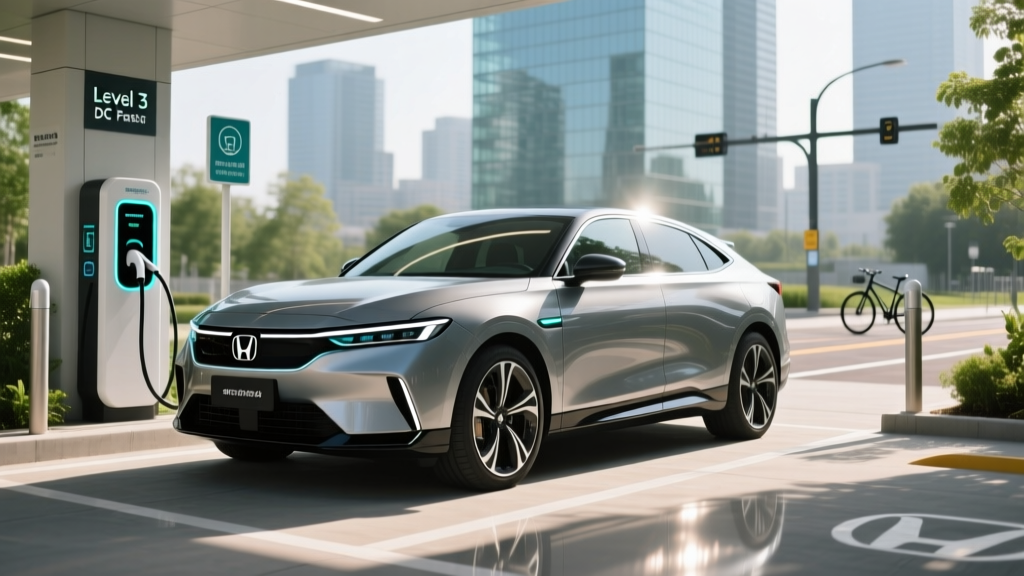
The Prologue supports up to 150 kW DC fast charging on compatible CCS/NACS stations (2026 models ship with NACS ports for native Tesla Supercharger access). Expect a 10-80% session in roughly 32 minutes. The charging curve tapers significantly above 80% SoC — charging from 80-100% can take nearly as long as 10-80%, so plan your road-trip stops accordingly.
Maintenance Savings: Where EVs Genuinely Win
EVs eliminate the most common recurring maintenance costs associated with internal combustion engines. The Prologue's Ultium electric powertrain has far fewer wear items than a turbocharged gas engine paired with a CVT or automatic transmission.
| Service Item | Prologue (EV) | CR-V (Gas) |
|---|---|---|
| Oil changes | $0 | $600-$900 |
| Transmission fluid | $0 | $150-$300 |
| Engine air filter | $0 | $100-$150 |
| Spark plugs | $0 | $300-$500 |
| Brake pads (regen extends life) | $0-$250 | $600-$1,000 |
| Cabin air filter | $150-$200 | $150-$200 |
| Tire rotation/replacement | $1,200-$1,500 | $1,000-$1,200 |
| Coolant / misc. | $200-$300 | $300-$500 |
| Total (est.) | $1,550-$2,250 | $3,200-$4,750 |
Notice the tire row: EVs are heavier (the Prologue weighs roughly 5,000 lbs) and deliver instant torque, which accelerates tire wear. Budget for tires every 30,000-40,000 miles rather than the 50,000+ you might get on a lighter gas crossover. This partially offsets maintenance savings.
Regenerative braking is the Prologue's maintenance superpower. By using the electric motor to decelerate — especially in one-pedal driving mode — the friction brakes see dramatically less use. Many EV owners report original brake pads lasting 80,000+ miles.
The Insurance Reality: Why EVs Cost More to Insure
Here's where the ownership math gets less pleasant. EV insurance premiums typically run 15-30% higher than equivalent gas vehicles. For the Prologue, expect annual premiums in the $2,200-$2,800 range depending on your state, driving record, and coverage level — compared to $1,700-$2,200 for a CR-V Touring.
The reasons are structural, not arbitrary:
- Higher repair costs: Battery pack damage, even minor, can trigger total-loss declarations. Specialized high-voltage repair training is required.
- Parts cost: Ultium platform components, sensor arrays, and integrated electronics are more expensive to replace than conventional drivetrain parts.
- Vehicle weight: At ~5,000 lbs, the Prologue causes more damage in collisions, raising liability exposure for insurers.
- Limited actuarial data: Insurers are still building long-term loss models for newer EV platforms, leading to conservative pricing.
Shop quotes from multiple carriers before signing. Some insurers — like Progressive, State Farm, and Tesla Insurance (in available states) — offer EV-specific discounts that can narrow the gap. Bundling with homeowners insurance and maintaining a clean record help further.
Depreciation and Resale Value: The EV Wildcard
Depreciation is the single largest cost in vehicle ownership — and it's where EVs have struggled compared to Toyota and Honda's traditional gas models. The Prologue faces specific depreciation headwinds:
- Rapid EV price competition: New models with better range and faster charging continuously pressure used EV values downward.
- Battery health uncertainty: Used buyers discount EVs with unknown battery state-of-health (SoH). GM's Ultium battery carries an 8-year/100,000-mile warranty (covering defects and capacity loss below ~70%), which helps.
- Tax credit resets: When new EV buyers receive $7,500 credits, used EV prices must drop to remain competitive — effectively passing depreciation to the original owner.
- Technology obsolescence: Charging speed, ADAS features, and infotainment evolve quickly, making 3-year-old EVs feel dated faster than gas equivalents.
Industry data from sources like Kelley Blue Book and iSeeCars suggests mainstream EVs depreciate 45-60% over five years, compared to 35-45% for top-selling gas SUVs. The Prologue, as a first-generation Honda EV on a GM platform, may land toward the higher end of that range until Honda's EV track record matures.
If you lease, depreciation is the lessor's problem. This is arguably the strongest argument for leasing a Prologue rather than purchasing: you lock in the residual value at signing, and Honda Financial absorbs whatever the used market does over the next 36 months. If EV values crater, you walk away. If they hold, you can buy at the predetermined residual or trade into a new lease.
State, Local, and Utility Incentives: Stack the Savings
Beyond the federal credit, many states and utilities offer additional incentives that can further reduce the effective cost of a Prologue lease or purchase. These vary dramatically by location and change frequently, so always verify current programs.
- California: CVRP rebate up to $2,000 for income-eligible buyers; additional $1,000 for low-income applicants. Some air districts offer local rebates.
- Colorado: State EV tax credit up to $5,000 for vehicles under $80,000 MSRP (stackable with federal credit).
- New York: Drive Clean Rebate up to $2,000 at point of sale.
- Utility rebates: Many utilities offer $250-$1,500 for home Level 2 charger installation (e.g., PG&E, ConEdison, Xcel Energy). Some offer reduced EV time-of-use electricity rates.
- HOV lane access: States like California, New York, and Virginia grant solo HOV lane access to qualifying EVs — a significant commuting benefit with real dollar value.
Note: Incentive amounts, eligibility, and program availability change frequently. Check your state energy office, utility provider, and AFDC for current programs in your area.
Should You Lease or Buy the Prologue? A Decision Framework
Choose a Prologue LEASE if:
- You want to capture the full federal credit value without worrying about personal income caps or battery-sourcing eligibility changes
- You're concerned about EV depreciation and want residual-value risk transferred to the lessor
- You plan to upgrade to a newer EV with better range/charging in 3 years
- You drive under 12,000-15,000 miles per year (lease mileage limits apply)
- You want lower upfront costs (typical lease: first month + fees vs. full down payment)
Choose a Prologue PURCHASE if:
- You qualify for the full $7,500 §30D credit based on income and sourcing rules
- You drive high annual miles (15,000+) and would face expensive lease overage charges
- You plan to keep the vehicle 7+ years, riding out the depreciation curve
- You want to modify the vehicle (wraps, aftermarket wheels, etc.)
- You can claim the full non-refundable credit against your tax liability
Frequently Asked Questions
How much does it really cost to own a Honda Prologue over 5 years?
Based on our analysis, a Prologue EX AWD purchased at ~$44,295 (after the $7,500 federal credit) costs approximately $86,720 over five years and 75,000 miles, including energy, maintenance, insurance, and depreciation. Leasing shifts depreciation risk to the lessor and may lower the effective total cost if you return the vehicle at lease-end.
Do I qualify for the federal EV tax credit on the Prologue?
For a purchase, you must meet IRS §30D requirements: income below $300K/$225K/$150K (joint/HOH/single), vehicle MSRP under $80,000 (Prologue qualifies as an SUV), and current-year battery sourcing/component thresholds. For a lease, the lessor claims a commercial credit that is typically passed through as a cap-cost reduction, bypassing the personal income and sourcing restrictions. Always verify current eligibility on fueleconomy.gov and consult a tax professional.
How much do I save on fuel and maintenance with the Prologue?
With 80% home charging at $0.15/kWh, expect to spend roughly $825/year on electricity versus $1,875/year on gas for a comparable 28 MPG SUV — saving about $1,050 annually. Maintenance savings add another $400-$600/year from eliminated oil changes, spark plugs, and extended brake life. Combined annual savings: approximately $1,450-$1,650.
Are EVs more expensive to insure than gas cars?
Yes, typically 15-30% more. The Prologue's higher repair costs (battery-related), increased vehicle weight, and specialized parts drive premiums up. Expect $2,200-$2,800/year depending on your profile. Shop multiple carriers and ask about EV-specific discounts.
How well does the Honda Prologue hold its value?
Mainstream EVs currently depreciate 45-60% over five years, compared to 35-45% for top gas SUVs. The Prologue's first-generation status and rapidly evolving EV competition create additional depreciation risk. Leasing mitigates this by locking the residual at signing. GM's 8-year/100,000-mile battery warranty provides some used-market confidence.
Can I charge the Prologue at Tesla Superchargers?
The 2026 Prologue comes equipped with a NACS (North American Charging Standard) port, enabling native access to Tesla's Supercharger network — over 25,000 stalls in North America. This significantly improves road-trip charging convenience compared to CCS-only vehicles. The Prologue's 150 kW peak charge rate means you won't max out V3 Supercharger stalls (250 kW), but 10-80% sessions still complete in roughly 32 minutes.
What happens if the Prologue battery degrades?
GM's Ultium battery warranty covers 8 years/100,000 miles against defects and excessive capacity loss (typically defined as dropping below 60-70% of original capacity). Real-world data from similar Ultium-based vehicles suggests NMC chemistry in this application retains approximately 88-92% capacity after 100,000 miles with normal use. Avoid habitual DC fast charging and routinely charging to 100% to maximize longevity — keeping daily SoC between 20-80% is ideal.