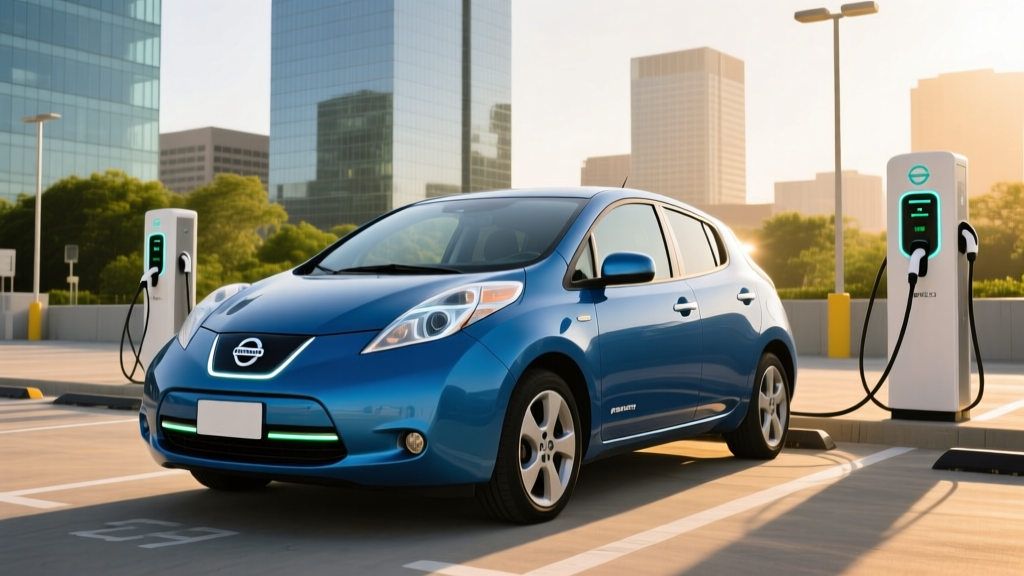
The 2010 Nissan Leaf holds a singular place in automotive history: it was the world's first mass-produced, purpose-built, highway-capable battery-electric vehicle sold to retail consumers. When it launched in December 2010, there was no Tesla Model 3, no Chevy Bolt, and no Supercharger network. The Leaf was a genuine leap into the unknown — a practical, five-door hatchback that ran entirely on electrons and asked mainstream buyers to trust a new propulsion technology.
More than 15 years later, the 2010 Leaf is no longer a new-car purchase. Nissan discontinued the Leaf after the 2025 model year, and the original 2010-2017 generation exists exclusively on the used market. But for budget-conscious commuters, EV-curious drivers, and anyone seeking a dirt-cheap electric daily driver, the first-generation Leaf still presents a compelling — if carefully caveated — value proposition. This review breaks down exactly what you're getting, what to watch out for, and whether a 2010 Leaf makes sense in 2026.
2010 Nissan Leaf: Core Specifications at a Glance
| Specification | 2010-2011 Nissan Leaf (SV) |
|---|---|
| EPA Range (Original) | 73 miles |
| Battery Capacity | 24 kWh gross (~21 kWh usable), NMC lithium-ion |
| Motor Power | 80 kW (107 hp), 207 lb-ft torque |
| Drivetrain | Front-wheel drive (single motor) |
| 0-60 mph | ~9.9 seconds |
| Top Speed | 90 mph (electronically limited) |
| EPA Efficiency | 99 MPGe combined (34 kWh/100 mi) |
| DC Fast Charge (CHAdeMO) | ~50 kW peak (optional on early models) |
| Level 2 Charge Rate | 3.3 kW (6.6 kW on 2013+ models) |
| Cargo Volume | 24.0 cu ft (rear seats up) / 30.0 cu ft (folded) |
| Passenger Volume | 94.0 cu ft |
| Curb Weight | ~3,340 lbs |
| Original MSRP (2011) | $32,780 (before federal tax credit) |
| Used Price Range (2026) | $3,500 - $7,500 depending on battery health |
| Battery Warranty (Original) | 8 years / 100,000 miles (capacity guarantee expired) |
Real-World Range: What 73 EPA Miles Actually Means in 2026
Real-World Expectation (2026, aged battery): 45-65 miles depending on State of Health
Highway (70 mph): ~40-55 miles
Cold Weather (below 32°F): ~30-45 miles
City/Stop-and-Go: ~55-70 miles (regen braking helps significantly)
The 2010 Leaf's 73-mile EPA rating was modest even at launch, and it becomes far less relevant once the battery ages. The 24 kWh NMC (nickel-manganese-cobalt) pack in early Leafs is air-cooled — a design decision that became the vehicle's Achilles' heel. Without active liquid thermal management, the battery degrades faster in hot climates and under repeated fast-charging stress.
Nissan's original battery warranty guaranteed the pack would retain at least 70% of its original capacity (roughly 16.8 kWh usable) for 8 years or 100,000 miles. That warranty has long expired for 2010 models. In practice, most 2010-2012 Leafs in 2026 show between 60% and 80% State of Health (SoH), meaning real-world range of 45 to 65 miles on a full charge.
The Leaf's dashboard includes a battery health indicator displayed as 12 capacity bars. A 2010 Leaf showing 9-10 bars still has roughly 75-83% SoH and offers usable commuter range. Anything below 8 bars signals significant degradation — expect under 50 miles and plan for a battery replacement or retirement of the vehicle. You can check SoH precisely using an OBD-II dongle paired with the LeafSpy app, which reads the actual battery capacity in Ah (amp-hours) and kWh.
For context on how this compares to modern EVs, the EPA maintains historical efficiency data at fueleconomy.gov.
Charging: CHAdeMO's Declining Network and Home Setup
Charging the 2010 Leaf is where ownership gets complicated in 2026. The vehicle uses two connector standards, both of which have been superseded by newer technology:
| Charge Level | Connector | Power (kW) | Time / Rate | Availability (2026) |
|---|---|---|---|---|
| Level 1 (120V) | J1772 | 1.2-1.4 kW | ~3-4 miles/hour (20+ hr full charge) | Any household outlet |
| Level 2 (240V) | J1772 | 3.3 kW | ~12 miles/hour (~7 hr full charge) | Home install or public Level 2 |
| DC Fast Charge | CHAdeMO | ~50 kW peak | 0-80% in ~30 minutes | Limited — stations declining |
Level 2 home charging is the most practical daily approach. The 2010-2012 Leaf's onboard charger maxes out at 3.3 kW, meaning even a 48-amp Level 2 home charger will only deliver 3.3 kW to the battery. You'll add roughly 12 miles of range per hour of charging — adequate for overnight replenishment of the ~60 miles you'll actually use. A basic 240V/16A home charger installation typically costs $500-$1,200 for equipment plus $300-$800 for electrician labor, depending on your panel's proximity to the garage.
DC fast charging on the 2010 Leaf uses the CHAdeMO connector, which was once common at Electrify America, EVgo, and independent stations. However, as of 2025-2026, most new DC fast-charging installations use the NACS (Tesla) or CCS1 connectors, and many networks have retired or reduced their CHAdeMO stalls. Before buying a 2010 Leaf, verify that CHAdeMO stations exist along your regular routes. The AFDC station locator can filter by connector type.
At a functioning 50 kW CHAdeMO station, the Leaf's charge curve is relatively flat — the air-cooled battery cannot accept high sustained power. Expect roughly 30 minutes from near-empty to 80%. Repeated fast charging accelerates degradation due to heat buildup, which is why many Leaf owners reserve DC fast charging for occasional road-trip use rather than daily reliance.
Performance and Driving Dynamics
The 2010 Leaf's 80 kW (107 hp) AC synchronous electric motor delivers its 207 lb-ft of torque instantly from zero RPM — a characteristic that makes it feel far peppier around town than the 9.9-second 0-60 time suggests. Off the line and through 0-35 mph, the Leaf is genuinely quick, pulling away from stoplights with the smooth, silent urgency that defines the EV driving experience.
But the single-speed reduction gear means acceleration tapers noticeably above 50 mph, and highway passing requires planning. The 90 mph electronic speed limiter reinforces that this is a commuter car, not a cruiser. Wind and road noise are prominent at highway speeds — sound insulation was minimal to save weight.
Handling is competent but unexciting. The heavy battery pack sits low in the chassis, giving the Leaf a lower center of gravity than most compact hatchbacks, but the soft suspension tuning prioritizes ride comfort over cornering confidence. Regenerative braking is moderate — the Leaf offers a "B" mode that increases regen, but it does not enable true one-pedal driving the way later EVs do. You'll still use the friction brake pedal regularly.
Notably absent: any form of advanced driver assistance. The 2010 Leaf has standard ABS, stability control, and six airbags, but no adaptive cruise control, lane-keeping assist, or automatic emergency braking. These features did not exist in mainstream compact cars at this price point in 2010.
Interior, Cargo, and Daily Practicality
The Leaf's interior was futuristic for 2010 — a digital instrument cluster, a center-mounted navigation screen, and the distinctive "mouse" shifter. The cabin seats five, though the rear bench is best suited for two adults or children. Rear legroom measures 33.5 inches, which is tight by modern compact-hatchback standards.
Cargo capacity is the Leaf's practical strong point: 24.0 cubic feet behind the rear seats and 30.0 cubic feet with the 60/40-split rear bench folded. That's competitive with a Honda Civic Hatchback and sufficient for weekly groceries, a couple of suitcases, or a large dog crate. The load floor is flat and reasonably low, making loading easy.
The infotainment system is a 7-inch touchscreen with navigation, Bluetooth audio, and a USB port. It lacks Apple CarPlay, Android Auto, or any modern smartphone integration — a significant drawback for 2026 buyers accustomed to seamless phone mirroring. The built-in navigation maps may be severely outdated unless a previous owner paid for map updates.
Pricing, Tax Credits, and Used EV Economics
The 2010 Nissan Leaf originally retailed at $32,780 for the base SV trim, with an SL package adding leather seats, a solar-powered rear spoiler (for trickle-charging the 12V battery), and upgraded audio for approximately $34,280. The $7,500 federal tax credit under the original program brought effective cost to ~$25,280 for qualified buyers.
In 2026, the 2010 Leaf trades exclusively on the used market:
| Condition / Battery SoH | Typical Used Price (2026) | Federal Used EV Credit (§25E) | Effective Cost |
|---|---|---|---|
| Excellent (10+ bars, 80%+ SoH) | $6,000 - $7,500 | Up to $4,000 (30% of sale price, max $4,000) | $3,500 - $4,500 |
| Good (9 bars, 70-79% SoH) | $4,500 - $6,000 | Up to $1,800 | $3,000 - $4,200 |
| Fair (7-8 bars, 60-69% SoH) | $3,000 - $4,500 | Up to $1,350 | $2,000 - $3,150 |
| Poor (below 7 bars, <60% SoH) | $1,500 - $3,000 | Up to $900 | $1,000 - $2,100 |
Used EV tax credit (§25E) rules for 2026: The federal credit for used EVs equals 30% of the sale price, capped at $4,000. To qualify, the vehicle must be purchased from a licensed dealer (not a private party), the sale price must be $25,000 or less, and the buyer must meet income caps ($75,000 single / $112,500 head of household / $150,000 joint filers). The vehicle must be at least two model years old — the 2010 Leaf qualifies. Full eligibility details are published at irs.gov. Always confirm current-year rules with a tax professional before relying on credit amounts.
Note: The new-vehicle §30D credit no longer applies to the Leaf because Nissan discontinued the model after 2025 and it cannot be purchased new.
Biggest Pros and Cons
Pros
- Extremely low entry cost — one of the cheapest EVs available
- Low operating cost: ~$0.04-$0.06/mile on home electricity
- Hatchback practicality with 24 cu ft cargo
- Smooth, silent electric drivetrain
- Eligible for up to $4,000 used EV tax credit
- Simple mechanicals — minimal maintenance (no oil, coolant flushes rare)
- Strong owner community and aftermarket support (LeafSpy, Muxsan CAN bridge for battery swaps)
Cons
- Severely degraded battery in most examples — 45-65 mile real range
- Air-cooled battery degrades faster; no thermal management
- CHAdeMO fast-charging network is shrinking rapidly
- 3.3 kW Level 2 onboard charger is slow by modern standards
- No modern driver-assist features (no AEB, no lane-keep)
- No Apple CarPlay/Android Auto; outdated infotainment
- Battery replacement ($6,500-$9,000) can exceed the car's value
- Not suitable for road trips or cold-climate primary vehicles
Who Should Buy a 2010 Nissan Leaf in 2026?
Choose the 2010 Leaf if:
- Your daily round-trip commute is under 40 miles and you can charge at home
- You want the cheapest possible entry into EV ownership
- You live in a mild climate (Southern California, Pacific Northwest, Southeast) where battery degradation is less extreme
- You need a second car for errands, school runs, and local driving
- You're comfortable using LeafSpy to monitor battery health and accept the risk of degradation
Look elsewhere if:
- You need more than 70 miles of reliable daily range
- You live in a hot climate (Arizona, Texas) or extreme cold (Upper Midwest) — battery degradation accelerates
- You rely on DC fast charging for road trips
- You want modern safety tech (AEB, blind-spot monitoring)
- This would be your only vehicle
For buyers who need more range but still want a budget EV, consider a 2016-2017 Leaf with the 30 kWh battery (107 miles EPA), a 2017+ Chevy Bolt EV (238 miles EPA, CCS charging), or a used Tesla Model 3 Standard Range (220+ miles EPA, NACS/Supercharger access). All cost more upfront but deliver dramatically better range and charging infrastructure access.
Frequently Asked Questions
What is the real-world range of a 2010 Nissan Leaf in 2026?
Expect 45-65 miles in mixed driving, depending on the battery's State of Health. Highway driving at 70 mph reduces this to roughly 40-55 miles, and cold weather below freezing can drop it to 30-45 miles. Use the LeafSpy app with an OBD-II dongle to check actual battery capacity before purchasing.
How fast does the 2010 Leaf charge?
On a 240V Level 2 home charger, the Leaf charges at 3.3 kW, adding about 12 miles of range per hour — a full charge takes roughly 7 hours. On a CHAdeMO DC fast charger (~50 kW), it reaches 80% in about 30 minutes. However, CHAdeMO stations are increasingly rare in 2026 as networks transition to NACS and CCS1.
How much does a used 2010 Leaf cost after tax credits?
A 2010 Leaf in good condition typically sells for $4,500-$7,500 from a dealer. The federal used EV tax credit (§25E) covers 30% of the sale price up to $4,000, potentially bringing effective cost to $3,000-$4,500. You must buy from a licensed dealer and meet income caps ($75K single / $150K joint) to qualify.
Does the 2010 Nissan Leaf qualify for any federal tax credit?
Not the new-vehicle §30D credit — the Leaf is discontinued and only available used. However, it does qualify for the §25E used clean vehicle credit: 30% of the sale price, max $4,000, with income and dealer-sale requirements. Check current rules at irs.gov and consult a tax professional.
Is the 2010 Leaf worth buying vs. other used EVs?
It depends on your budget and range needs. The 2010 Leaf is the cheapest used EV available, but its degraded battery and shrinking CHAdeMO network are serious limitations. A 2017 Chevy Bolt EV offers 238 miles of EPA range and CCS charging for roughly $10,000-$14,000 used — significantly more capable. A 2018+ Tesla Model 3 offers Supercharger access and 220+ miles for $15,000-$20,000. The 2010 Leaf wins only on absolute lowest cost.
How long does the 2010 Leaf battery last, and what does replacement cost?
Most 2010 Leaf batteries retain 60-80% of original capacity after 14-16 years. A replacement battery from Nissan costs approximately $6,500-$9,000 installed — often exceeding the car's market value. Third-party options and salvaged packs from wrecked newer Leafs can reduce this to $3,500-$5,500, but availability varies. The original 8-year/100,000-mile battery warranty has expired for all 2010 models.
Can I upgrade the 2010 Leaf's battery for more range?
Yes, with caveats. The aftermarket has developed solutions to install 30 kWh, 40 kWh, or even 62 kWh packs from later-model Leafs into the 2010-2011 chassis using a CAN-bridge adapter (such as the Muxsan module). A 40 kWh swap can restore range to 120+ miles, but costs $5,000-$8,000 including parts and labor. This is a specialist procedure — not a DIY project for most owners.