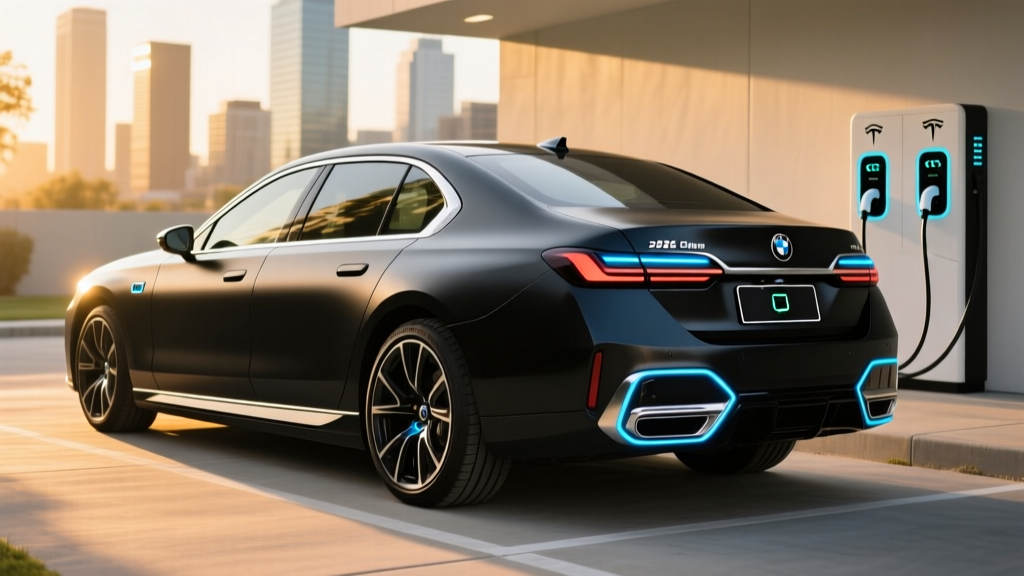
The Quick Verdict on the BMW i7 M70
The BMW i7 M70 is the automaker's fastest, most powerful electric sedan — a 650-horsepower flagship that attempts to reconcile M-division performance with 7 Series luxury and zero tailpipe emissions. For 2026, it remains one of the few electric luxury sedans that can genuinely seat four adults in comfort while cracking 60 mph in under 3.8 seconds. But at a base MSRP exceeding $170,000, and with real-world range that falls short of its EPA sticker on highway road trips, the i7 M70 demands buyers who value driving dynamics and prestige over maximum efficiency or value.
If you're cross-shopping the Mercedes EQS 580, Audi e-tron GT, or Porsche Taycan Turbo S, this review breaks down the exact numbers — from charging-curve behavior to cold-weather range loss — that spec sheets don't always make obvious.
Range and Efficiency: EPA vs. the Real World
Real-World Expectation: Plan for 250–270 miles on sustained highway driving at 70–80 mph. In freezing temperatures (below 32°F), expect a further 20–30% reduction, bringing usable highway range down to roughly 185–220 miles without preconditioning.
The i7 M70 uses a 101.7 kWh usable battery pack (gross capacity approximately 105.7 kWh) built on BMW's fifth-generation eDrive architecture. The cells are NMC (nickel-manganese-cobalt) chemistry, chosen for their higher energy density compared to LFP — a necessary trade-off in a vehicle this large and heavy. The pack sits low in the chassis, contributing to a center of gravity that helps the M70 feel more planted than its 5,800-pound curb weight would suggest.
EPA efficiency is rated at approximately 82 MPGe combined, which translates to roughly 41 kWh per 100 miles. That's not class-leading — the Mercedes EQS 450+ achieves closer to 97 MPGe — but it's competitive for a dual-motor, 650-hp performance sedan. In mixed suburban driving at moderate speeds, owners typically see 2.3–2.6 miles per kWh. Sustained highway travel at 75+ mph pushes consumption closer to 2.0–2.2 mi/kWh, which is where the range gap between EPA estimates and real-world experience becomes most noticeable.
BMW equips the i7 M70 with a heat pump as standard, which helps mitigate cold-weather range loss compared to resistive cabin heating. Preconditioning the battery while still plugged in — a feature accessible through the BMW app — is essential for both range preservation and optimal DC fast-charging speeds in cold conditions.
Charging Speed: DC Fast, Level 2, and the Curve
| Charging Level | Max Rate | Estimated Speed |
|---|---|---|
| Level 1 (120V household) | ~1.4 kW | ~3 miles per hour |
| Level 2 (240V home, 48A) | 11.5 kW | ~25–28 miles per hour |
| DC Fast Charging | 195 kW peak | 10–80% in ~34 minutes |
The i7 M70's 195 kW peak DC fast-charge rate is respectable but no longer best-in-class. Competitors like the Hyundai Ioniq 5 N (which shares an 800V architecture) can accept 250+ kW, and Porsche's Taycan on 800V infrastructure peaks even higher. BMW's eDrive platform operates on a 400V architecture, which limits peak charge rate but keeps system cost and complexity lower.
Here's what the charging curve actually looks like in practice: the i7 M70 will sustain close to its 195 kW peak from roughly 10% to 35% State of Charge (SoC). From there, the rate tapers progressively — dropping to around 120–140 kW by 50% SoC, and falling below 75 kW past 70%. This is normal for NMC chemistry with active thermal management, but it means that the advertised 10–80% time of 34 minutes assumes ideal conditions: a warm battery, a capable 200+ kW charger (such as an Electrify America or EVgo 350 kW station), and no concurrent heavy battery drain from climate control.
For home charging, the onboard 11.5 kW AC charger means a full 0–100% charge takes roughly 9–10 hours on a properly installed 48-amp Level 2 circuit. Most i7 owners will plug in nightly and rarely deplete below 20%, making a home Level 2 setup effectively mandatory for this vehicle. Relying solely on public DC fast charging is feasible for road trips but impractical for daily use at this price point.
BMW includes the BMW Charging program, which provides complimentary access to partner networks for a limited period on new vehicles. Verify current terms with your dealer, as promotional details shift model year to model year.
Performance and Drivetrain
The i7 M70 pairs dual electric motors — one on each axle — for BMW's xDrive all-wheel-drive system. Combined output is 650 horsepower and 749 lb-ft of torque (with M Launch Control engaged). The result is a 0–60 mph time of 3.7 seconds, according to BMW's official figures, making this the quickest 7 Series variant ever produced, internal combustion or otherwise.
| Specification | BMW i7 M70 |
|---|---|
| Powertrain | Dual-motor AWD (xDrive) |
| Horsepower | 650 hp (M Launch Control) |
| Torque | 749 lb-ft |
| 0–60 mph | 3.7 seconds |
| Top Speed | 155 mph (electronically limited) |
| Battery (usable) | 101.7 kWh, NMC chemistry |
| EPA Range | 318 miles (19" wheels) |
| Efficiency | 82 MPGe / ~41 kWh/100mi |
| DC Fast Charge Peak | 195 kW |
| 10–80% DC Charge Time | ~34 minutes |
| Level 2 Charge Rate | 11.5 kW |
| Curb Weight | ~5,995 lbs |
| Cargo Volume (trunk) | 17.7 cu ft |
| Rear Legroom | 42.8 inches |
| Base MSRP (2026) | $170,495 |
| Battery Warranty | 8 years / 100,000 miles |
On the road, the M70's performance is startling for a vehicle approaching three tons. Instant electric torque delivery means passing maneuvers on two-lane highways require virtually no planning — just point and go. The adaptive M suspension, standard on the M70, manages body control surprisingly well, though you'll feel the mass during aggressive direction changes. This is a grand-touring performance car, not a track weapon, and that distinction matters.
Regenerative braking offers multiple levels of aggressiveness, selectable via steering-wheel paddles or through BMW's adaptive mode, which uses radar and navigation data to modulate regen automatically based on traffic and upcoming terrain. One-pedal driving is achievable in its strongest setting, though BMW stops short of a true one-pedal default like you'd find in a Tesla or Nissan Leaf.
Interior, Tech, and Driver Assistance
The i7 cabin is where BMW's flagship positioning becomes most apparent. The M70 comes standard with BMW's Curved Display — a 12.3-inch digital instrument cluster merged with a 14.9-inch infotainment touchscreen running iDrive 8.5. The system is responsive, logically structured, and supports wireless Apple CarPlay and Android Auto, along with over-the-air updates.
Rear-seat passengers in the Executive Lounge seating package get individual 12.8-inch theater screens, heated and ventilated seats with massage functions, and rear-axle steering that tightens the turning radius for city maneuvering. The 17.7-cubic-foot trunk is generous for a luxury sedan, though it's worth noting that the i7 does not offer a front trunk (frunk) — the space is consumed by power electronics and HVAC components.
On the driver-assistance front, the i7 M70 includes BMW's Driving Assistant Professional, which provides adaptive cruise control with stop-and-go, lane-keeping with active lane-change capability, and hands-free driving at speeds up to 85 mph on divided highways (where legally permitted). This is an SAE Level 2 system — the driver must remain attentive, keep hands near the wheel (or eyes on the road where the eye-tracking cabin camera is enabled), and be ready to take over at any moment. This is not autonomous driving.
Pricing, Trims, and Federal Tax Credit Eligibility
The 2026 BMW i7 M70 starts at a base MSRP of $170,495, including destination. With common options — the Executive Lounge package, M Sport brakes, Bowers & Wilkins diamond surround sound, and 22-inch wheels — as-tested pricing routinely climbs to $185,000–$195,000.
There is only one trim for the M70 (it is itself the top trim of the i7 lineup), though BMW also offers the i7 xDrive60 at a lower starting price of approximately $125,000 for buyers who want the i7 platform without M-division output.
| Cost Factor | Details |
|---|---|
| Base MSRP (i7 M70) | $170,495 |
| Typical As-Tested Price | $185,000–$195,000 |
| Federal §30D Tax Credit | Not eligible (exceeds MSRP cap) |
| Estimated Annual Insurance | $4,500–$6,000 (varies by state/profile) |
| Estimated Annual Electricity Cost | $900–$1,200 (12,000 mi/yr, $0.16/kWh avg) |
Regarding the federal §30D clean vehicle tax credit: the i7 M70 does not qualify. The IRS §30D credit imposes an MSRP cap of $55,000 for sedans (and $80,000 for SUVs, vans, and trucks). At over $170,000, the i7 M70 far exceeds the sedan cap. Additionally, buyer income limits (adjusted gross income of $150,000 for single filers, $300,000 for joint filers) and battery critical-mineral sourcing requirements further constrain eligibility for any vehicle. Buyers in this price bracket should not factor the federal credit into their purchase decision.
Some states offer their own EV incentives that are not subject to the same MSRP caps — check your state's energy office or DMV for current programs, as these vary significantly by jurisdiction and change frequently.
Ownership Costs, Warranty, and Longevity
BMW provides a 4-year/50,000-mile limited vehicle warranty and an 8-year/100,000-mile high-voltage battery warranty. The battery warranty guarantees that the pack will retain at least 70% of its original capacity during the coverage period. If degradation exceeds 30% within those bounds, BMW will repair or replace the battery to bring it back within threshold.
For an NMC pack of this size, real-world degradation data from BMW's existing EV fleet (i4, iX) suggests owners can expect roughly 8–12% capacity loss over the first 100,000 miles under normal use patterns — well within the warranty threshold. Best practices for longevity include avoiding habitual DC fast charging above 80% SoC, using preconditioning in extreme temperatures, and not regularly storing the vehicle at 100% or below 10% SoC for extended periods.
Total cost of ownership is substantial. Beyond the purchase price, insurance for the i7 M70 runs 30–50% higher than comparable ICE luxury sedans due to repair-cost complexity and parts pricing. Tire replacement (the M70 wears 22-inch performance rubber) can cost $2,000–$3,000 per set and may be needed every 15,000–20,000 miles given the vehicle's weight and torque. However, fuel savings versus a comparable BMW M760i xDrive (the V12 predecessor) are significant — roughly $3,000–$4,000 per year at current energy and gasoline prices.
Who the BMW i7 M70 Is For
- You want a full-size luxury sedan with genuine M-car acceleration and don't need to cross 300+ miles between charges regularly
- Home Level 2 charging is already set up or easily installable at your residence
- You value BMW's driving dynamics and cabin technology over maximum range-per-dollar
- Federal tax credit eligibility is not a factor in your purchase decision at this price point
- You regularly drive 300+ mile highway routes in cold climates (consider the Mercedes EQS 450+ or Lucid Air Grand Touring for superior range)
- You want the fastest possible DC charging — the 400V architecture limits the M70 vs. 800V competitors
- Cargo flexibility matters — no frunk and a sedan trunk limits utility vs. electric SUVs
- You're seeking federal or most state incentive eligibility
The ideal i7 M70 buyer is a luxury-sedan loyalist transitioning from a 7 Series, S-Class, or A8 who has reliable home charging, primarily drives within a 200-mile daily radius, and wants to make the EV switch without sacrificing performance or material quality. For road-trip-heavy buyers or those in extreme-cold climates without garage parking, the range limitations become a genuine consideration rather than a footnote.
- 650 hp with 3.7-second 0–60 — quickest 7 Series ever
- Exceptional cabin materials, rear-seat luxury, and tech
- Adaptive regen and heat pump are well-executed
- 8-year/100,000-mile battery warranty
- Quiet, composed ride even at highway speed
- Real-world highway range well below 318-mile EPA sticker
- 195 kW peak DC charging trails 800V competitors
- No federal tax credit eligibility (MSRP cap)
- No front trunk (frunk)
- Insurance and tire costs are steep
- Curved Display can be distracting while driving
Frequently Asked Questions
What is the real-world range of the BMW i7 M70?
The EPA rates the i7 M70 at 318 miles with 19-inch wheels, but expect 250–270 miles in real-world highway driving at moderate temperatures. In cold weather (below freezing), that figure can drop to 185–220 miles without battery preconditioning. Wheel size significantly affects range — opting for 22-inch M wheels reduces the EPA estimate to approximately 295 miles.
How fast does the BMW i7 M70 charge?
On a DC fast charger, the i7 M70 peaks at 195 kW and can charge from 10% to 80% in approximately 34 minutes under ideal conditions (warm battery, capable charger). At home on a 48-amp Level 2 charger (11.5 kW), expect roughly 25–28 miles of range added per hour, or a full charge in about 9–10 hours. The charging curve tapers significantly above 70% SoC.
Does the BMW i7 M70 qualify for the federal EV tax credit?
No. Under current IRS §30D rules, the federal clean vehicle credit has an MSRP cap of $55,000 for sedans. The i7 M70 starts at $170,495, making it ineligible regardless of buyer income or battery sourcing. Some state-level incentives may still apply — check your local programs.
Is the BMW i7 M70 worth buying vs. competitors?
It depends on priorities. If you want the most range, the Lucid Air Grand Touring (516 miles EPA) or Mercedes EQS 450+ (390 miles EPA) are superior. If you want the sharpest handling in an electric luxury sedan, the Porsche Taycan Turbo S is more focused. The i7 M70 occupies a specific niche: full-size luxury with M-car performance. Nothing else offers exactly that combination, and if that's what you want, it delivers convincingly.
What is the battery warranty on the BMW i7 M70?
BMW covers the high-voltage battery for 8 years or 100,000 miles, whichever comes first. The warranty guarantees at least 70% capacity retention during that period. Based on data from BMW's existing EV fleet, typical degradation over 100,000 miles is 8–12% under normal use.
Does the i7 M70 have a frunk?
No. The i7 does not include a front trunk. The space under the hood houses power electronics, the HVAC compressor, and related components. All cargo goes in the 17.7-cubic-foot rear trunk.
Is BMW's Highway Assistant self-driving?
No. BMW's Highway Assistant is an SAE Level 2 driver-assistance system. It can manage steering, acceleration, and braking on divided highways, but the driver must remain fully attentive and prepared to take over immediately. It is not autonomous or "self-driving" in any sense.