If you've been searching for Tesla Skylink, you've likely encountered a tangle of forum rumors, YouTube speculation, and ambiguous patent filings. As of early 2026, there is no Tesla vehicle called the "Skylink" available for purchase, pre-order, or reservation. Tesla's current lineup consists of the Model 3, Model Y, Model S, Model X, and Cybertruck. What "Skylink" likely refers to is a conflation of Tesla's growing satellite connectivity ambitions and speculative next-generation vehicle concepts.
This article separates verified facts from rumor, explains the satellite-connected EV technology Tesla and Starlink are developing, and gives you a concrete framework for deciding which actual 2026 Tesla model fits your needs if you were drawn here by the Skylink buzz.
What "Tesla Skylink" Actually Refers To
The term "Skylink" does not appear in any official Tesla press release, investor presentation, or Tesla blog post as a vehicle nameplate. What it likely references is one of three overlapping concepts:
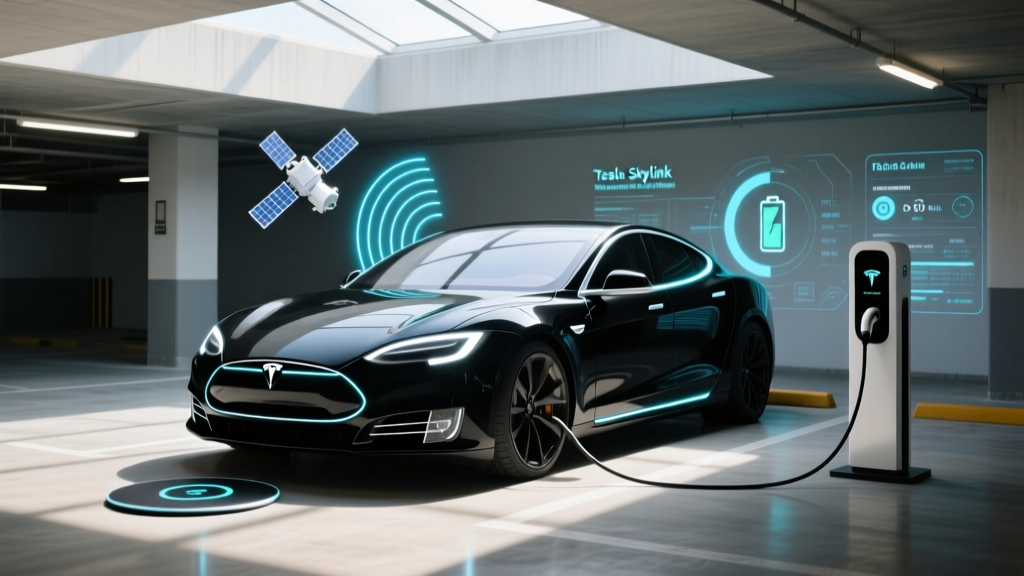
- Starlink + Tesla vehicle integration: SpaceX's Starlink satellite internet constellation providing direct connectivity to Tesla vehicles, enabling over-the-air (OTA) updates, telemetry, and infotainment in areas without cellular coverage.
- Tesla's patent filings around satellite-assisted navigation, vehicle-to-satellite communication, and low-earth-orbit (LEO) data links for autonomous driving redundancy.
- Speculative next-gen vehicle codenames: EV forums and social media have used "Skylink" informally to describe rumored Tesla platforms (sometimes conflated with the "next-gen" or "$25,000 Tesla" discussions).
None of these constitute a purchasable vehicle in 2026. If a Tesla-branded satellite-connected vehicle or connectivity package is formally announced, we will update this article with verified specs, pricing, and availability.
Satellite Connectivity in EVs: Where the Technology Stands in 2026
While there is no "Skylink" car, satellite-to-vehicle communication is a real and advancing field. Here's what's currently operational or credibly announced:
| Technology | Status (2026) | Function | Bandwidth |
|---|---|---|---|
| Tesla Premium Connectivity | Active (cellular) | OTA updates, navigation, streaming, Sentry Mode | LTE/5G (cellular-dependent) |
| Starlink Direct-to-Cell (SpaceX) | Beta / expanding | Text messaging in dead zones via satellite | Very low bandwidth (~text only) |
| Starlink Mini / Mobile | Available (aftermarket) | Portable Wi-Fi hotspot for vehicle cabin | ~50-150 Mbps (stationary) |
| GM + Starlink Partnership | Announced (pilot phase) | Dealer and fleet connectivity | TBD |
| Tesla native Starlink integration | Not announced | — | — |
The key bottleneck: Direct-to-cell satellite links in 2026 are bandwidth-constrained. SpaceX's Direct-to-Cell service is designed for text messaging and minimal data in areas with zero cellular coverage — not for streaming Netflix on your Tesla's center display or pushing multi-gigabyte OTA firmware updates. High-bandwidth satellite connectivity (like Starlink dish terminals) requires a phased-array antenna that is not currently integrated into any production Tesla vehicle's roof.
Which 2026 Tesla Should You Actually Consider?
If you landed here interested in a futuristic, highly-connected Tesla, here are the real vehicles available now — with the exact specs that matter for purchase decisions.
2026 Tesla Model 3 Long Range AWD
| Spec | Value |
|---|---|
| EPA Range | 341 miles |
| Battery (usable) | ~75 kWh, NMC chemistry |
| Max DC Fast Charge | 250 kW (peak) |
| 10-80% DC Charge Time | ~25 minutes |
| Level 2 Home Charge | 11.5 kW (~44 mi/hr) |
| 0-60 mph | 4.2 seconds |
| Horsepower | 346 hp (dual motor) |
| MPGe (combined) | 132 MPGe |
| Efficiency | 25 kWh/100 mi |
| Cargo Volume | 23 cu ft (rear) + 3 cu ft (frunk) |
| Base MSRP | $47,740 (before incentives) |
| Battery Warranty | 8 years / 120,000 miles (≥70% retention) |
2026 Tesla Model Y Long Range AWD
| Spec | Value |
|---|---|
| EPA Range | 320 miles |
| Battery (usable) | ~75 kWh, NMC chemistry |
| Max DC Fast Charge | 250 kW (peak) |
| 10-80% DC Charge Time | ~27 minutes |
| Level 2 Home Charge | 11.5 kW (~40 mi/hr) |
| 0-60 mph | 4.8 seconds |
| Horsepower | 384 hp (dual motor) |
| MPGe (combined) | 122 MPGe |
| Cargo Volume | 34 cu ft (rear seats up) + 4.1 cu ft (frunk) |
| Base MSRP | $48,990 (before incentives) |
| Battery Warranty | 8 years / 120,000 miles (≥70% retention) |
Both vehicles carry Tesla's standard battery and drive unit warranty: 8 years or 120,000 miles, whichever comes first, with a guaranteed minimum of 70% battery capacity retention over that period.
2026 Federal EV Tax Credit: What Tesla Buyers Need to Know
The IRS §30D Clean Vehicle Credit remains available for qualifying Tesla purchases in 2026, but eligibility depends on several intersecting rules that trip up many buyers:
- MSRP Cap: The vehicle's manufacturer-suggested retail price must be ≤$55,000 for sedans (Model 3) and ≤$80,000 for SUVs/trucks (Model Y, Cybertruck). Both the Model 3 Long Range and Model Y Long Range fall under their respective caps at base MSRP.
- Buyer Income Cap: Your modified adjusted gross income (MAGI) must not exceed $150,000 (single), $225,000 (head of household), or $300,000 (married filing jointly).
- Battery Sourcing Requirements: The $7,500 credit is split into two halves — $3,750 for meeting critical-mineral sourcing thresholds and $3,750 for battery-component manufacturing in North America. These thresholds tighten annually. For 2026, consult the IRS clean vehicle credit page or a tax professional, as Tesla's supply chain sourcing determines which half (or full amount) applies.
- Point-of-Sale Transfer: As of 2024, you can transfer the credit to the dealer at purchase, reducing your out-of-pocket cost immediately rather than waiting to claim it on your tax return.
- One Vehicle Per 3 Years: You can only claim one new clean vehicle credit per three-year period.
Connectivity & Autopilot: What Tesla Actually Offers Today
While satellite-native connectivity isn't here, Tesla's current tech stack is worth understanding — especially since it's often a draw for buyers searching for futuristic EV features.
Tesla Connectivity (Cellular-Based)
Every new Tesla includes Standard Connectivity (basic maps, navigation, and OTA updates over Wi-Fi). Premium Connectivity ($9.99/month or $99/year as of 2026) adds satellite maps, live traffic visualization, in-car streaming (Spotify, YouTube, Netflix when parked), and Sentry Mode live camera access — all over cellular networks, not satellite.
Autopilot & FSD (Supervised)
As of 2026, FSD (Supervised) is available as a one-time purchase ($8,000) or monthly subscription ($99/month). It provides traffic-light and stop-sign recognition, autosteer on city streets, and automatic lane changes — but real-world performance varies significantly by geography, weather, and road-marking quality. The NHTSA continues to investigate Tesla's Autopilot/FSD in certain crash scenarios.
Pros, Cons, and the Bottom Line
✅ Pros
- Class-leading Supercharger network access (17,000+ U.S. stalls)
- Proven OTA update cadence — vehicle improves over time
- Strong range-to-price ratio (Model 3 LR at 341 mi / $47,740)
- 250 kW DC fast charging widely supported at V3 Superchargers
- Minimalist interior with spacious cabin for the footprint
- Extensive Sentry Mode and security features
❌ Cons
- No native satellite connectivity — cellular-dependent
- FSD (Supervised) costs $8,000 extra and is still Level 2
- No Apple CarPlay or Android Auto integration
- Panel gaps and build-quality inconsistency reported by owners
- Insurance premiums tend to be above segment average
- Phantom braking incidents documented in NHTSA complaints
Who Should Buy a Tesla in 2026 — And Who Should Wait?
Buy now if: You want access to the most reliable DC fast-charging network in the U.S. (Superchargers), you value OTA software improvements, you commute or road-trip primarily in areas with strong cellular coverage, and you want proven long-range efficiency at a competitive price.
Wait if: You're specifically seeking satellite-native vehicle connectivity for off-grid or rural use, you require Apple CarPlay/Android Auto, you want a Level 4 autonomous driving experience (no consumer vehicle offers this in 2026), or you need a vehicle for heavy towing (Cybertruck aside, Tesla's lineup isn't optimized for towing).
Frequently Asked Questions
Is the Tesla Skylink a real car I can buy?
No. As of 2026, there is no Tesla vehicle named "Skylink." The term appears to be a mix of Starlink satellite-connectivity speculation and unofficial forum codenames for rumored future Tesla platforms. Tesla's current purchasable lineup is the Model 3, Model Y, Model S, Model X, and Cybertruck.
Will Tesla ever integrate Starlink directly into its vehicles?
Tesla and SpaceX share leadership through Elon Musk, making integration plausible long-term. However, no official announcement has been made. The physics challenge is real: Starlink's current high-bandwidth service requires a phased-array antenna roughly the size of a laptop lid — far larger than what fits in a car roof. Direct-to-cell Starlink exists but is limited to text-level bandwidth in 2026.
What's the real-world range of the 2026 Tesla Model 3 Long Range?
The EPA rates it at 341 miles. In practice, expect approximately 280-300 miles during sustained highway driving at 70-80 mph, and 230-260 miles in freezing winter conditions. City driving with regenerative braking in moderate temperatures can meet or slightly exceed the EPA figure.
How fast does the 2026 Model Y charge at home and on the road?
On a DC fast charger (Tesla V3 Supercharger), the Model Y Long Range peaks at 250 kW, achieving a 10-80% charge in roughly 27 minutes — though charge speed tapers significantly above 80% SoC. At home on a Level 2 charger (11.5 kW / 48A), you'll add approximately 40 miles of range per hour, meaning a full overnight charge (8-10 hours) easily replenishes daily driving.
Does the 2026 Tesla Model 3 qualify for the $7,500 federal tax credit?
It may qualify for the full $7,500 or a partial $3,750, depending on battery-sourcing compliance for the specific production batch, your income level (must be under $150K single / $300K joint), and whether the MSRP of your configured trim stays under the $55,000 sedan cap. The base Long Range at $47,740 clears the MSRP cap. Verify current sourcing eligibility at fueleconomy.gov before finalizing your purchase.
Is Tesla's FSD (Supervised) worth buying in 2026?
For most drivers, no — at $8,000 upfront or $99/month, it's an expensive Level 2 system that still requires full driver attention and hands-on-wheel engagement. The standard Autopilot (included) handles highway lane-keeping and adaptive cruise competently. FSD's city-street capability is improving but remains inconsistent in construction zones, heavy rain, and poorly marked roads. If you want hands-off driving, GM's Super Cruise on mapped highways offers a more polished (but geographically limited) Level 2 experience.