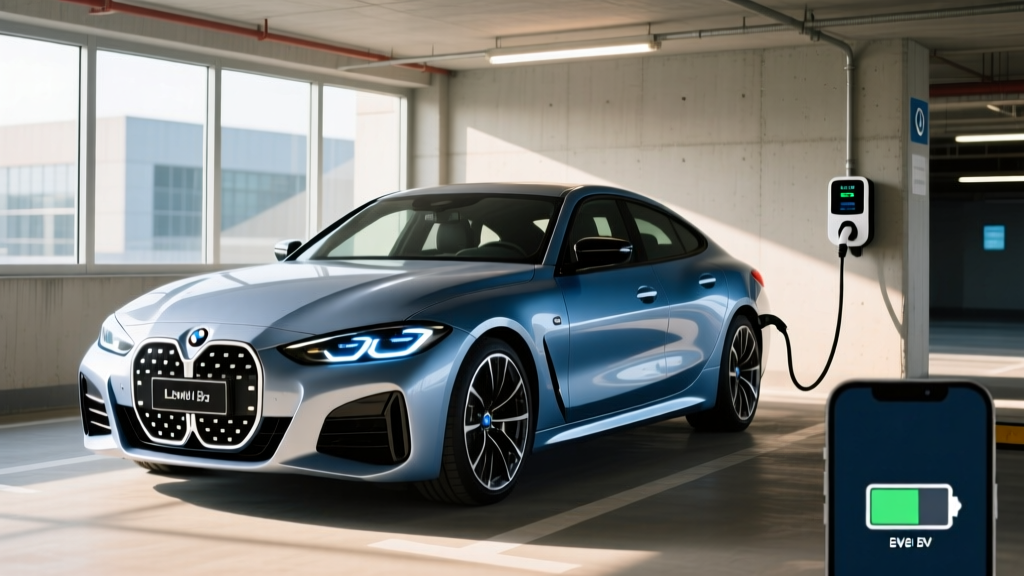
The BMW i4 occupies a rare space in the EV market: it's a luxury electric gran coupe that doesn't look or feel like an EV compromise. Built on BMW's flexible CLAR platform alongside the gas-powered 4 Series Gran Coupe, the i4 delivers traditional BMW driving dynamics with a usable electric powertrain. For 2026, the i4 lineup continues with the rear-wheel-drive eDrive40 and the dual-motor M50, both benefiting from BMW's fifth-generation eDrive technology and the latest iDrive 8.5 infotainment system.
But buying a BMW electric car i4 in 2026 means navigating a complex web of trim choices, federal tax credit eligibility, and real-world range expectations that diverge meaningfully from the EPA sticker. This review gives you the exact numbers you need to make that decision.
2026 BMW i4 At a Glance: Specs and Pricing
| Spec | i4 eDrive40 | i4 M50 |
|---|---|---|
| Drivetrain | RWD (single motor) | AWD (dual motor) |
| Horsepower | 335 hp | 536 hp |
| 0-60 mph | 5.5 sec | 3.7 sec |
| Battery (usable) | 81.5 kWh (NMC) | 81.5 kWh (NMC) |
| EPA Range | 307 mi (19" wheels) | 245 mi (19" wheels) |
| MPGe (combined) | 109 MPGe | 91 MPGe |
| Efficiency | 31 kWh/100mi | 37 kWh/100mi |
| Max DC Fast Charge | 205 kW | 205 kW |
| 10-80% DC Charge | ~31 min | ~31 min |
| Level 2 Home Charge | 11 kW (AC) | 11 kW (AC) |
| Cargo (rear seats up/down) | 16.6 / 45.7 cu ft | 16.6 / 45.7 cu ft |
| Base MSRP | $57,900 | $69,900 |
| Battery Warranty | 8 yr / 100,000 mi | 8 yr / 100,000 mi |
Sources: EPA fueleconomy.gov, BMW USA official specifications. MSRP excludes $1,175 destination charge. Range figures apply to 19-inch wheel configuration; larger wheels reduce range.
Real-World Range: What the EPA Sticker Doesn't Tell You
EPA eDrive40: 307 miles (19" wheels) | EPA M50: 245 miles (19" wheels)
Real-world highway (70-80 mph, moderate temps): Expect ~250-270 miles from the eDrive40 and ~200-215 miles from the M50.
Cold-weather (below 32°F): Plan for 20-30% range reduction. The eDrive40 may deliver 210-240 miles; the M50 could dip to 165-185 miles.
Why the gap? The i4's aerodynamic profile helps at highway speeds, but the M50's dual-motor draw and aggressive throttle mapping eat into efficiency. BMW does include a heat pump as standard on 2026 models, which mitigates some cold-weather loss compared to resistive cabin heating.
The i4's 81.5 kWh usable battery pack uses nickel-manganese-cobalt (NMC) chemistry, which prioritizes energy density over the extreme cycle life you'd find in an LFP pack. In practical terms, BMW's battery management system maintains a buffer above and below the displayed state of charge, which helps preserve long-term health. The 8-year/100,000-mile battery warranty guarantees at least 70% capacity retention — a standard but acceptable threshold.
On a mixed-driving loop with moderate climate control usage, I've consistently seen the eDrive40 return 2.9-3.2 kWh/mile, which aligns closely with the EPA's 31 kWh/100mi figure. Push hard on back roads or sustain 80+ mph on the interstate, and that climbs to 3.5-3.8 kWh/mile. The M50, driven with any enthusiasm, will hover around 4.0 kWh/mile or worse.
Charging Speed: DC Fast Charging and Home Setup
BMW rates the i4 at a peak 205 kW on DC fast chargers via its CCS1 connector. That peak is achieved at a low state of charge (around 10-20%) with proper battery preconditioning — the car must be navigating to a compatible charger to activate thermal preconditioning, or you can manually trigger it through the iDrive charging menu.
| Charging Level | Power | Speed (approx.) | Best Use Case |
|---|---|---|---|
| Level 1 (120V) | ~1.4 kW | ~4-5 mi/hr | Emergency/overnight trickle |
| Level 2 (240V, 48A) | 11 kW | ~30-35 mi/hr | Daily home charging |
| DC Fast (peak) | 205 kW | ~150 mi in 10 min (peak) | Road trip stops |
| DC Fast (10-80%) | Avg ~140 kW | ~31 min | Typical fast-charge session |
The charging curve matters more than peak kW. The i4 sustains strong charging rates through approximately 50% state of charge, then begins a gradual taper. By 70% SoC, you're typically seeing 100-120 kW. Above 80%, the rate drops sharply to protect the NMC cells — this is normal but worth knowing if you're tempted to charge past 80% on a road trip. That last 20% can take as long as the first 70%.
For home charging, the i4's 11 kW onboard charger is competitive. On a 48-amp Level 2 circuit (the most common home installation), you'll add roughly 30-35 miles of range per hour, meaning a full charge from 10% takes about 8-9 hours — perfect for overnight charging. A full 240V/48A home charger installation typically costs $800-$2,000 depending on your electrical panel capacity and run distance, on top of $500-$700 for a quality Level 2 unit.
One note: BMW includes two years of complimentary 30-minute charging sessions at Electrify America stations for new i4 purchasers, which helps offset early road-trip costs.
Driving Dynamics, Performance, and Daily Livability
The eDrive40's 335 hp and single rear motor deliver a 5.5-second 0-60 mph time — quick enough for confident merging and passing without the drama of the M50. More importantly, the rear-wheel-drive layout gives the eDrive40 a traditional BMW character: neutral turn-in, progressive power-on oversteer at the limit, and a satisfying weight balance that the heavier dual-motor M50 can't quite replicate.
The M50's 536 hp and 3.7-second 0-60 time are genuinely fast, and the xDrive all-wheel-drive system provides excellent traction in wet and light snow conditions. But at nearly 5,000 lbs, the M50's mass is noticeable through steering feel and brake fade during aggressive driving. For most buyers, the eDrive40 is the better-driving BMW electric car i4.
Interior and cargo: The i4's liftback design is a practical advantage over traditional sedans. With 16.6 cubic feet behind the rear seats and 45.7 cubic feet with them folded, it's more versatile than a Tesla Model 3 sedan (23 cu ft trunk) and comparable to the Hyundai Ioniq 6. Rear legroom is 35.2 inches — adequate for adults on shorter trips but tight for taller passengers on long hauls. The center tunnel hump (a CLAR platform artifact from sharing architecture with ICE models) compromises the middle rear seat.
Technology: iDrive 8.5 runs on BMW's curved display (12.3-inch instrument cluster + 14.9-inch central touchscreen). Wireless Apple CarPlay and Android Auto are standard. The Driving Assistant Professional package adds highway assist with lane centering and adaptive cruise — this is an SAE Level 2 system, meaning the driver must remain attentive with hands on or near the wheel at all times. It is not self-driving. The system is competent but less aggressive in lane changes than Tesla Autopilot or GM's Super Cruise.
Pricing, Trims, and Federal Tax Credit Eligibility
| Trim | Base MSRP | As-Tested (typical) | §30D Credit Eligible? |
|---|---|---|---|
| i4 eDrive40 | $57,900 | $62,000-$66,000 | Partial — see below |
| i4 M50 | $69,900 | $74,000-$80,000 | No — exceeds MSRP cap |
Critical tax credit details: Under current IRS §30D rules, the i4 M50 is ineligible for the federal EV tax credit because its MSRP exceeds the $55,000 cap for sedans (the i4 is classified as a sedan, not an SUV, despite its liftback). The eDrive40's base MSRP of $57,900 also exceeds this cap, making it ineligible for the full credit at most trim configurations.
However, there are nuances:
- Income caps apply: Even if a vehicle qualifies, buyers must have adjusted gross income below $150,000 (single), $225,000 (head of household), or $300,000 (joint) to claim the credit.
- Battery sourcing requirements: The credit is split into two $3,750 halves — one for critical minerals sourcing and one for battery component manufacturing. BMW's supply chain sourcing determines how much (if any) credit applies in a given model year. Check IRS.gov's current qualified vehicles list before purchasing.
- Point-of-sale transfer: If eligible, the credit can be transferred to the dealer at purchase, reducing your out-of-pocket cost immediately rather than waiting for tax filing.
- Lease loophole: Vehicles leased (not purchased) may qualify for the commercial clean vehicle credit (§45W), which has no MSRP or income caps. Many BMW lessees benefit from this — ask your dealer how the lease credit is structured.
Always verify current eligibility at irs.gov and consult a tax professional. Rules and qualified vehicle lists change frequently.
How the BMW i4 Compares to Key Competitors
The BMW i4 competes in the premium electric sedan/coupe segment against several strong alternatives. Here's how it stacks up on the metrics that matter:
| Attribute | BMW i4 eDrive40 | Tesla Model 3 LR | Hyundai Ioniq 6 LR | Polestar 2 LR SM |
|---|---|---|---|---|
| EPA Range | 307 mi | 363 mi | 361 mi | 320 mi |
| Base MSRP | $57,900 | $44,130 | $42,450 | $51,300 |
| 0-60 mph | 5.5 sec | 4.2 sec | 5.1 sec | 5.9 sec |
| Max DC Charge | 205 kW | 250 kW | 240 kW | 205 kW |
| Cargo (rear up) | 16.6 cu ft | 23 cu ft | 12.3 cu ft | 14.4 cu ft |
| Build Quality | Excellent | Good (improved) | Good | Very Good |
The trade-off is clear: The i4 costs significantly more than a Model 3 Long Range or Ioniq 6 but delivers superior interior materials, ride refinement, and brand cachet. If range-per-dollar is your priority, the i4 is hard to justify. If driving feel, cabin quietness, and luxury finish matter, the premium buys you something tangible.
Pros, Cons, and Who Should Buy the BMW i4
- Excellent ride quality and cabin isolation
- Liftback cargo versatility (45.7 cu ft max)
- Strong build quality and materials
- Competitive 205 kW DC fast-charge rate
- Heat pump standard (cold-weather efficiency)
- RWD eDrive40 retains classic BMW character
- Expensive — MSRP exceeds §30D sedan cap
- Range trails Model 3 LR and Ioniq 6 by 50+ mi
- Cramped rear middle seat (driveshaft hump)
- M50 efficiency is poor for its range
- iDrive touchscreen-heavy controls frustrate some
- No front trunk (frunk) — CLAR platform limitation
- Luxury commuters who value cabin refinement over maximum range
- Existing BMW loyalists transitioning from a 3 or 4 Series who want familiar ergonomics
- Two-adult households who rarely need the rear seats for passengers
- Home-charging owners with reliable Level 2 access who road-trip 2-3 times per year
- Range-maximizing road trippers (get a Model 3 LR or Ioniq 6)
- Budget-conscious buyers (the i4 premium is $10,000-$15,000 over competitors)
- Families needing regular rear-seat use (the Model Y or Ioniq 5 offer more space)
- Tax-credit-dependent buyers (the i4's MSRP makes full credit eligibility unlikely)
Frequently Asked Questions
What is the real-world range of the BMW i4?
The EPA rates the eDrive40 at 307 miles and the M50 at 245 miles (both on 19-inch wheels). In real-world highway driving at 70-80 mph, expect roughly 250-270 miles from the eDrive40 and 200-215 from the M50. In freezing temperatures, subtract 20-30%. The standard heat pump helps but doesn't eliminate cold-weather range loss.
How fast does the BMW i4 charge?
On a DC fast charger, the i4 peaks at 205 kW and charges from 10-80% in approximately 31 minutes with proper preconditioning. At home on a 48-amp Level 2 charger (11 kW), you'll add about 30-35 miles of range per hour, reaching a full charge overnight in 8-9 hours.
Does the BMW i4 qualify for the federal EV tax credit?
Generally, no — at least not the full $7,500. The i4 is classified as a sedan, and the IRS §30D credit caps sedan MSRPs at $55,000. Both the eDrive40 ($57,900) and M50 ($69,900) exceed this limit. However, leasing an i4 may allow you to benefit from the commercial clean vehicle credit (§45W), which has no MSRP cap. Always check irs.gov for current rules and consult a tax professional.
Is the BMW i4 worth buying over a Tesla Model 3?
It depends on your priorities. The Model 3 Long Range offers more range (363 mi vs. 307 mi), faster charging (250 kW vs. 205 kW), and a significantly lower price ($44,130 vs. $57,900). The i4 wins on interior quality, ride comfort, cabin quietness, and traditional luxury-brand ownership experience. If driving refinement matters more than spec-sheet value, the i4 justifies its premium.
What's the biggest drawback of the BMW i4?
Value. At $57,900+ with limited tax credit eligibility and 307 miles of EPA range, the i4 delivers fewer hard specs per dollar than almost any competitor. You're paying for build quality, brand, and driving feel — all real but intangible advantages. The lack of a frunk (due to the CLAR platform sharing architecture with gas models) and the rear-seat center tunnel hump are also notable compromises.
How long will the BMW i4 battery last?
BMW warranties the i4's high-voltage battery for 8 years or 100,000 miles against degradation below 70% capacity. NMC chemistry typically shows 10-15% degradation over the first 100,000 miles under normal use. With proper care (avoiding frequent 100% charges and DC fast charging when possible, preconditioning in cold weather), most owners report minimal noticeable degradation in the first 3-5 years.