Why the Golden Cybertruck Is Dominating EV Culture in 2026
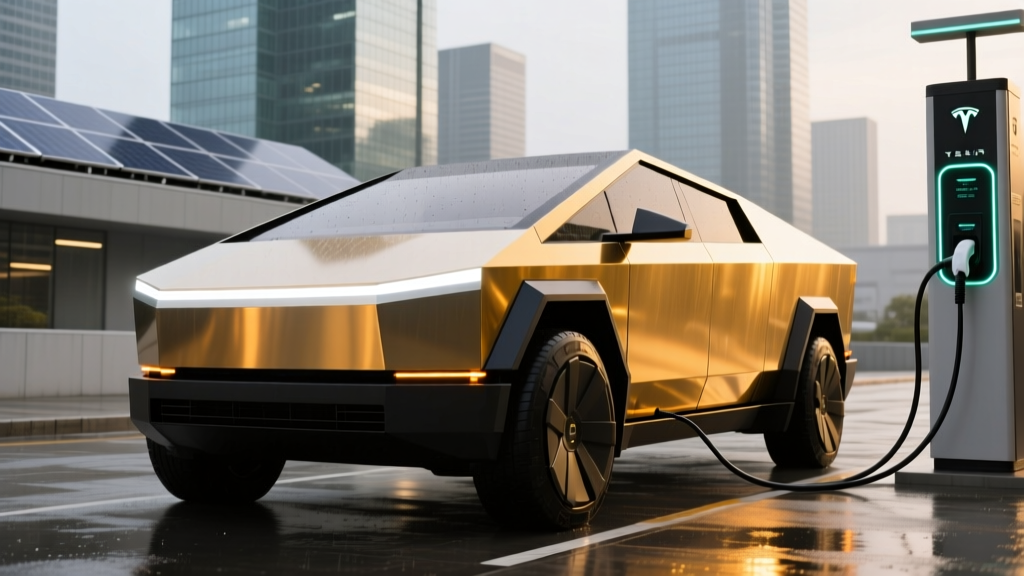
Search "golden Cybertruck" on any social platform and you'll find dozens of Tesla's angular pickup wrapped in mirror-gold, satin-champagne, and brushed-bronze vinyl. What started as a handful of influencer builds in late 2024 has become one of the most replicated aftermarket aesthetics in the EV space. The stainless-steel exoskeleton of the Cybertruck — already polarizing in its bare-metal finish — becomes something entirely different under a gold wrap: warmer, more luxurious, and paradoxically more exclusive-looking than a truck that starts near $82,000.
But beneath the gold vinyl sits one of the most technically complex electric pickups on the market. Whether you're researching the Cybertruck as a potential purchase and curious about the wrap trend, or you already own one and want to know what the golden Cybertruck phenomenon is about, this review covers the full 2026 model-year specifications, real-world performance data, and ownership economics you need.
Let's get into the numbers.
2026 Tesla Cybertruck: Full Specification Breakdown
The 2026 Cybertruck continues with three primary trims after Tesla streamlined the lineup following its turbulent 2024 launch year. Here's the complete spec sheet based on Tesla's published figures and EPA data:
| Specification | Long Range AWD | Beast (Tri-Motor AWD) | Cyberbeast |
|---|---|---|---|
| Base MSRP | $81,895 | $101,895 | $101,895 |
| Drivetrain | Dual-Motor AWD | Tri-Motor AWD | Tri-Motor AWD |
| Horsepower | 600 hp | 845 hp | 845 hp |
| 0-60 mph | 4.1 sec | 2.6 sec | 2.6 sec |
| EPA Range | 340 mi | 320 mi | 320 mi |
| Battery (usable, est.) | ~123 kWh | ~123 kWh | ~123 kWh |
| Battery Chemistry | NMC (2170 cells, structural pack) | NMC (2170 cells, structural pack) | NMC (2170 cells, structural pack) |
| Max DC Fast Charge | 250 kW | 250 kW | 250 kW |
| 10-80% DC Time | ~28 min | ~28 min | ~28 min |
| Level 2 Home Charging | 11.5 kW (44 mi/hr) | 11.5 kW (44 mi/hr) | 11.5 kW (44 mi/hr) |
| MPGe (combined) | 72 MPGe | 68 MPGe | 68 MPGe |
| Efficiency (kWh/100 mi) | 47 kWh/100 mi | 50 kWh/100 mi | 50 kWh/100 mi |
| Towing Capacity | 11,000 lbs | 11,000 lbs | 11,000 lbs |
| Payload | 2,500 lbs | 2,500 lbs | 2,500 lbs |
| Bed Length | 6 ft (72 in) | 6 ft (72 in) | 6 ft (72 in) |
| Cargo Volume (bed + frunk) | ~67 cu ft bed + ~7 cu ft frunk | ~67 cu ft bed + ~7 cu ft frunk | ~67 cu ft bed + ~7 cu ft frunk |
| Rear Legroom | 38.2 in | 38.2 in | 38.2 in |
| Battery/Powertrain Warranty | 8 yr / 120,000 mi | 8 yr / 120,000 mi | 8 yr / 120,000 mi |
| Basic Warranty | 4 yr / 50,000 mi | 4 yr / 50,000 mi | 4 yr / 50,000 mi |
Key note on chemistry: The Cybertruck uses Tesla's structural battery pack with NMC (nickel manganese cobalt) 2170 cells. Unlike LFP (lithium iron phosphate) chemistry found in the base Model 3, NMC offers higher energy density — necessary for a heavy truck — but is less tolerant of sustained 100% SoC storage. For daily driving, Tesla recommends charging to 80-90% and only going to 100% before long trips.
Real-World Range: What the EPA Number Doesn't Tell You
EPA Estimated: 340 mi (Long Range) / 320 mi (Beast & Cyberbeast)
Real-World Highway (70-75 mph, 72°F): ~265-290 mi
Real-World City/Mixed: ~290-315 mi
Cold Weather (20°F, highway): ~210-240 mi (30-35% reduction)
Towing (5,000-lb trailer, highway): ~160-190 mi
The Cybertruck's slab-sided, angular design generates more aerodynamic drag than a rounded body at highway speeds. In EPA testing, the Long Range AWD achieves 340 miles, but sustained 75 mph freeway driving — the most common road-trip scenario — will realistically net 265-290 miles in mild temperatures. The truck's 6,800+ lb curb weight also means regenerative braking recovers less energy in stop-and-go driving compared to lighter EVs.
Cold weather compounds the issue. The structural battery pack has thermal management, but NMC cells lose efficiency below freezing. Expect a 30-35% range reduction at 20°F on highway runs. If you live in the upper Midwest or Northeast and plan winter road trips, budget for charging stops every 200-220 miles.
Towing is the Cybertruck's range killer. With an 11,000-lb max rating, pulling even a modest 5,000-lb travel trailer cuts effective range nearly in half. This is consistent with every electric pickup we've tested — the physics of moving mass and overcoming trailer drag at speed are unforgiving on battery capacity.
Charging Speed: DC Fast Charging and Home Setup
The Cybertruck supports up to 250 kW on DC fast chargers via the NACS (North American Charging Standard) connector — the native Tesla connector now adopted industry-wide. At Tesla Supercharger V3 and V4 stalls, the charging curve looks like this:
| Charging Level | Power (kW) | Rate (mi/hr added) | Typical Use Case |
|---|---|---|---|
| Level 1 (120V outlet) | ~1.4 kW | ~4-5 mi/hr | Emergency/trickle only |
| Level 2 (240V, 48A) | 11.5 kW | ~44 mi/hr | Home daily charging |
| DC Fast (peak) | 250 kW | ~650+ mi/hr (peak) | Road trips, Superchargers |
| DC Fast (10-80%) | Avg ~150 kW | — | ~28 min typical session |
The 10-80% session takes approximately 28 minutes at a V3/V4 Supercharger. The charge curve peaks near 250 kW up to roughly 35-40% SoC, then tapers progressively. By 70% SoC, you're pulling closer to 100-120 kW. This taper is normal for NMC chemistry — the battery management system protects cell longevity by reducing current as voltage rises.
For home charging, a 48-amp Level 2 wall connector on a 60-amp circuit adds about 44 miles of range per hour. An overnight charge (10 hours) from 20% to full is easily achievable. Installation of a 240V/60A circuit typically runs $800-$2,500 depending on panel proximity and local permit requirements — consult a licensed electrician for your specific setup. The Tesla Wall Connector itself retails around $475.
Charging network advantage: The Cybertruck's native NACS connector gives it direct access to the entire Tesla Supercharger network — currently the largest and most reliable DC fast-charging network in North America with over 20,000 stalls. Non-Tesla EVs now access Superchargers via adapters, but Cybertruck owners plug in natively with no adapter required.
The Golden Cybertruck Wrap: Cost, Process, and Considerations
The golden Cybertruck look is achieved through vinyl wrapping, not paint. The stainless-steel body panels of the Cybertruck are not paintable in the traditional sense — they're cold-rolled 30X stainless steel, harder than conventional automotive steel, and Tesla does not offer factory gold or bronze paint options. Vinyl wrap is the only practical path to a gold finish.
Here's what owners are spending on the golden Cybertruck build:
- Full-body wrap (premium cast vinyl): $4,500-$7,500 depending on shop, region, and material brand (3M, Avery Dennison, KPMF)
- Popular gold finishes: Mirror Chrome Gold, Satin Champagne Gold, Brushed Bronze, Metallic Rose Gold
- Wrap lifespan: 5-7 years with proper care (garage-parked, hand-washed)
- Paint protection: The wrap actually protects the stainless steel from fingerprints, water spots, and minor scratches — a genuine practical benefit
- Removal: Professional removal runs $1,000-$2,000; stainless steel underneath returns to original condition
A practical advantage of wrapping the Cybertruck specifically: the flat, angular panels are easier to wrap than curved vehicles. Fewer compound curves mean fewer seams and a cleaner finish. Many wrap shops actually prefer working on the Cybertruck's geometry.
Insurance note: Notify your insurer after wrapping. Some carriers consider a premium wrap a "custom modification" requiring a rider. Others treat it as paint protection. The wrap itself adds no resale value, but preserving the stainless steel underneath may help long-term condition.
Performance, Tech, and Daily Livability
The Cybertruck Beast and Cyberbeast trims deliver supercar acceleration in a 6,800-lb truck: 0-60 mph in 2.6 seconds. This is verified, repeatable, and genuinely startling the first time you experience it. The Long Range AWD at 4.1 seconds is also quick by any truck standard.
The steer-by-wire system — no mechanical connection between the steering wheel and the wheels — remains the Cybertruck's most debated technology. At low speeds, the yoke requires fewer turns lock-to-lock (roughly 340 degrees vs. a conventional 900+ degrees). At highway speeds, the ratio adjusts dynamically. Most owners adapt within a week, but the learning curve is real. The yoke also limits hand-over-hand maneuvering in parking lots, which is a genuine ergonomic drawback.
Infotainment and tech:
- 18.5-inch front touchscreen with Tesla's latest UI (2026 software build)
- 9.4-inch rear touchscreen for passengers
- No Apple CarPlay or Android Auto (Tesla's proprietary system only)
- Over-the-air updates continue to add features post-purchase
- Sentry Mode dashcam, Dog Mode, and Camp Mode standard
- Powered tonneau bed cover with 6-ft bed and integrated ramp
- 120V and 240V bed outlets ( Powers tools, appliances — a genuine V2L capability)
Driver assistance:
Tesla Autopilot and Full Self-Driving (Supervised) are SAE Level 2 driver-assistance systems. The driver must remain fully attentive, hands on the yoke, and ready to take over at any moment. FSD Supervised can navigate intersections, change lanes, and follow navigation routes, but it is not autonomous driving. Only Level 4 services like Waymo operate without a human driver. Do not treat FSD as a substitute for active driving attention.
The Cybertruck's 4-wheel steering (rear wheels turn up to 10 degrees) gives this large truck a surprisingly tight 37.4-foot turning circle — comparable to a midsize sedan. This is one of the most practical features for urban driving and tight parking situations.
Pricing, Tax Credits, and Total Cost
The 2026 Cybertruck's pricing places it firmly in the premium truck segment. Here's the cost breakdown with current federal incentive context:
| Trim | Base MSRP | §30D Credit Eligible? | Effective Price (if eligible) |
|---|---|---|---|
| Long Range AWD | $81,895 | Yes (meets MSRP cap for trucks: <$80,000 — NOTE: exceeds cap) | $81,895 (no credit) |
| Beast | $101,895 | No (exceeds $80,000 truck MSRP cap) | $101,895 |
| Cyberbeast | $101,895 | No (exceeds $80,000 truck MSRP cap) | $101,895 |
Critical tax credit update: Under IRS §30D rules, the federal EV tax credit for new clean vehicles caps eligible trucks at an $80,000 MSRP. The Cybertruck Long Range AWD at $81,895 marginally exceeds this threshold as currently priced, making it ineligible for the $7,500 credit in its base configuration. The Beast and Cyberbeast trims far exceed the cap. Additionally, buyer income limits apply ($300,000 joint / $225,000 head of household / $150,000 single), and battery component and critical mineral sourcing requirements must be met. Consult a tax professional for your specific eligibility — these rules are subject to legislative change.
5-year ownership cost context: Despite the high entry price, the Cybertruck's fuel savings over a comparable gas truck (Ford F-150 Platinum, RAM 1500 Limited) are substantial. At national average electricity rates of $0.17/kWh and gas at $3.40/gallon, a Cybertruck driven 15,000 miles/year saves roughly $2,200-$2,800 annually in energy costs versus a 17-mpg gas truck. Over five years, that's $11,000-$14,000 in fuel savings — meaningful, though not enough to close the gap with a base F-150 XLT.
Competitor Comparison: Cybertruck vs. F-150 Lightning vs. Silverado EV
| Metric | Tesla Cybertruck LR AWD | Ford F-150 Lightning Ext. Range | Chevy Silverado EV 4WT |
|---|---|---|---|
| EPA Range | 340 mi | 320 mi | 440 mi |
| Base MSRP | $81,895 | $73,990 | $77,900 |
| 0-60 mph | 4.1 sec | 3.8 sec | 4.5 sec |
| Max DC Charge | 250 kW | 150 kW | 350 kW (Ultium) |
| 10-80% Time | ~28 min | ~41 min | ~20 min |
| Towing | 11,000 lbs | 10,000 lbs | 12,500 lbs |
| Bed Length | 6 ft | 5.5 ft | 5 ft 11 in |
| Charging Network | NACS (native Supercharger) | NACS (adapter to Supercharger) | NACS (adapter to Supercharger) |
| §30D Credit | No (MSRP cap) | Yes (select trims) | Yes (select trims) |
The Silverado EV's 440-mile range and 350 kW Ultium charging architecture give it a clear road-trip advantage. The F-150 Lightning's conventional truck layout, lower price, and tax-credit eligibility make it the pragmatic fleet and family choice. The Cybertruck wins on acceleration, tech integration, Supercharger network seamlessness, and — for better or worse — attention. The golden Cybertruck wrap amplifies that last factor considerably.
- Class-leading Supercharger network access (native NACS)
- 250 kW DC fast charging, ~28 min 10-80%
- Stunning acceleration across all trims
- 4-wheel steering yields tight turning circle
- Stainless body resists dents; wrap-friendly flat panels
- 240V bed outlet for job-site or camping power
- Continuous OTA feature updates
- Exceeds $80K MSRP cap — no federal tax credit
- Real-world highway range well below EPA sticker
- Steer-by-wire yoke has genuine learning curve
- No Apple CarPlay/Android Auto
- Cold-weather range loss significant (30-35%)
- Towing cuts range nearly in half
- Polarizing design limits broad resale appeal
- Wrap adds $4,500-$7,500 to an already expensive truck
Who the Golden Cybertruck Is Actually For
Choose the Cybertruck if: You want maximum Supercharger network integration, prioritize acceleration and tech over traditional truck utility, live in a mild-to-warm climate, have home Level 2 charging, and want a truck that doubles as a conversation piece — especially in gold.
Choose the F-150 Lightning if: You need a conventional truck layout, want federal tax credit eligibility, prioritize fleet/family practicality, and prefer a familiar driving experience.
Choose the Silverado EV if: Maximum range and fastest DC charging are your priorities, you tow frequently, and you want the longest road-trip legs between stops.
The golden wrap is right if: You want to personalize your Cybertruck, protect the stainless from cosmetic wear, and stand out — the gold aesthetic photographs exceptionally well and has become a recognizable signature in the EV community.
Frequently Asked Questions
What is the real-world range of the 2026 Cybertruck?
The EPA rates the Long Range AWD at 340 miles and Beast/Cyberbeast trims at 320 miles. In real-world highway driving at 70-75 mph in moderate temperatures, expect 265-290 miles. City and mixed driving yields 290-315 miles. Cold weather (below freezing) reduces range by 30-35%, and towing a 5,000-lb trailer drops effective range to roughly 160-190 miles.
How fast does the Cybertruck charge at home and on the road?
On DC fast chargers, the Cybertruck peaks at 250 kW and charges from 10-80% in approximately 28 minutes at a Tesla Supercharger V3/V4. At home on a 48-amp Level 2 charger (240V), it adds about 44 miles of range per hour, or roughly 11.5 kW. A full overnight charge from 20% is standard.
Does the Cybertruck qualify for the $7,500 federal EV tax credit?
As of 2026, the Cybertruck does not qualify for the IRS §30D federal tax credit. The Long Range AWD starts at $81,895, exceeding the $80,000 MSRP cap for trucks. The Beast and Cyberbeast trims at $101,895 are well above the cap. Buyer income limits and battery sourcing rules add additional restrictions for qualifying vehicles. Consult a tax professional for current eligibility details.
How much does a golden Cybertruck wrap cost?
A full-body premium vinyl wrap in gold, champagne, or bronze typically costs $4,500 to $7,500 depending on the shop, material brand, and finish type (mirror, satin, brushed). The Cybertruck's flat stainless-steel panels are actually easier to wrap than curved vehicles. The wrap lasts 5-7 years with proper care and protects the underlying steel from cosmetic wear.
Is the Cybertruck worth buying over the F-150 Lightning or Silverado EV?
It depends on your priorities. The Cybertruck offers the best Supercharger integration, quickest acceleration, and most distinctive design. The F-150 Lightning provides a more traditional truck experience at a lower price with tax credit eligibility. The Silverado EV delivers the longest range (440 mi) and fastest charging (350 kW). If maximum tech, performance, and visual impact matter most — and budget is flexible — the Cybertruck is compelling. If practicality, tax incentives, and value lead your decision, the Lightning or Silverado EV are stronger choices.
Can I wrap a Cybertruck myself?
Technically possible but not recommended. The Cybertruck's panels are large and flat, which helps, but achieving a bubble-free, professional finish on a vehicle this size requires experience, heat guns, squeegees, and a controlled environment. Most owners use professional wrap shops. A DIY attempt on an $82,000+ vehicle carries real risk of material waste and poor results.