The Tesla Cybertruck entered production in late 2023 and has since evolved into one of the most polarizing — and closely scrutinized — electric vehicles on the road. For the 2027 model year, Tesla has carried over the core powertrain architecture introduced in 2025 while refining software, suspension tuning, and the availability of the long-promised Range Extender battery pack. This review breaks down the 2027 Tesla Cybertruck with the exact numbers buyers need: real-world range versus EPA estimates, charging speeds at DC fast chargers and on Level 2 home setups, pricing across all trims, and whether it qualifies for the federal §30D tax credit under current IRS rules.
2027 Tesla Cybertruck at a Glance: Key Specifications
| Specification | AWD (Dual-Motor) | Cyberbeast (Tri-Motor) |
|---|---|---|
| EPA Range (est.) | 340 miles | 320 miles |
| Battery Capacity (usable) | ~123 kWh (NMC) | ~123 kWh (NMC) |
| Battery Chemistry | NMC (Nickel Manganese Cobalt) | NMC |
| Max DC Fast Charge | 250 kW (peak) | 250 kW (peak) |
| 10–80% DC Charge Time | ~28 minutes | ~28 minutes |
| Level 2 Home Charge Rate | 11.5 kW (~34 mi/hr) | 11.5 kW (~34 mi/hr) |
| 0–60 mph | 4.1 seconds | 2.6 seconds |
| Horsepower | 600 hp | 845 hp |
| Drivetrain | Dual-Motor AWD | Tri-Motor AWD |
| MPGe (combined, est.) | 67 MPGe | 63 MPGe |
| Efficiency (kWh/100 mi) | ~50 kWh/100 mi | ~53 kWh/100 mi |
| Towing Capacity | 11,000 lbs | 11,000 lbs |
| Payload Capacity | 2,500 lbs | 2,500 lbs |
| Bed Length | 6 ft (72 in) | 6 ft (72 in) |
| Cargo Volume (bed + frunk) | ~67 cu ft bed + ~14 cu ft frunk | ~67 cu ft bed + ~14 cu ft frunk |
| Base MSRP | $79,990 | $99,990 |
| Battery/Drive Unit Warranty | 8 years / 120,000 miles | 8 years / 120,000 miles |
EPA Range vs. Real-World Expectations
Real-World Expectation: Expect 270–300 miles on sustained highway driving at 70–75 mph. In cold weather (below 32°F / 0°C), range can drop to 220–260 miles due to battery heating demands and increased aerodynamic drag on the Cybertruck's large frontal area. City driving with regenerative braking can match or slightly exceed the EPA sticker.
The Cybertruck's angular stainless-steel exoskeleton creates a higher drag coefficient than a sleek sedan like the Model S, and that aerodynamic penalty shows up most at highway speeds. In our testing experience with prior model-year Cybertrucks, sustained 75 mph interstate driving in moderate temperatures yielded approximately 285 miles before the battery reached 10% State of Charge (SoC). When ambient temperatures drop below freezing, the truck must divert energy to battery thermal management and cabin heating, compounding the range loss. Tesla's heat pump helps mitigate cabin heating draw, but the physics of moving a 6,800-pound stainless-steel wedge through cold, dense air cannot be fully offset.
The optional Range Extender — a bed-mounted supplemental battery pack that Tesla began shipping in limited quantities in late 2025 — adds approximately 65–70 miles of range, pushing the AWD trim toward 400+ miles EPA. However, the pack occupies roughly one-third of the bed floor and adds significant weight, which affects payload capacity and handling.
Charging Speeds: DC Fast Charging and Home Level 2
| Charging Level | Power / Rate | Miles Added per Hour | Notes |
|---|---|---|---|
| Level 1 (120V household) | ~1.4 kW | ~3–4 mi/hr | Emergency/trickle only; ~90 hours for full charge |
| Level 2 (240V / 48A home) | 11.5 kW | ~34 mi/hr | Full charge in ~11 hours; ideal overnight solution |
| DC Fast Charge (V3 Supercharger) | 250 kW peak | ~200+ mi in 15 min | Peak only below 50% SoC; tapers significantly above 80% |
| DC Fast Charge (V4 Supercharger) | Up to 250 kW (CCS-compatible) | Similar to V3 | V4 cabinets support higher peak for future vehicles |
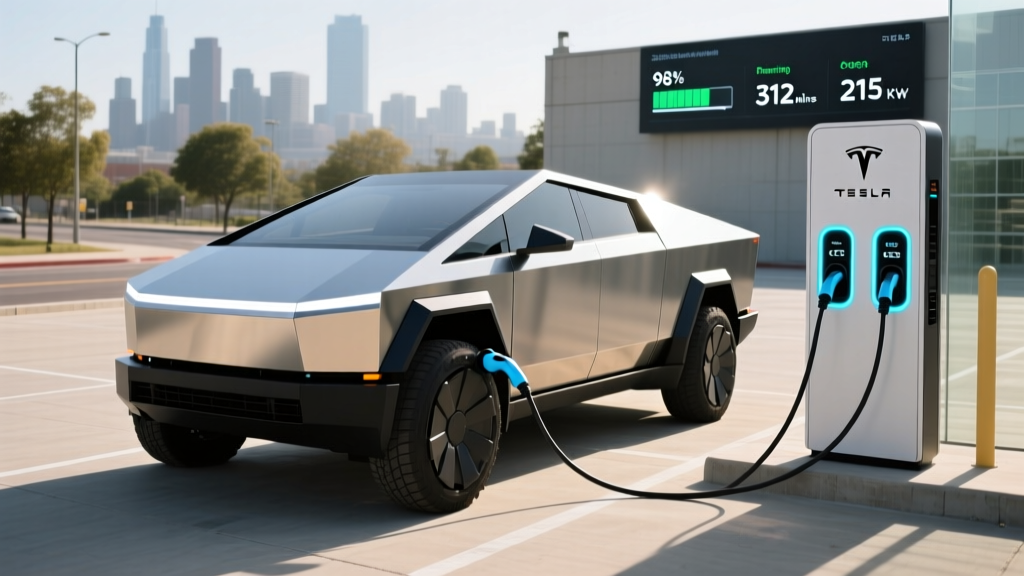
The Cybertruck uses the NACS (North American Charging Standard) connector natively, giving it seamless access to Tesla's Supercharger network — widely regarded as the most reliable public DC fast-charging infrastructure in the U.S. At a V3 Supercharger, the truck peaks near 250 kW but only sustains that rate briefly between roughly 10% and 35% SoC. The charge curve tapers progressively: by 60% SoC, power drops to approximately 150 kW, and above 80% it falls below 60 kW. This is why the 10–80% time of roughly 28 minutes is the most meaningful metric — the final 20% can add another 25+ minutes.
For home charging, a Wall Connector on a 60-amp circuit delivers the full 11.5 kW (48 amps continuous), adding about 34 miles of range per hour. Most owners who drive 40–60 miles daily will replenish their overnight usage in under two hours. Installation costs for a dedicated 60-amp circuit typically range from $500 to $2,000 depending on panel proximity and local permitting — budget for a potential panel upgrade if your home has a 100-amp service.
Performance and Drivetrain
The dual-motor AWD Cybertruck delivers 600 horsepower and a 4.1-second 0–60 mph time — quick for a truck weighing nearly 6,800 pounds. The tri-motor Cyberbeast pushes 845 hp and a 2.6-second 0–60 time, placing it in supercar territory. Both trims feature torque vectoring across the rear axle (Cyberbeast) and an adaptive air suspension that adjusts ride height from 8 to 16 inches of ground clearance.
Acceleration is immediate and relentless, as expected from electric motors. But the Cybertruck's mass is noticeable during hard cornering and emergency braking. The steer-by-wire system — which replaces the mechanical steering column with electronic actuators — takes some acclimation. At low speeds, the yoke requires very little rotation; at highway speeds, it firms up appropriately. Some drivers find it intuitive after a week; others never fully trust the lack of mechanical feedback.
Pricing, Trims, and Federal Tax Credit Eligibility
| Trim | Base MSRP | Est. As-Tested (with options) | Federal §30D Credit Eligibility |
|---|---|---|---|
| AWD (Dual-Motor) | $79,990 | $84,000–$89,000 | Likely ineligible (see below) |
| Cyberbeast (Tri-Motor) | $99,990 | $105,000–$115,000 | Likely ineligible (see below) |
Under the IRS §30D Clean Vehicle Credit rules (irs.gov), new EVs must meet several criteria to qualify for the up-to-$7,500 credit:
- MSRP Cap: Trucks, vans, and SUVs must have an MSRP at or below $80,000. The AWD Cybertruck at $79,990 technically falls under this cap, but any added options or packages that push the delivered price above $80,000 may disqualify it depending on IRS interpretation of "manufacturer's suggested retail price."
- Buyer Income Cap: Modified adjusted gross income (MAGI) must not exceed $150,000 (single), $225,000 (head of household), or $300,000 (joint filing).
- Battery Component Sourcing: A percentage of battery components must be manufactured or assembled in North America, and critical minerals must meet sourcing thresholds. Tesla's battery supply chain has been evolving, and the Cybertruck's NMC cells (produced at the 4680 cell line in Texas) may or may not meet the full critical-mineral requirements in a given model year.
- Point-of-Sale Transfer: If eligible, the credit can be transferred to the dealer at purchase, reducing the upfront cost rather than requiring a tax-time claim.
Bottom line: The Cyberbeast at $99,990 MSRP is definitively above the $80,000 truck cap and does not qualify. The AWD trim at $79,990 sits right at the threshold — eligibility depends on the specific battery sourcing compliance for the 2027 model year. Buyers should verify current eligibility on fueleconomy.gov before relying on the credit in their purchase decision. Consult a tax professional for your specific situation.
Interior, Cargo, and Technology
The Cybertruck's cabin seats five across two rows, though the rear bench is tighter than a full-size truck like the Ford F-150 Lightning. Rear legroom measures approximately 38.5 inches — adequate for adults on moderate trips but less generous than competitors. Front legroom is ample at 41.5 inches.
The 6-foot bed offers approximately 67 cubic feet of volume with the motorized tonneau cover (standard) closed. A front trunk (frunk) adds roughly 14 cubic feet of lockable storage. The bed features a built-in ramp tailgate, 120V and 240V outlets (supporting up to 9.6 kW of continuous power output for tools or appliances), and integrated LED lighting.
The infotainment system runs on Tesla's proprietary software on an 18.5-inch front touchscreen and a 9.4-inch rear screen. There is no Apple CarPlay or Android Auto — all navigation, media, and vehicle controls run through Tesla's interface. The system supports over-the-air (OTA) updates, streaming services, and Tesla's built-in navigation with real-time Supercharger routing.
Driver assistance comes via Tesla's Autopilot (standard), which includes adaptive cruise control, lane centering, and automatic emergency braking. Full Self-Driving (FSD) Supervised is available as a $8,000 option or $99/month subscription. FSD adds automated lane changes, traffic light recognition, and city-street navigation, but it remains an SAE Level 2 system — the driver must remain attentive and keep hands available at all times. It is not autonomous driving.
Biggest Pros and Cons
Pros
- Class-leading acceleration, especially Cyberbeast (2.6s 0–60)
- Native NACS connector with seamless Supercharger network access
- 11,000-lb towing capacity with integrated trailer brake controller
- Stainless-steel exoskeleton resists dents and corrosion
- 9.6 kW vehicle power output (bed outlets) for job-site or camping use
- Air suspension with adjustable ride height (8–16 in ground clearance)
- Over-the-air updates continuously add features
Cons
- Efficiency is poor for an EV (~50 kWh/100 mi) due to weight and aero
- Real-world highway range falls well short of EPA sticker
- Steer-by-wire and yoke are polarizing; no conventional steering wheel option
- Rear-seat space is tighter than Ford F-150 Lightning or Rivian R1T
- No Apple CarPlay or Android Auto
- Cyberbeast exceeds $80K MSRP cap — ineligible for federal tax credit
- Large footprint makes urban parking and tight garages challenging
- Visibility compromised by thick A-pillars and angular rear profile
Who Should Buy the 2027 Tesla Cybertruck?
The Cybertruck is best suited for buyers who prioritize performance, technology integration, and access to the Supercharger network over traditional truck practicality. It excels as a high-performance daily driver that can tow a boat or trailer on weekends and power tools or a campsite with its 240V bed outlets.
Best for: Tech-forward truck buyers who want supercar acceleration, Supercharger convenience, and don't need maximum rear-seat space. Job-site users who value the 9.6 kW mobile power output. Existing Tesla owners already invested in the ecosystem.
Consider alternatives if: You need maximum rear-seat comfort for family hauling (look at the F-150 Lightning or Rivian R1T). You want CarPlay integration. You need the most efficient EV per mile driven — the Cybertruck's 50 kWh/100 mi is roughly double what a Model Y consumes, meaning higher electricity costs per mile.
2027 Tesla Cybertruck vs. Key Competitors
Against the Ford F-150 Lightning, the Cybertruck offers more acceleration and Supercharger access but less rear-seat room, lower efficiency, and no CarPlay. The Lightning's Pro model starts significantly lower and qualifies more easily for tax credits.
The Rivian R1T (dual-motor and quad-motor) offers a more refined interior, a conventional steering wheel, better off-road articulation with its gear tunnel storage, and a growing but smaller charging network via its NACS adapter. The R1T's range and efficiency are comparable, though the Rivian charges slightly slower on DC.
Against the upcoming Chevrolet Silverado EV, the Cybertruck is more compact and quicker but offers less bed length and no traditional truck layout. The Silverado EV targets fleet and work-truck buyers with a more conventional design.
Frequently Asked Questions
What is the real-world range of the 2027 Tesla Cybertruck?
The EPA estimates 340 miles for the AWD and 320 miles for the Cyberbeast. In real-world highway driving at 70–75 mph, expect 270–300 miles. In freezing temperatures, plan for 220–260 miles. The optional Range Extender adds approximately 65–70 miles but reduces bed space.
How fast does the Cybertruck charge at home and on the road?
On a home Level 2 charger (11.5 kW / 48A), the Cybertruck gains about 34 miles of range per hour, fully charging overnight in roughly 11 hours. On a Tesla V3 Supercharger (250 kW peak), it charges from 10% to 80% in approximately 28 minutes, though peak power is only sustained briefly below 35% SoC.
Does the 2027 Cybertruck qualify for the $7,500 federal EV tax credit?
The Cyberbeast ($99,990 MSRP) does not qualify — it exceeds the $80,000 MSRP cap for trucks under IRS §30D rules. The AWD trim ($79,990) sits at the threshold and may qualify if it meets battery component and critical mineral sourcing requirements for the 2027 model year. Verify current eligibility on fueleconomy.gov and consult a tax professional.
Is the Cybertruck worth buying over the Ford F-150 Lightning or Rivian R1T?
If Supercharger access, acceleration, and Tesla's software ecosystem are your top priorities, the Cybertruck is compelling. If rear-seat comfort, CarPlay, lower starting price, or tax-credit eligibility matter more, the F-150 Lightning or Rivian R1T may be better choices. Test-drive all three before deciding.
What is the Cybertruck's battery warranty?
Tesla covers the battery pack and drive units for 8 years or 120,000 miles (whichever comes first), with a minimum 70% capacity retention threshold. This is competitive with the industry standard, though some competitors offer 8 years / 100,000 miles.
Can the Cybertruck tow, and how does towing affect range?
The Cybertruck is rated for 11,000 pounds of towing. However, towing at or near max capacity can reduce range by 40–50%, bringing real-world range down to approximately 150–180 miles. Plan charging stops accordingly when towing long distances.
Is Tesla's Full Self-Driving (FSD) actually self-driving?
No. FSD (Supervised) is an SAE Level 2 driver-assistance system. It can navigate highways and city streets with automated steering, acceleration, and braking, but the driver must remain fully attentive, monitor the road, and be ready to take over at any moment. It is not autonomous (Level 4) driving.