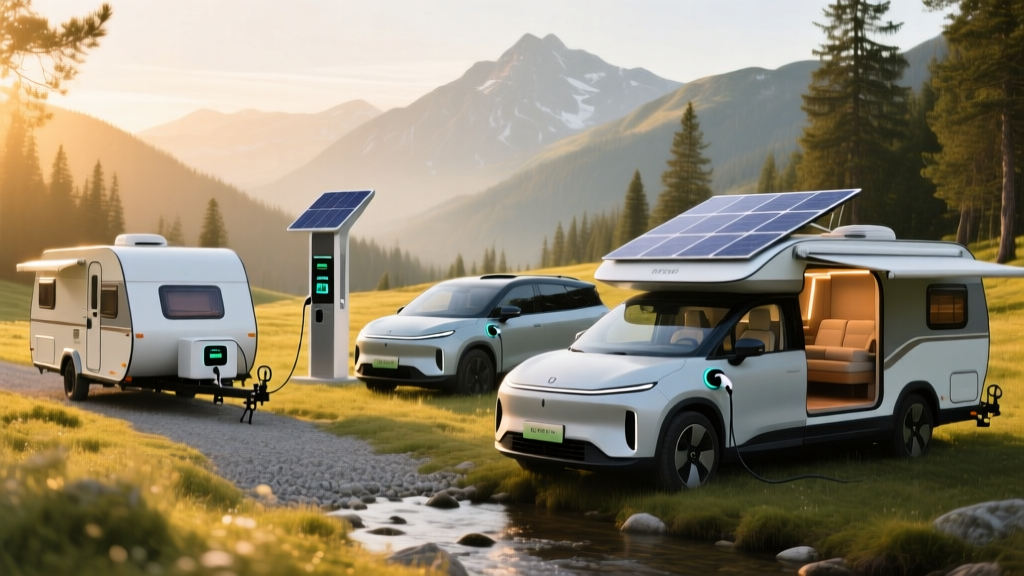
Quick Answer: As of 2026, fully electric campers and RVs remain extremely limited in the U.S. market. The Lightship L1 (announced, deliveries expected late 2026) is the most prominent all-electric travel trailer, targeting 300+ miles of tow range with a 140 kWh battery and solar-equipped roof. Winnebago's e-RV (based on the Ford E-Transit) offers a Class B motorhome with ~126 miles of range. For most buyers, pairing an electric SUV or truck (like the Ford F-150 Lightning or Rivian R1S) with a lightweight conventional trailer remains the more practical path. Expect to pay $80,000–$125,000+ for dedicated electric campers, with real-world highway range significantly lower than EPA or manufacturer estimates when towing or running house systems.
The Current State of All Electric Campers
The electric RV market is still in its infancy. Unlike passenger EVs, where dozens of models offer 250–400 miles of EPA range, electric campers face a brutal physics problem: moving a heavy, boxy vehicle at highway speeds demands enormous energy. A conventional Class A motorhome weighs 15,000–30,000 lbs and achieves 6–8 MPG in gas form. Electrifying that platform requires a massive battery pack — which adds more weight, compounding the problem.
Here's what's actually available or credibly announced as of 2026:
| Model | Type | Battery (kWh) | Est. Range | Status | Est. Price |
|---|---|---|---|---|---|
| Lightship L1 | Travel Trailer | 140 kWh (NMC) | ~300 mi (claimed, light load) | Announced / Pre-order | $125,000+ |
| Winnebago e-RV | Class B Motorhome | 89 kWh (NMC, Ford E-Transit) | ~126 mi (EPA est.) | Limited production | ~$125,000 |
| Thor Vision Vehicle | Class B Concept | ~89 kWh (Ford E-Transit) | ~126 mi (EPA est.) | Concept / Limited | TBD |
| Grounded G1 (announced) | Teardrop Camper | ~40 kWh (LFP) | N/A (house power only) | Announced | ~$45,000 |
The Lightship L1 stands out because it's designed from scratch as an electric trailer — with an integrated powertrain that assists the tow vehicle, reducing range loss. Most other "electric RVs" are conversions of commercial electric vans with limited range, suitable primarily for campground-to-campground travel with shore power hookups.
Range Reality: Towing Kills Battery Life
The single biggest factor in electric camping is range reduction. Even the best electric trucks lose 40–60% of their EPA range when towing a conventional trailer. Here's what that looks like in practice:
Real-World Towing Range Estimates (2026):
- Ford F-150 Lightning (EPA 320 mi, 131 kWh usable): ~130–170 mi towing a 5,000-lb trailer at 65 mph
- Rivian R1T Dual-Motor (EPA 352 mi, 135 kWh usable): ~150–190 mi towing a 5,000-lb trailer
- Chevrolet Silverado EV (EPA 440 mi, ~200 kWh usable): ~200–250 mi towing a 5,000-lb trailer
- Tesla Cybertruck AWD (EPA 340 mi, ~123 kWh usable): ~140–175 mi towing a 5,000-lb trailer
Cold weather (below 40°F) can reduce these figures by an additional 15–30%. Mountain passes add further losses due to elevation gain, though regenerative braking recovers some energy on descents.
The Lightship L1 attempts to solve this by integrating electric motors on the trailer's own axle, powered by its 140 kWh battery. This "powered trailer" approach means the tow vehicle doesn't bear the full energy burden. Lightship claims this can preserve up to 80% of the tow vehicle's solo range — a significant advantage if validated in independent testing.
Charging Logistics: The Campground Problem
Home charging is straightforward if you have a Level 2 (240V) setup — a 48-amp charger delivers roughly 11.5 kW, adding about 25–30 miles of range per hour to a large electric truck. But campground charging is the critical bottleneck for electric camping.
| Charging Level | Power (kW) | Miles Added/Hour* | Availability at Campgrounds |
|---|---|---|---|
| Level 1 (120V, standard outlet) | 1.4–1.9 kW | 3–5 mi/hr | Common (standard outlets at sites) |
| Level 2 (240V, NEMA 14-50 or J1772) | 7.2–11.5 kW | 18–30 mi/hr | Rare (some RV parks adding 50-amp EV circuits) |
| DC Fast Charge (CCS/NACS) | 50–350 kW | 150–600 mi/hr (tapered) | Almost never at campgrounds; highway corridors only |
*Miles per hour estimates based on large electric trucks (2–3 mi/kWh efficiency). Actual figures vary by vehicle.
Most RV parks offer 50-amp, 120/240V shore power (NEMA 14-50 outlets), which can deliver up to 12 kW — enough for Level 2 charging of a tow vehicle overnight. However, many parks restrict these outlets to RV house power only, and not all are wired to sustain a full 50-amp continuous draw. Always confirm with the campground before relying on shore power for vehicle charging.
DC fast charging at 150–350 kW stations (Tesla Superchargers, Electrify America, EVgo) is your lifeline on the road. A Ford F-150 Lightning can charge from 10–80% in roughly 40–45 minutes at a 150 kW CCS station. But you'll need to unhitch your trailer to access most charging stalls — a significant logistical hassle.
Cost Breakdown: Electric Camper vs. Gas RV
The upfront cost of electric campers is steep, but operating costs can be dramatically lower — especially if you charge at home with residential electricity rates.
| Cost Factor | Electric Setup (F-150 Lightning + Lightship L1 est.) | Gas Setup (F-150 Gas + Conventional Travel Trailer) |
|---|---|---|
| Vehicle + Trailer Purchase | ~$75,000 (truck) + ~$125,000 (trailer) = $200,000 | ~$55,000 (truck) + ~$45,000 (trailer) = $100,000 |
| Fuel/Energy per 1,000 mi (towing) | ~400 kWh × $0.15/kWh (home) = $60 | ~140 gal × $3.50/gal = $490 |
| Annual Maintenance | ~$300 (tires, cabin filter, brake inspection) | ~$800–$1,200 (oil, transmission, engine, brakes) |
| Insurance (annual est.) | ~$2,800–$3,500 (higher EV premiums) | ~$1,800–$2,400 |
| Federal Tax Credit (§30D) | Up to $7,500 for truck (if eligible); trailer = $0 | $0 |
| 5-Year Fuel/Energy (6,000 towing mi/yr) | ~$1,800 (home charging) | ~$14,700 |
The fuel savings are real — roughly $12,900 over five years at 6,000 towing miles per year. But the $100,000 purchase-price gap means the electric setup doesn't break even on fuel alone within a typical ownership period. The electric path makes financial sense primarily for high-mileage campers who travel frequently, charge at home, and plan to keep the rig for 8–10+ years.
Tax credit note: Under IRS §30D rules, the electric tow vehicle (not the trailer) may qualify for up to $7,500 in federal credits, subject to MSRP caps ($80,000 for trucks/vans), buyer income limits ($300,000 joint / $150,000 single), and battery critical-mineral sourcing requirements. Always verify current-year eligibility with a tax professional. Trailers do not qualify for §30D credits.
Electric Trucks as Camper Platforms: A Practical Alternative
Given the scarcity of dedicated electric campers, most EV-owning campers in 2026 are pairing electric trucks or SUVs with lightweight conventional trailers. This approach works well if you:
- Keep trips within 150–200 miles from home (round trip)
- Camp at sites with shore power (for house battery and vehicle top-up)
- Choose lightweight trailers (under 4,000 lbs dry weight)
- Plan routes around DC fast-charging corridors
| Factor | Electric Truck + Conventional Trailer | Gas Truck + Conventional Trailer |
|---|---|---|
| Towing Capacity | 7,700–10,000 lbs (varies by model) | 9,000–13,000 lbs (varies by model) |
| Real-World Towing Range | 130–250 mi (model dependent) | 250–400 mi (with 36-gal tank) |
| Refuel/Recharge Time | 35–50 min (DC fast, 10–80%, unhitched) | 8–10 min (gas station) |
| Off-Grid Power (boondocking) | Excellent — truck battery + V2L can power campsite for days | Poor — requires separate generator |
| Noise & Emissions at Camp | Silent operation, zero tailpipe emissions | Engine noise, exhaust fumes |
| Cold-Weather Performance | 15–30% range loss below 40°F | Minimal range impact |
The standout advantage of electric trucks for camping is off-grid power. The Ford F-150 Lightning's Pro Power Onboard can deliver up to 9.6 kW of continuous 240V power — enough to run air conditioning, a microwave, induction cooktop, and LED lighting simultaneously for days without a generator. This eliminates the noise, fuel cost, and fumes of a portable gas generator, making electric trucks exceptional boondocking platforms.
Decision Framework: Should You Go Electric for Camping?
Choose an all-electric camper setup if:
- You camp primarily within 150 miles of home and have reliable home Level 2 charging
- You boondock frequently and value silent, generator-free off-grid power (V2L/V2H)
- You already own or plan to buy an electric truck/SUV for daily use
- You're willing to accept 130–200 miles of real towing range and plan trips around charging
- You camp in moderate climates (cold weather compounds range loss significantly)
Stick with gas/diesel or wait if:
- You take multi-state road trips covering 300+ miles between campsites
- You tow heavy trailers (7,000+ lbs) that would crush electric range further
- You camp in remote areas far from DC fast-charging infrastructure
- You camp in extreme cold (below 20°F) regularly
- Budget is a primary concern — the electric premium is $50,000–$100,000+
Common Misconceptions About Electric Campers
| Myth | Fact |
|---|---|
| "Electric campers can go 300 miles just like electric cars" | Towing reduces range by 40–60%. A truck rated for 320 mi solo may deliver only 140–170 mi towing. The Lightship L1's 300-mi claim assumes ideal conditions with its powered-axle system assisting. |
| "You can charge at any RV park" | Most RV parks have 50-amp shore power for RV house systems, but not all circuits support sustained high-draw vehicle charging. Always confirm amperage and circuit capacity before relying on it. |
| "Solar panels on the roof will keep the battery full" | Even 1,000W of solar (a large RV roof array) generates roughly 4–5 kWh per day in good sun — enough for house systems, but only ~2–3% of a 140 kWh traction battery. |
| "Electric campers need zero maintenance" | Tires, suspension, brakes, and trailer bearings still require regular service. EV drivetrains need less maintenance than gas engines, but they're not maintenance-free. |
| "The federal tax credit covers the whole rig" | The §30D credit applies only to the motorized vehicle (truck or motorhome), not to towed trailers. Maximum credit is $7,500, subject to income, MSRP, and sourcing limits. |
What First-Time Electric Camper Buyers Should Know
If you're considering an electric camping setup for the first time, here are the non-obvious realities that will shape your experience:
1. Charging while hitched is nearly impossible at public stations. Most DC fast-charging stalls aren't designed for vehicles with trailers. You'll need to unhitch in the parking lot, charge, then re-hitch — adding 15–20 minutes of labor to every charging stop. Some truck-specific charging plazas (like certain Tesla Supercharger locations with pull-through stalls) are beginning to accommodate trailers, but they're rare.
2. Your home electrical panel may need an upgrade. Charging a large-battery electric truck at Level 2 speeds (11.5 kW / 48 amps) requires a dedicated 60-amp circuit. If your home has a 100-amp main panel, you'll likely need a 200-amp panel upgrade, which costs $1,500–$3,500 depending on your utility and local electrician rates. Factor this into your budget.
3. Battery degradation matters more for campers. If you regularly deep-cycle your truck battery (draining to 10% on long trips, then fast-charging to 80%), expect 10–15% capacity loss over 5–8 years. This directly reduces your already-limited towing range. NMC batteries (used in the F-150 Lightning, Rivian R1T, and Lightship L1) degrade faster under high-heat and fast-charge stress than LFP chemistry, though LFP's lower energy density makes it less practical for large vehicles.
4. Insurance costs are higher for EVs. According to industry data, EV insurance premiums run 15–25% higher than comparable gas vehicles, driven by higher repair costs and battery replacement risk. For a $200,000 electric truck-and-trailer combination, expect annual premiums of $2,800–$3,500+ depending on your state and driving record.
5. Resale value is uncertain. Electric RVs are so new that long-term depreciation data doesn't exist. Conventional travel trailers depreciate 20–30% in the first two years. Electric models may hold value better due to scarcity — or worse, if battery replacement costs spook used buyers. This is uncharted territory.
The Bottom Line for 2026
All electric campers are real but remain a niche, premium-priced category. The Lightship L1 represents the most ambitious attempt at a purpose-built electric travel trailer, and its powered-axle concept could genuinely change the towing-range equation — but it hasn't yet been independently validated at scale. For most campers, the practical path in 2026 is pairing a capable electric truck with a lightweight conventional trailer, accepting the range and charging compromises, and enjoying the substantial benefits of silent off-grid power and dramatically lower fuel costs.
If your camping style involves short trips, boondocking, and moderate climates, an electric setup is viable today. If you chase cross-country adventures in all weather, gas or diesel remains the pragmatic choice — at least until DC fast-charging infrastructure reaches campgrounds and battery energy density takes the next leap forward.
Can I tow a trailer with an electric truck and still get 300 miles of range?
No. Real-world towing reduces electric truck range by 40–60%. An F-150 Lightning rated at 320 miles EPA will deliver roughly 130–170 miles towing a 5,000-lb trailer at highway speeds. Only the Lightship L1's powered-axle trailer claims to preserve a larger share of tow-vehicle range, but independent verification is pending.
Do electric campers qualify for the $7,500 federal tax credit?
The motorized vehicle (electric truck or Class B motorhome) may qualify under IRS §30D, subject to MSRP caps ($80,000 for trucks), buyer income limits, and battery sourcing rules. Towed trailers do not qualify for any federal EV tax credit. Always consult a tax professional for your specific situation.
How do I charge my electric truck at a campground?
Many RV parks offer 50-amp (NEMA 14-50) shore power, which can deliver up to 12 kW — enough for overnight Level 2 charging. Confirm with the park that the circuit can sustain a continuous high-amperage draw. For DC fast charging, you'll need to drive (unhitched) to the nearest highway charging station.
Is an electric truck good for boondocking?
Yes — this is where electric trucks excel. Ford's Pro Power Onboard (up to 9.6 kW) and similar V2L systems in the Rivian R1T and Hyundai Ioniq 5 can power an entire campsite (lights, fridge, microwave, AC) for days without a noisy gas generator. The truck's large battery serves as a massive portable power station.
What's the cheapest way to go electric camping in 2026?
The most affordable entry point is pairing a used or new electric SUV (Hyundai Ioniq 5, Kia EV6, or Tesla Model Y) with a lightweight teardrop or pop-up trailer (under 2,500 lbs). This keeps towing range in the 150–200 mile window and total cost under $70,000 before incentives.