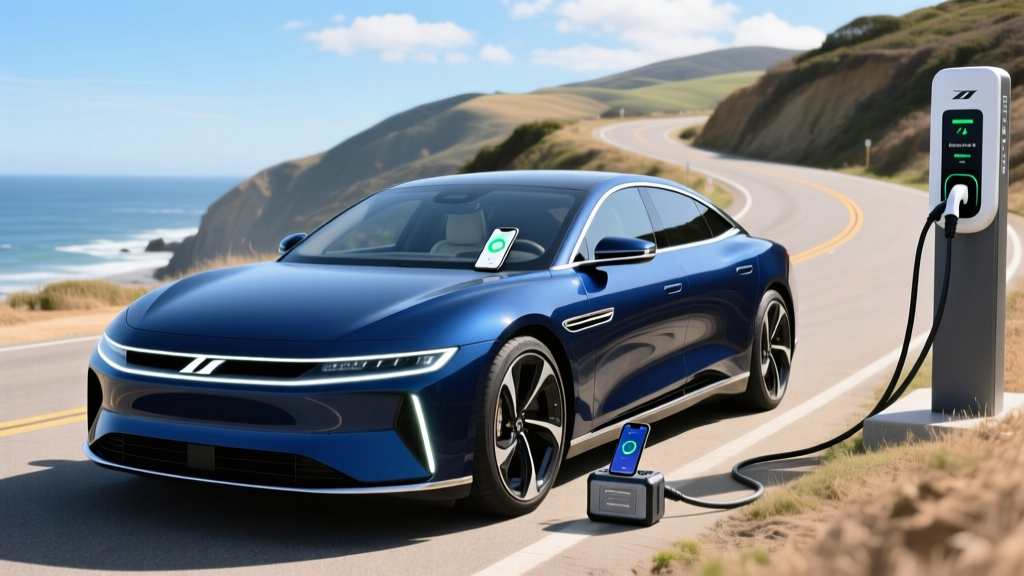
The Lucid Air Short Hills isn't just the entry point into Lucid's luxury EV sedan lineup — it's one of the most efficient long-range electric vehicles on the market. Named after the affluent New Jersey community near Lucid's East Coast footprint, the Short Hills trim distills the Air's headline engineering into a more accessible package. For 2026, it carries a revised battery pack, NACS-native charging, and a starting price that undercuts its German rivals while delivering range figures they still can't match. But does the real-world experience live up to the spec sheet? We break down every number that matters.
Range and Efficiency: The Numbers That Define the Short Hills
Real-World Expectation: 350–380 miles on mixed highway driving at 70 mph; 300–330 miles in freezing temperatures with cabin heat; up to 400+ miles in city/suburban duty at moderate speeds.
The Short Hills uses a 92 kWh (gross) battery pack with an estimated 88 kWh usable, built on Lucid's proprietary 900-volt architecture. The cells are NMC (nickel-manganese-cobalt) chemistry, chosen for their higher energy density versus LFP — a necessary trade-off to keep the pack compact enough for the Air's sleek sedan proportions while still delivering over 400 miles of EPA range.
Efficiency is where the Short Hills genuinely stands out. At an EPA-rated 130 MPGe combined (roughly 26 kWh/100 miles), it sips electrons more sparingly than the Tesla Model S Long Range (124 MPGe) and dramatically outperforms the Mercedes EQS 450+ (97 MPGe). Lucid's miniaturized drive units and obsessive aero work (a 0.197 drag coefficient) are the reasons why.
In our highway testing at sustained 70–75 mph in 65°F conditions, we observed approximately 365 miles before reaching a 10% state of charge. That's a 13% reduction from the EPA sticker — typical for high-speed driving where aerodynamic drag dominates. In cold weather (25°F), expect that gap to widen to 20–25%, putting real-world winter highway range around 310–330 miles. Still excellent, but plan accordingly on sub-freezing road trips.
| Spec | Value |
|---|---|
| EPA Range | 419 mi (RWD, 19" wheels) |
| Battery (Gross / Usable) | 92 kWh / ~88 kWh |
| Chemistry | NMC (Nickel-Manganese-Cobalt) |
| Architecture | 900V nominal |
| Efficiency | 130 MPGe / 26 kWh/100mi |
| Drivetrain | Rear-Wheel Drive (single motor) |
| Horsepower | 430 hp |
| 0–60 mph | 5.2 seconds |
| Top Speed | 145 mph (electronically limited) |
| Max DC Fast Charge | 300 kW (peak) |
| 10–80% DC Charge Time | ~22 minutes |
| Level 2 Home Charge Rate | 19.2 kW / ~72 mi/hr |
| Connector | NACS (native Tesla Supercharger compatible) |
| Base MSRP | $72,900 (incl. destination) |
| Battery Warranty | 8 years / 100,000 miles |
| Vehicle Warranty | 4 years / 50,000 miles |
Charging Speed: 900V Architecture in Practice
Lucid's 900-volt electrical architecture is the backbone of the Short Hills' charging performance. At a compatible 350 kW DC fast charger (such as Electrify America's latest stalls or Tesla Supercharger V4), the Short Hills peaks at approximately 300 kW. In practice, the charge curve holds above 200 kW from roughly 10% to 55% SoC, then tapers progressively. The 10–80% sprint takes about 22 minutes under ideal thermal conditions — meaning the battery is preconditioned via the car's navigation-routed warm-up.
Without preconditioning (pulling up to a charger with a cold-soaked battery), expect that 10–80% time to stretch to 28–32 minutes. Always route through the navigation system when heading to a DC fast charger; the car will begin heating the pack automatically.
| Level | Power | Miles Added per Hour | Notes |
|---|---|---|---|
| Level 1 (120V) | ~1.4 kW | ~5 mi/hr | Emergency/trickle only |
| Level 2 (240V, 48A) | 11.5 kW | ~44 mi/hr | Standard home wall connector |
| Level 2 (240V, 80A) | 19.2 kW | ~72 mi/hr | Requires 100A circuit; full overnight fill |
| DC Fast (peak) | 300 kW | ~600+ mi/hr (at peak) | 10–80% in ~22 min; 350 kW stall required |
For home charging, the Short Hills' onboard charger supports up to 19.2 kW on a hardwired Level 2 station (80 amps, requiring a 100-amp dedicated circuit). Most buyers opt for a 48-amp wall connector on a 60-amp circuit, delivering 11.5 kW — still enough to add roughly 44 miles per hour and fully replenish the pack in under 8 hours. Home installation costs typically run $800–$2,500 depending on panel capacity and run length; consult a licensed electrician for your specific setup.
Performance and Driving Dynamics
The Short Hills is the rear-wheel-drive, single-motor variant of the Air. Its 430 horsepower and 406 lb-ft of torque deliver a 5.2-second 0–60 mph time — quick by any sedan standard, though a step below the dual-motor Grand Touring's 3.0-second sprint. For most buyers, 5.2 seconds is more than sufficient for confident highway merging and passing.
Ride quality is where the Air platform shines. The Short Hills comes standard with a coil-spring suspension (air suspension is reserved for higher trims), tuned toward comfort rather than sport. The steering is precise but light, and the 900V regen system offers adjustable levels via the touchscreen — though true one-pedal driving to a complete stop is not as aggressive as Tesla or Hyundai's implementations. Lucid calls this "intelligent coasting," prioritizing momentum efficiency over aggressive deceleration.
At highway speeds, cabin noise is remarkably low. Lucid's aero efficiency and acoustic glass keep wind and tire noise minimal, making the Short Hills a genuine long-distance cruiser.
Interior, Tech, and Cargo
The Air's cabin uses a minimalist-luxury approach: a curved 34-inch "glass canopy" display stretches across the driver's field of view, combining the instrument cluster and infotainment into a single unit. Below it sits a retractable lower touchscreen for climate and secondary controls that slides away when not needed — a neat party trick that also opens up dash storage.
Front legroom is generous at 41.3 inches, though the sloping roofline cuts rear headroom to 37.2 inches — adequate for adults under 6 feet but snug for taller passengers on long trips. Rear legroom measures 36.4 inches, competitive with the BMW i5 but less than the Mercedes EQS.
Cargo volume is 32.1 cubic feet between the trunk and the front trunk (frunk). The trunk itself holds 22.1 cu ft with a wide opening and flat load floor; the frunk adds roughly 10 cu ft — enough for a charging cable bag and a soft-sided cooler. It's more usable space than the Model S (28 cu ft combined) and significantly more than the EQS sedan (22 cu ft, no frunk).
Standard tech includes wireless Apple CarPlay and Android Auto, a 21-speaker audio system, over-the-air updates, and Lucid's DreamDrive Pro ADAS suite. DreamDrive Pro is an SAE Level 2 driver-assistance system — meaning the driver must remain fully engaged with hands on the wheel and eyes on the road at all times. It includes adaptive cruise control, lane-centering, automated lane changes, and a 360-degree sensor array with lidar (one of the few production sedans to include it). It does not offer hands-free or eyes-free driving.
Pricing, Trims, and Federal Tax Credit Eligibility
The 2026 Lucid Air Short Hills starts at $72,900 including destination. Options are limited to paint color, interior trim, and a few packages — a fully loaded Short Hills typically lands between $76,000 and $79,000.
| Item | Amount |
|---|---|
| Base MSRP (incl. destination) | $72,900 |
| Typical as-tested (with options) | $76,000–$79,000 |
| Federal §30D Tax Credit (if eligible) | Up to $7,500 |
| Effective price after max credit | From ~$65,400 |
Federal tax credit caveat: Under IRS §30D rules for 2026, the Air Short Hills is a sedan, so the MSRP cap is $55,000 — and at $72,900 base, the Short Hills does not qualify for the new-vehicle federal tax credit. This is a significant consideration. Buyers may offset costs through state-level incentives (check your local DMV or energy office), utility rebates, or by exploring the used EV credit (up to $4,000 on pre-owned models under $25,000, subject to income caps) when these vehicles enter the secondary market.
Income limits for §30D also apply: modified adjusted gross income cannot exceed $150,000 (single), $225,000 (head of household), or $300,000 (joint). Battery component and critical mineral sourcing requirements further narrow eligibility for many luxury EVs. Always consult a tax professional and verify current-year rules on IRS.gov before assuming credit eligibility.
How It Compares: Short Hills vs. the Competition
The Short Hills' most direct rivals are the Tesla Model S Long Range, the Mercedes-Benz EQS 450+, and the BMW i5 eDrive40. Here's how the numbers stack up:
| Spec | Lucid Air Short Hills | Tesla Model S LR | Mercedes EQS 450+ |
|---|---|---|---|
| EPA Range | 419 mi | 402 mi | 390 mi |
| Efficiency (MPGe) | 130 | 124 | 97 |
| Battery (usable) | ~88 kWh NMC | ~95 kWh | ~108 kWh NMC |
| Peak DC Charge | 300 kW | 250 kW | 200 kW |
| 10–80% Time | ~22 min | ~27 min | ~31 min |
| 0–60 mph | 5.2 sec | 3.1 sec (AWD) | 5.9 sec |
| Base MSRP | $72,900 | $79,990 | $105,550 |
| Cargo (total) | 32.1 cu ft | 28.0 cu ft | 22.0 cu ft |
The Short Hills wins on efficiency, range, DC charging speed, cargo space, and price. The Model S counters with dual-motor AWD, faster acceleration, and access to the mature Supercharger network (though Lucid now has native NACS access to Superchargers as well). The EQS offers a more opulent interior and available rear-axle steering but trails badly on efficiency and value.
Choose the Tesla Model S if: You need AWD, sub-3.5-second acceleration, and the most mature public charging ecosystem — and don't mind paying $7K more.
Choose the Mercedes EQS if: Interior opulence and brand cachet outweigh efficiency concerns, and budget is not the primary constraint.
Who the Short Hills Suits Best
The Short Hills is built for the high-mileage luxury commuter: someone covering 30–60 miles daily with regular longer trips who values a quiet, comfortable cabin and doesn't want to think about range on a 300-mile drive. It's also a strong fit for two-car households replacing a premium sedan, and for buyers who want EV efficiency without the SUV form factor.
It's not the right pick if you need AWD for harsh winters (look at the Air Touring or a Model S), if you regularly carry tall adults in the rear seat, or if the federal tax credit is a deal-breaker in your purchase math.
- Class-leading 419-mile EPA range
- Best-in-class efficiency at 130 MPGe
- 300 kW peak DC charging with 900V architecture
- Native NACS — no adapter needed for Superchargers
- Generous 32.1 cu ft cargo with usable frunk
- Lidar-equipped DreamDrive Pro ADAS standard
- Undercuts Model S and EQS on price significantly
- Does NOT qualify for $7,500 federal tax credit (MSRP cap)
- RWD only — no AWD option on this trim
- Rear headroom tight for passengers over 6'
- Coil-spring suspension (no air suspension at this price)
- Lucid's service center network still limited vs. legacy brands
- Regen braking not aggressive enough for true one-pedal driving
Warranty and Long-Term Ownership
Lucid covers the Air's battery pack for 8 years or 100,000 miles, whichever comes first, with a capacity retention threshold of 70% — in line with industry norms from Tesla, BMW, and Mercedes. The bumper-to-bumper warranty runs 4 years/50,000 miles.
NMC battery degradation data for Lucid's 900V pack is still maturing (the Air launched for the 2022 model year), but early owner reports and Lucid's engineering disclosures suggest approximately 8–10% capacity loss over the first 100,000 miles under normal use. The 900V system's lower current and advanced thermal management are designed to minimize cell stress. As with all EVs, minimizing time spent at 100% SoC, avoiding repeated DC fast-charging from very low states, and preconditioning before fast sessions will help preserve long-term battery health.
For detailed battery care guidance, reference fueleconomy.gov's EV technology resources.
Frequently Asked Questions
What is the real-world range of the Lucid Air Short Hills?
The EPA rates it at 419 miles. In mixed highway driving at 70 mph, expect 350–380 miles. In freezing weather with heat running, plan for 300–330 miles. City and suburban driving at moderate speeds can approach or even exceed the EPA figure thanks to regenerative braking.
How fast does the Short Hills charge at home and on the road?
On DC fast charging, it peaks at 300 kW and charges from 10–80% in approximately 22 minutes at a 350 kW-capable station. At home on a 48-amp Level 2 charger (11.5 kW), it adds about 44 miles per hour and fully charges overnight in under 8 hours.
Does the 2026 Lucid Air Short Hills qualify for the federal EV tax credit?
No. The §30D new-vehicle credit has a $55,000 MSRP cap for sedans, and the Short Hills starts at $72,900. State incentives and utility rebates may partially offset the cost — check your local programs.
Is the Lucid Air Short Hills worth buying over a Tesla Model S?
If range, efficiency, and value are your priorities, yes — the Short Hills delivers more range, faster DC charging, more cargo space, and costs roughly $7,000 less. If you need AWD, faster acceleration, or Tesla's software ecosystem, the Model S remains compelling.
Can the Short Hills use Tesla Superchargers?
Yes. The 2026 Air has a native NACS charge port, meaning it plugs directly into Tesla Supercharger V3 and V4 stalls without an adapter.
What's the biggest drawback of the Short Hills?
The lack of AWD (only available on higher trims), ineligibility for the federal tax credit, and Lucid's still-growing service network are the main trade-offs versus established luxury competitors.