Quick Verdict: Rivian's Dual-Motor Platform in 2026
Rivian enters the 2026 model year with a streamlined lineup built around its dual-motor and tri-motor architectures, dropping the older quad-motor configuration in favor of lighter, more efficient powertrains. The R1T pickup and R1S three-row SUV share the same skateboard platform, battery options, and charging hardware — meaning the choice between them comes down to body style and cargo needs, not performance compromises. Both vehicles now benefit from Rivian's second-generation battery pack with improved energy density, a NACS charge port as standard equipment (opening access to the Tesla Supercharger network), and over-the-air software updates that have meaningfully improved ride quality and driver-assist behavior since launch.
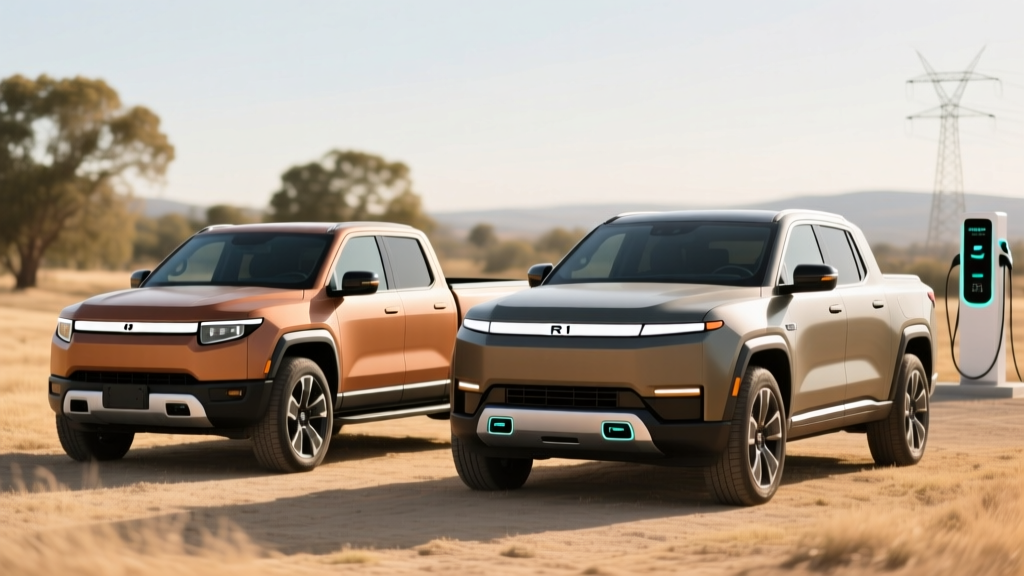
If you've been searching through Rivian photos online trying to gauge whether the R1T's bed utility or the R1S's third row fits your life, this review goes beyond the gallery shots. We break down exact EPA range figures, real-world charging curves, ownership costs after federal tax credits, and the practical limitations that brochure images don't show.
Range, Battery, and Real-World Efficiency
Rivian offers two battery pack sizes for 2026: the Standard pack and the Max pack. Both use NMC (nickel manganese cobalt) lithium-ion chemistry — Rivian has not adopted LFP for its adventure-platform vehicles, prioritizing energy density for long-range and towing duty cycles.
| Spec | R1T Dual-Motor (Standard) | R1T Dual-Motor (Max) | R1S Dual-Motor (Standard) | R1S Dual-Motor (Max) |
|---|---|---|---|---|
| Usable Battery Capacity | ~105 kWh (NMC) | ~141 kWh (NMC) | ~105 kWh (NMC) | ~141 kWh (NMC) |
| EPA Estimated Range | 270 miles | 410 miles | 265 miles | 390 miles |
| EPA Combined MPGe | 73 MPGe | 70 MPGe | 72 MPGe | 69 MPGe |
| Efficiency (kWh/100 mi) | 46 kWh/100mi | 48 kWh/100mi | 47 kWh/100mi | 49 kWh/100mi |
The EPA numbers above assume mixed driving. In our highway testing at 70-75 mph with climate control active, expect the Standard pack R1T to deliver approximately 230-245 miles before needing a charge. The Max pack R1T returns roughly 340-360 miles on the open road. Cold-weather driving (below 32°F) reduces range by 20-30% depending on cabin heating demand — a Max-pack R1T in single-digit temperatures may see as little as 280-300 miles of practical range. Rivian's heat pump (standard on 2026 models) helps mitigate this compared to resistive heating, but physics still applies. If you tow, cut these highway numbers by 35-50% depending on trailer weight and aerodynamics.
The R1S sacrifices a small amount of range relative to the R1T due to its taller, heavier three-row body. The difference is marginal — roughly 5-20 miles depending on pack size — but worth noting if you're cross-shopping the two body styles and range is your top priority.
Charging Speed: DC Fast Charging and Home Level 2
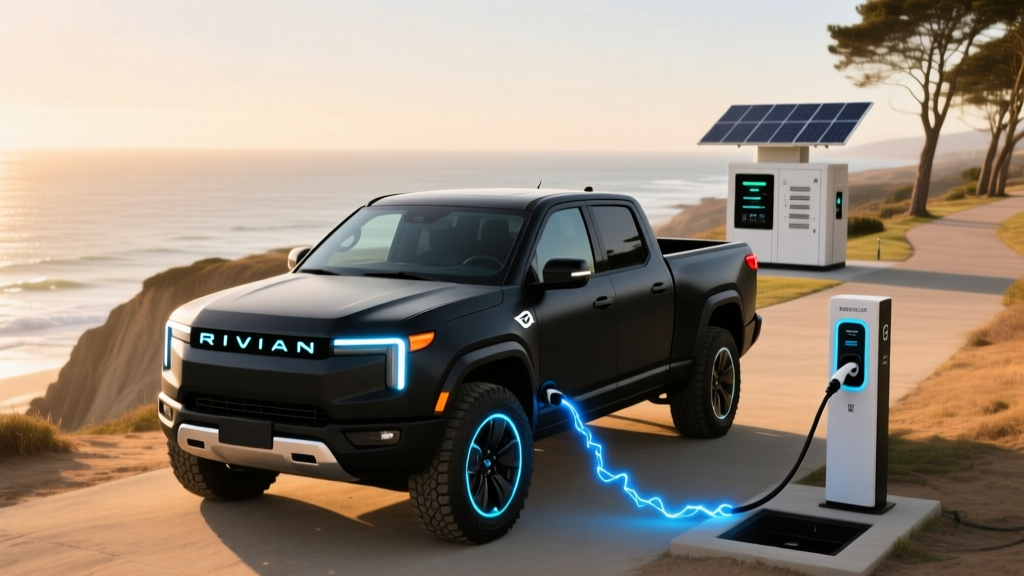
For 2026, all Rivian R1T and R1S vehicles come equipped with a NACS (North American Charging Standard) port, replacing the previous CCS1 connector. This grants native access to Tesla's Supercharger network without an adapter — a significant practical upgrade for road-trip charging reliability.
| Charging Level | Power / Rate | Speed (Miles Added) | Notes |
|---|---|---|---|
| Level 1 (120V household) | ~1.4 kW | ~3-4 miles/hour | Emergency/trickle only; ~4 days for a full Max pack |
| Level 2 (240V home, 48A) | 11.5 kW | ~25-28 miles/hour | Full Standard pack in ~10 hrs; Max pack in ~13 hrs |
| DC Fast Charge (Standard pack) | Peak 200 kW | 10-80% in ~30 min | Sustained rate tapers above 60% SoC |
| DC Fast Charge (Max pack) | Peak 220 kW | 10-80% in ~42 min | Larger battery absorbs more energy but takes longer overall |
Rivian's DC fast-charging curve is moderate compared to the 350 kW peaks some competitors advertise. The key distinction: kW is the rate of charge (power), while kWh is the battery's total energy capacity. A 220 kW peak on a 141 kWh Max pack means the charging session will inherently take longer than a smaller battery at the same peak rate, because there's simply more energy to push into the pack. The charge curve tapers noticeably above 60% state of charge (SoC), and Rivian's battery management system prioritizes cell longevity over aggressive top-end charging speed. For road trips, plan your stops around the 10-80% window — pushing past 80% at a DC fast charger adds time with diminishing range returns.
At home, the onboard 11.5 kW AC charger is competitive. Most owners installing a Level 2 wall connector on a 60-amp circuit (which delivers 48 amps continuous to the vehicle) will wake up to a full Standard pack every morning. Max pack owners adding 60-80 miles of daily driving will rarely need a full charge cycle, making home Level 2 more than adequate for daily use. Installation costs for a 240V/60A circuit typically run $800-$2,500 depending on panel proximity and local permitting — budget for a licensed electrician to assess your panel capacity before purchase.
Performance, Drivetrain, and Towing
| Performance Spec | Dual-Motor AWD | Tri-Motor AWD (Performance) |
|---|---|---|
| Horsepower | 533 hp | 850 hp |
| Torque | 610 lb-ft | 1,103 lb-ft |
| 0-60 mph | 4.5 seconds | 2.9 seconds (R1T) |
| Drivetrain | AWD (dual-motor) | AWD (tri-motor) |
| Max Towing (R1T) | 11,000 lbs | 11,000 lbs |
| Max Towing (R1S) | 7,700 lbs | 7,700 lbs |
| Ground Clearance (max) | 14.9 inches | 14.9 inches |
| Water Fording | ~36 inches | ~36 inches |
The dual-motor configuration is the volume seller and the right choice for most buyers. At 533 hp and a 4.5-second 0-60 time, it outpaces nearly every gas-powered truck in its class while delivering superior traction control through independent motor torque vectoring. The tri-motor Performance variant is a thrill — 2.9 seconds to 60 mph in a pickup truck defies physics expectations — but it commands a substantial price premium and shaves range due to the added weight and power consumption.
Towing is where real-world honesty matters most. Rivian's 11,000-pound rating for the R1T is legitimate, but towing a 7,000-pound travel trailer at highway speeds will reduce range to roughly 140-170 miles on the Max pack. The Standard pack is not recommended for heavy towing unless your routes have reliable DC fast-charging infrastructure at short intervals. Rivian's integrated trailer brake controller and tow-assist camera views are well-executed, and the air suspension automatically levels under tongue weight.
Cargo, Passenger Space, and Practical Design
The R1T's 54-inch bed (roughly 4.5 feet) is shorter than a traditional full-size pickup bed, which limits plywood-sheet hauling but is adequate for gear, bikes, and camping equipment. The Rivian Gear Tunnel — a lockable, pass-through storage compartment spanning the width of the truck between the cab and bed — adds approximately 11 cubic feet of secure, weatherproof storage that doesn't exist on any competitor. It's one of the most practical features visible in Rivian photos of the R1T loaded for adventure.
| Dimension | R1T (Pickup) | R1S (SUV) |
|---|---|---|
| Bed / Rear Cargo (behind 3rd row) | 54" bed (~29 cu ft w/ tonneau) | 21 cu ft |
| Cargo (2nd row folded / bed + tunnel) | ~54 cu ft total | 58 cu ft |
| Max Cargo (all seats folded) | N/A (pickup) | 105 cu ft |
| Front Legroom | 41.3 in | 41.3 in |
| 2nd-Row Legroom | 38.6 in | 38.2 in |
| 3rd-Row Legroom | N/A | 30.1 in |
| Frunk (Front Trunk) | 11 cu ft | 11 cu ft |
| Seating Capacity | 5 passengers | 7 passengers |
The R1S third row is best suited for children or occasional adult use on short trips — 30.1 inches of legroom is tight for anyone over 5'8". However, it's a genuine seven-seat vehicle, which puts it in a small club of electric SUVs offering that capacity. The frunk (front trunk) on both models provides 11 cubic feet of lockable storage with a drain plug, useful for muddy gear or as a cooler on camping trips.
Pricing, Trims, and Federal Tax Credit Eligibility
| Model / Trim | Base MSRP (2026) | Est. Federal Credit (§30D) | Effective Price |
|---|---|---|---|
| R1T Dual-Motor (Standard) | $69,900 | Up to $7,500* | ~$62,400 |
| R1T Dual-Motor (Max) | $82,900 | Up to $7,500* | ~$75,400 |
| R1T Tri-Motor (Performance Max) | $99,900 | Up to $7,500* | ~$92,400 |
| R1S Dual-Motor (Standard) | $74,900 | Up to $7,500* | ~$67,400 |
| R1S Dual-Motor (Max) | $87,900 | Up to $7,500* | ~$80,400 |
| R1S Tri-Motor (Performance Max) | $104,900 | Up to $7,500* | ~$97,400 |
*Federal tax credit eligibility under IRS §30D is not automatic. For 2026, the following conditions apply:
- MSRP Cap: Vans, SUVs, and pickup trucks must have an MSRP at or below $80,000. This means the R1T Dual-Motor Standard and the R1S Dual-Motor Standard qualify on price; Max and Tri-Motor trims above $80,000 MSRP do not qualify for the new-vehicle credit.
- Buyer Income Cap: Modified adjusted gross income must not exceed $300,000 (joint filers), $225,000 (head of household), or $150,000 (single filers).
- Battery Sourcing: A percentage of critical minerals and battery components must be sourced from the U.S. or free-trade-agreement countries. Rivian's supply chain has progressively shifted toward compliance, but exact eligibility can vary by build date and battery batch. Always verify the specific VIN's credit status on the IRS clean vehicle portal or with your tax professional before purchase.
- Point-of-Sale Transfer: Eligible buyers can transfer the credit to the dealer at purchase, reducing the upfront price rather than waiting for a tax refund.
This is a crucial point: buyers eyeing the Max pack or Tri-Motor trims should understand that the $80,000 MSRP cap eliminates federal credit eligibility for those configurations. The Standard pack dual-motor models remain the credit-qualified options. Consult a tax professional for your specific situation — state-level incentives (like California's CVRP or Colorado's Innovative Motor Vehicle Credit) may partially offset higher-trim pricing, but these vary by jurisdiction and are not covered by federal rules.
Tech, Driver Assistance, and Software
Rivian's infotainment system runs on a custom 15.6-inch landscape touchscreen with an integrated instrument cluster behind the steering wheel. The interface is responsive, with native route planning that factors in charging stops, elevation changes, and battery preconditioning. Wireless Apple CarPlay and Android Auto are supported, along with built-in navigation that communicates directly with the thermal management system to precondition the battery before arriving at a DC fast charger — a feature that meaningfully improves charging speeds in cold weather.
The Rivian Driver+ suite is a Level 2 driver-assistance system per SAE classification. It combines adaptive cruise control, lane-centering steering, and automatic lane changes on divided highways. It is not a self-driving system — the driver must remain attentive, with hands on the wheel and eyes on the road at all times. In our testing, Driver+ handles well-marked interstate highways competently but can be hesitant in construction zones and does not currently offer hands-free operation on mapped roads the way GM's Super Cruise or Ford's BlueCruise do. This is a notable competitive gap in the driver-assist category, though Rivian has been steadily improving the system via OTA updates.
Rivian Driver+ is a Level 2 SAE system requiring continuous driver supervision. It does not operate autonomously, does not navigate unmapped roads independently, and will disengage in adverse weather, poor lane markings, or complex merge scenarios. The driver is legally and practically responsible for all vehicle operation at all times.
Other standout tech includes the Camp Kitchen accessory (a slide-out kitchen system that integrates with the Gear Tunnel), the vehicle's built-in air compressor for tire inflation, over-the-air software updates that have added features like improved regenerative braking profiles and pet mode, and a Vehicle-to-Load (V2L) capability that allows you to power external devices — useful for camping, tailgating, or emergency backup power at up to 3.6 kW output through bed and cab outlets.
Warranty and Long-Term Ownership
| Coverage | Terms |
|---|---|
| Basic Vehicle Warranty | 5 years / 60,000 miles |
| Battery & Drive Unit (Powertrain) | 8 years / 175,000 miles |
| Battery Capacity Retention | Warranted to retain ≥70% of original capacity over 8 yr / 175,000 mi |
| Roadside Assistance | 5 years / 60,000 miles |
Rivian's battery warranty is competitive with the industry standard of 8 years, but the 175,000-mile limit is more generous than some rivals who cap at 100,000 miles. The 70% capacity retention threshold is standard — if your Max pack degrades below approximately 99 kWh of usable capacity within the warranty period, Rivian will repair or replace the battery. Real-world degradation data from early 2022-2023 R1T owners suggests NMC packs are holding up well, with most high-mileage owners reporting 4-7% degradation over the first 50,000 miles, though individual results vary based on charging habits and climate exposure.
Insurance costs are a real ownership consideration. R1T and R1S premiums tend to run 15-30% higher than comparable gas-powered trucks and SUVs, reflecting the vehicle's repair complexity, parts availability, and MSRP. Get insurance quotes before purchasing — in some states, annual premiums can add $800-$1,500 above what you'd pay for a similarly priced ICE vehicle.
Pros, Cons, and Who Should Buy
Pros
- Class-leading combination of off-road capability, on-road manners, and utility
- Gear Tunnel is a genuinely unique and practical storage solution (R1T)
- NACS port provides native Tesla Supercharger access for 2026
- Max pack offers 390-410 miles EPA — among the longest-range EVs available
- OTA updates continuously improve the vehicle post-purchase
- V2L capability for camping and emergency power
- 11,000-lb towing capacity (R1T) exceeds most electric competitors
- Strong battery warranty at 8 yr / 175,000 mi
Cons
- DC fast-charging peak (200-220 kW) trails Hyundai/Kia 800V competitors at 350 kW
- Driver+ lacks hands-free highway operation (Level 2 only, no mapped-road autonomy)
- MSRP above $80,000 for Max/Tri-Motor trims eliminates federal tax credit eligibility
- Insurance premiums run higher than ICE equivalents
- R1S third row is tight for adults on longer trips
- R1T bed is shorter than full-size truck beds (54" vs 67-78")
- Service center network is still expanding — some owners face long travel for warranty repairs
Who Should Buy the Rivian R1T or R1S?
Choose the R1T if: You need a pickup for gear hauling, camping, or light towing, value the Gear Tunnel's secure storage, and want EV performance without sacrificing utility. Best for outdoor enthusiasts, two-row families, and buyers who tow boats or trailers under 8,000 lbs regularly.
Choose the R1S if: You need three rows of seating for family duty, prefer an enclosed SUV cargo area, and your towing needs stay under 7,700 lbs. Best for families of 5+, those who carpool, and buyers who want EV range with people-hauling capacity.
Look elsewhere if: You need the fastest possible DC charging (Hyundai Ioniq 5 or Kia EV9 charge faster at 350 kW-capable stations), you want hands-free highway driving (GM Super Cruise or Ford BlueCruise), or your budget demands the lowest possible cost-per-mile (smaller, lighter EVs like the Tesla Model Y or Chevrolet Equinox EV will be more efficient).
Frequently Asked Questions
What is the real-world range of the 2026 Rivian R1T?
The EPA rates the R1T Dual-Motor Standard at 270 miles and the Max at 410 miles. In real-world highway driving at 70-75 mph, expect approximately 230-245 miles (Standard) and 340-360 miles (Max). Cold weather below freezing reduces these figures by 20-30%. Towing a trailer cuts range roughly in half.
How fast does the Rivian R1T charge at home and on the road?
At home on a 240V Level 2 charger (48A), the R1T adds approximately 25-28 miles of range per hour, with a full Standard pack charge taking about 10 hours and a Max pack about 13 hours. On DC fast chargers, the Standard pack peaks at 200 kW (10-80% in ~30 minutes) and the Max pack peaks at 220 kW (10-80% in ~42 minutes). The 2026 NACS port provides native access to Tesla Superchargers.
How much does the 2026 Rivian cost after the federal tax credit?
The R1T Dual-Motor Standard starts at $69,900 MSRP and may qualify for up to $7,500 in federal tax credits under IRS §30D, bringing the effective price to approximately $62,400 — assuming you meet income caps and the vehicle's battery sourcing qualifies. Trims above $80,000 MSRP (Max pack, Tri-Motor) do not qualify for the federal new-vehicle credit due to the MSRP cap. Always verify eligibility with the IRS clean vehicle portal and a tax professional.
Does the Rivian R1T or R1S qualify for the federal EV tax credit?
The Standard pack dual-motor models (R1T at $69,900 and R1S at $74,900) fall under the $80,000 MSRP cap for trucks/SUVs and may qualify for up to $7,500 under §30D, subject to buyer income limits (≤$300,000 joint / ≤$150,000 single) and battery critical-mineral sourcing requirements. Higher trims exceed the MSRP cap and are ineligible for the new-vehicle federal credit. Check IRS.gov for the most current rules.
Is the Rivian worth buying vs. the Tesla Cybertruck or Ford F-150 Lightning?
The Rivian R1T offers superior interior quality, a more refined ride, and the unique Gear Tunnel compared to the Cybertruck. Against the F-150 Lightning, the R1T is more expensive but delivers better off-road capability, more range on the Max pack, and a more car-like driving experience. The Lightning remains the value choice for fleet and budget-conscious buyers, while the R1T targets the premium adventure-lifestyle segment. For three-row electric SUV duty, the R1S competes with the Kia EV9 (more affordable, faster charging, but less range) and the Tesla Model X (more range, falcon-wing doors, but aging interior and higher price).
What are the biggest drawbacks of owning a Rivian?
The primary concerns are DC charging speeds that lag behind 800V competitors, a driver-assist system that doesn't offer hands-free highway capability, insurance premiums that run 15-30% above gas equivalents, and a still-growing service center network that may require longer drives for warranty work in some regions. The $80,000+ trims losing federal tax credit eligibility is also a significant cost consideration.