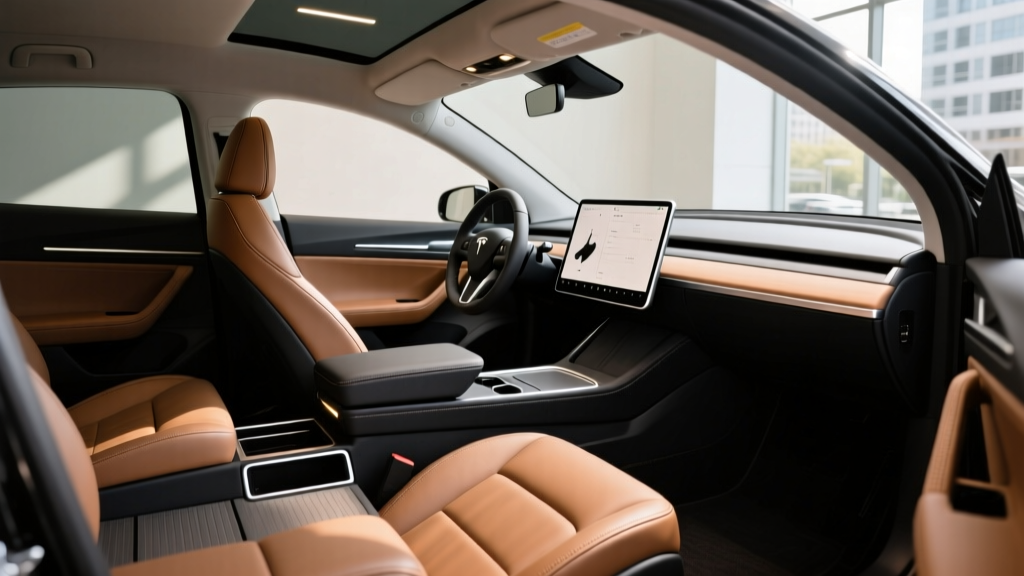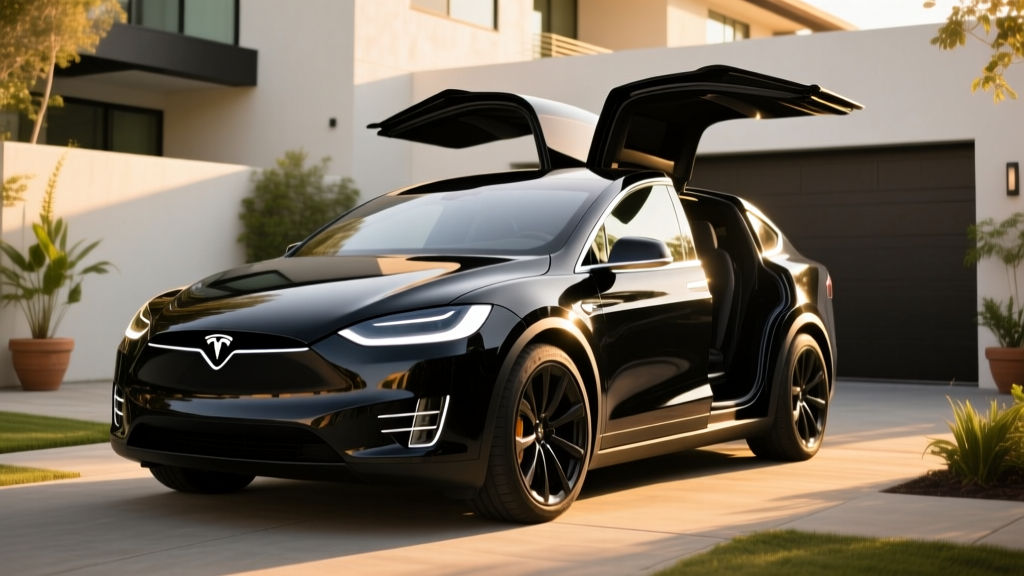
If you've been searching for every detail on dimension Tesla Model X specifications, you've landed in the right spot. The 2026 Tesla Model X remains one of the few three-row electric SUVs that pairs serious cargo volume with sports-car acceleration and access to the Supercharger network. Below, we break down every exterior and interior measurement, real-world range data, charging curves, pricing, and whether the §30D federal tax credit applies.
Exterior Dimensions: How Big Is the 2026 Model X?
The Model X sits on a 116.7-inch wheelbase and stretches 199.1 inches bumper to bumper — roughly the same footprint as a BMW X5 but with a taller, more aerodynamic profile. The falcon-wing rear doors add vertical clearance requirements that matter in tight garages.
| Measurement | Value |
|---|---|
| Wheelbase | 116.7 in (2,964 mm) |
| Overall Length | 199.1 in (5,057 mm) |
| Width (mirrors folded) | 81.5 in (2,070 mm) |
| Width (mirrors out) | 88.0 in (2,235 mm) |
| Height (standard suspension) | 66.9 in (1,699 mm) |
| Ground Clearance (adjustable) | 5.4 – 8.1 in |
| Curb Weight | 5,185 lb (Long Range) / 5,390 lb (Plaid) |
| Falcon-Wing Door Opening Height | ~84 in required clearance |
Garage tip: Measure your garage ceiling before ordering. The falcon-wing doors need roughly 84 inches (7 feet) of vertical clearance to open fully. Most standard US garages are 96–108 inches tall, but low-ceiling parking structures can be a problem.
Interior Space: Passenger and Cargo Dimensions
The 2026 Model X is offered in five-, six-, and seven-seat layouts. The six-seat configuration (second-row captains chairs) is the most popular for families because it preserves walk-through access to the third row and keeps each passenger in a dedicated seat.
| Measurement | Value |
|---|---|
| Headroom (front / 2nd row / 3rd row) | 41.7 / 40.9 / 37.1 in |
| Legroom (front / 2nd row / 3rd row) | 41.2 / 38.4 / 32.7 in |
| Shoulder Room (front / 2nd row) | 60.7 / 56.8 in |
| Cargo (behind 3rd row) | 15.0 cu ft |
| Cargo (3rd row folded) | 43.9 cu ft |
| Cargo (all rear rows folded) | 81.1 cu ft |
| Front Trunk (Frunk) | 6.5 cu ft |
The third row is best suited for children or adults on short trips — 32.7 inches of legroom is tight for six-footers. For maximum cargo, the five-seat config gives you a flat load floor and the full 81.1 cu ft with both rows down, plus the 6.5 cu ft frunk for charging cables or groceries.
Range, Efficiency, and Battery Specs
The 2026 Model X Long Range carries an estimated 100 kWh battery pack (NMC chemistry) and achieves an EPA-estimated 320 miles of range. The Plaid variant, which trades some efficiency for tri-motor performance, is rated at 304 miles EPA.
EPA 320 mi (Long Range) / 304 mi (Plaid). In real-world highway driving at 70–75 mph, expect ~265–285 miles. In freezing temperatures (below 32°F), range can drop 20–30%, putting winter highway range closer to 220–240 miles. The heat pump helps, but cold-soak and cabin heating still draw significant energy.
| Trim | EPA Range | Battery (usable) | Chemistry | MPGe (combined) | kWh/100 mi |
|---|---|---|---|---|---|
| Long Range (AWD) | 320 mi | ~100 kWh | NMC | 102 MPGe | 33 kWh |
| Plaid (AWD Tri-Motor) | 304 mi | ~100 kWh | NMC | 98 MPGe | 34 kWh |
Efficiency of 33–34 kWh per 100 miles is typical for a 5,200-lb SUV. For comparison, the lighter Tesla Model Y achieves roughly 28 kWh/100 mi. If you drive 15,000 miles per year, expect to consume about 4,950–5,100 kWh annually — roughly $600–$900 in electricity at the US average rate of $0.16/kWh.
Charging Speed: DC Fast, Level 2, and Supercharger Access
Charging speed is where the Model X's 2026 architecture shows its age relative to 800V competitors like the Hyundai Ioniq 9 or Kia EV9, which can sustain higher charge rates for longer. The Model X runs a 400V architecture and peaks around 250 kW on a V3 Supercharger.
| Charging Level | Power | Speed / Time |
|---|---|---|
| Level 1 (120V household) | ~1.4 kW | ~3 mi/hr |
| Level 2 (240V, 48A Wall Connector) | 11.5 kW | ~34 mi/hr |
| DC Fast Charge (V3 Supercharger) | Peak 250 kW | 10–80% in ~30 min |
| DC Fast Charge (CCS adapter, EA/others) | Peak ~150–170 kW | 10–80% in ~40 min |
Charging curve reality: The 250 kW peak only holds between roughly 10–30% State of Charge. Above 50%, the curve tapers significantly — expect ~100 kW at 60% and ~50 kW above 80%. A 10–80% session takes about 30 minutes at a V3 Supercharger, but a 10–95% session can stretch past 55 minutes due to the taper.
At home, the Tesla Wall Connector at 48 amps delivers 11.5 kW, adding roughly 34 miles per hour of charging. An overnight session (10 hours) replenishes about 340 miles — more than a full battery. Installation typically costs $800–$2,000 depending on panel proximity and whether your electrical panel needs a 60A circuit upgrade.
Performance: 0–60, Horsepower, and Drivetrain
The Model X has always been a performance outlier among three-row SUVs. Both trims use dual-motor all-wheel drive, with the Plaid adding a third rear motor.
| Spec | Long Range | Plaid |
|---|---|---|
| Drivetrain | Dual-Motor AWD | Tri-Motor AWD |
| Horsepower | 670 hp | 1,020 hp |
| 0–60 mph | 3.8 sec | 2.5 sec |
| Top Speed | 155 mph | 163 mph |
| Towing Capacity | 5,000 lb | 5,000 lb |
The Long Range's 3.8-second 0–60 time outpaces most V8 sport SUVs. The Plaid's 2.5 seconds is supercar territory — genuinely startling in a vehicle that can seat seven. Towing is rated at 5,000 pounds for both trims, adequate for a small boat or utility trailer, but expect a 35–45% range reduction when towing near max capacity.
Pricing, Trims, and Federal Tax Credit Eligibility
The 2026 Model X starts at $79,990 for the Long Range and $94,990 for the Plaid, before destination fees and options.
| Trim | Base MSRP | Est. As-Tested (6-seat, FSD) |
|---|---|---|
| Long Range AWD | $79,990 | ~$91,000 |
| Plaid Tri-Motor AWD | $94,990 | ~$106,000 |
The Model X is unlikely to qualify for the full $7,500 federal EV tax credit under current IRS §30D rules. Key disqualifying factors:
- MSRP Cap: SUVs must be under $80,000. The Long Range at $79,990 is right at the edge — any options push it over.
- Income Cap: Modified AGI must be ≤ $300,000 (joint) / $150,000 (single).
- Battery Sourcing: Critical minerals and battery component requirements have tightened annually through 2026. Tesla's supply chain has shifted, but verify current-year eligibility on fueleconomy.gov before purchasing.
- Point-of-Sale Transfer: If eligible, the credit can be transferred to the dealer at purchase for an immediate price reduction.
Warranty, Tech, and Driver Assistance
Tesla covers the Model X with a 4-year/50,000-mile basic vehicle warranty and an 8-year/150,000-mile battery and drive unit warranty (retaining at least 70% capacity). This battery warranty is competitive with rivals like the Rivian R1S (8-yr/175,000-mi) and better than most legacy automakers.
Standout Tech:
- 17-inch center touchscreen with tilt adjustment and gaming-capable GPU
- Second-row 8-inch touchscreen for rear passengers
- HEPA air filtration with Bioweapon Defense Mode
- Over-the-air updates adding features post-purchase
- 22-speaker 960W audio system
Driver Assistance: Tesla Autopilot (lane centering + adaptive cruise) is standard. Full Self-Driving (Supervised) is an $8,000 option or $99/month subscription.
Both Autopilot and FSD (Supervised) are SAE Level 2 driver-assistance systems. You must keep your hands on the wheel and eyes on the road at all times. Tesla's camera-based monitoring enforces attention, but the system does not handle all driving scenarios. True driverless (Level 4) operation is only available in limited robotaxi services like Waymo.
Pros and Cons at a Glance
- 320-mile EPA range is strong for a 3-row SUV
- Supercharger network access (most reliable DC network)
- Supercar acceleration (3.8s / 2.5s 0–60)
- Falcon-wing doors ease 2nd/3rd-row car-seat loading
- Continuous OTA improvements
- 5,000-lb towing capacity
- 30-minute 10–80% DC charge is slower than 800V rivals
- Third-row legroom (32.7 in) is tight for adults
- MSRP at/above §30D tax credit cap for SUVs
- Falcon-wing doors need tall garage clearance
- No Apple CarPlay / Android Auto
- Panel gaps and build quality still inconsistent
Who Should Buy the 2026 Model X?
The Model X fits a specific buyer: a family that needs three rows, values acceleration and tech, and wants the most reliable public charging network. It's ideal for:
- Tech-forward families who want car-seat-friendly falcon-wing doors and rear-seat entertainment screens
- Road trippers who benefit from Supercharger density on cross-country routes
- Performance seekers who refuse to sacrifice 0–60 times for practicality
It's not the best pick if you need maximum third-row comfort (the Kia EV9 or Rivian R1S offer more space), if you want the fastest DC charging (800V platforms charge 10–80% in ~18 minutes), or if you need Apple CarPlay integration.
Frequently Asked Questions
What is the real-world range of the 2026 Tesla Model X?
The EPA rates the Long Range at 320 miles and the Plaid at 304 miles. In real-world highway driving at 70–75 mph, expect 265–285 miles. In cold weather below freezing, that drops to approximately 220–240 miles due to battery resistance and cabin heating demands.
How fast does the Model X charge at home and on DC fast chargers?
At home on a 48A Level 2 Wall Connector (11.5 kW), the Model X adds about 34 miles per hour — a full overnight charge. On a V3 Supercharger, it peaks at 250 kW and charges 10–80% in approximately 30 minutes, though the curve tapers significantly above 50%.
Does the 2026 Model X qualify for the $7,500 federal EV tax credit?
It's borderline. The Long Range starts at $79,990 — right at the $80,000 SUV MSRP cap. Adding any options pushes it over the limit. Buyer income must also be under $300,000 (joint) or $150,000 (single), and battery sourcing requirements must be met. Always verify on fueleconomy.gov before purchasing.
Is the Model X worth buying vs. the Rivian R1S or Kia EV9?
Choose the Model X if Supercharger access, acceleration, and falcon-wing doors are priorities. Choose the Rivian R1S if you need better off-road capability and more third-row space. Choose the Kia EV9 if you want faster 800V charging (~18 min 10–80%), a lower starting price (~$55,000), and more traditional SUV ergonomics.
How reliable are the falcon-wing doors?
Tesla has revised the door mechanism multiple times since the 2016 launch. Current-generation doors are more reliable, but they remain a complex system with more potential failure points than conventional doors. The ultrasonic sensors help avoid obstacles, but snow and ice buildup on the door seams can cause issues in winter climates.
What is the battery replacement cost?
Out-of-warranty battery replacement for the Model X currently ranges from $15,000 to $22,000 depending on the pack and labor. However, Tesla's 8-year/150,000-mile battery warranty (70% capacity retention) means most owners will never pay out of pocket. NMC packs in the Model X have shown degradation of roughly 8–12% at 100,000 miles based on fleet data.