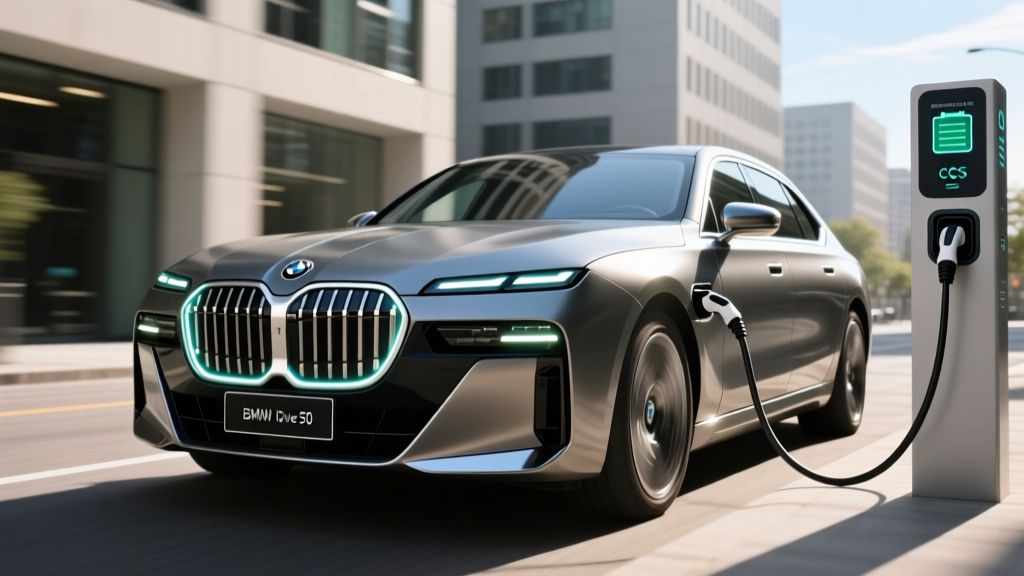
The 2026 BMW i7 eDrive50 occupies a rare position in the luxury EV sedan market: it delivers flagship comfort and technology without the six-figure-plus premium of the dual-motor xDrive60. For buyers who prioritize rear-seat serenity and long-distance range over sub-four-second acceleration, the single-motor eDrive50 is arguably the smarter buy in BMW's electric 7 Series lineup. But does a rear-wheel-drive luxury barge make sense when competitors offer all-wheel drive as standard?
After examining EPA data, real-world efficiency patterns, and total ownership costs, here is everything you need to know before configuring or test-driving the 2026 BMW i7 eDrive50.
2026 BMW i7 eDrive50: Quick Specs at a Glance
| Spec | Value |
|---|---|
| EPA Range | 318 miles |
| Battery (Usable) | 101.7 kWh (NMC) |
| Drivetrain | Rear-Wheel Drive (single motor) |
| Horsepower | 449 hp / 479 lb-ft torque |
| 0–60 mph | 5.4 seconds |
| Max DC Fast Charge | 195 kW (CCS1) |
| 10–80% DC Charge | ~34 minutes |
| Level 2 Home Charging | 11 kW (~30 mi/hr) |
| EPA Efficiency | 82 MPGe combined |
| Base MSRP | $106,675 (incl. destination) |
| Federal Tax Credit | Up to $7,500 (eligibility varies) |
| Battery Warranty | 8 years / 100,000 miles |
Range and Real-World Efficiency
The EPA rates the 2026 BMW i7 eDrive50 at 318 miles of combined range. That figure places it ahead of the dual-motor xDrive60 (301 miles EPA) thanks to the efficiency advantage of a single rear motor and slightly lower curb weight. According to fueleconomy.gov, the eDrive50 achieves 82 MPGe combined, translating to roughly 41 kWh per 100 miles — competitive for a 5,800-pound luxury sedan.
The 318-mile EPA sticker assumes a mix of city and highway driving at moderate temperatures. In practice:
• Highway cruising (70–75 mph): Expect 265–285 miles before needing a charge, as aerodynamic drag dominates at speed.
• City/suburban mixed driving: 300–320 miles is achievable, with regenerative braking recovering energy in stop-and-go traffic.
• Cold weather (below 32°F): Range drops 15–25%, yielding roughly 240–270 miles. The i7's standard heat pump mitigates cabin-heating losses but cannot fully offset cold battery chemistry effects.
• Mountainous terrain: Sustained climbs reduce range significantly; expect 220–250 miles on steep passes, partially recovered on descents.
The eDrive50's NMC (nickel manganese cobalt) battery pack provides high energy density suited to this long-range application. Unlike LFP chemistries found in some lower-cost EVs, NMC offers superior performance in cold conditions but benefits from staying between 20% and 80% state of charge for daily use to maximize long-term cell health.
Charging Speed: DC Fast and Home Level 2
Charging capability often separates a usable luxury EV from a frustrating one. The i7 eDrive50 supports up to 195 kW via DC fast charging on CCS1 connectors. BMW quotes a 10–80% charge time of approximately 34 minutes under optimal conditions — meaning a pre-conditioned battery at a compatible station.
| Charging Method | Power (kW) | Speed (mi/hr added) | Notes |
|---|---|---|---|
| Level 1 (120V outlet) | ~1.4 kW | ~3–4 mi/hr | Emergency/trickle only |
| Level 2 (240V, 48A) | 11 kW | ~30 mi/hr | Full charge in ~10.5 hours |
| DC Fast Charge (peak) | 195 kW | ~650 mi/hr (peak) | 10–80% in ~34 min |
Charging curve reality: The 195 kW peak is not sustained across the entire session. Expect peak rates between 10–40% SoC, with a progressive taper beginning around 50% and a sharp reduction above 80%. If you're road-tripping and only need a 15-minute top-up from 20% to 55%, the i7 rewards you with roughly 120–140 miles of added range. Charging from 80–100% at a DC station is painfully slow — plan to charge to 80% and move on unless you need every last mile.
For home charging, the onboard 11 kW AC charger is a strong point. With a properly installed 48-amp Level 2 wallbox (such as the BMW Wallbox Professional or a ChargePoint Home Flex), you'll recover a full battery overnight in about 10.5 hours. This means most owners will rarely visit a public charger outside of road trips.
Performance and Driving Dynamics
The single rear-mounted electric motor produces 449 horsepower and 479 lb-ft of torque, launching the i7 eDrive50 from 0–60 mph in 5.4 seconds. That's hardly slow — it matches sports sedans from just a decade ago — but it trails the xDrive60's 4.5-second sprint. The difference matters less than you'd think: the eDrive50's instant torque delivery makes it feel brisk in urban merging and passing situations, and the 5,800-pound curb weight is managed well by BMW's adaptive air suspension.
Rear-wheel drive is a deliberate choice for this trim. BMW engineers prioritize the driving refinement and efficiency of a single rear motor, and the i7's weight distribution and traction control handle wet roads competently. However, buyers in regions with heavy snow should consider the xDrive60 for its dual-motor all-wheel drive, or plan to equip dedicated winter tires on the eDrive50.
Ride quality is where the i7 truly shines. The two-axle air suspension with electronically controlled dampers absorbs highway imperfections with genuine authority. Rear-wheel steering (standard on the i7) shrinks the car's effective turning radius to that of a 3 Series, making parking manageable despite the 212-inch overall length.
Interior, Tech, and Cargo Practicality
The i7 cabin is a showcase of BMW's latest luxury thinking. The Curved Display merges a 12.3-inch instrument cluster with a 14.9-inch central touchscreen running iDrive 8.5. Standard features include:
- Merino leather upholstery with heated and ventilated front seats
- Heated rear seats with available rear-seat entertainment (31.3-inch Theater Screen)
- Harman Kardon surround sound (standard); Bowers & Wilkins Diamond available
- BMW Highway Assistant (Level 2 hands-free driving on divided highways up to 85 mph)
- Panoramic glass roof with electrochromic shading
- Wireless Apple CarPlay, Android Auto, and Qi2 charging
The 31.3-inch rear Theater Screen (part of the Executive Lounge package) is a genuine differentiator — it supports streaming via built-in Amazon Fire TV and transforms the rear cabin into a mobile cinema. It's a $3,000+ option but one that competitors like the Mercedes EQS and Porsche Taycan cannot match.
Cargo space measures 17.7 cubic feet in the trunk — generous for a full-size sedan and sufficient for four rolling carry-on bags. There is no front trunk (frunk); the space is occupied by power electronics. Rear-seat legroom is a limousine-grade 42.8 inches, making the i7 a legitimate chauffeur-driven vehicle.
Pricing, Trims, and Federal Tax Credit
The 2026 BMW i7 eDrive50 starts at $106,675 including the $1,175 destination charge. BMW positions this as the entry point to the i7 lineup, with the xDrive60 starting at $125,175 and the M70 at $169,675.
| Trim | MSRP (incl. destination) | Key Differentiator |
|---|---|---|
| eDrive50 | $106,675 | RWD, 318 mi range, 449 hp |
| xDrive60 | $125,175 | AWD, 301 mi range, 536 hp |
| M70 | $169,675 | AWD, 295 mi range, 650 hp |
Popular options on the eDrive50 include the Premium Package ($3,400), Executive Lounge seating ($3,600), and the Theater Screen ($3,200). A well-equipped eDrive50 typically lands between $115,000 and $120,000 before incentives.
Federal Tax Credit Eligibility (§30D)
The BMW i7 eDrive50 may qualify for up to $7,500 in federal EV tax credits under IRS §30D, but eligibility depends on multiple factors that change frequently. Key requirements per irs.gov:
- MSRP cap: Sedans must not exceed $55,000. The i7 eDrive50 at $106,675 exceeds this cap, making it ineligible for the new-vehicle §30D credit.
- Buyer income limits: AGI must not exceed $300,000 (joint) / $225,000 (head of household) / $150,000 (single).
- Battery sourcing: Critical minerals and battery components must meet phased-in domestic-content thresholds.
Warranty and Long-Term Ownership
BMW backs the i7 eDrive50 with a competitive warranty package:
- Basic vehicle warranty: 4 years / 50,000 miles
- Battery and high-voltage components: 8 years / 100,000 miles (covers capacity loss below 70% of original)
- Rust perforation: 12 years / unlimited miles
- Roadside assistance: 4 years / unlimited miles
The 70% capacity retention threshold is industry-standard. Based on data from BMW's earlier iX and i4 models using similar NMC cells, owners can expect roughly 8–12% degradation over the first 100,000 miles under normal use — meaning the 318-mile range would drop to approximately 280–290 miles after a decade of typical driving. The liquid-cooled thermal management system and conservative buffer strategy (roughly 6 kWh reserved above and below the usable window) help preserve cell longevity.
Insurance costs run higher than the gas-powered 7 Series. Expect annual premiums of $3,200–$4,500 depending on your profile, driven by the i7's repair costs and aluminum-intensive construction. Get quotes before purchasing.
How the i7 eDrive50 Stacks Up Against Competitors
| Spec | BMW i7 eDrive50 | Mercedes EQS 450+ | Tesla Model S LR |
|---|---|---|---|
| EPA Range | 318 mi | 352 mi | 402 mi |
| Battery | 101.7 kWh NMC | 107.8 kWh NMC | ~100 kWh NMC |
| 0–60 mph | 5.4 sec | 5.9 sec | 3.1 sec |
| DC Fast Charge | 195 kW | 200 kW | 250 kW |
| Base MSRP | $106,675 | $105,550 | $79,990 |
| Cargo Space | 17.7 cu ft | 22.0 cu ft | 28.0 cu ft |
| Rear Legroom | 42.8 in | 41.7 in | 35.4 in |
The EQS 450+ offers more range and cargo space at a similar price, but its rear-seat experience and material quality fall short of the BMW. The Tesla Model S Long Range dominates on range, performance, and price, but its interior is a generation behind and rear-seat comfort is not in the same class. The i7 eDrive50 wins on rear-seat luxury, ride refinement, and the availability of the Theater Screen — making it the choice for buyers who are chauffeured or prioritize rear-cabin comfort.
Who Should Buy the 2026 BMW i7 eDrive50?
• You want a true luxury flagship with best-in-class rear-seat comfort
• You charge at home and road-trip fewer than 5 times per year
• You value ride quality and cabin quietness over outright performance
• You want the Theater Screen and latest BMW iDrive technology
• You live in a mild climate where RWD is manageable year-round
• You need AWD for heavy snow (consider the xDrive60 or EQS 450 4MATIC)
• You want maximum range per dollar (Tesla Model S LR wins decisively)
• You require the federal tax credit (i7 exceeds the sedan MSRP cap)
• You prioritize cargo versatility (the EQS hatchback offers 22 cu ft)
Pros and Cons
- Class-leading rear-seat comfort and legroom
- 318-mile EPA range is practical for most owners
- 11 kW Level 2 charging enables full overnight replenishment
- 31.3-inch Theater Screen is unmatched in the segment
- Adaptive air suspension delivers outstanding ride quality
- Competitive 195 kW DC fast-charging speed
- Ineligible for §30D federal tax credit (MSRP exceeds cap)
- RWD only — no AWD option on the eDrive50 trim
- No front trunk (frunk) for additional cargo
- Options quickly push price above $120,000
- Real-world highway range drops to ~265–285 miles
- Insurance premiums higher than gas 7 Series equivalent
Frequently Asked Questions
What is the real-world range of the 2026 BMW i7 eDrive50?
The EPA rates it at 318 miles combined. In real-world highway driving at 70–75 mph, expect 265–285 miles. City driving can approach the EPA number. Cold weather (below freezing) reduces range by 15–25%, yielding approximately 240–270 miles.
How fast does the i7 eDrive50 charge?
On a DC fast charger, it peaks at 195 kW, achieving a 10–80% charge in roughly 34 minutes with a preconditioned battery. At home on a Level 2 (240V/48A) charger, the 11 kW onboard charger adds about 30 miles per hour, fully replenishing the battery in approximately 10.5 hours.
Does the BMW i7 eDrive50 qualify for the $7,500 federal EV tax credit?
No. Under current IRS §30D rules, the federal new clean vehicle credit has a $55,000 MSRP cap for sedans. The i7 eDrive50 at $106,675 exceeds this limit. Buyers may explore state incentives, the commercial vehicle credit (§45W for business use), or leasing arrangements where a lessor credit may reduce costs. Always consult a tax professional.
Is the i7 eDrive50 worth buying vs. the Mercedes EQS or Tesla Model S?
If rear-seat luxury and ride comfort are your top priorities, the i7 eDrive50 is the strongest choice. The EQS 450+ offers more range and cargo space at a similar price, while the Model S dominates on range, performance, and value. The BMW wins specifically on interior material quality, rear-seat experience, and available features like the Theater Screen.
Should I be concerned about rear-wheel drive in snow?
The eDrive50 is RWD-only; AWD is available only on the xDrive60 and M70 trims. With quality winter tires, the eDrive50's traction control and weight distribution handle light to moderate snow adequately. If you live in an area with heavy, sustained snowfall, the xDrive60 is the safer choice.
How long will the i7 battery last?
BMW warranties the high-voltage battery for 8 years or 100,000 miles against capacity loss below 70%. Based on NMC cell data from BMW's current EV fleet, expect 8–12% degradation over 100,000 miles with normal charging habits. Avoiding routine DC fast charging and keeping daily SoC between 20–80% will maximize longevity.