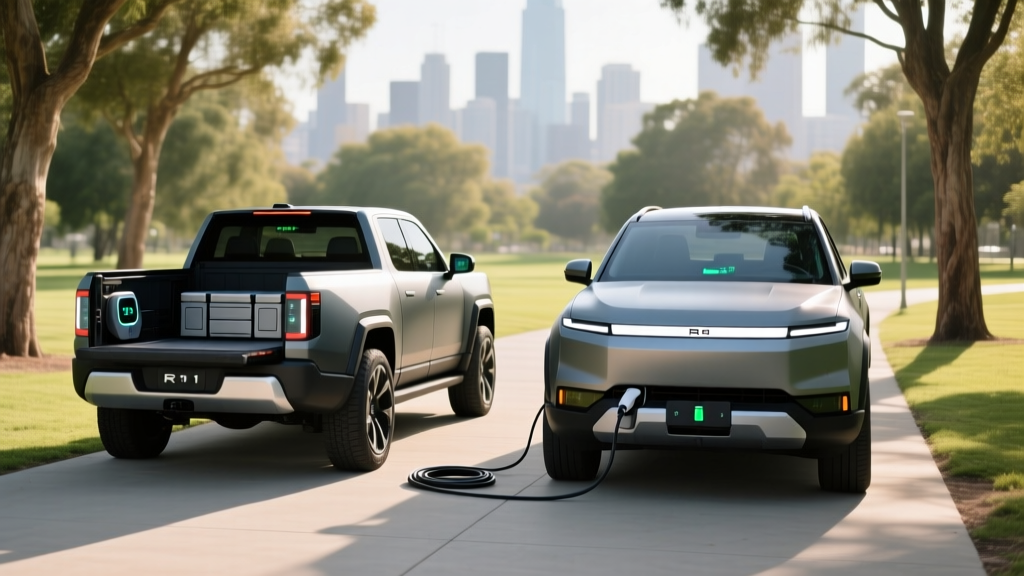
The announcement of the Rivian Uber partnership sent ripples through the EV industry, but for everyday buyers, the real question is simple: How does this commercial deal affect the R1T pickup and R1S SUV you can actually buy? As of 2026, Rivian's consumer lineup has matured considerably, benefiting from manufacturing scale and technology refinements that trace partly back to fleet-level engineering lessons. This review breaks down the current Rivian R1T and R1S — the models you can order today — with exact specs, real-world range expectations, charging data, and pricing after federal tax credits.
What the Rivian Uber Partnership Actually Means for Buyers
In late 2024, Rivian and Uber announced a collaboration focused on future autonomous-capable electric vehicles designed for rideshare use. The deal signaled Rivian's intent to scale production and develop a dedicated commercial platform. For consumer buyers in 2026, the practical impact is indirect but real: Rivian's Normal, Illinois factory has increased throughput, supply-chain logistics have improved, and software development has accelerated thanks to the revenue and engineering focus the fleet partnership brought. The R1T and R1S you test-drive today benefit from tighter build quality and more mature over-the-air (OTA) update cycles than the 2022–2023 launch vehicles.
Importantly, the Uber partnership focuses on a future dedicated robotaxi-style platform — not the R1 consumer vehicles. Rivian's R1T and R1S remain fully available to individual buyers, and the brand's consumer roadmap continues independently of its commercial fleet ambitions.
2026 Rivian R1T & R1S: Core Specifications at a Glance
| Spec | R1T (Dual-Motor AWD) | R1S (Dual-Motor AWD) | R1T/R1S (Quad-Motor) |
|---|---|---|---|
| EPA Range | 352 miles (Max Pack) | 352 miles (Max Pack) | 328 miles (Max Pack) |
| Battery Capacity | 149 kWh usable (Max Pack) | 149 kWh usable (Max Pack) | 149 kWh usable (Max Pack) |
| Battery Chemistry | NMC (nickel manganese cobalt) | NMC | NMC |
| Standard Pack Range | 270 miles (92 kWh) | 270 miles (92 kWh) | N/A |
| Horsepower | 533 hp (Dual-Motor) | 533 hp (Dual-Motor) | 1,025 hp (Quad-Motor) |
| 0–60 mph | 4.5 sec | 4.6 sec | 2.9 sec |
| Drivetrain | AWD (Dual-Motor) | AWD (Dual-Motor) | AWD (Quad-Motor, individual wheel torque) |
| Max DC Fast Charge | 220 kW peak | 220 kW peak | 220 kW peak |
| 10–80% DC Charge Time | ~30 minutes (Max Pack) | ~30 minutes (Max Pack) | ~30 minutes (Max Pack) |
| Level 2 Home Charge Rate | 11.5 kW (~25 mi/hr) | 11.5 kW (~25 mi/hr) | 11.5 kW (~25 mi/hr) |
| Efficiency (MPGe) | 73 MPGe combined | 73 MPGe combined | 70 MPGe combined |
| Towing Capacity | 11,000 lbs | 7,700 lbs | 11,000 lbs (R1T) |
| Cargo Volume | 54 cu ft bed + 11 cu ft frunk + Gear Tunnel | 104.7 cu ft max (seats folded) | Same as above by body style |
| Base MSRP | $74,800 (Dual-Motor Standard) | $79,800 (Dual-Motor Standard) | $99,000 (Quad-Motor) |
| Battery/Powertrain Warranty | 8 years / 175,000 miles | 8 years / 175,000 miles | 8 years / 175,000 miles |
Sources: fueleconomy.gov, Rivian official specifications. Efficiency figures for Max Pack Dual-Motor trims.
Real-World Range: What the EPA Sticker Doesn't Tell You
The Max Pack Dual-Motor R1T and R1S carry an EPA-estimated 352 miles of range. In real-world driving, expect the following:
- Highway (70–75 mph, mild weather): ~290–310 miles
- City/mixed driving (moderate climate): ~320–340 miles
- Cold weather (below 32°F): ~240–270 miles, depending on cabin heating demand
- Towing (5,000+ lb trailer): ~160–190 miles — range roughly halves under heavy tow load
Rivian's heat pump (standard on 2025+ models) mitigates some cold-weather loss compared to earlier resistive-heating setups, but the R1's large frontal area and 7,000+ lb curb weight mean aerodynamic drag dominates at highway speeds.
The Standard Pack models, with their 92 kWh battery and 270-mile EPA rating, are better suited to buyers with reliable home charging and shorter commutes. In cold climates, a Standard Pack R1T could realistically deliver 180–200 miles on a winter highway drive — a figure that demands route planning for longer trips.
Charging Speed and Infrastructure: DC Fast + Home Level 2
Rivian uses the CCS1 connector on all 2026 R1 vehicles (the brand has not adopted NACS as of this model year, though a NACS adapter is available for Tesla Supercharger access). Here's how charging breaks down across levels:
| Charging Level | Power | Miles Added Per Hour | Notes |
|---|---|---|---|
| Level 1 (120V household) | ~1.4 kW | ~3–4 miles/hr | Emergency/top-up only; full charge takes days |
| Level 2 (240V home, 48A) | 11.5 kW | ~25 miles/hr | Overnight charge: 0–100% in ~13 hours (Max Pack) |
| DC Fast Charge (peak) | 220 kW | ~140 miles in 20 min | Peak rate to ~40% SoC; tapers significantly above 80% |
| DC Fast (10–80%) | Avg ~140 kW sustained | 10–80% in ~30 min | Max Pack; Standard Pack 10–80% in ~22 min |
Charging curve reality: The 220 kW peak is achieved only at low states of charge (roughly 5–35% SoC) and with a preconditioned battery. Above 60% SoC, charge rate drops to approximately 120 kW, and above 80% it falls below 50 kW. This is typical for NMC chemistry in a large battery pack. For road trips, plan stops around the 10–80% window to minimize time at the charger.
Rivian's built-in navigation routes through the Rivian Adventure Network and partner DC fast stations, automatically preconditioning the battery when a charger is set as your destination. The Rivian Adventure Network offers chargers rated at 200+ kW at locations near outdoor destinations — a genuine differentiator for overlanding-oriented buyers, though the network remains far smaller than Electrify America or Tesla's Supercharger network.
Pricing, Trims, and Federal Tax Credit Eligibility
Rivian's 2026 pricing positions the R1T and R1S in the premium adventure-EV segment. Here's the current lineup:
| Model / Trim | MSRP | §30D Federal Tax Credit | Effective Price (if eligible) |
|---|---|---|---|
| R1T Dual-Motor Standard Pack | $74,800 | Up to $7,500 | ~$67,300 |
| R1T Dual-Motor Max Pack | $86,800 | Up to $7,500 | ~$79,300 |
| R1S Dual-Motor Standard Pack | $79,800 | Up to $7,500 | ~$72,300 |
| R1S Dual-Motor Max Pack | $91,800 | Up to $7,500 | ~$84,300 |
| R1T Quad-Motor | $99,000 | Up to $7,500 | ~$91,500 |
IRS §30D tax credit caveats: The full $7,500 credit requires meeting several conditions that change periodically. As of 2026, key eligibility requirements include:
- MSRP cap: Trucks and SUVs must have an MSRP at or below $80,000. This means the R1T Dual-Motor Standard Pack qualifies, but Max Pack and Quad-Motor trims exceed the cap and are ineligible for the credit.
- Buyer income limits: Adjusted gross income must not exceed $300,000 (joint filers), $225,000 (head of household), or $150,000 (single filers).
- Battery sourcing requirements: A portion of the credit depends on critical minerals and battery components being sourced from the U.S. or free-trade-agreement countries. Rivian has worked to increase domestic sourcing, but the exact credit amount (full $7,500 vs. partial $3,750) depends on current-year battery supply chain compliance.
- Point-of-sale transfer: Eligible buyers can now transfer the credit to the dealer at purchase, reducing the purchase price directly rather than waiting for a tax refund.
Always verify current eligibility at IRS.gov and consult a tax professional before relying on credit estimates.
Interior, Cargo, and Technology
The R1T's defining feature is the Gear Tunnel — a full-width, lockable pass-through storage compartment between the cab and bed that holds roughly 11 cubic feet of cargo. Combined with the 4.5-foot bed (54 cu ft) and front trunk (frunk, 11 cu ft), the R1T offers versatile storage that out-practicals many traditional pickups for gear-heavy users.
The R1S provides three-row seating (up to 7 passengers) with 104.7 cubic feet of maximum cargo space behind the front seats. Third-row legroom is tight at approximately 30 inches — adequate for children but not comfortable for adults on long drives.
Infotainment: Rivian runs its proprietary software on a 15.6-inch center display with a clean, responsive interface. Wireless Apple CarPlay and Android Auto are standard. The system has improved significantly through OTA updates since launch, with faster map rendering and more reliable voice commands.
Driver assistance: Rivian's Driver+ system includes adaptive cruise control, lane centering, and automatic lane changes on divided highways. This is an SAE Level 2 system — the driver must remain attentive with hands on the wheel at all times. It is not a self-driving system and should not be confused with Level 4 autonomous services like Waymo. Driver+ performs competently on highways but lags behind GM's Super Cruise and Ford's BlueCruise in hands-free capability and geographic coverage.
Rivian's Driver+ requires continuous driver supervision. It does not operate hands-free, does not handle complex urban intersections, and may disengage in construction zones or faded lane markings. Keep your hands on the wheel and eyes on the road at all times.
Pros and Cons: The Honest Assessment
Pros
- Class-leading adventure utility: Gear Tunnel, frunk, and genuine off-road capability (up to 14.9 inches ground clearance)
- Strong range with Max Pack (352 mi EPA) — among the best in the full-size EV truck/SUV segment
- 8-year / 175,000-mile battery warranty exceeds the industry-standard 100,000 miles
- Quad-Motor variant offers staggering performance (1,025 hp, 2.9-sec 0–60) with individual-wheel torque vectoring
- Continuous OTA improvements; 2026 software is substantially better than launch-era versions
- Rivian Adventure Network chargers placed near national parks and outdoor destinations
Cons
- Most trims exceed the $80,000 MSRP cap, disqualifying them from the §30D federal tax credit
- High base price — entry point is $74,800 before options, well above mid-market EVs
- CCS1 connector (no native NACS) requires an adapter for Tesla Supercharger access
- Real-world towing range drops sharply (~50% loss), limiting electric towing to shorter hauls
- Driver+ is competent but not class-leading among Level 2 ADAS systems
- R1S third row is cramped for adult passengers
How Rivian Compares to Key Competitors
In the premium electric truck and SUV space, the R1T and R1S compete against a growing field:
- Ford F-150 Lightning: Lower starting price (~$55,000), NACS connector, broader dealer network, but less range (max 320 mi EPA) and less off-road capability.
- Chevrolet Silverado EV: Available 450-mile Max Range variant, but larger, heavier, and less nimble off-pavement.
- Tesla Cybertruck: Polarizing design, NACS native, 340-mile EPA range, stainless steel body. Less conventional utility and polarizing build-quality reputation.
- Jeep Wagoneer S (upcoming): Promises luxury and off-road heritage, but not yet widely available for comparison.
The Rivian's advantage is its combination of genuine off-road geometry (approach/departure/breakover angles), clever storage solutions, and a software-first approach that improves over time. Its disadvantage is price — you pay a premium for the adventure-focused engineering.
Who Should Buy the Rivian R1T or R1S?
- You need a pickup for outdoor recreation (bikes, kayaks, camping gear) and value the Gear Tunnel
- You tow occasionally but mostly drive unloaded — the 11,000-lb capacity is there when needed
- You want 300+ miles of range for road trips to remote destinations
- You can charge at home and budget allows for a $75K+ vehicle
- You need three-row seating for a family but want EV efficiency
- You prioritize off-road capability in a family SUV
- You're willing to accept a tight third row in exchange for cargo versatility
- Budget is under $60,000 — consider the F-150 Lightning or wait for more affordable options
- You regularly tow heavy loads over long distances — EV towing range remains a significant limitation
- You need hands-free highway driving — GM Super Cruise or Ford BlueCruise are more advanced
Frequently Asked Questions
What is the real-world range of the Rivian R1T?
The EPA estimates 352 miles for the Max Pack Dual-Motor R1T. In real-world highway driving at 70–75 mph, expect approximately 290–310 miles. In cold weather (below freezing), plan for 240–270 miles. Towing reduces range to roughly 160–190 miles depending on trailer weight and conditions.
How fast does the Rivian charge at home and on the road?
At home on a 240V Level 2 charger (48 amps / 11.5 kW), the R1T gains approximately 25 miles of range per hour, fully charging the Max Pack overnight in about 13 hours. On a DC fast charger, the R1T peaks at 220 kW and charges from 10–80% in approximately 30 minutes for the Max Pack, or about 22 minutes for the Standard Pack. Charging slows significantly above 80% SoC to protect battery health.
Does the Rivian R1T qualify for the $7,500 federal EV tax credit?
Partially. The R1T Dual-Motor Standard Pack, with an MSRP of $74,800, falls under the $80,000 MSRP cap for trucks and is potentially eligible for up to $7,500 under IRS §30D — provided the buyer meets income limits and the vehicle's battery sourcing satisfies current-year critical mineral and component requirements. Max Pack and Quad-Motor trims exceed the MSRP cap and do not qualify. Always verify eligibility at IRS.gov before purchasing.
Is the Rivian R1T worth buying vs. the Ford F-150 Lightning?
It depends on your priorities. The F-150 Lightning starts significantly lower (~$55,000), has a native NACS connector, and benefits from Ford's vast dealer network. The Rivian R1T offers superior off-road capability, the unique Gear Tunnel, longer Max Pack range (352 vs. 320 mi EPA), and a more robust battery warranty (175,000 vs. 100,000 miles). If budget is the primary concern, the Lightning wins. If adventure capability and range are paramount, the R1T is the stronger choice.
What is Rivian's battery warranty?
Rivian provides an 8-year / 175,000-mile warranty on the battery pack and powertrain, which is among the most generous in the EV industry. The warranty covers defects and capacity degradation below a specified threshold (typically 70% retention, though confirm current terms with Rivian at purchase).
Does the Rivian Uber partnership affect my consumer warranty or vehicle?
No. The Rivian Uber partnership focuses on a future dedicated commercial vehicle platform for rideshare and autonomous fleet use. The R1T and R1S are consumer vehicles with their own engineering roadmap, warranty coverage, and OTA update schedule. The partnership has not changed Rivian's consumer warranty terms or vehicle specifications.