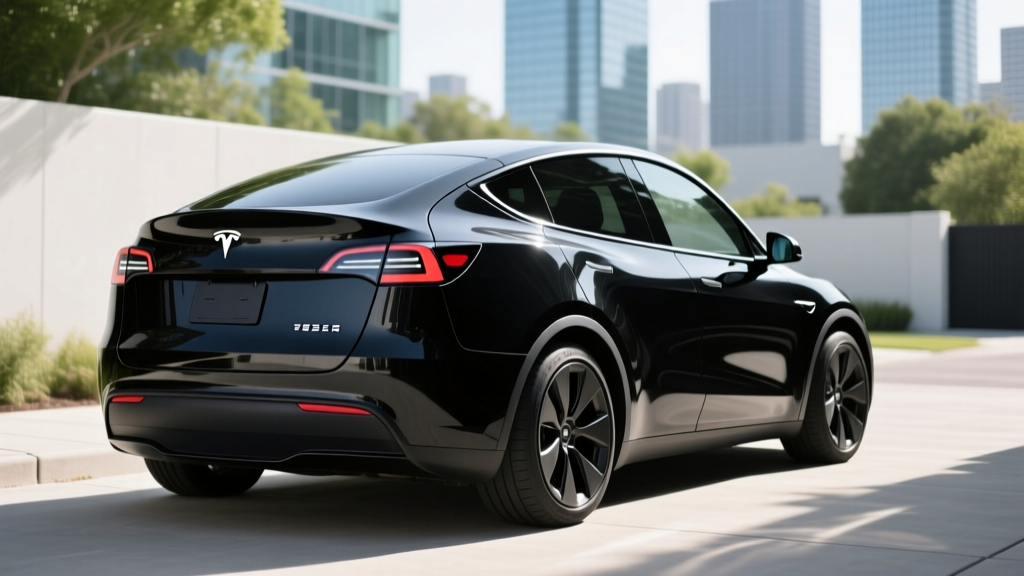
If you've been searching for Tesla SUV images to see what the refreshed 2026 Model Y looks like in the metal, you're not alone. The Juniper-updated Model Y remains Tesla's volume leader and one of the best-selling electric vehicles globally. But photos only tell part of the story. What matters to buyers is how this electric SUV performs in the real world — its actual range on a cold highway morning, how quickly it charges on a road trip, and whether it still qualifies for federal tax incentives in 2026.
This review goes beyond the gallery. We break down every spec that matters, reconcile EPA estimates with real-world driving, and give you a clear buy-or-pass framework against competitors like the Hyundai Ioniq 5, Ford Mustang Mach-E, and Kia EV6.
2026 Tesla Model Y: Quick Verdict
The 2026 Model Y Long Range AWD delivers a compelling package: 320 miles of EPA-estimated range, access to Tesla's 17,000+ Supercharger network, best-in-class cargo space, and OTA updates that keep improving the vehicle post-purchase. The Juniper refresh brought a quieter cabin, ambient lighting, ventilated front seats, and a rear touchscreen — addressing the most common complaints about the pre-2025 model.
The tradeoffs? The minimalist interior still isn't for everyone, insurance costs run higher than segment average, and the base rear-wheel-drive trim lost some range in the refresh. If you need a practical family EV with excellent charging infrastructure, the Model Y remains a top pick. If you prioritize ride comfort or traditional luxury materials, competitors deserve a look.
| Spec | Long Range AWD | Rear-Wheel Drive |
|---|---|---|
| EPA Range | 320 miles | 302 miles |
| Battery Capacity | 78.1 kWh usable (NMC) | 60 kWh usable (LFP) |
| Peak DC Fast Charge | 250 kW | 170 kW |
| 10–80% DC Charge Time | ~25 minutes | ~28 minutes |
| Level 2 Home Charge Rate | 11.5 kW (~44 mi/hr) | 11.5 kW (~44 mi/hr) |
| 0–60 mph | 4.8 seconds | 6.5 seconds |
| Horsepower | 384 hp (dual motor) | 295 hp (single motor) |
| Drivetrain | AWD (dual motor) | RWD (single motor) |
| Efficiency | 111 MPGe / 28 kWh/100mi | 117 MPGe / 27 kWh/100mi |
| Base MSRP | $48,990 | $44,990 |
| Battery Warranty | 8 years / 120,000 miles | 8 years / 100,000 miles |
Source: fueleconomy.gov and Tesla official specifications. Prices reflect 2026 model year before destination fees.
Range and Efficiency: EPA vs. the Real World
Real-World Expectation: ~270–290 miles in mixed driving; ~240–260 miles sustained highway at 75 mph; ~220–250 miles in freezing temperatures with cabin heat.
The 320-mile EPA figure for the Long Range AWD is competitive, but EPA tests use a specific drive cycle that doesn't fully replicate highway cruising or cold-weather demands. In our experience and consistent with independent testing, sustained 75 mph highway driving nets roughly 250–270 miles before you need to find a charger. Cold weather (below 32°F) compounds this: battery chemistry becomes less efficient, and resistive cabin heating draws significant power. Expect 15–25% range loss in winter conditions depending on your climate.
The RWD trim's 60 kWh LFP (lithium iron phosphate) battery sacrifices about 18 miles of EPA range compared to the Long Range, but LFP chemistry offers advantages: it tolerates regular 100% charging without degradation concerns, and it's less dependent on critical minerals — a factor in tax credit eligibility. The NMC (nickel manganese cobalt) pack in the Long Range provides higher energy density but Tesla recommends daily charging to 80–90% for longevity, reserving 100% for road trips.
Efficiency is where Tesla continues to lead. At 28 kWh per 100 miles (Long Range), the Model Y converts battery energy into distance more effectively than most competitors. The Hyundai Ioniq 5 AWD, for comparison, uses about 30 kWh/100mi. Over a year of 12,000 miles, that difference translates to roughly $50–$80 in electricity savings depending on your local rates.
Charging Speed and Infrastructure
Charging is where Tesla's ecosystem advantage becomes tangible. The Model Y uses the NACS (North American Charging Standard) connector natively — the same port now being adopted by Ford, GM, Rivian, and most major automakers through 2025–2026.
| Charging Level | Power | Miles Added per Hour | Use Case |
|---|---|---|---|
| Level 1 (120V household) | ~1.4 kW | ~4–5 miles | Overnight trickle / emergencies |
| Level 2 (240V home) | 11.5 kW | ~44 miles | Daily home charging |
| DC Fast Charge (Long Range) | Up to 250 kW | ~162 miles in 15 min | Road trips, Superchargers |
| DC Fast Charge (RWD/LFP) | Up to 170 kW | ~110 miles in 15 min | Road trips, Superchargers |
A critical detail many spec sheets gloss over: peak charge rate is not sustained charge rate. The Long Range AWD peaks at 250 kW only at a low state of charge (around 10–15%) and on a V3 or V4 Supercharger. The charge curve tapers progressively — by 50% SoC, you're likely seeing 150–170 kW, and above 80%, speeds drop sharply to protect battery health. The 10–80% time of ~25 minutes reflects this tapered curve, not a sustained 250 kW pull.
For home charging, a Level 2 wall connector on a 60-amp circuit delivers 11.5 kW, adding roughly 44 miles per hour of charging. Most owners plug in overnight and wake to a full battery. Installation typically runs $800–$2,000 depending on your panel capacity and run distance — factor this into your purchase budget.
Tesla's Supercharger network remains the most reliable public charging ecosystem in North America. With over 17,000 stalls in the U.S., route planning via the built-in navigation automatically preconditions the battery for optimal charge speed upon arrival — a feature that meaningfully reduces real-world charging time compared to non-preconditioning competitors.
Performance and Driving Dynamics
The Long Range AWD's dual-motor setup produces 384 horsepower and launches the Model Y to 60 mph in 4.8 seconds. That's genuinely quick for a family SUV, and the instant torque delivery makes highway merging and passing effortless. The single-motor RWD trim at 295 hp and 6.5 seconds is adequate for daily driving but noticeably less urgent.
Ride quality improved with the Juniper refresh. Tesla retuned the suspension and added acoustic glass, reducing cabin noise substantially. The Model Y still rides firmer than a Hyundai Ioniq 5 or Kia EV6, and you'll feel sharp pavement imperfections, but it's no longer the jarring experience of pre-2024 models. The low center of gravity (battery pack under the floor) keeps body roll minimal through corners, and the steering is precise if somewhat numb.
Regenerative braking in the Model Y remains aggressive in its default setting, enabling one-pedal driving in most city conditions. Unlike some competitors, Tesla does not offer adjustable regen levels — you adapt to the car's calibration, not the other way around.
Interior, Cargo, and Technology
The Juniper refresh transformed the Model Y's interior from spartan to genuinely pleasant. Ambient lighting strips, ventilated front seats, a power-folding second row, and an 8-inch rear touchscreen for passengers bring it closer to premium competitors. The 15.4-inch front touchscreen handles all vehicle controls, navigation, and entertainment — there are still no physical buttons for climate or volume (a swipe-based interface on the screen handles both).
Cargo space remains a Model Y strong point:
- Behind second row: 30.2 cubic feet
- Second row folded: 72.1 cubic feet
- Front trunk (frunk): 4.1 cubic feet
- Total max cargo: 76.2 cubic feet
That's more usable volume than the Ford Mustang Mach-E (59.7 cu ft max) or Hyundai Ioniq 5 (56.2 cu ft max). The powered liftgate and low load floor make it practical for strollers, groceries, and camping gear alike.
Legroom is generous: 41.8 inches up front and 38.4 inches in the rear, sufficient for adults on longer trips. The panoramic glass roof creates an airy feel, though it does reduce headroom slightly compared to a conventional steel roof.
Driver Assistance: Autopilot and FSD (Supervised)
Tesla Autopilot and Full Self-Driving (Supervised) are driver-assistance systems, not autonomous driving. You must keep your hands on the wheel and eyes on the road at all times. The "Supervised" label in FSD's name is legally meaningful — Tesla acknowledges the driver is the supervisor. True driverless operation (Level 4) is currently limited to geofenced robotaxi services like Waymo.
Standard Autopilot includes traffic-aware cruise control and autosteer (lane centering) on highways. The optional FSD (Supervised) package ($8,000 one-time or $99/month subscription in 2026) adds automatic lane changes, traffic light and stop sign recognition, and navigate-on-autopilot for highway interchanges. FSD has improved substantially, but it still makes errors in construction zones, unmapped areas, and complex intersections. Treat it as a fatigue-reduction tool, not a replacement for your attention.
Pricing, Trims, and Federal Tax Credit Eligibility
| Trim | Base MSRP | Destination | Total Before Credit | Est. §30D Credit | Effective Price |
|---|---|---|---|---|---|
| Rear-Wheel Drive | $44,990 | $1,390 | $46,380 | Up to $7,500* | ~$38,880 |
| Long Range AWD | $48,990 | $1,390 | $50,380 | Up to $7,500* | ~$42,880 |
*Federal tax credit eligibility depends on multiple factors. See checklist below.
- MSRP Cap: SUVs/vans/pickups must be at or below $80,000 MSRP (both Model Y trims qualify)
- Buyer Income Cap: Modified AGI ≤ $300,000 (joint filers), ≤ $225,000 (head of household), ≤ $150,000 (single)
- Battery Sourcing: Critical minerals and battery components must meet phased-in domestic/free-trade-partner thresholds — verify current-year compliance on fueleconomy.gov
- Point-of-Sale Transfer: Eligible buyers can transfer the credit to the dealer at purchase, reducing the purchase price upfront rather than waiting for a tax refund
- Final Assembly: Vehicle must undergo final assembly in North America (Model Y assembled in Fremont, CA and Austin, TX — qualifies)
The battery-sourcing requirements tightened in 2025 and 2026 under the Inflation Reduction Act. Some trims or build periods may qualify for only $3,750 (half credit) if they meet one of two sourcing thresholds but not both. Always verify the specific VIN's eligibility before purchase using the IRS's official tool or by asking your Tesla advisor. Tax rules change — consult a tax professional for your specific situation.
The FSD (Supervised) option adds $8,000 to the purchase price, and 20-inch wheels, premium colors, and tow hitch can push a Long Range build past $58,000 before credits.
Warranty and Long-Term Ownership
Tesla's warranty coverage is competitive within the EV segment:
- Basic Vehicle: 4 years / 50,000 miles
- Battery & Drive Unit (Long Range NMC): 8 years / 120,000 miles, minimum 70% capacity retention
- Battery & Drive Unit (RWD LFP): 8 years / 100,000 miles, minimum 70% capacity retention
The 70% retention threshold is the trigger for a warranty claim — meaning if your battery degrades to 69% of original capacity within the warranty period, Tesla will repair or replace it. Real-world degradation data from Tesla's fleet shows most Model Y packs retain 88–92% capacity at 100,000 miles, with the steepest drop occurring in the first 20,000 miles before leveling off. LFP packs in the RWD trim tend to show slightly less measurable degradation due to the chemistry's inherent stability and tolerance for full-charge cycles.
Insurance costs are a real ownership factor: the Model Y typically runs 15–30% more expensive to insure than comparable gas SUVs, and 5–10% more than some EV competitors, due to repair costs and Tesla's proprietary parts ecosystem. Get quotes before committing.
How It Compares: Model Y vs. Key Competitors
| Spec | Tesla Model Y LR AWD | Hyundai Ioniq 5 AWD | Ford Mustang Mach-E ER AWD |
|---|---|---|---|
| EPA Range | 320 mi | 290 mi | 305 mi |
| Peak DC Charge | 250 kW | 238 kW | 150 kW |
| 10–80% Time | ~25 min | ~18 min | ~36 min |
| 0–60 mph | 4.8 sec | 5.1 sec | 5.1 sec |
| Max Cargo | 76.2 cu ft | 56.2 cu ft | 59.7 cu ft |
| Base MSRP (AWD) | $48,990 | $50,850 | $51,995 |
| Charging Network | Tesla Supercharger (native) | CCS → NACS adapter | CCS → NACS adapter |
Choose the Hyundai Ioniq 5 if: you want the fastest DC charging in the segment, prefer physical controls and a softer ride, and don't mind using a NACS adapter for Supercharger access.
Pros and Cons at a Glance
- Class-leading 320-mile EPA range (Long Range)
- Best-in-class cargo capacity (76.2 cu ft)
- Native Supercharger network — no adapter needed
- Excellent efficiency (28 kWh/100mi)
- Strong OTA update cadence adds features post-purchase
- Juniper refresh significantly improved cabin refinement
- Qualifies for up to $7,500 federal tax credit (eligibility varies)
- DC charging slower than 800V competitors (Ioniq 5, EV6)
- Firm ride on larger wheel options
- No physical buttons — all controls through touchscreen
- Insurance premiums above segment average
- FSD (Supervised) is $8,000 and still requires full driver attention
- Rear visibility limited by sloping roofline and no rear wiper
- Turn signal stalk removed in Juniper — buttons on steering wheel instead
Who Should Buy the 2026 Tesla Model Y?
Best for: Families needing max cargo space, commuters with home charging, road-trippers who value Supercharger reliability, and tech-forward buyers who want continuous feature improvements via OTA updates.
Consider alternatives if: You prioritize the absolute fastest DC charging (look at Ioniq 5/EV6 with 800V), you want a more traditional luxury interior with physical controls (BMW iX, Genesis GV60), or you live in an area without reliable home charging access (the Model Y's advantages shrink significantly without overnight Level 2 charging).
For towing: The Model Y Long Range AWD is rated for 3,500 lbs — adequate for a small utility trailer or a pair of jet skis, but not for larger boat or camper trailers. If towing is a priority, the Rivian R1S or Ford F-150 Lightning serve better.
Frequently Asked Questions
What is the real-world range of the 2026 Tesla Model Y?
The EPA estimates 320 miles for the Long Range AWD and 302 miles for the RWD. In real-world mixed driving, expect 270–290 miles. Sustained highway driving at 75 mph reduces this to roughly 250–270 miles, and freezing temperatures can drop range by 15–25% depending on cabin heating use.
How fast does the Model Y charge at home and on DC fast chargers?
On a Level 2 home charger (240V, 48A), the Model Y charges at 11.5 kW, adding about 44 miles per hour — enough to fully recharge overnight. On DC fast chargers, the Long Range peaks at 250 kW (10–80% in ~25 minutes) and the RWD at 170 kW (10–80% in ~28 minutes). Peak rates are not sustained — charging tapers significantly above 80% SoC.
How much does the Model Y cost after federal tax credits?
The RWD starts at $46,380 with destination, and the Long Range AWD at $50,380. If you qualify for the full $7,500 §30D credit (subject to income caps, MSRP caps, and battery-sourcing requirements), effective prices drop to roughly $38,880 and $42,880 respectively. Verify your specific eligibility on IRS.gov before purchasing.
Is the Model Y worth buying over the Ioniq 5 or Mach-E?
It depends on your priorities. The Model Y wins on range (320 vs. 290/305 mi), cargo space (76.2 vs. 56.2/59.7 cu ft), and native Supercharger access. The Ioniq 5 wins on DC charging speed (18 vs. 25 min, 10–80%) and ride comfort. The Mach-E offers a more traditional driving feel but charges significantly slower. For most families prioritizing practicality and road-trip ease, the Model Y holds a slight edge in 2026.
Does the 2026 Model Y qualify for the $7,500 federal EV tax credit?
Both trims fall under the $80,000 SUV MSRP cap and are assembled in North America. However, the full $7,500 credit depends on your income (≤$300K joint / ≤$150K single), battery critical-mineral and component sourcing compliance, and point-of-sale transfer eligibility. Sourcing rules have tightened through 2026 — check the latest status on fueleconomy.gov or consult a tax professional.
How long will the Model Y battery last?
Tesla warranties the Long Range battery for 8 years/120,000 miles (70% minimum retention) and the RWD LFP battery for 8 years/100,000 miles. Fleet data indicates most packs retain 88–92% capacity at 100,000 miles. Full battery replacement outside warranty currently costs $12,000–$16,000, though prices continue to decline. The LFP pack in the RWD trim may offer longer cycle life due to its chemistry.