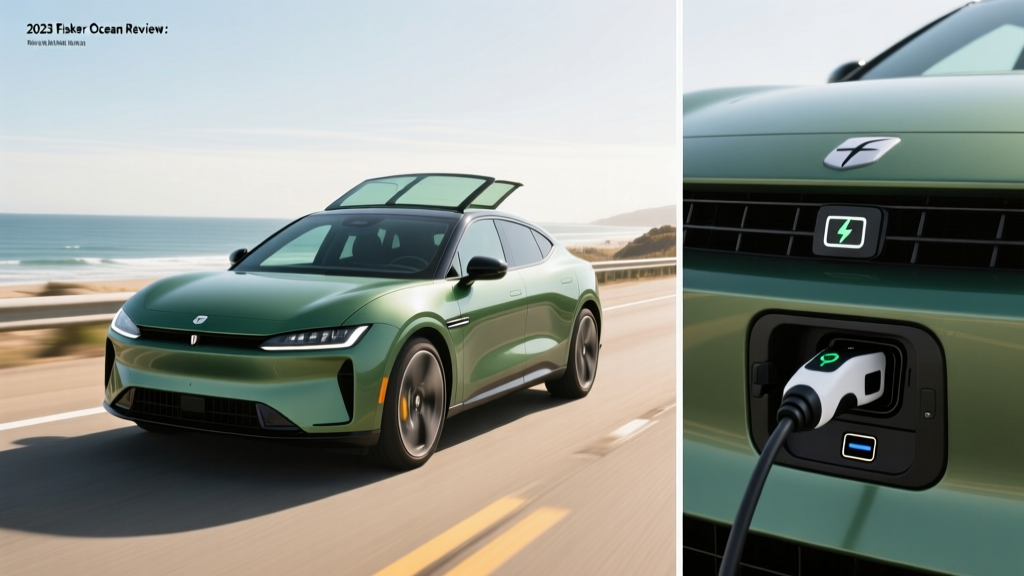
The 2023 Fisker Ocean arrived with bold promises: up to 360 miles of EPA range, solar-roof trickle charging, and a starting price under $39,000. Henrik Fisker's second automotive venture aimed to undercut the Tesla Model Y and Ford Mustang Mach-E on price while beating them on range. But with Fisker Inc. filing for Chapter 11 bankruptcy in mid-2024, the 2023 Fisker Ocean now exists in a complicated space — a compelling spec sheet shadowed by long-term support uncertainty. This review examines what the Ocean actually delivers on the road, at the charger, and on your balance sheet.
Range, Battery, and Efficiency: The Numbers That Matter
The 2023 Fisker Ocean was offered in three trims with two distinct battery packs. The entry-level Sport uses a 113 kWh (gross) lithium iron phosphate (LFP) battery supplied by CATL, while the Ultra and Extreme trims use a 106 kWh (gross) nickel-manganese-cobalt (NMC) pack from CATL's higher-energy-density lineup. Usable capacity sits at approximately 106 kWh (Sport) and 98 kWh (Ultra/Extreme), with the buffer protecting long-term State of Health (SoH).
| Trim | EPA Range | Real-World Highway (~70 mph) | Cold Weather (20°F) |
|---|---|---|---|
| Ocean Sport (FWD) | 250 mi | ~215-230 mi | ~175-195 mi |
| Ocean Ultra (AWD) | 340 mi | ~285-305 mi | ~235-260 mi |
| Ocean Extreme (AWD) | 360 mi | ~300-320 mi | ~250-275 mi |
The Ocean Extreme's 360-mile EPA figure was among the highest of any production SUV at launch. On real-world highway loops at sustained 70-75 mph, expect 15-18% below sticker — typical for a 5,500+ lb SUV with a flat underbody. Cold weather compounds this; the Ocean's heat pump helps, but LFP chemistry in the Sport trim is more susceptible to low-temperature range loss than NMC.
Efficiency ratings from fueleconomy.gov place the Ocean Extreme at approximately 95 MPGe combined (35 kWh/100 mi), while the Sport FWD achieves roughly 101 MPGe combined (33 kWh/100 mi). These figures trail the Tesla Model Y Long Range (~122 MPGe) due to the Ocean's heavier curb weight and less optimized drivetrain efficiency.
Charging Speed: DC Fast and Home Level 2
The Ocean's charging architecture uses a 400V platform — not the 800V systems found in the Hyundai Ioniq 5 or Porsche Taycan. This limits peak charge rates but remains adequate for most road-trip scenarios when paired with the large battery.
| Charging Level | Spec | Sport (LFP) | Ultra / Extreme (NMC) |
|---|---|---|---|
| DC Fast Charge (Peak) | Max kW | ~175 kW | ~250 kW |
| DC 10-80% | Time | ~38 min | ~30 min |
| DC Sustained (20-60%) | Avg kW | ~140 kW | ~190 kW |
| Level 2 (240V / 48A) | Rate | 11.5 kW (~33 mi/hr) | 11.5 kW (~33 mi/hr) |
| Level 1 (120V / 12A) | Rate | ~1.4 kW (~4 mi/hr) | ~1.4 kW (~4 mi/hr) |
| Connector | Standard | CCS1 (J1772 combo) | CCS1 (J1772 combo) |
The Extreme trim's 250 kW peak is impressive on paper, but real-world charge-curve behavior tells a more nuanced story. Peak rate holds only between roughly 15-35% State of Charge (SoC), tapering to ~150 kW by 50% and dropping below 80 kW past 70%. If you arrive at a 350 kW charger at 10% SoC, your 10-80% session will take closer to 33-35 minutes, not the 30-minute claim. This is typical 400V behavior — independent testing confirms the taper.
Home Level 2 charging at 11.5 kW (48 amps on a 60-amp circuit) replenishes the Extreme's 98 kWh usable pack from empty in about 9 hours — overnight-friendly. The Sport's larger 106 kWh usable pack takes roughly 10 hours. Plan on a $500-$1,500 home Level 2 installation (equipment plus electrician) if you don't already have a 240V/60A circuit.
Performance and Drivetrain
The Ocean Sport sends 275 horsepower to the front wheels via a single motor, reaching 0-60 mph in approximately 6.9 seconds. The Ultra and Extreme trims add a rear motor for dual-motor AWD, producing 540 hp (Ultra) and 550 hp (Extreme). The Extreme's 0-60 time of 3.7 seconds puts it in sports-sedan territory despite its 5,540-lb curb weight.
Drive dynamics are competent but not class-leading. The steering is precise, body roll is well-controlled for an SUV, and the one-pedal driving mode offers aggressive regen that can bring the Ocean to a near-stop without touching the brake pedal. However, ride quality on 22-inch wheels (Extreme) is firm — the 20-inch setup on the Ultra strikes a better comfort-to-handling balance for daily driving. Towing capacity is rated at 4,000 lbs for AWD trims, adequate for a small trailer but not competitive with the Ford F-150 Lightning or Rivian R1S.
Interior, Cargo, and Standout Tech
The Ocean's interior leans heavily into sustainability branding: recycled materials, vegan leather, and what Fisker called a "California Mode" that lowers all windows simultaneously for open-air driving. The 17.1-inch rotating center touchscreen (Extreme/Ultra) dominates the dashboard and can flip between landscape and portrait orientation — a gimmick that works surprisingly well for navigation.
| Measurement | Specification |
|---|---|
| Cargo Volume (behind 2nd row) | 32.5 cu ft |
| Cargo Volume (2nd row folded) | 67.0 cu ft |
| Front Legroom | 41.7 in |
| Rear Legroom | 38.2 in |
| Front Headroom | 40.5 in |
| Rear Headroom | 38.8 in |
| Frunk (front trunk) | Not available |
Cargo space trails the Model Y (76 cu ft max) and falls short of the Hyundai Ioniq 5's versatility. The absence of a frunk is a missed opportunity for stowing charging cables. Rear-seat legroom is adequate for adults but not generous — taller passengers may find the floor-mounted battery raises the seating position higher than expected.
The Ocean's solar roof (standard on Extreme, optional on Ultra) generates up to 1,500 miles of supplemental range per year under ideal conditions — roughly 4 miles per day of peak sun. It's a neat party trick but won't meaningfully offset your charging costs. The Fisker Intelligent Pilot ADAS suite includes adaptive cruise control, lane-keeping assist, and automatic emergency braking — a Level 2 driver-assist system that requires constant driver supervision. It performs adequately but lacks the polish of GM's Super Cruise or Ford's BlueCruise on divided highways.
Pricing, Tax Credits, and Total Cost
At launch, the 2023 Fisker Ocean's MSRP structure was:
| Trim | Drivetrain | Base MSRP | §30D Federal Credit | Effective Price* |
|---|---|---|---|---|
| Sport | FWD | $38,999 | Up to $7,500 | ~$31,499 |
| Ultra | AWD | $52,999 | Up to $7,500 | ~$45,499 |
| Extreme | AWD | $68,999 | Up to $7,500 | ~$61,499 |
*Effective price assumes full §30D credit eligibility. As of 2026, the Fisker Ocean's eligibility depends on remaining new-old-stock availability and IRS battery-sourcing compliance. Consult IRS §30D guidelines before purchase.
The §30D federal tax credit has strict eligibility rules: buyer adjusted gross income cannot exceed $150,000 (single) or $300,000 (joint), the vehicle MSRP must be under $80,000 for SUVs (all Ocean trims qualify), and the battery must meet critical-mineral and component-sourcing thresholds that tighten annually. Because Fisker sourced CATL batteries from China, some model-year configurations may not meet the 2024+ sourcing requirements — verify current eligibility on the IRS clean vehicle credit page before committing. The credit can be transferred to the dealer at point of sale for an immediate price reduction.
For 2026 buyers, the Ocean's situation is unique: Fisker Inc.'s bankruptcy means remaining inventory is sold through liquidation channels, often at steep discounts (30-50% below original MSRP has been reported). However, this comes with significant caveats regarding warranty support, parts availability, and software updates.
Warranty Coverage and Ownership Risk
Fisker originally backed the Ocean with a competitive warranty package:
- Basic Vehicle: 6 years / 60,000 miles
- Battery & Powertrain: 10 years / 100,000 miles (capacity retention guaranteed to 70% minimum)
- Corrosion: 12 years / unlimited miles
The 10-year battery warranty is strong on paper, matching or exceeding most competitors. However, Fisker's Chapter 11 bankruptcy filing in June 2024 raises serious questions about long-term warranty fulfillment, replacement parts supply, and dealership service infrastructure. As of 2026, third-party service networks have attempted to fill gaps, but Ocean owners report difficulty sourcing body panels, replacement screens, and proprietary components. This is the single largest risk factor for any prospective buyer.
2023 Fisker Ocean: Pros and Cons
- Class-leading EPA range on Extreme trim (360 mi)
- Large battery packs (98-106 kWh usable) reduce charging frequency
- Sustainable interior materials and distinctive design
- Competitive 0-60 times on dual-motor trims (3.7 sec Extreme)
- Steep liquidation discounts on remaining inventory
- Solar roof provides marginal supplemental range
- Fisker bankruptcy creates warranty and parts-support risk
- 400V architecture limits DC fast-charge speed vs 800V rivals
- No frunk; cargo volume trails Model Y and Ioniq 5
- Heavy curb weight (5,500+ lbs) hurts efficiency (95-101 MPGe)
- Software bugs reported by early owners; update pipeline uncertain
- Resale value highly uncertain given brand dissolution
Who Should Buy the 2023 Fisker Ocean?
Choose the Ocean Extreme/Ultra if: you find deeply discounted remaining inventory (40%+ off MSRP), you prioritize maximum range over charging speed, you have reliable home Level 2 charging, and you're comfortable assuming warranty-support risk for a distinctive, sustainable-branded SUV.
Choose a competitor instead if: you need guaranteed long-term service support, you road-trip frequently and want the fastest DC charging (look at Hyundai Ioniq 5 or Kia EV6 with 800V), you need maximum cargo space (Model Y), or you want proven ADAS capability (GM Super Cruise models).
The Ocean is best suited for range-prioritized commuters who charge at home, value design differentiation, and can absorb the ownership uncertainty that comes with a defunct manufacturer. It is not the right choice for buyers who need bulletproof reliability assurances or who depend on frequent long-distance DC fast charging.
Frequently Asked Questions
What is the real-world range of the 2023 Fisker Ocean?
The EPA rates the Ocean Extreme at 360 miles, the Ultra at 340 miles, and the Sport at 250 miles. In real-world highway driving at 70-75 mph, expect 15-18% less than the sticker figure — roughly 300-320 miles for the Extreme, 285-305 for the Ultra, and 215-230 for the Sport. Cold weather (below 30°F) can reduce range an additional 15-25%, particularly on the LFP-equipped Sport trim.
How fast does the Fisker Ocean charge?
The Extreme and Ultra trims peak at approximately 250 kW on a DC fast charger, achieving a 10-80% charge in roughly 30-35 minutes. The Sport peaks at ~175 kW, taking about 38 minutes for 10-80%. Home Level 2 charging at 11.5 kW adds about 33 miles per hour, fully recharging the battery overnight in 9-10 hours.
Does the 2023 Fisker Ocean qualify for the federal EV tax credit?
It can, but eligibility depends on current IRS §30D rules. The Ocean's MSRP is under the $80,000 SUV cap, and qualifying buyers must meet income thresholds ($150K single / $300K joint AGI). However, the battery-sourcing requirements for critical minerals and components may disqualify some configurations due to CATL's Chinese supply chain. Always verify on the IRS clean vehicle credit page before purchasing.
Is the Fisker Ocean worth buying vs. a Tesla Model Y or Hyundai Ioniq 5?
On spec alone, the Ocean Extreme competes well — more range than either rival, distinctive styling, and a strong sustainability story. However, Fisker's bankruptcy makes the Model Y and Ioniq 5 far safer long-term bets for service support, software updates, parts availability, and resale value. Buy the Ocean only if the discount is steep enough to offset these risks.
What happens to my Fisker Ocean warranty now that Fisker filed for bankruptcy?
Fisker's original 10-year/100,000-mile battery warranty may be difficult to enforce post-bankruptcy. Some third-party service providers have stepped in, but proprietary parts (screens, solar roof panels, body panels) are already challenging to source. Factor this risk into any purchase decision and consider an extended third-party warranty if available.