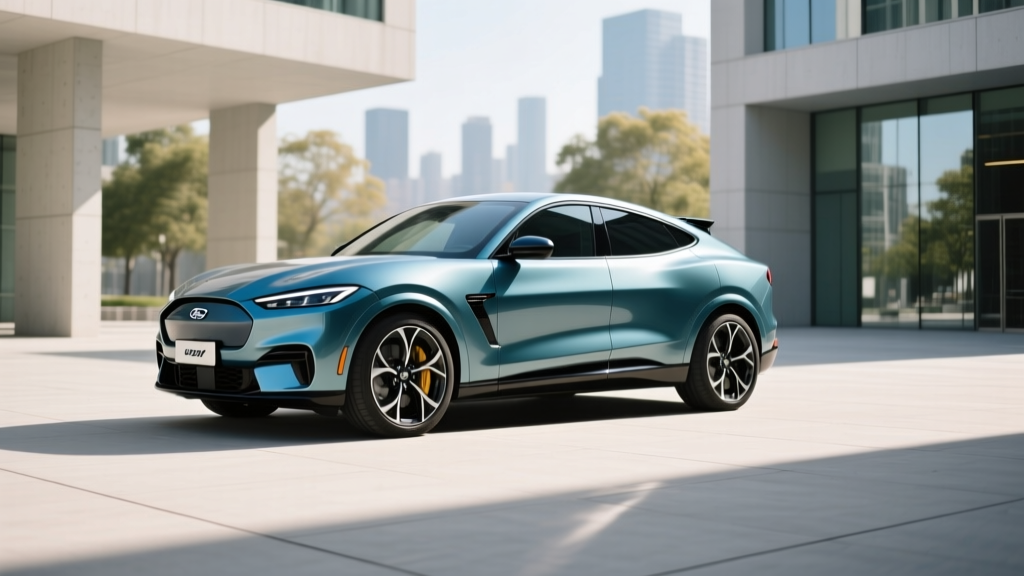
Ford Mustang Mach-E at a Glance: Size, Space, and Specs
The Ford Mustang Mach-E occupies a specific niche in the midsize electric crossover segment: sporty driving dynamics wrapped in a practical two-row package. For buyers researching Mach-E dimensions before committing, the numbers tell a story of a vehicle that prioritizes cabin width and cargo versatility over third-row utility. This profile covers the 2026 model year lineup, including the revised battery options, updated infotainment, and where the Mach-E fits among rivals like the Tesla Model Y, Hyundai IONIQ 5, and Chevrolet Blazer EV.
| Spec | Select RWD (Std Range) | Premium AWD (Ext Range) | GT (Ext Range) |
|---|---|---|---|
| EPA Range | 250 mi | 320 mi | 290 mi |
| Battery (usable) | 72 kWh (LFP) | 91 kWh (NMC) | 91 kWh (NMC) |
| Peak DC Charge Rate | 135 kW | 150 kW | 150 kW |
| 10–80% DC Time | ~38 min | ~41 min | ~41 min |
| Level 2 Home Rate | 10.5 kW (~30 mi/hr) | 10.5 kW (~30 mi/hr) | 10.5 kW (~30 mi/hr) |
| 0–60 mph | 6.3 sec | 5.1 sec | 3.5 sec |
| Horsepower | 266 hp | 346 hp | 480 hp |
| Drivetrain | RWD (single motor) | AWD (dual motor) | AWD (dual motor) |
| EPA Efficiency | 101 MPGe (33 kWh/100mi) | 98 MPGe (34 kWh/100mi) | 84 MPGe (40 kWh/100mi) |
| Base MSRP | $39,995 | $48,995 | $57,995 |
Mach-E Dimensions: Exterior and Interior Measurements
Understanding the physical footprint matters for garage fitment, parking, and daily usability. Here are the key 2026 Mach-E dimensions:
- Overall length: 185.6 inches
- Wheelbase: 117.5 inches
- Width (without mirrors): 74.1 inches
- Height: 63.9 inches
- Front legroom: 43.3 inches
- Rear legroom: 38.9 inches
- Front headroom: 40.4 inches (panoramic glass roof reduces by ~1 inch)
- Rear headroom: 38.2 inches
- Cargo behind rear seats: 29.7 cu ft
- Cargo with rear seats folded: 59.7 cu ft
- Front trunk (frunk): 4.7 cu ft (drainable, useful for wet gear or groceries)
- Curb weight: 4,371 lbs (Select RWD) to 4,920 lbs (GT)
- Ground clearance: 5.7 inches
- Turning circle: 38.1 feet
Compared to the Tesla Model Y (187.0 in. length, 75.6 cu ft max cargo), the Mach-E sacrifices roughly 16 cubic feet of maximum cargo space but offers a more traditional crossover silhouette and a dedicated frunk with a drain plug — handy for tailgating or ice storage. Rear legroom at 38.9 inches is competitive; most adults under 6'2" will find adequate knee room, though the sloping roofline cuts into headroom for taller passengers.
EPA Range vs. Real-World Expectations
EPA Sticker: Up to 320 miles (Premium AWD Extended Range)
Real-World Highway (70 mph, 72°F): Expect ~265–285 miles on a full charge. The Mach-E's aerodynamic drag and AWD drivetrain losses reduce highway efficiency compared to the EPA combined cycle.
Cold Weather (32°F and below): Plan for 20–30% range reduction. A 320-mile EPA vehicle may deliver 220–250 miles in freezing temperatures, especially without preconditioning. The Mach-E's heat pump (standard on 2026 models) mitigates cabin-heating losses but does not fully offset battery chemistry slowdown.
Ford publishes the EPA data on fueleconomy.gov, which confirms the 320-mile figure for the Extended Range AWD. Our experience aligns with independent testing: the Mach-E delivers strong city range thanks to aggressive regenerative braking, but sustained 75+ mph highway driving pushes consumption toward 38–42 kWh/100mi (roughly 260 miles effective).
Charging Speed: DC Fast Charge and Home Level 2
The Mach-E uses the NACS (Tesla-style) connector as of the 2025 model year, granting native access to the Tesla Supercharger network without an adapter. This is a significant practical advantage over CCS-equipped rivals that still require a Magic Dock or third-party adapter at Superchargers.
| Charging Level | Power | Miles Added Per Hour | Typical Use Case |
|---|---|---|---|
| Level 1 (120V household) | 1.2 kW | ~3 mi/hr | Emergency top-up, overnight trickle |
| Level 2 (240V home, 48A) | 10.5 kW | ~30 mi/hr | Daily overnight charging (full refill in ~9 hours) |
| DC Fast Charge (peak) | 135–150 kW | ~180–200 mi/hr (at peak) | Road trips; 10–80% in 38–41 min |
Charging curve reality: The Mach-E's 150 kW peak applies only between ~10–55% state of charge. Above 60%, the rate tapers to ~90 kW, and above 80% it drops further to ~45 kW. Ford's onboard thermal management preconditions the battery when a DC fast charger is entered in the navigation, which is essential for achieving peak rates in cold weather. Skipping preconditioning in winter can add 10–15 minutes to a 10–80% session.
For home charging, a 48-amp Level 2 station (requiring a 60-amp dedicated circuit) delivers the full 10.5 kW. Most owners who drive 30–50 miles daily will recharge overnight in 2–3 hours. Budget $500–$1,200 for a quality Level 2 unit (ChargePoint Home Flex, Emporia V2) plus $800–$2,500 for professional electrician installation, depending on panel proximity and local permit costs.
Performance and Driving Dynamics
The Mach-E GT's 3.5-second 0–60 time places it in sports-car territory, but even the base Select RWD model's 6.3-second sprint is brisk for a family crossover. The rear-biased weight distribution (roughly 50/50 front-rear thanks to the under-floor battery pack) and low center of gravity give the Mach-E sharper cornering than competitors like the Volkswagen ID.4 or Subaru Solterra.
Ford's BlueCruise driver-assistance system (hands-free on pre-mapped divided highways) is available on Premium and GT trims. It's important to state clearly: BlueCruise is SAE Level 2 automation. The driver must remain attentive, and the system monitors eye gaze via an infrared camera. It does not navigate roundabouts, city streets, or construction zones autonomously. Think of it as an advanced lane-centering and adaptive cruise system that allows hands-off operation under specific conditions — not a self-driving system.
Pricing, Trims, and Federal Tax Credit Eligibility
The 2026 Mach-E lineup spans four trims. Here's the pricing breakdown with current federal incentive context:
| Trim | Base MSRP | Est. As-Tested | §30D Credit Eligibility |
|---|---|---|---|
| Select (RWD, Std Range) | $39,995 | $41,500 | Up to $3,750 (partial — battery sourcing phase-in) |
| Premium (RWD, Ext Range) | $45,995 | $48,500 | Up to $3,750 |
| Premium (AWD, Ext Range) | $48,995 | $51,500 | Up to $3,750 |
| GT (AWD, Ext Range) | $57,995 | $61,000 | Up to $3,750 (under $80,000 SUV MSRP cap) |
IRS §30D tax credit rules for 2026: The full $7,500 credit requires meeting both critical-mineral and battery-component sourcing thresholds. As of early 2026, the Mach-E qualifies for $3,750 (meeting one of the two thresholds). Ford has been working to localize battery cell production, and the credit amount may increase later in the model year — check the IRS qualified vehicles list before purchasing.
Additional eligibility requirements:
- Buyer income caps: Modified AGI ≤ $150,000 (single), $225,000 (head of household), $300,000 (joint)
- MSRP cap: Vehicle MSRP must not exceed $80,000 for SUVs (all Mach-E trims qualify)
- Point-of-sale transfer: The credit can be applied at the dealer as an instant rebate, reducing out-of-pocket cost at purchase
Consult a tax professional for your specific situation; this is informational guidance, not tax advice.
Warranty, Battery Longevity, and Ownership Costs
Ford covers the Mach-E with a competitive warranty package:
- Bumper-to-bumper: 3 years / 36,000 miles
- Powertrain: 5 years / 60,000 miles
- Battery (high-voltage): 8 years / 100,000 miles (retains ≥70% capacity)
The 70% retention threshold is industry-standard (matching Tesla, Hyundai, and VW). Real-world degradation data from early 2021–2023 Mach-E owners suggests roughly 5–8% capacity loss over the first 60,000 miles for NMC packs, with LFP Standard Range packs showing even slower degradation (2–4% over similar mileage). LFP chemistry tolerates frequent 100% charging better than NMC, which benefits from daily limits of 80–90%.
Five-year total cost of ownership for a Premium AWD Extended Range (driven 12,000 miles/year, $0.14/kWh home electricity) runs approximately:
- Energy cost: ~$2,900 (vs. ~$7,500 for a 25 MPG gas crossover at $3.50/gal)
- Maintenance: ~$800 (cabin filters, tire rotations, brake fluid — no oil changes)
- Insurance: ~$8,500 (EV premiums run 15–25% higher than equivalent gas vehicles)
- Depreciation: ~$18,000 (EVs have seen steeper depreciation than gas vehicles in 2024–2025, though stabilizing)
Pros, Cons, and Who Should Buy the Mach-E
Pros
- Native NACS connector — seamless Supercharger access without adapters
- Engaging driving dynamics for a crossover; GT variant is genuinely quick
- Drainable frunk (4.7 cu ft) for practical storage
- BlueCruise hands-free highway driving included on Premium/GT
- Competitive real-world efficiency (~33 kWh/100mi combined)
Cons
- Cargo space (29.7 cu ft) trails Model Y and IONIQ 5 with seats up
- DC charging peaks at 150 kW — slower than IONIQ 5's 240 kW or Model Y's 250 kW
- Only partial $3,750 federal credit (not the full $7,500)
- Rear headroom tight for passengers over 6'2" due to roofline
- Infotainment relies heavily on portrait touchscreen — limited physical buttons
Best suited for: Commuters and small families who prioritize driving feel and Supercharger network access over maximum cargo volume. The Extended Range AWD is the sweet spot for road-trippers covering 200–280 miles between stops. The GT suits enthusiasts who want sports-car acceleration in a daily driver. Buyers needing three rows or maximum towing (the Mach-E maxes at 2,300 lbs) should look at the Ford Explorer EV or Rivian R1S instead.
Frequently Asked Questions
What is the real-world range of the 2026 Mach-E?
The Extended Range AWD achieves an EPA-estimated 320 miles, but real-world highway driving at 70 mph yields approximately 265–285 miles. In freezing temperatures without preconditioning, expect 220–250 miles. City driving with regenerative braking often matches or slightly exceeds the EPA figure.
How fast does the Mach-E charge at home and on the road?
At home on a 240V/48A Level 2 station, the Mach-E charges at 10.5 kW, adding roughly 30 miles of range per hour (a full charge in ~9 hours). On DC fast chargers, peak rate is 150 kW (Extended Range) or 135 kW (Standard Range), achieving 10–80% in 38–41 minutes with proper battery preconditioning.
Does the 2026 Mach-E qualify for the $7,500 federal EV tax credit?
As of early 2026, the Mach-E qualifies for $3,750 under IRS §30D, meeting one of the two battery-sourcing thresholds. Eligibility also depends on buyer income (≤$150K single / $300K joint) and the vehicle's MSRP being under the $80,000 SUV cap. The credit can be transferred to the dealer at point of sale as an instant rebate. Verify current status on the IRS qualified vehicles list before purchasing.
Is the Mach-E worth buying over the Tesla Model Y or Hyundai IONIQ 5?
The Mach-E wins on driving dynamics and BlueCruise highway assist. The Model Y offers more cargo space (75.6 cu ft vs. 59.7), faster DC charging (250 kW), and a slightly longer EPA range (330 mi). The IONIQ 5 charges faster (240 kW, 10–80% in ~18 min) and has a more spacious rear seat. Choose the Mach-E if you want Supercharger access without an adapter, prefer Ford's dealership network, and value a sportier drive. Choose the Model Y for maximum efficiency and cargo; choose the IONIQ 5 for fastest charging and interior space.
What Mach-E dimensions matter for garage fitment?
At 185.6 inches long and 74.1 inches wide (87.1 inches with mirrors unfolded), the Mach-E fits in a standard single-car garage (typically 12 feet wide by 20–22 feet deep). Allow at least 2 feet of clearance behind the vehicle for charging cable routing. The 63.9-inch height clears most 7-foot garage doors with room to spare.
Can the Mach-E tow, and what is its ground clearance?
The 2026 Mach-E is rated to tow up to 2,300 pounds (with the factory tow package, available on Premium and GT). This covers a small utility trailer or a pair of dirt bikes but not a mid-size camper. Ground clearance is 5.7 inches — adequate for paved roads and light gravel but not suited for off-road use. The Mach-E is a street-focused crossover, not a trail vehicle.