The Minivan Showdown: Retro EV vs. Established PHEV
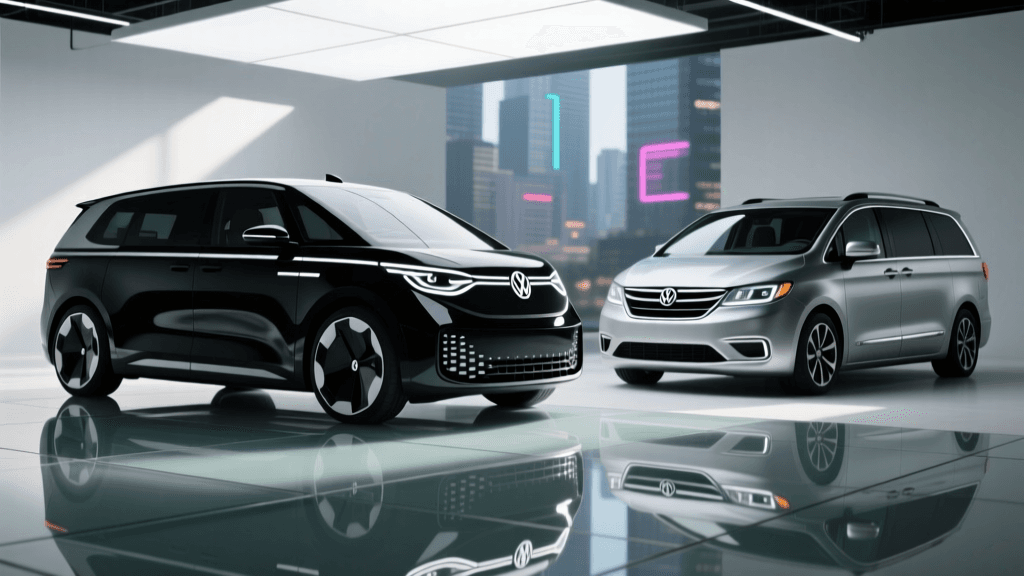
The family hauler landscape is undergoing a massive revolution. For decades, the internal combustion minivan reigned supreme, offering unmatched practicality for school runs, grocery hauls, and cross-country road trips. Today, two distinct philosophies are battling for the modern family's driveway: the all-electric, retro-futuristic Volkswagen ID.Buzz and the plug-in hybrid (PHEV) Chrysler Pacifica Hybrid. As buyers cross-shop these two radically different vehicles, a fog of misinformation, outdated EV stereotypes, and PHEV misconceptions has clouded the decision-making process.
At AutoEdgeView, we believe in data over dogma. In this comprehensive head-to-head comparison, we are busting the most pervasive myths surrounding the VW ID.Buzz and the Chrysler Pacifica Hybrid. We will also highlight the most common, expensive mistakes buyers make when choosing between a fully electric vehicle (BEV) and a plug-in hybrid. Let's separate fact from fiction and find out which minivan truly deserves a spot in your garage.
Myth 1: The ID.Buzz's Range Makes Family Road Trips Impossible
The Myth: With an EPA-estimated range hovering around 231 miles for the Long Wheelbase (LWB) model, critics argue that the all-electric ID.Buzz is nothing more than a glorified city runabout. The assumption is that any family road trip will be ruined by endless, hours-long charging stops, making the Pacifica Hybrid's combined 430+ mile total range the only logical choice for travel.
The Reality: This myth relies on a fundamental misunderstanding of modern EV travel and daily driving statistics. According to the U.S. Environmental Protection Agency, the vast majority of daily household driving falls well under 40 miles. For 90% of your weekly routine, the ID.Buzz will operate exclusively on cheap, home-charged electricity, never requiring a visit to a public charger or a gas station. The Pacifica Hybrid, while offering 32 miles of pure electric range, will inevitably burn gasoline during longer commutes or road trips.
When it comes to actual road trips, the ID.Buzz's DC fast-charging architecture completely dismantles the 'endless waiting' myth. The ID.Buzz supports peak charging speeds of up to 175 kW. Under optimal conditions, this allows the battery to charge from 10% to 80% in approximately 26 minutes. If you strategically plan your road trips around reliable 150kW+ charging corridors (using apps like PlugShare or A Better Routeplanner), a 25-minute stop every two to two-and-a-half hours aligns perfectly with natural family rest stops for bathroom breaks, snacks, and stretching. The Pacifica Hybrid requires gas station stops that, while faster to refuel, cost significantly more per mile and expose you to volatile gasoline prices.
Myth 2: The Pacifica Hybrid is Always Cheaper to Own Long-Term
The Myth: Because the Chrysler Pacifica Hybrid generally carries a lower starting MSRP than the fully loaded VW ID.Buzz, and because it eliminates 'range anxiety' by relying on a gas engine as a backup, buyers assume it is the safer, more economical long-term financial decision.
The Reality: Sticker price is only one fraction of the Total Cost of Ownership (TCO). The most glaring omission in this myth is the reality of powertrain maintenance. A PHEV is essentially two vehicles crammed into one chassis: it has a complex internal combustion engine, an exhaust system, a multi-speed transmission, spark plugs, and oil filters, alongside a high-voltage battery and electric motors. Over a 5-to-10-year ownership period, the maintenance costs compound heavily. Conversely, the ID.Buzz relies on a single electric motor and a battery pack, eliminating the need for oil changes, transmission fluid flushes, and exhaust repairs. According to the U.S. Department of Energy's Alternative Fuels Data Center, the estimated scheduled maintenance cost for a light-duty electric vehicle is roughly 6.1 cents per mile, compared to over 10 cents per mile for a conventional or hybrid internal combustion vehicle.
Furthermore, 'fuel' costs heavily favor the ID.Buzz. Charging an EV at home at the national average electricity rate of roughly $0.16 per kWh equates to an equivalent fuel cost of about $1.20 to $1.50 per gallon. Even with the Pacifica's impressive MPGe when running on battery, once that 32-mile buffer is depleted, you are paying $3.50+ per gallon for premium fuel to move a heavy, 5,000-pound minivan. Over five years of family driving, the ID.Buzz's operational savings frequently eclipse its higher initial purchase price.
Myth 3: The ID.Buzz Lacks Real Minivan Cargo Utility
The Myth: The Chrysler Pacifica's legendary 'Stow 'n Go' seating system is the gold standard of minivan utility, allowing seats to fold completely into the floor. Skeptics claim the ID.Buzz, burdened by a massive battery pack underneath the floor, cannot possibly offer competitive cargo volume or the flexibility required for a growing family.
The Reality: While it is true that the ID.Buzz cannot fold its seats into the floor due to the battery placement, the Long Wheelbase (LWB) U.S. version of the ID.Buzz was specifically engineered to compete with full-size American minivans. According to Car and Driver's comprehensive reviews, the LWB ID.Buzz offers up to 163.7 cubic feet of cargo space behind the front seats. This actually edges out the Pacifica's maximum cargo volume of 140.5 cubic feet behind the first row. The ID.Buzz achieves this through a clever, flat-floor design and a highly adjustable second and third row that can slide, fold, and tumble to accommodate everything from hockey gear to flat-pack furniture. While the Pacifica wins on the sheer speed of hiding seats into the floor, the ID.Buzz wins on maximum volumetric capacity and the low, flat load floor that makes sliding heavy items into the rear incredibly easy.
Common Buyer Mistakes to Avoid
Mistake 1: Buying a PHEV Without a Home Charging Strategy
One of the most expensive and environmentally damaging mistakes a buyer can make is purchasing the Chrysler Pacifica Hybrid without installing a Level 2 home charger. The Pacifica's onboard charger is limited to 7.2 kW. If you rely on a standard 120V wall outlet (Level 1), it will take upwards of 14 hours to fully charge the 16 kWh battery. Many buyers who lack home charging simply give up, stop plugging the van in, and end up driving a heavy, less-efficient gasoline minivan. If you cannot charge at home or at work daily, a PHEV is a wasted investment; you are paying a premium for a battery you never utilize.
Mistake 2: Ignoring the ID.Buzz's Charging Curve on Road Trips
EV novices often make the mistake of plugging the ID.Buzz into a DC fast charger and waiting for it to reach 100%. Lithium-ion batteries experience a significant slowdown in charging speed after 80% to protect battery health. The ID.Buzz's 175 kW peak speed only applies between roughly 10% and 30% state of charge. To optimize road trip efficiency, plan your stops to arrive with a low battery and unplug at 80%. Sitting at a charger waiting for that final 20% will take longer than the initial 10-to-80% sprint, ruining your travel schedule.
Head-to-Head Specification Table
| Feature | VW ID.Buzz (LWB) | Chrysler Pacifica Hybrid |
|---|---|---|
| Powertrain | All-Electric (BEV) | Plug-in Hybrid (PHEV) |
| EPA Range (EV Only) | ~231 Miles | 32 Miles (430+ Total w/ Gas) |
| Max Cargo Volume | 163.7 cu. ft. | 140.5 cu. ft. |
| Peak DC Charge Speed | 175 kW | N/A (7.2 kW AC Level 2 Max) |
| Home Charge Time (Level 2) | ~8.5 Hours (11 kW) | ~2 Hours (7.2 kW) |
| Maintenance Complexity | Low (No engine/oil) | High (Engine + Electric Motors) |
The Verdict: Which Minivan Fits Your Family?
Busting these myths reveals a clear dichotomy between these two exceptional family haulers. The Volkswagen ID.Buzz is the ultimate choice for the forward-thinking family that has access to home charging and wants to drastically reduce their long-term operating and maintenance costs. It offers superior maximum cargo space, a whisper-quiet ride, and the undeniable joy of zero-emission driving. As long as you are willing to spend 15 minutes planning your road-trip charging stops, the ID.Buzz's range is a non-issue.
Conversely, the Chrysler Pacifica Hybrid remains the undisputed champion for families who frequently travel to remote areas lacking DC fast-charging infrastructure, or those who simply cannot install a Level 2 charger at home but still want a taste of electric commuting. Its Stow 'n Go seating offers unmatched quick-change flexibility for weekend warriors. However, buyers must recognize that they are signing up for the long-term maintenance costs of a gas engine. Choose the ID.Buzz for the future of efficient, low-maintenance family travel; choose the Pacifica Hybrid if uncompromising, off-the-grid range flexibility is your absolute top priority.