The Shift to Electric Fleet Vehicles
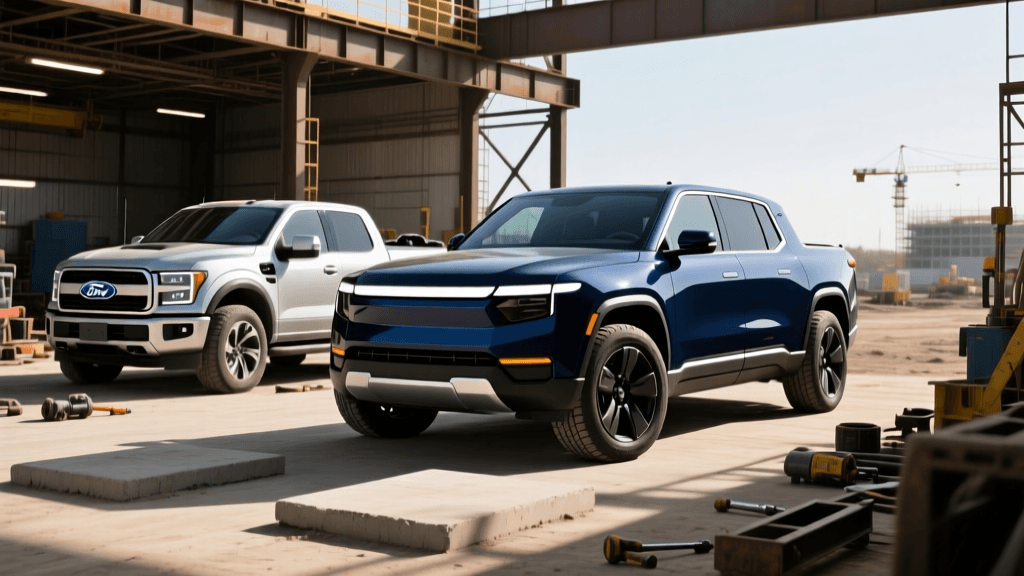
The transition from internal combustion to electric vehicles in the commercial and fleet sectors is no longer a theoretical exercise; it is a data-driven reality. For contractors, fleet managers, and tradespeople, an electric pickup truck must be evaluated not on its lifestyle appeal, but on its raw utility, uptime, and total cost of ownership. In the current North American market, two distinct philosophies dominate the electric truck space: the legacy evolution represented by the Ford F-150 Lightning, and the ground-up skateboard architecture of the Rivian R1T. While both vehicles offer impressive performance metrics, their capabilities diverge significantly when subjected to the rigorous demands of a commercial job site. This analysis strips away the marketing gloss to compare the hard data governing towing, payload, cargo management, on-site power generation, and range degradation under load.
Towing and Payload: The Raw Specifications
When evaluating work trucks, the fundamental metrics of payload and towing capacity dictate which vehicle can legally and safely handle specific commercial loads. The Ford F-150 Lightning leverages decades of F-Series engineering, optimizing its frame and suspension for traditional work duties. Conversely, the Rivian R1T utilizes a rigid, battery-integrated skateboard platform that prioritizes structural rigidity and off-road articulation, which inherently impacts its maximum payload rating due to a higher curb weight.
| Metric | Ford F-150 Lightning (Ext. Range) | Rivian R1T (Dual-Motor Max) |
|---|---|---|
| Max Towing Capacity | 10,000 lbs | 11,000 lbs |
| Max Payload Capacity | 2,235 lbs | 1,760 lbs |
| Curb Weight (Approx.) | 6,765 lbs | 7,150 lbs |
| Hitch Technology | Pro Trailer Hitch Assist | Standard Receiver (No integrated auto-hitch) |
According to specifications detailed by Car and Driver's F-150 Lightning hub, Ford's Pro Trailer Hitch Assist and onboard scale technologies provide a distinct advantage for fleet operators who frequently swap trailers. The Lightning's ability to measure payload via the bed and display it on the center screen or via taillight indicators reduces the risk of overloading, a critical liability factor for commercial fleets. While the Rivian R1T boasts a slightly higher maximum towing capacity of 11,000 lbs, its heavier curb weight severely limits its payload capacity to 1,760 lbs, making it less suitable for hauling heavy materials like gravel, wet concrete, or dense lumber directly in the bed.
Cargo Management: Bed Dimensions and Secure Storage
The physical footprint of the cargo area is just as critical as the weight it can carry. The F-150 Lightning maintains the traditional 5.5-foot bed of its gas-powered counterpart, ensuring compatibility with standard commercial accessories, ladder racks, and toolboxes.
- Ford F-150 Lightning Bed: 5.5 feet long, 50.6 inches wide between the wheel wells. This allows for standard 4x8-foot sheets of plywood to lay flat on the floor.
- Rivian R1T Bed: 4.5 feet long, 50 inches wide between the wheel wells. The shorter bed restricts flat-floor plywood transport without angling the material or resting it on the tailgate.
However, Rivian compensates for its shorter bed with the innovative Gear Tunnel, an 11-cubic-foot pass-through storage area located behind the rear seats. As noted in Rivian R1T reviews and spec sheets, the Gear Tunnel can support up to 600 lbs and is ideal for securing long, narrow items like pipes, conduit, or specialized surveying equipment out of the weather and away from prying eyes. Both vehicles offer massive front trunks (frunks). The Lightning's 14.1-cubic-foot Mega Power Frunk offers 400 lbs of payload and features a waterproof, lockable environment with built-in drainage, making it an exceptional mobile secure-storage unit for expensive power tools on urban job sites.
On-Site Power: Pro Power Onboard vs. Rivian's Ecosystem
For mobile work crews, the ability to use the vehicle's high-voltage battery to power job-site tools is a game-changer, eliminating the need for loud, maintenance-heavy gas generators. This is where the data reveals the most significant divergence between the two platforms.
Ford Pro Power Onboard (9.6 kW)
The F-150 Lightning Extended Range offers the 9.6 kW Pro Power Onboard system. This is not merely a collection of 120V outlets; it is a fully integrated, inverter-based power grid. It includes a 240V NEMA 14-50 outlet in the bed, capable of running heavy-duty commercial equipment such as MIG welders, plasma cutters, and large air compressors simultaneously. A crew can draw up to 7.6 kW from the bed outlets and 2.0 kW from the cabin/frunk, providing enough continuous power to run an entire remote job site for a full day without depleting the battery to a critical level.
Rivian R1T Power Outlets
The Rivian R1T approaches power from a lifestyle and light-duty perspective. It features 110V household-style outlets in the bed, cabin, and Gear Tunnel. While perfect for charging laptops, running portable coolers, or powering small rotary hammers, the R1T lacks a native high-amperage 240V output. Contractors relying on heavy 240V machinery will find the Rivian's electrical ecosystem insufficient for primary job-site power generation without bringing along an external inverter or generator.
Range Degradation and Charging Infrastructure
Electric vehicle range is highly sensitive to aerodynamic drag and gross combined weight. The U.S. Department of Energy's EV technology hub notes that towing significantly increases the energy required to maintain highway speeds. When evaluating work trucks, manufacturers' EPA-estimated ranges are virtually irrelevant; fleet managers must calculate the 'towing range.'
Real-world data tests indicate that when towing a 10,000 lb enclosed trailer at 65 mph, both the F-150 Lightning and the Rivian R1T experience a range reduction of approximately 50% to 60%. A Lightning with an EPA range of 320 miles will realistically achieve 120 to 140 miles of towing range before requiring a charge. Similarly, the R1T Max Pack, despite its massive 149 kWh battery, faces the same aerodynamic penalties. For commercial routing, this means both trucks are best suited for localized fleet duties, last-mile delivery, or job sites where Level 2 or DC Fast Charging infrastructure is already established. Furthermore, DC fast charging speeds can throttle if the battery is overheated from sustained towing, adding unexpected downtime to a fleet's schedule if not properly managed via battery preconditioning features.
Total Cost of Ownership and Fleet Incentives
The initial MSRP of both vehicles positions them in the premium truck segment, but the Total Cost of Ownership (TCO) shifts favorably when factoring in commercial incentives and operational savings. Under current IRS guidelines, the Commercial Clean Vehicle Credit (45W) allows businesses to claim up to $7,500 for qualifying light-duty electric trucks, provided they meet battery component sourcing requirements and are used for business purposes. Unlike consumer credits, the commercial credit does not have MSRP caps, making higher-trim Rivians and Lightnings eligible for fleet write-offs.
Maintenance data heavily favors the EVs over their gas counterparts. Eliminating oil changes, transmission fluid flushes, and exhaust system repairs saves fleets an estimated $0.05 to $0.08 per mile in scheduled maintenance. Additionally, regenerative braking drastically extends the life of friction brake pads, a significant cost saver for urban delivery fleets that stop and start hundreds of times a day.
The Final Verdict
The data clearly delineates the ideal buyer for each vehicle. The Ford F-150 Lightning is the undisputed champion for traditional commercial work, heavy trades, and fleet integration. Its 9.6 kW Pro Power Onboard system, 5.5-foot standard bed, superior payload capacity, and Pro Trailer Hitch Assist make it a direct, zero-compromise replacement for a gas-powered F-150 work truck.
The Rivian R1T, while boasting an impressive 11,000 lb towing capacity and the brilliant Gear Tunnel, is fundamentally limited by its lower payload rating, shorter bed, and lack of 240V high-output power. It is better suited for tech-forward contractors, site inspectors, or light-duty commercial users who prioritize secure, weather-proof storage for delicate equipment and require exceptional off-road capability to reach remote job sites, rather than those hauling max-weight pallets of concrete or running heavy welders.