Introduction: The New Family SUV Tech Battleground
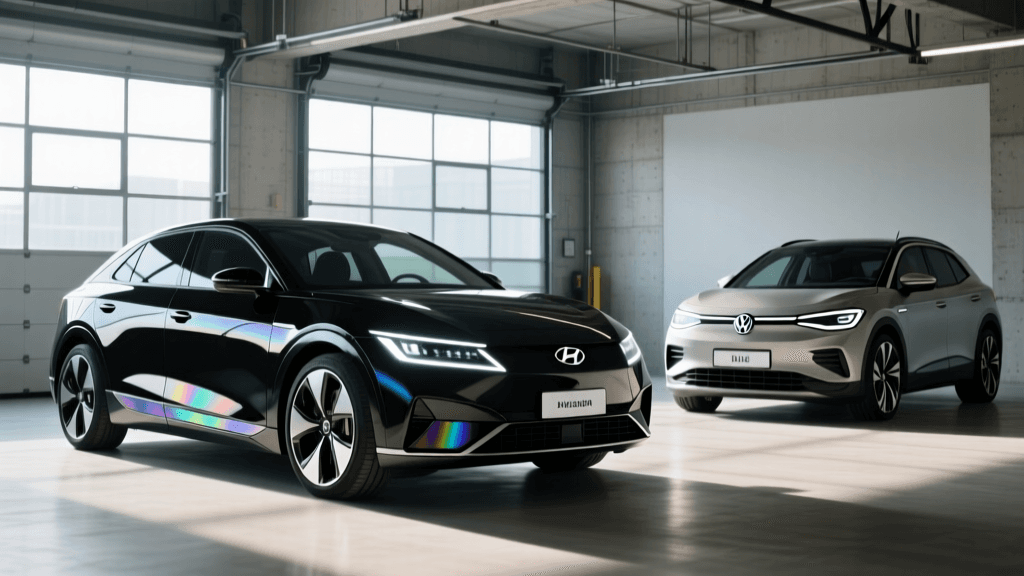
When modern families shop for an electric vehicle, the conversation has shifted far beyond simple range estimates and cargo volume. Today’s EV buyers are deeply invested in the underlying software, charging architectures, digital ecosystems, and advanced driver assistance systems (ADAS) that dictate the daily ownership experience. In the highly competitive compact electric SUV segment, two heavyweights constantly find themselves cross-shopped: the Volkswagen ID.4 and the Hyundai Ioniq 5. While both offer spacious interiors and competitive range, their technological philosophies are vastly different. In this technology deep dive, we dissect the silicon, software, and electrical architectures of the VW ID.4 and Hyundai Ioniq 5 to determine which EV truly offers the superior tech suite for the modern family.
Platform Architecture: 800-Volt E-GMP vs. 400-Volt MEB
The most profound technological divergence between these two SUVs lies beneath the floorboards. The Hyundai Ioniq 5 is built on the Hyundai Motor Group’s Electric-Global Modular Platform (E-GMP), which natively supports an 800-volt electrical architecture. In contrast, the Volkswagen ID.4 utilizes the Modular Electric Drive Matrix (MEB) platform, which operates on a more traditional 400-volt system. According to Car and Driver’s Hyundai Ioniq 5 overview, this 800-volt system is a game-changer for road-tripping families.
Why does voltage matter? In electrical terms, Power (Watts) equals Voltage multiplied by Current (Amps). By doubling the voltage to 800V, Hyundai can push massive amounts of power into the battery while keeping the current (and consequently, heat generation) relatively low. This allows the Ioniq 5 to accept peak DC fast-charging rates of up to 235 kW. Under optimal conditions, the Ioniq 5 can charge from 10% to 80% in roughly 18 minutes. The VW ID.4, capped by its 400-volt architecture, peaks at around 135 kW to 170 kW (depending on the model year and battery pack), requiring closer to 30 minutes for the same 10-80% sprint. For families enduring long highway stretches with restless children, the Ioniq 5’s ability to minimize charging downtime is a massive technological advantage.
Infotainment and Digital Cockpit: Hardware vs. Haptics
Stepping inside, the digital cockpits of both vehicles reflect their respective brands' approaches to user experience. The Hyundai Ioniq 5 features a seamless, curved glass housing that contains two 12.3-inch displays—one for the digital instrument cluster and one for the infotainment touchscreen. Hyundai’s Gen5W infotainment system is widely praised for its crisp graphics, logical menu structures, and rapid processing speeds. Crucially, Hyundai has retained physical toggle switches for critical functions like HVAC controls and volume, recognizing that families need tactile, easy-to-use controls while driving.
Volkswagen, however, took a more radical, minimalist approach with the ID.4. The center console is dominated by a 12-inch floating touchscreen (running the MIB3 or newer MIB4 software, depending on the year). As noted in Car and Driver’s Volkswagen ID.4 review hub, VW initially removed almost all physical buttons, replacing them with haptic-touch sliders and capacitive panels. While visually sleek, this tech has been a point of frustration for many users; the haptic sliders lack backlighting at night and require precise visual attention to adjust cabin temperature or volume. Although VW has introduced software updates and minor hardware revisions to improve responsiveness, the Ioniq 5’s blend of high-resolution screens with traditional, tactile ergonomics remains the more family-friendly technological choice.
Advanced Driver Assistance Systems (ADAS)
For family haulers, highway safety tech is paramount. Both vehicles offer robust Level 2 ADAS suites, but their execution differs. The Hyundai Ioniq 5 utilizes Highway Driving Assist (HDA), which combines adaptive cruise control with stop-and-go capability and lane-centering assistance. HDA is incredibly intuitive, utilizing steering wheel grip sensors and offering smooth, predictable interventions that mimic human driving. It also integrates navigation-based speed control, automatically slowing the vehicle for upcoming curves or toll booths.
Volkswagen counters with Travel Assist, which also pairs adaptive cruise control with lane-keeping assistance. VW’s system is highly capable and operates smoothly at highway speeds, but its user interface requires more frequent driver confirmation inputs via the capacitive touch steering wheel. If a driver’s hand rests lightly on the wheel without registering a capacitive change, the system may issue unnecessary warnings. Hyundai’s torque-based or grip-based steering wheel sensors generally provide a less intrusive monitoring experience, allowing parents to focus more on the road and less on placating the car’s attention alarms.
Vehicle-to-Load (V2L): The Ultimate Camping and Utility Tech
One of the most innovative features exclusive to the Hyundai Ioniq 5 in this matchup is Vehicle-to-Load (V2L) technology. The Ioniq 5 acts as a massive rolling power bank, capable of outputting up to 3.6 kW of 120-volt AC power. It features an interior outlet (often located under the rear seats) and an exterior adapter that plugs into the charge port. For active families, this tech is revolutionary. You can plug in a CPAP machine for overnight camping, run a coffee maker at a youth soccer tournament, or even power essential home appliances during a grid outage. The Volkswagen ID.4 currently lacks native V2L capabilities in the North American market, making the Ioniq 5 the undisputed champion of off-grid utility and lifestyle technology.
Thermal Management and Battery Preconditioning
Battery longevity and cold-weather efficiency are critical considerations for EV owners. As explained by the U.S. Department of Energy’s EV technology resources, lithium-ion batteries operate best within specific temperature bands, making thermal management systems vital. Both the ID.4 and Ioniq 5 offer available heat pumps, which scavenge waste heat from the drivetrain and ambient air to warm the cabin, significantly reducing the range penalty associated with winter driving.
However, the Ioniq 5’s battery preconditioning algorithm is generally regarded as more aggressive and transparent. When the navigation system routes you to a DC fast charger, the Ioniq 5 automatically begins heating the battery pack to its optimal operating temperature, ensuring you hit peak charging speeds upon arrival. Early iterations of the VW ID.4 suffered from opaque or inconsistent battery preconditioning logic, though recent over-the-air (OTA) software updates have vastly improved the MEB platform’s thermal routing. Still, Hyundai’s E-GMP platform was designed from day one with high-speed thermal conditioning in mind, giving it a slight edge in cold-weather charging reliability.
Tech Spec Showdown: ID.4 vs. Ioniq 5
| Technology Feature | Volkswagen ID.4 (Pro S / AWD) | Hyundai Ioniq 5 (Limited / AWD) |
|---|---|---|
| Electrical Architecture | 400-Volt (MEB Platform) | 800-Volt (E-GMP Platform) |
| Peak DC Fast Charging | ~170 kW | ~235 kW |
| 10-80% Charge Time (Ideal) | ~28-30 Minutes | ~18 Minutes |
| Infotainment Display | 12.0-inch Touchscreen | Dual 12.3-inch Curved Displays |
| HVAC Controls | Capacitive Haptic Touch | Physical Buttons / Toggle |
| Vehicle-to-Load (V2L) | Not Available | Standard (Interior & Exterior) |
| Highway Assist Tech | Travel Assist (Capacitive Wheel) | Highway Driving Assist (Grip/Torque) |
| Over-the-Air (OTA) Updates | Supported (Infotainment & BMS) | Supported (Infotainment & Nav) |
The Verdict: Which Tech Suite Wins for Families?
When evaluating these two exceptional electric SUVs purely through a technological lens, the Hyundai Ioniq 5 emerges as the clear victor for family buyers. Its 800-volt E-GMP architecture is not just a marketing buzzword; it translates directly to less time spent idling at charging stations and more time enjoying your destination. Furthermore, Hyundai’s thoughtful integration of V2L technology transforms the vehicle from a mere mode of transport into a versatile mobile power hub for camping, tailgating, and emergencies.
The Volkswagen ID.4 remains a fantastic vehicle with a comfortable ride, excellent interior space, and a highly refined driving dynamic. However, its reliance on a 400-volt architecture and its occasionally frustrating haptic-touch interface hold it back in a direct technology comparison. VW is actively addressing these software quirks via OTA updates and mid-cycle refreshes, but as it stands today, the Ioniq 5’s digital ecosystem, charging supremacy, and practical utility tech make it the ultimate tech-forward family hauler.