The Electric Truck Revolution: Separating Fact from Fiction
The introduction of the Rivian R1T and the Ford F-150 Lightning marked a seismic shift in the American automotive landscape. For decades, the full-size pickup truck segment was dominated by internal combustion engines, and the transition to electric vehicles (EVs) has been met with equal parts excitement and intense skepticism. As buyers transition from traditional gas-powered trucks to electric alternatives, a massive amount of misinformation has flooded forums, social media, and comment sections. Misunderstandings about towing capabilities, battery degradation, and charging infrastructure are causing many potential buyers to make common mistakes or avoid EV trucks entirely.
In this comprehensive head-to-head comparison, we are busting the five most pervasive myths surrounding the Rivian R1T and the Ford F-150 Lightning. By looking at the engineering realities, real-world testing data, and actionable ownership strategies, we will help you avoid costly mistakes and determine which of these pioneering electric trucks actually fits your lifestyle. According to the Environmental Protection Agency (EPA), many common myths about electric vehicles stem from outdated early-generation EV data that simply does not apply to modern, liquid-cooled, high-capacity battery architectures found in today's electric trucks.
Myth 1: "EV Trucks Automatically Lose 50% of Their Range When Towing"
The Myth: A pervasive claim in truck forums is that hooking up any trailer to an electric truck will instantly halve your advertised EPA range, making road trips or job site runs impossible.
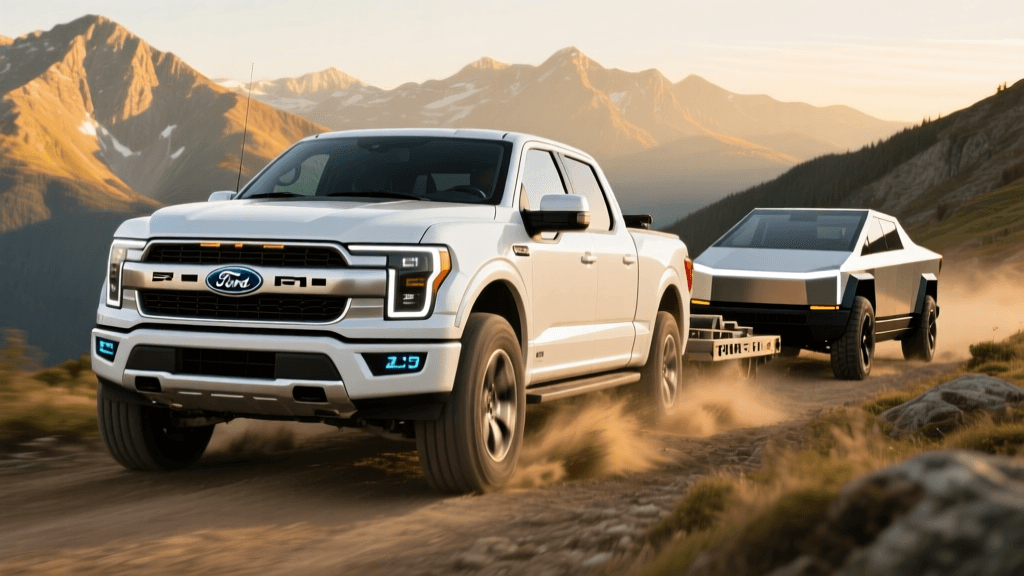
The Reality: The range reduction is not a flat 50% penalty; it is highly dependent on aerodynamics, speed, and the specific battery pack equipped. The Ford F-150 Lightning, with its traditional, upright, and boxy F-150 silhouette, pushes a massive wall of air. When towing a tall, flat-faced cargo trailer at 75 mph, the Lightning can indeed see range reductions approaching 45-50%. However, the Rivian R1T features a slightly more aerodynamic profile and available active air suspension that lowers the ride height at highway speeds, which can mitigate drag.
Common Mistake: Buyers purchase a Standard Range Lightning (98 kWh usable) expecting to tow a 24-foot enclosed car hauler across state lines without planning.
Actionable Advice: If towing is a priority, you must opt for the Extended Range Lightning (131 kWh) or the Rivian R1T Max Pack (149 kWh). Furthermore, aerodynamics matter more than weight in EV towing. Use teardrop or streamlined trailers, and keep highway speeds under 65 mph. As noted by the U.S. Department of Energy's Fuel Economy guide, EV efficiency drops exponentially at higher speeds due to aerodynamic drag, which is magnified when towing.
Myth 2: "The F-150 Lightning Cannot Handle Real Commercial Work"
The Myth: Because the Lightning uses an independent rear suspension and a unibody-like skate platform, traditionalists claim it lacks the ruggedness and utility of a solid-axle work truck.
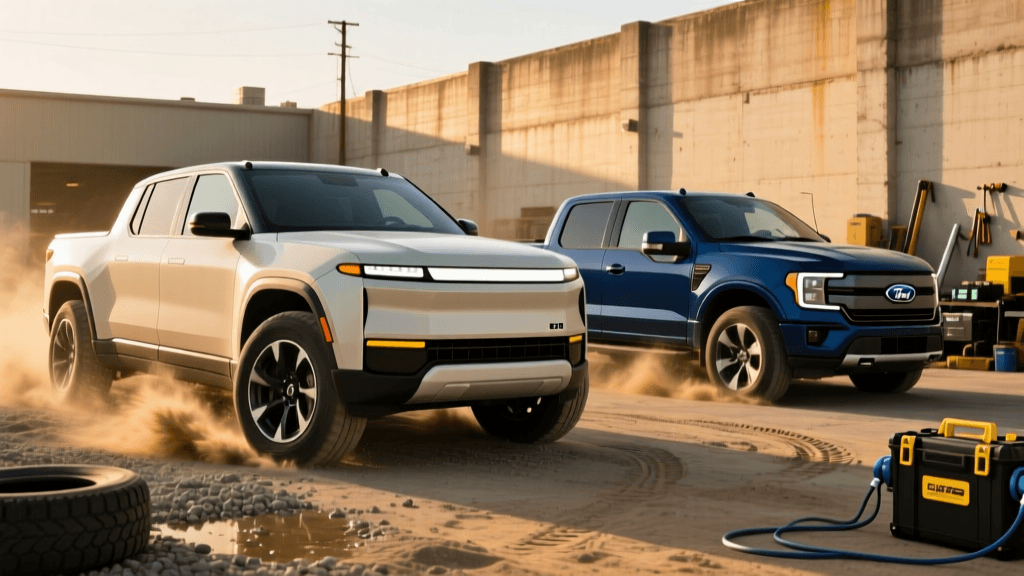
The Reality: The F-150 Lightning is arguably the most versatile mobile workstation on the market. Ford's integration of the Pro Power Onboard system turns the truck into a mobile generator, capable of powering heavy-duty job site tools, welders, or even an entire house during a grid outage. The Mega Power Frunk (front trunk) offers 400 liters of lockable, weatherproof storage with 400 pounds of payload capacity, completely changing how contractors secure expensive tools.
| Feature / Spec | Ford F-150 Lightning (Lariat/Platinum) | Rivian R1T (Dual-Motor Large Pack) |
|---|---|---|
| Max Towing Capacity | 10,000 lbs (Extended Range) | 11,000 lbs (Max Tow Package) |
| Max Payload Capacity | 2,235 lbs | 1,760 lbs |
| Frunk Volume / Payload | 400 Liters / 400 lbs | 11 Cubic Feet / 440 lbs |
| Mobile Power Output | 9.6 kW (Pro Power Onboard) | 11 kW (Rivian Gear Guard / Camp Kitchen) |
| Bed Length | 5.5 Feet | 4.5 Feet (plus 11 cu-ft Gear Tunnel) |
Common Mistake: Fleet managers overlook the Lightning's software capabilities. The Ford Pro ecosystem allows for remote telematics, battery health monitoring, and automated charging schedules that drastically reduce total cost of ownership (TCO) for commercial fleets compared to gas equivalents.
Myth 3: "The Rivian R1T is Just an Overpriced Toy for Camping"
The Myth: Critics often dismiss the R1T as a "lifestyle accessory" for wealthy tech workers, claiming it lacks the heavy-duty utility required for serious off-roading or agricultural work.
The Reality: The R1T is a remarkably capable off-road machine and utility vehicle. With up to 835 horsepower and 908 lb-ft of torque in the Quad-Motor configuration, it possesses instantaneous traction control that outperforms traditional locking differentials in rock-crawling scenarios. The hydraulic roll control system eliminates the need for traditional sway bars, providing immense wheel articulation without sacrificing on-road handling.
Common Mistake: Owners fail to utilize the patented Gear Tunnel. Because the R1T has a shorter 4.5-foot bed, buyers mistakenly assume it cannot carry long items. The Gear Tunnel spans the width of the truck behind the rear seats, offering 11 cubic feet of space. It is perfect for storing muddy gear, golf clubs, or heavy toolboxes, keeping the main bed free for larger cargo and maintaining optimal weight distribution over the axles.
Myth 4: "Charging an Electric Truck on a Road Trip is a Nightmare"
The Myth: You will be stranded for hours at broken, crowded charging stations, making cross-country travel in an electric truck a miserable experience.
The Reality: The charging landscape has evolved dramatically, and both Rivian and Ford have secured robust network access. Ford F-150 Lightning owners now have access to the Tesla Supercharger network via the NACS (North American Charging Standard) adapter, unlocking over 15,000 high-speed chargers across North America. Rivian is also transitioning to NACS and has built its own exclusive Rivian Adventure Network (RAN) strategically placed near national parks and outdoor recreation hubs, complete with amenities and pull-through charging stalls designed specifically for trucks with trailers.
Common Mistake: Failing to precondition the battery. Both trucks feature battery thermal management systems. If you navigate to a DC Fast Charger using the truck's native navigation system, the battery will automatically precondition (warm up or cool down) to accept the maximum charge rate upon arrival.
Actionable Advice: Always use the in-dash navigation to route to chargers. According to the Alternative Fuels Data Center (AFDC), utilizing mapped fast-charging corridors and preconditioning the battery can reduce 10-80% charging times by up to 20%, turning a potential 45-minute wait into a 25-minute rest stop.
Myth 5: "Rapid Battery Degradation Will Destroy Resale Value"
The Myth: Towing heavy loads and frequent DC fast charging will fry the battery cells, leaving you with a $20,000 replacement bill and a worthless truck in five years.
The Reality: Modern EV batteries are heavily fortified. Both the Lightning and the R1T utilize advanced liquid cooling and heating systems to keep the battery cells within their optimal thermal window, even when towing 10,000 pounds up a 6% grade in the middle of summer. Furthermore, Ford offers an LFP (Lithium Iron Phosphate) battery option on the Standard Range Lightning. LFP chemistry is renowned for its exceptional longevity and ability to be charged to 100% daily without the degradation concerns associated with NMC (Nickel Manganese Cobalt) chemistries.
Common Mistake: Treating the truck's battery like a smartphone. Owners frequently DC fast-charge to 100% and let the truck sit in a hot driveway for a week.
Actionable Advice: For daily driving, set your charge limit to 80% (or 100% if you have the LFP Standard Range Lightning). Reserve 100% charging and DC Fast Charging strictly for road trips and heavy towing days. Both manufacturers back their battery packs with an 8-year/100,000-mile warranty guaranteeing at least 70% capacity retention, providing a massive safety net for resale value.
Final Verdict: Matching the Truck to the Reality of Your Needs
When you strip away the myths and internet hyperbole, the choice between the Rivian R1T and the Ford F-150 Lightning comes down to your specific use case, free from the baggage of misinformation.
- Choose the Ford F-150 Lightning if: You need a traditional truck footprint, maximum payload capacity, commercial fleet integration, or the unmatched convenience of the Mega Power Frunk and Tesla Supercharger network access. It is the ultimate evolution of the American work truck.
- Choose the Rivian R1T if: You prioritize on-road performance, advanced off-road capability, innovative storage solutions like the Gear Tunnel, and a premium, tech-forward interior. It is the ultimate adventure and lifestyle vehicle that refuses to compromise on ruggedness.
By understanding the real-world physics of EV towing, leveraging the unique storage and power features of these platforms, and adopting smart charging habits, you can confidently join the electric truck revolution without falling victim to common buyer mistakes.