Introduction: The Twin EV Dilemma
The automotive industry is no stranger to badge engineering, but the collaboration between Toyota and Subaru to create the e-TNGA platform represents one of the most closely watched joint ventures in the modern electric vehicle space. The result of this partnership is two remarkably similar yet distinctly branded compact electric SUVs: the Toyota bZ4X and the Subaru Solterra. While they share the same underlying chassis, battery pack architecture, and electric motors, a closer look reveals that each automaker has tuned its respective EV to appeal to its loyal brand enthusiasts.
In this head-to-head showdown, we will dissect the nuances of the Toyota bZ4X and the Subaru Solterra. From range and charging speeds to off-road capability and interior ergonomics, we will provide actionable advice to help you determine which twin EV deserves a spot in your driveway.
Exterior Design: Sleek Futurism vs. Rugged Utility
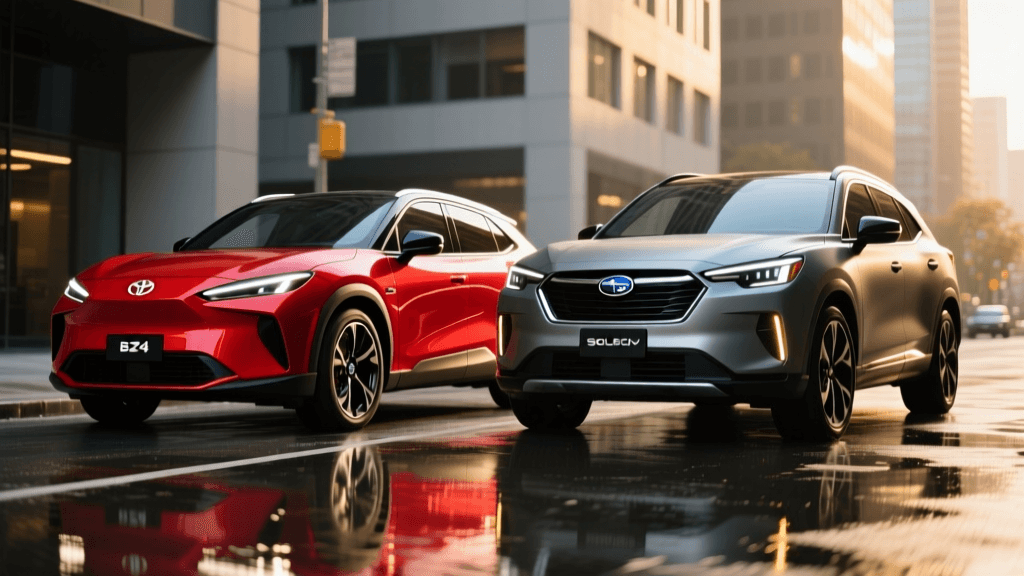
While the side profiles and rear fascias of the bZ4X and Solterra are nearly identical, the front ends tell two different styling stories. Toyota has adopted its controversial 'hammerhead' shark-nose front fascia, featuring sleek, split LED headlights and a smooth, closed-off grille area that emphasizes aerodynamic efficiency. It looks undeniably futuristic and aligns with Toyota's broader 'bZ' (Beyond Zero) design language.
Subaru, on the other hand, leans heavily into its rugged, outdoorsy heritage. The Solterra features a traditional hexagonal grille (albeit closed off for aerodynamics), prominent C-shaped headlights, and aggressive, matte-black plastic wheel arch cladding. According to comprehensive testing by Car and Driver's Solterra overview, Subaru's design choices are not just cosmetic; they signal the vehicle's intended use case for light off-roading and outdoor adventures. Both vehicles ride on 18-inch or 20-inch wheels, but the Subaru's cladding offers slightly better protection against trail debris and road salt.
Performance and Drivetrain: Where the Twins Diverge
The most significant mechanical difference between these two EVs lies in their drivetrain configurations. Toyota offers the bZ4X in both Front-Wheel Drive (FWD) and All-Wheel Drive (AWD) layouts. The FWD model produces 201 horsepower and 196 lb-ft of torque, while the AWD version bumps output to 214 horsepower and 248 lb-ft of torque.
Subaru, staying true to its symmetrical AWD legacy, offers the Solterra exclusively with All-Wheel Drive. This means every Solterra produces 215 horsepower and 249 lb-ft of torque. But the advantage goes beyond mere power figures. Subaru has integrated its legendary X-MODE software into the Solterra's powertrain management system. X-MODE optimizes torque distribution to individual wheels, providing superior traction in mud, snow, and dirt. Furthermore, the Solterra includes Hill Descent Control and a specialized 'Grip Control' feature that acts as an off-road cruise control.
Both vehicles share an identical 8.3 inches of ground clearance, which is respectable for the compact crossover segment. However, if your weekend plans involve navigating snowy mountain passes or muddy campsite trails, the Subaru Solterra's software tuning gives it a definitive edge in real-world traction.
Battery, Range, and the Charging Curve Reality
Both the bZ4X and Solterra are powered by a 72.8 kWh lithium-ion battery pack (with roughly 71.4 kWh usable). However, range estimates vary based on drivetrain and wheel size. The most efficient Toyota bZ4X FWD with 18-inch wheels achieves an EPA-estimated 252 miles of range. Opt for the AWD system and 20-inch wheels on either vehicle, and the range drops to approximately 222 miles.
The most critical talking point for prospective buyers is the DC fast-charging curve. Both vehicles share the same charging hardware limitations. The FWD bZ4X peaks at 150 kW, while the AWD models of both brands peak at just 100 kW. More importantly, the charging speed tapers off significantly after reaching a 60% state of charge. A 10% to 80% charge takes roughly 55 minutes under optimal conditions, which is notably slower than competitors like the Hyundai Ioniq 5 or Kia EV6.
Actionable Advice: To mitigate this on road trips, plan your stops to charge only from 10% to 60%. The vehicles accept their fastest charging rates in this lower bracket. Unplugging at 60% and driving to the next station will actually save you time compared to waiting for a slow trickle charge from 80% to 100%. For battery longevity and winter range preservation, the U.S. Department of Energy's EV tech guide highly recommends utilizing the vehicles' battery pre-conditioning features when navigating to a fast charger in cold weather.
Winter Driving: The Heat Pump Factor
If you live in a climate that experiences freezing temperatures, pay close attention to the thermal management systems. The AWD versions of both the Toyota bZ4X and Subaru Solterra come standard with a radiant heater and a highly efficient heat pump. This system extracts ambient heat from the outside air to warm the cabin, drastically reducing the battery drain associated with traditional resistive electric heaters. However, early FWD models of the Toyota bZ4X lacked this heat pump, relying on less efficient heating elements. Always verify the window sticker or build sheet to ensure a heat pump is included if you are purchasing a FWD Toyota in a northern climate.
Interior Space, Technology, and Ergonomics
Step inside either vehicle, and the shared DNA is immediately apparent. Both feature a massive 12.3-inch touchscreen infotainment system, physical knobs for climate control (a major win for ergonomics), and a center console with wireless charging and a clever storage cubby. According to Car and Driver's bZ4X review team, the cabin materials are a mix of premium soft-touch plastics and some harder, cheaper-feeling materials on the lower door panels.
The most polarizing interior feature is the steering wheel placement. To accommodate a unique instrument cluster positioned far forward (acting almost like a head-up display), the steering wheel sits unusually low. Taller drivers may find their knees brushing the wheel, and seeing the gauges requires looking over the rim rather than through it. Toyota initially offered a 'yoke' style steer-by-wire wheel in select markets to solve this visibility issue, but the traditional round wheel remains the standard in North America. Subaru never offered the yoke, sticking strictly to the round wheel.
Cargo space is identical, offering 27.7 cubic feet behind the rear seats, which is slightly less than some gas-powered competitors in the segment, largely due to the sloping roofline and lack of a front trunk (frunk).
Head-to-Head Specifications Table
| Feature | Toyota bZ4X (AWD) | Subaru Solterra (AWD) |
|---|---|---|
| Starting MSRP (Approx) | $46,700 | $44,995 |
| Drivetrain | FWD or AWD | AWD Only |
| Horsepower / Torque | 214 hp / 248 lb-ft | 215 hp / 249 lb-ft |
| EPA Range (AWD) | 228 miles | 222 miles |
| Max DC Charging Speed | 100 kW (AWD) | 100 kW |
| Ground Clearance | 8.3 inches | 8.3 inches |
| Towing Capacity | 2,000 lbs (AWD) | 2,000 lbs |
| Off-Road Software | Standard AWD Logic | X-MODE + Grip Control |
Pricing, Warranty, and Value Proposition
Pricing is where the twins' different strategies become clear. Because Toyota offers a FWD option, the entry-level bZ4X starts at a lower price point, making it an attractive option for budget-conscious buyers in mild climates who do not need all-wheel drive. However, when comparing apples to apples (AWD to AWD), the Subaru Solterra often undercuts the Toyota bZ4X by a few hundred to a thousand dollars, depending on the trim level and current dealer incentives.
Both vehicles come with a standard 3-year/36,000-mile bumper-to-bumper warranty and a 5-year/60,000-mile powertrain warranty. Crucially, the battery is backed by an 8-year/100,000-mile warranty guaranteeing it will retain at least 70% of its original capacity. Both automakers have also partnered with charging networks to offer complimentary charging credits (such as EVgo or Electrify America) for the first year of ownership, though these promotions change frequently and should be verified at the dealership.
The Verdict: Which Twin Should You Buy?
The choice between the Toyota bZ4X and the Subaru Solterra ultimately comes down to your specific lifestyle, climate, and driving habits.
- Buy the Subaru Solterra if: You live in an area with harsh winters, frequently drive on unpaved roads, or value off-road capability. The standard AWD, inclusion of a heat pump across all trims, and the brilliant X-MODE software make it the undisputed champion for outdoor enthusiasts and snowy commutes. It also offers slightly better base pricing for the AWD configuration.
- Buy the Toyota bZ4X if: You live in a mild, sun-belt climate where AWD is unnecessary. The FWD bZ4X offers the best range of the bunch (252 miles), a lower starting price, and a slightly more futuristic exterior design. It is an excellent, comfortable daily commuter for urban and suburban drivers who prioritize efficiency over trail-riding capability.
Both vehicles share the same mediocre fast-charging speeds and quirky steering wheel ergonomics. If road-tripping across the country is your primary use case, you may want to cross-shop rivals with 800-volt architectures. But for daily driving, grocery runs, and weekend getaways, these twin EVs offer comfortable, quiet, and highly practical electric mobility.