The e-TNGA Platform: A Tale of Two Badges
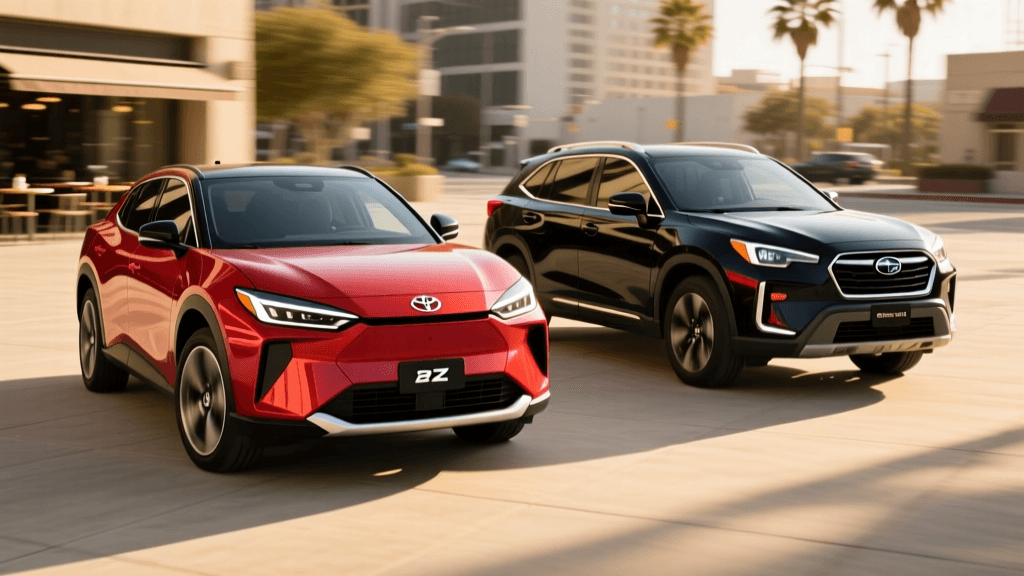
When Toyota and Subaru announced a partnership to develop a dedicated electric vehicle platform, the automotive world paid close attention. The result is the e-TNGA (Toyota New Global Architecture) platform, which underpins both the Toyota bZ4X and the Subaru Solterra. On paper, these two compact electric SUVs are nearly identical twins, sharing the same chassis, battery pack, and basic dimensions. However, as any seasoned car buyer knows, the badge on the grille often dictates the soul of the vehicle.
In this head-to-head showdown, we are putting the Toyota bZ4X and the Subaru Solterra in the same ring to determine which twin executes the electric SUV formula best. While they share bones, their tuning, standard equipment, and target demographics diverge significantly. Whether you are a suburban commuter looking for maximum efficiency or an outdoor enthusiast needing rugged all-weather capability, this comparison will guide you to the right choice.
Exterior Design and Dimensions
Because they share the e-TNGA platform, the bZ4X and Solterra share a 112.2-inch wheelbase and similar overall footprints. However, their design philosophies immediately set them apart. The Toyota bZ4X adopts a sharp, futuristic, and somewhat polarizing aesthetic. With its hammerhead front fascia, sleek black cladding, and aerodynamic focus, it looks like a vehicle beamed in from a sci-fi movie.
The Subaru Solterra, on the other hand, leans heavily into the brand's rugged heritage. It features a more traditional SUV silhouette, a hexagonal grille, and pronounced wheel arches. Subaru also includes standard roof rails with a high static load capacity, a feature that is either an expensive add-on or entirely unavailable on many competing EVs. If you plan to mount a rooftop tent or carry heavy cargo boxes, the Solterra's exterior utility gives it an early edge.
Drivetrain, Performance, and Off-Road Prowess
Both vehicles offer a single-motor front-wheel-drive (FWD) layout and a dual-motor all-wheel-drive (AWD) layout. The FWD models produce 201 horsepower and 196 lb-ft of torque, while the AWD variants bump that up to 214 horsepower and 248 lb-ft of torque. In straight-line acceleration, the difference between the two is negligible, with both hitting 60 mph in the high-six-second range.
Where the twins diverge is in their software tuning and off-road capability. According to extensive testing documented on Car and Driver's Solterra hub, Subaru has integrated its legendary X-MODE system into the Solterra's dual-motor setup. X-MODE features specialized traction control algorithms for deep snow, mud, and dirt, alongside a low-speed 'Grip Control' cruise control system for technical off-road crawling. The Solterra also boasts 8.3 inches of ground clearance, slightly optimized for approach and departure angles.
The Toyota bZ4X AWD system is tuned primarily for on-road safety, inclement weather stability, and efficiency. It features an 'X-MODE' equivalent for snow/mud, but it lacks the aggressive low-speed crawling software and rugged underbody protection of the Subaru. For urban drivers, the Toyota's tuning is perfectly adequate, but for those who venture onto unmaintained forest service roads, the Subaru is the undisputed champion.
Battery, Range, and the Charging Curve Update
Both SUVs are powered by a 72.8 kWh lithium-ion battery pack (with roughly 71.4 kWh usable). Range estimates vary slightly based on wheel size and drivetrain. The FWD Toyota bZ4X achieves an EPA-estimated 252 miles, while the AWD versions of both the bZ4X and Solterra hover around 222 to 228 miles. In real-world highway testing, both vehicles tend to fall slightly short of their EPA estimates, a common trait among boxy electric crossovers.
Early adopters of both vehicles faced criticism regarding their DC fast-charging speeds, which tapered off aggressively after reaching an 80% state of charge to preserve battery health. However, both Toyota and Subaru issued over-the-air (OTA) software updates that significantly improved the charging curve. For deeper insights into how these charging networks and battery thermal systems interact, the Alternative Fuels Data Center provides excellent baseline data on EV charging infrastructure and battery management expectations.
Post-update, both the bZ4X and Solterra can charge from 10% to 80% in roughly 30 to 35 minutes on a 150 kW DC fast charger. While this is respectable, it still lags behind the blistering 18-minute charging speeds of the Hyundai Ioniq 5 and Kia EV6, which utilize 800-volt architectures compared to the 400-volt system in the Toyota-Subaru twins.
Real-World Winter Driving and Thermal Management
Subaru's brand identity is intrinsically linked to snow and winter driving. The Solterra comes standard with a battery pre-conditioning feature, which is critical for maintaining fast-charging speeds in freezing temperatures. While the bZ4X eventually received similar functionality via updates, the Solterra's integration feels more cohesive, tying the battery thermal management directly into the climate control and navigation systems for winter routing.
Furthermore, the Solterra's standard All-Weather package on higher trims includes heated rear seats, a heated steering wheel, and specialized wiper de-icers. Toyota offers these as well, but often packages them differently depending on the trim level. If you live in the Rust Belt or the Mountain West, the Solterra's out-of-the-box winter readiness is a major selling point.
Interior Cabin, Tech, and Cargo Space
Stepping inside, the shared architecture is obvious, but the interior layouts reflect their distinct brand identities. The Toyota bZ4X features a unique, floating center console that creates a massive open storage area beneath the dashboard. It looks modern and airy, but some drivers find the lack of a traditional physical barrier between the driver and passenger unsettling during hard cornering.
Subaru opted for a traditional, fixed center console with a physical armrest and dedicated storage. For off-road driving, having a solid console to brace your knee against is highly preferred. Both vehicles feature a 12.3-inch infotainment touchscreen, physical buttons for climate control (a major win for usability), and a digital instrument cluster. However, the placement of the driver's display has been a point of contention; it sits low and far forward, requiring some drivers to look over the steering wheel rim rather than through it.
Cargo space is nearly identical, offering roughly 27 cubic feet behind the rear seats and 56 cubic feet with the seats folded. Neither vehicle offers a front trunk (frunk), which is a missed opportunity for storing charging cables securely.
Head-to-Head Spec Table
| Feature | Toyota bZ4X (AWD) | Subaru Solterra (AWD) |
|---|---|---|
| Starting MSRP (Approx) | $46,700 | $48,495 |
| Horsepower / Torque | 214 hp / 248 lb-ft | 214 hp / 248 lb-ft |
| EPA Range | 228 miles | 222 miles |
| Ground Clearance | 8.1 inches | 8.3 inches |
| Off-Road Software | Basic Snow/Mud | X-MODE + Grip Control |
| Roof Rails | Optional / Trim Dependent | Standard (High Capacity) |
| DC Fast Charge (10-80%) | ~35 minutes | ~35 minutes |
Pricing, Warranty, and Total Cost of Ownership
The Subaru Solterra generally carries a slightly higher starting MSRP than the Toyota bZ4X, primarily because Subaru includes AWD and a robust suite of off-road and winter features as standard on almost all trims. Toyota, conversely, offers a cheaper FWD entry point, making the bZ4X more accessible for budget-conscious buyers in mild climates.
Both vehicles come with a standard 3-year/36,000-mile bumper-to-bumper warranty and a 5-year/60,000-mile powertrain warranty. Crucially, the battery is backed by an 8-year/100,000-mile warranty, providing peace of mind regarding long-term degradation. When calculating the total cost of ownership, buyers should factor in the federal EV tax credit (up to $7,500, depending on current sourcing requirements and point-of-sale rules) and local utility rebates for home charging installations.
Maintenance costs for both will be exceptionally low compared to gas-powered counterparts, eliminating oil changes, spark plugs, and transmission fluid flushes. Brake pad life will also be significantly extended thanks to regenerative braking, though neither vehicle offers true one-pedal driving that brings the car to a complete, sustained halt without touching the brake pedal.
The Final Verdict: Which Twin Should You Buy?
Choosing between the Toyota bZ4X and the Subaru Solterra ultimately comes down to your lifestyle and the environment in which you drive. As noted by automotive experts reviewing the Toyota bZ4X lineup, the Toyota is best suited for urban and suburban commuters. If you prioritize a slightly lower price point, futuristic styling, and a spacious, airy cabin for daily school runs and grocery trips, the bZ4X is the logical choice.
However, the Subaru Solterra is the clear winner for the adventurous buyer. If you regularly encounter heavy snow, plan to tackle dirt trails, or need robust roof rails for outdoor gear, the Solterra's X-MODE, superior ground clearance, and rugged utility make it worth the slight price premium. It takes the baseline e-TNGA platform and injects it with the genuine, all-weather DNA that Subaru enthusiasts have come to expect.