The Heavyweights of EV Efficiency: Model Y vs. EV6
When planning a long-distance electric vehicle road trip, two metrics dictate your experience more than any other: real-world highway range and DC fast charging speed. The Tesla Model Y and the Kia EV6 are arguably the two most popular and capable electric crossovers on the market today. Both offer spacious interiors, cutting-edge technology, and impressive efficiency. However, their underlying electrical architectures and battery management systems differ significantly, leading to distinct behaviors on the open road and at the charging station.
In this head-to-head comparison, we are putting the Tesla Model Y Long Range All-Wheel Drive (AWD) and the Kia EV6 Long Range AWD to the test. We will analyze their real-world range versus EPA estimates, dissect their charging curves, and provide expert best practices to help you maximize efficiency and minimize downtime, regardless of which vehicle you choose to drive.
The Contenders: Trims and Specifications
To ensure a fair comparison, we are focusing on the most popular long-range, dual-motor configurations of both vehicles. The Tesla Model Y Long Range AWD utilizes a structural battery pack with a usable capacity of approximately 75 kWh, paired with a highly efficient 400-volt-class architecture and Tesla’s industry-leading heat pump system. The Kia EV6 Long Range AWD, built on Hyundai Motor Group’s E-GMP platform, features a slightly larger 77.4 kWh usable battery and a next-generation 800-volt electrical architecture.
While the EPA estimated ranges favor the Tesla on paper, the real-world application of these vehicles reveals a much more nuanced story about aerodynamics, thermal management, and powertrain efficiency.
Real-World Highway Range Test: EPA vs. Reality
The EPA estimates the Tesla Model Y Long Range AWD at 330 miles of range, while the Kia EV6 Long Range AWD is rated at 282 miles. On paper, the Tesla holds a massive 48-mile advantage. However, industry experts and independent testers have repeatedly shown that EPA estimates do not always reflect sustained highway driving at 70-75 mph.
According to extensive 75-mph highway range testing conducted by automotive journalists, EVs often achieve between 80% and 90% of their EPA estimates in real-world conditions. The Model Y’s slippery aerodynamic profile (0.23 Cd) gives it a distinct advantage at highway speeds, allowing it to consistently achieve around 280 to 295 miles of real-world highway range in mild weather. The EV6, with its slightly more aggressive crossover stance and wider tires, typically yields between 245 and 260 miles in the same 75-mph tests. For a deeper dive into how EVs perform under sustained highway loads, you can review the comprehensive testing methodology and results published in Car and Driver's real-world EV range test hub.
Expert Tip: The Climate Control Factor
Range is heavily dictated by thermal management. The Tesla Model Y’s octovalve and heat pump system are incredibly efficient at scavenging waste heat from the battery and motors to warm the cabin in cold weather. The EV6 also features a highly capable heat pump, but Tesla's software integration remains the gold standard. Best Practice: In winter months, always use seat heaters and the heated steering wheel instead of relying solely on the cabin air heater. This can reclaim up to 10% of your total range on both vehicles.
DC Fast Charging Showdown: 400V vs. 800V Architecture
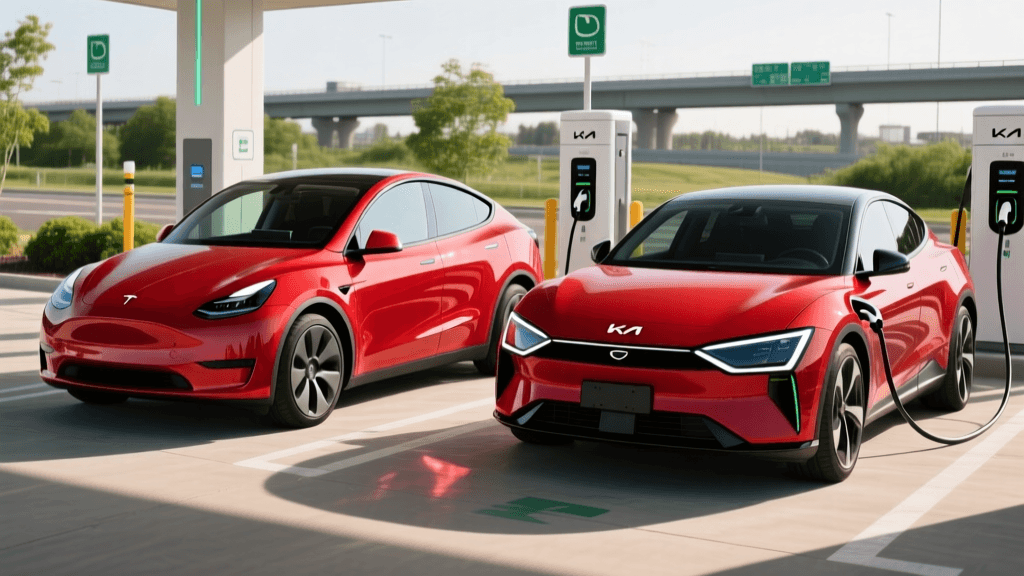
Where the Kia EV6 strikes back with a vengeance is at the DC fast charger. The EV6 utilizes an 800-volt electrical architecture, a feature that allows it to accept higher power levels with less current, thereby generating less heat and sustaining peak charging speeds for longer periods. The Model Y, while capable of peaking at 250 kW on a V3 Supercharger, operates on a lower voltage architecture and experiences a more aggressive taper in its charging curve as the battery fills up.
When plugged into a 350 kW Electrify America or Ionity charger, the EV6 can charge from 10% to 80% in roughly 18 minutes under ideal conditions. The Model Y, when routed to a V3 Supercharger via its native navigation, will precondition the battery and peak at 250 kW, but the 10% to 80% session typically takes between 25 and 28 minutes. The U.S. Department of Energy’s Alternative Fuels Data Center provides an excellent breakdown of how voltage and battery chemistry impact these charging speeds and long-term battery health on their EV batteries and charging infrastructure page.
Data Table: Charging & Range Metrics Compared
| Metric | Tesla Model Y LR AWD | Kia EV6 LR AWD |
|---|---|---|
| Usable Battery Capacity | ~75 kWh | ~77.4 kWh |
| EPA Estimated Range | 330 miles | 282 miles |
| Real-World 75 MPH Range | ~285 miles | ~255 miles |
| Max DC Fast Charge Rate | 250 kW (400V Class) | 240 kW (800V Class) |
| 10-80% Charge Time (Ideal) | ~27 minutes | ~18 minutes |
| Miles Added in 15 Mins | ~160 miles | ~190 miles |
Expert Best Practices for Maximizing Range
Whether you are driving the Model Y or the EV6, adopting expert driving and vehicle setup habits can drastically improve your road trip efficiency. The U.S. Department of Energy highlights several key factors that influence EV range, including tire pressure, aerodynamics, and driving habits, which you can explore further on the official Fuel Economy EV Tech guide.
- Optimize Tire Pressure: EVs are heavy, and under-inflated tires increase rolling resistance significantly. Check your door jamb sticker and inflate tires to the exact recommended PSI (usually between 35 and 42 PSI for these models) when the tires are cold. For every 5 PSI drop, you can lose up to 3% of your range.
- Remove Aerodynamic Drag: Roof boxes, bike racks, and even aftermarket mud flaps disrupt the carefully engineered airflow of both the Model Y and EV6. Removing a roof box at highway speeds can instantly restore up to 15% of lost range.
- Master One-Pedal Driving and Regen: In the Kia EV6, use the paddle shifters behind the steering wheel to dynamically adjust regenerative braking levels. On the highway, set it to Level 1 or 2 to maintain momentum. In the Tesla, rely on the standard regenerative braking profile and practice modulating the accelerator pedal to avoid unnecessary friction braking.
Expert Best Practices for DC Fast Charging
Charging speed is not just about the capability of the vehicle; it is heavily dependent on battery temperature and your state of charge (SoC) strategy.
1. Always Precondition the Battery
Lithium-ion batteries accept charge fastest when they are warm (typically between 90°F and 110°F at the cell level). In the Tesla Model Y, simply enter the Supercharger into the navigation system, and the car will automatically precondition the battery as you drive. In the Kia EV6, you must manually activate the "Battery Conditioning" feature in the EV settings menu if you are using a third-party charger, or ensure the route is actively guiding you to a mapped 800V charger to trigger it automatically.
2. The 10% to 80% Sweet Spot
DC fast charging curves are non-linear. Both the Model Y and EV6 will charge incredibly fast between 10% and 60% SoC. However, once you pass 80%, the battery management system (BMS) drastically reduces the charging speed to protect the battery cells from lithium plating and excess heat. Expert Rule of Thumb: Never wait for a 100% charge on a road trip unless it is your final destination. Charging from 80% to 100% on a DC fast charger can take as long as charging from 10% to 80%. Plan your stops to arrive at the next charger with 10% to 15% remaining, and unplug at 80%.
3. Leverage the NACS Adapter Ecosystem
With Tesla opening the Supercharger network to non-Tesla EVs via the North American Charging Standard (NACS), Kia EV6 owners can now access Tesla's highly reliable infrastructure. However, because the EV6 has a CCS port located on the opposite rear corner from the Tesla's charge port, you may need a NACS-to-CCS adapter or a V4 Supercharger with a longer cable. Always plan your pull-through or backing-in strategy to avoid stretching cables or blocking adjacent stalls.
"The secret to seamless EV road tripping isn't just buying the car with the biggest battery; it's understanding the thermal limits of your specific battery chemistry and utilizing route-based preconditioning to ensure you hit the charger at the optimal temperature."
Final Verdict: Which EV Wins the Road Trip?
The Tesla Model Y takes the crown for ultimate highway range and charging network convenience. Its superior aerodynamics yield more real-world miles per charge, and the seamless integration of the Supercharger network removes the anxiety of broken chargers. It is the ultimate choice for cross-country drivers who want a "set it and forget it" navigation and charging experience.
Conversely, the Kia EV6 is the undisputed king of the charging pad. Its 800V architecture is a genuine generational leap, allowing it to gulp down electrons in the time it takes to grab a coffee and use the restroom. If your road trips consist of frequent, shorter hops where you can take advantage of 350 kW chargers, or if you prefer a more traditional interior layout and physical buttons, the EV6’s blistering charge times will easily make up for its slightly lower overall range.
By applying these expert best practices—optimizing tire pressures, mastering battery preconditioning, and adhering to the 10-80% charging rule—you can transform either of these exceptional EVs into a highly efficient, long-distance touring machine.