Introduction to the Electric Work Truck Showdown
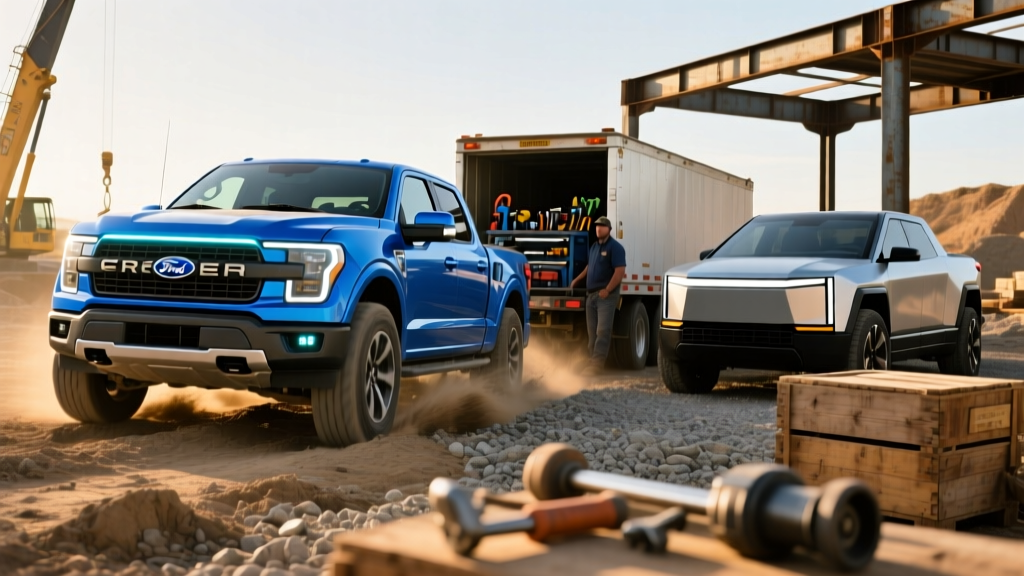
The transition to electric work trucks is no longer a futuristic concept; it is a data-driven reality for fleet managers, independent contractors, and job site foremen. When evaluating the battery-electric pickup market, two distinct engineering philosophies dominate the conversation: the traditional body-on-frame evolution seen in the Ford F-150 Lightning, and the bespoke skateboard architecture of the Rivian R1T. While both vehicles offer instant torque and zero tailpipe emissions, their utility on a commercial job site varies drastically. In this data-driven comparison analysis, we strip away the lifestyle marketing and focus strictly on the metrics that matter to work truck buyers: payload capacity, towing efficiency, cargo geometry, mobile power generation, and total cost of ownership (TCO). By analyzing spec sheets, real-world telemetry, and job site requirements, we can determine which electric pickup truly earns the title of ultimate workhorse.
Payload, Towing, and Core Specifications
Before analyzing real-world range degradation, we must establish the baseline hardware capabilities. The Ford F-150 Lightning benefits from decades of F-Series fleet data, resulting in a truck optimized for traditional commercial applications. The Rivian R1T, conversely, was engineered with a premium adventure-lifestyle focus, though its robust chassis and quad-motor (or dual-motor) setups give it formidable utility. Below is a side-by-side data table comparing the core work truck metrics of both platforms.
| Metric | Ford F-150 Lightning (Extended Range) | Rivian R1T (Dual-Motor Max Pack) |
|---|---|---|
| Max Payload Capacity | 2,235 lbs | 1,764 lbs |
| Max Towing Capacity | 10,000 lbs | 11,000 lbs |
| Ground Clearance (Max) | 8.9 inches | 14.9 inches |
| Bed Length | 5.5 feet | 4.5 feet (plus 11.6 cu-ft Gear Tunnel) |
| Max Power Export | 9.6 kW (Pro Power Onboard) | Standard 110V / 220V bed outlets |
| Front Trunk (Frunk) Volume | 14.1 cu-ft | 11.1 cu-ft |
| Approach / Departure Angles | 24.4° / 23.6° | 35.5° / 29.3° |
As the data illustrates, the Ford F-150 Lightning holds a distinct advantage in raw payload capacity, offering nearly 500 pounds more vertical load capability than the Rivian R1T. For contractors hauling heavy pallets of concrete, gravel, or dense machinery, the Lightning is the superior choice. However, the Rivian edges out the Ford in maximum towing capacity by 1,000 pounds, making it highly relevant for those pulling heavy equipment trailers or large boat lifts.
Towing Efficiency and Range Degradation Data
Towing capacity is only half the equation; the real challenge for electric work trucks is range degradation under load. Aerodynamic drag and rolling resistance severely impact battery efficiency. Industry testing data reveals that towing near maximum capacity typically reduces an EV truck's range by 45% to 55%. For the F-150 Lightning Extended Range (EPA estimated 320 miles), towing a 9,000-pound trailer yields a practical range of roughly 130 to 150 miles at highway speeds. The Rivian R1T Max Pack, with its larger battery and slightly more aerodynamic profile, manages similar degradation percentages but starts with a larger baseline range, offering marginally better towing endurance.
However, fleet managers must also consider the charging curve. According to Car and Driver's R1T testing hub and independent fleet analyses, DC fast charging speeds are critical for minimizing job site downtime. The F-150 Lightning supports peak charging rates up to 150 kW (standard) and higher on newer iterations, while the Rivian R1T Max Pack can accept over 200 kW under optimal thermal conditions. For a work truck that needs to recharge during a 30-minute lunch break on a long haul, the Rivian's advanced thermal management and higher peak charging architecture offer a slight operational advantage.
Cargo Volume and Job Site Storage Solutions
The physical dimensions of the cargo areas represent the most significant divergence in design philosophy. The F-150 Lightning utilizes a traditional 5.5-foot bed. While shorter than the 6.5-foot beds found on some gas F-150s, it accommodates standard pallets and integrates seamlessly with existing commercial ladder racks and bed cap systems. The Lightning's 14.1 cubic-foot frunk is also a massive asset for job sites, providing lockable, weather-sealed storage for expensive power tools and compressors.
The Rivian R1T features a 4.5-foot bed, which is inadequate for standard commercial lumber or drywall. However, Rivian compensates with the innovative Gear Tunnel—an 11.6 cubic-foot pass-through storage area located behind the rear seats. The Gear Tunnel is lockable, weatherproof, and perfect for securing long, high-value items like surveying equipment, shovels, pipes, and specialized plumbing tools. While the Lightning wins for traditional, open-bed bulk cargo, the Rivian's secure, partitioned storage is highly advantageous for specialized tradesmen (electricians, HVAC technicians, and plumbers) who require organized, theft-proof gear management.
Mobile Power Generation: Pro Power Onboard vs. Rivian
For commercial job sites lacking grid access, mobile power generation is a non-negotiable requirement. This is where the Ford F-150 Lightning decisively outclasses the Rivian R1T. Ford’s available Pro Power Onboard system transforms the truck into a rolling commercial generator. The 9.6 kW system provides 240-volt and 120-volt outlets directly in the bed, capable of simultaneously running heavy-duty job site equipment such as plasma cutters, miter saws, air compressors, and high-lumen floodlights. In the event of a grid failure, the Lightning can even be wired to power a home or job site office for up to three days.
The Rivian R1T offers 110-volt and 220-volt outlets in the bed and cab, which are sufficient for charging laptops, running small coolers, or powering light camping gear. However, it lacks the continuous, high-amperage 240V export capability required for heavy industrial tools. For contractors whose daily operations rely on running high-draw equipment off-grid, the F-150 Lightning's Pro Power Onboard is an indispensable, data-backed necessity.
Off-Road Geometry and Unimproved Job Site Access
Not all job sites are paved. Forestry workers, rural utility repair crews, and off-grid solar installers frequently navigate deep ruts, mud, and steep inclines. The Rivian R1T dominates this category. Thanks to its standard air suspension, the R1T can raise its ride height to an impressive 14.9 inches of ground clearance. Combined with a 35.5-degree approach angle and advanced torque vectoring (especially on Quad-Motor variants), the Rivian can extract itself from treacherous, unimproved terrain that would easily high-center a traditional truck.
The F-150 Lightning, constrained by its traditional solid rear axle and battery packaging, offers a maximum ground clearance of just 8.9 inches. While perfectly adequate for graded dirt roads and suburban construction sites, the Lightning is highly susceptible to undercarriage damage in extreme off-road environments. If your daily route includes severe off-pavement traversal, the Rivian’s geometry data makes it the undisputed winner.
Fleet Pricing and Total Cost of Ownership (TCO)
When evaluating TCO, initial acquisition cost, maintenance savings, and fuel equivalency must be modeled. The Ford F-150 Lightning is available in dedicated commercial trims (such as the Pro and XLT), with starting prices significantly lower than the Rivian R1T. Ford’s established commercial dealer network also ensures faster turnaround times for fleet servicing and warranty repairs. Furthermore, the Lightning's compatibility with standard F-150 fleet upfitting equipment (racks, bins, and caps) reduces secondary modification costs.
The Rivian R1T starts at a higher price point and operates on a direct-to-consumer model. While Rivian has launched a dedicated commercial fleet program, the service network is still expanding, which could result in increased vehicle downtime for commercial operators in rural areas. However, the Rivian’s over-the-air (OTA) software updates and lack of traditional drivetrain components still yield massive long-term savings on fluid changes, brake wear (thanks to aggressive regenerative braking), and transmission maintenance.
Final Verdict: Which EV Truck Wins the Job Site?
The data reveals that there is no single winner; rather, the optimal choice depends entirely on the specific trade and operational requirements of the buyer.
- Choose the Ford F-150 Lightning if: Your work requires high payload capacity, traditional 5.5-foot bed compatibility with commercial racks, and heavy-duty mobile power generation (9.6 kW Pro Power Onboard) for running job site tools. It is the ultimate replacement for the traditional commercial fleet truck.
- Choose the Rivian R1T if: Your trade involves navigating severe off-road terrain, you require secure and partitioned lockable storage (Gear Tunnel) for specialized tools, and your towing needs prioritize maximum pulling capacity over raw bed payload.
Ultimately, the F-150 Lightning remains the pragmatic, data-backed choice for general contracting and heavy fleet duty, while the Rivian R1T serves as a highly capable, premium utility vehicle for specialized, off-grid technicians.