Introduction to EV Affordability
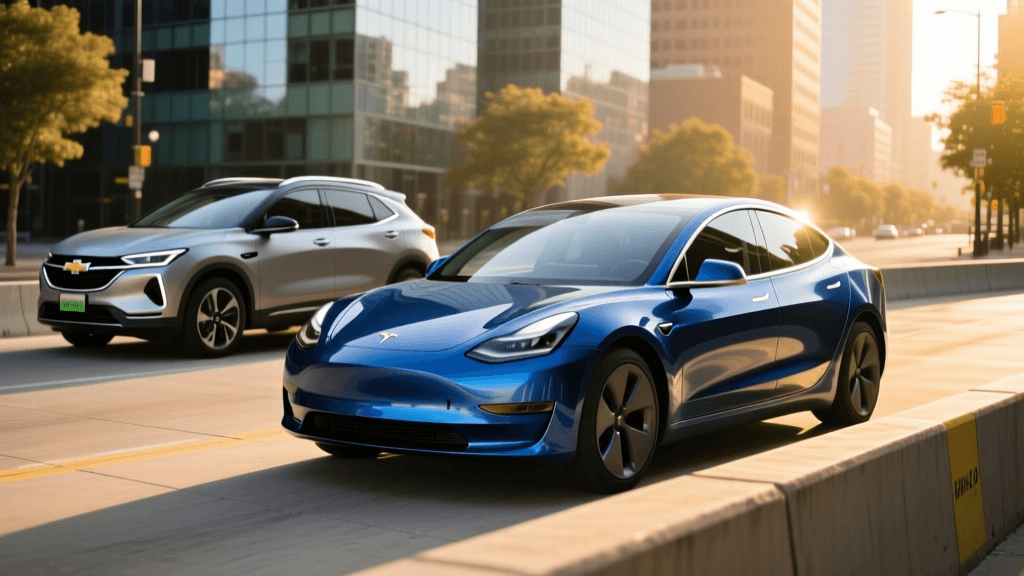
Transitioning to your first electric vehicle (EV) can feel like learning a completely new language. Between deciphering MPGe ratings, understanding charging speeds, and navigating federal tax incentives, the financial side of EV ownership is often the most confusing hurdle for beginners. In this complete guide, we are putting two of the most talked-about electric SUVs head-to-head: the budget-friendly Chevrolet Equinox EV and the industry-benchmark Tesla Model Y.
While the Tesla Model Y has dominated global sales charts with its cutting-edge tech and Supercharger network, the newly introduced Chevy Equinox EV promises to democratize electric driving with a drastically lower entry price. But which one is truly more affordable when you look beyond the window sticker? We will break down purchase prices, hidden home-charging costs, insurance premiums, and the 5-year Total Cost of Ownership (TCO) to help you make the smartest financial decision.
Base MSRP and Initial Purchase Price
The most immediate difference between these two SUVs is the manufacturer's suggested retail price (MSRP). Chevrolet has aggressively positioned the Equinox EV to capture the mass market. The base Equinox EV 2LT (Front-Wheel Drive) starts at an advertised MSRP of roughly $33,000. Even when you step up to the all-wheel-drive (AWD) RS trim with extended range, the price hovers around $41,900, making it highly accessible for the average American family.
On the other hand, the Tesla Model Y sits in the premium compact SUV segment. Following recent price adjustments, the entry-level Model Y Long Range AWD starts at approximately $44,990. While Tesla occasionally offers Standard Range rear-wheel-drive variants at lower price points, the Long Range AWD remains the most common and practical choice for buyers seeking adequate range and dual-motor traction. Right out of the gate, the Chevy Equinox EV holds a massive $10,000 to $12,000 advantage in base sticker price.
The $7,500 Federal Tax Credit Equalizer
For beginners, the Internal Revenue Service (IRS) Clean Vehicle Credit is a vital tool for EV affordability. Under the Inflation Reduction Act (IRA), both the Chevrolet Equinox EV and the Tesla Model Y (when built with qualifying battery components) are eligible for the maximum $7,500 federal tax credit.
As of 2024, the biggest advantage for buyers is the Point-of-Sale (POS) rebate. Instead of waiting until tax season to claim your credit, you can transfer the $7,500 credit directly to the dealership at the time of purchase. This effectively drops the Equinox EV's starting price to an astonishing $25,500 and the Model Y to roughly $37,490. This immediate price reduction drastically lowers your down payment and monthly loan costs, though the Chevy maintains a clear financial lead.
The Hidden Cost: Home Charging Setup
A common beginner mistake is budgeting only for the car while forgetting the 'fuel pump' you need to install in your garage. To truly enjoy the affordability of an EV, you must charge at home. Both vehicles require a Level 2 (240-volt) home charger for optimal overnight charging.
A high-quality Level 2 smart charger (like the ChargePoint Home Flex or Tesla Wall Connector) will cost between $500 and $800. However, the real variable is your home's electrical panel. If your home requires an electrical service upgrade from 100-amp to 200-amp to support continuous 48-amp EV charging, you could spend an additional $1,500 to $2,500 on an electrician. Fortunately, the U.S. Department of Energy's Alternative Fuels Data Center notes that many local utility companies offer rebates for home charger installations, which can offset these upfront hardware costs significantly.
Public Charging Networks: NACS vs. CCS
When road-tripping, the Tesla Model Y holds a distinct advantage. It uses the native North American Charging Standard (NACS) plug, granting it seamless, plug-and-charge access to Tesla's legendary Supercharger network, which is widely considered the most reliable public charging infrastructure available.
The Chevy Equinox EV currently uses the Combined Charging System (CCS) connector. While General Motors is transitioning future EVs to NACS, current Equinox EV owners will need a GM-approved adapter to access Tesla Superchargers. Furthermore, relying on third-party CCS networks (like Electrify America or EVgo) can sometimes result in higher per-kWh costs and lower reliability compared to Tesla's proprietary network. For beginners who travel frequently, the Model Y's native charging ecosystem offers peace of mind that is difficult to quantify strictly in dollars.
Understanding EV Efficiency: Miles per kWh
When comparing affordability, you must look beyond the sticker price and examine how efficiently each vehicle uses electricity. The U.S. Environmental Protection Agency (EPA) measures this in miles per gallon equivalent (MPGe) and kWh per 100 miles. The Tesla Model Y is renowned for its industry-leading efficiency, often achieving around 28 kWh per 100 miles. The Chevy Equinox EV, being slightly heavier and less aerodynamically optimized, averages closer to 32 kWh per 100 miles. While this difference seems minor, over 15,000 miles of annual driving, the Model Y's superior efficiency translates to tangible savings on your monthly electric bill, especially if you rely on public fast chargers where per-kWh costs are higher.
Insurance, Maintenance, and Depreciation
Insurance premiums are a major factor in EV affordability. Because Teslas feature specialized aluminum bodies, proprietary software, and require certified repair networks, insurance companies often charge higher premiums for the Model Y. Conversely, the Equinox EV shares underlying architecture and parts with mainstream gas-powered Chevys, making it generally cheaper and easier to insure through traditional providers.
Maintenance on both vehicles is remarkably low compared to gas cars. You will never pay for an oil change, spark plugs, or a transmission flush. Your primary recurring costs will be windshield washer fluid, cabin air filters, and tires. Note that EVs are heavier and deliver instant torque, meaning you may need to replace your tires every 30,000 to 40,000 miles rather than the 50,000 miles typical of gas SUVs.
5-Year Total Cost of Ownership (TCO) Breakdown
To visualize the long-term financial impact, here is an estimated 5-year TCO comparison assuming 15,000 miles driven annually, home charging at a national average of $0.16 per kWh, and the $7,500 tax credit applied upfront.
| Cost Factor (5-Year Estimate) | Chevy Equinox EV (2LT FWD) | Tesla Model Y (Long Range AWD) |
|---|---|---|
| Base MSRP | $33,000 | $44,990 |
| Federal Tax Credit | -$7,500 | -$7,500 |
| Effective Starting Price | $25,500 | $37,490 |
| Home Charging Setup | $1,200 | $1,200 |
| Electricity Costs (5 Yrs) | $2,900 | $2,500 |
| Insurance Premiums (5 Yrs) | $8,500 | $11,000 |
| Maintenance & Tires (5 Yrs) | $1,800 | $2,100 |
| Est. Total 5-Year Cost | $40,900 | $55,290 |
Beginner's Checklist for Dealership Negotiation
To maximize affordability, do not simply accept the window sticker price. Here is a practical checklist for your dealership visit:
- Inventory Incentives: Ask about manufacturer-to-dealer cash incentives that might not be advertised online.
- Dealer Markups: The Equinox EV is highly anticipated. Ensure the dealer is not adding unauthorized 'market adjustment' fees.
- Charging Bundles: Some dealerships will include a free Level 2 home charger or credit toward installation to close the deal.
- Lease vs. Buy: Sometimes, leasing a Tesla or Chevy unlocks a $7,500 lease cash incentive that bypasses strict IRA income and battery sourcing requirements.
The Beginner's Verdict
If your primary goal is strict financial affordability and minimizing your monthly budget, the Chevrolet Equinox EV is the undisputed winner. With an effective starting price in the mid-$20,000s after tax credits, lower insurance rates, and a comfortable, familiar interior, it is the perfect gateway EV for budget-conscious families and first-time buyers.
However, if you view affordability through the lens of long-term value, cutting-edge technology, and road-trip convenience, the Tesla Model Y justifies its premium. Its superior electrical efficiency, native access to the Supercharger network, and over-the-air software updates offer a premium ownership experience that many buyers feel is worth the extra monthly payment. Choose the Chevy to protect your wallet today; choose the Tesla to invest in the EV ecosystem of tomorrow.