The Shift to Electric Work Trucks
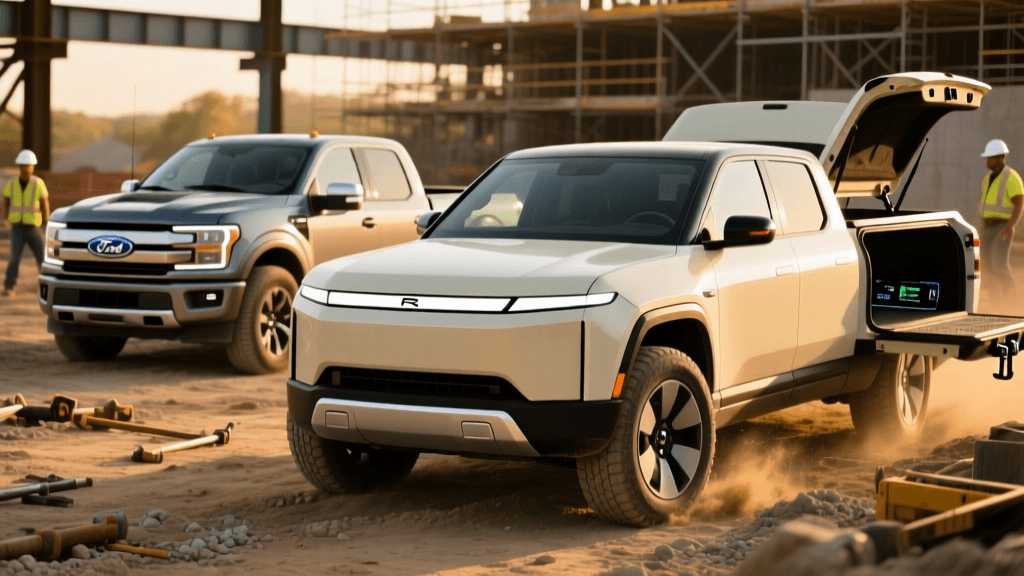
The transition from internal combustion to electric powertrains in the commercial truck sector is no longer a speculative trend; it is a data-driven reality. For independent contractors, fleet managers, and tradespeople, choosing the right electric vehicle (EV) requires looking past marketing gloss and focusing on hard metrics. Two of the most prominent players in this space are the Ford F-150 Lightning and the Rivian R1T. While both offer impressive performance, their underlying architectures cater to fundamentally different workflows. This data-driven comparison analysis breaks down the exact specifications, real-world capabilities, and total cost of ownership (TCO) to help you determine which EV truck actually belongs on your jobsite.
Towing, Payload, and GCWR: The Core Metrics
When evaluating work truck capability, Gross Combined Weight Rating (GCWR), maximum towing, and payload capacity are the non-negotiable baseline metrics. The Ford F-150 Lightning leverages decades of F-Series fleet engineering, while the Rivian R1T utilizes a bespoke skateboard chassis designed for versatility. According to the EPA Fuel Economy database and manufacturer specifications, the data reveals distinct advantages for each platform depending on your specific trade requirements.
| Metric | Ford F-150 Lightning (Max Tow) | Rivian R1T (Max Tow Package) |
|---|---|---|
| Max Towing Capacity | 10,000 lbs (Extended Range) | 11,000 lbs (Dual/Quad Motor) |
| Max Payload Capacity | 2,235 lbs (Standard Range) | 1,760 lbs |
| Bed Length | 5.5 feet | 4.5 feet |
| Bed Volume | 52.8 cu-ft | 29.2 cu-ft |
| Peak Horsepower | 580 hp | 1,025 hp (Quad-Motor) |
| Peak Torque | 775 lb-ft | 1,198 lb-ft (Quad-Motor) |
Data Takeaway: The Rivian R1T edges out the Lightning in raw towing capacity by 1,000 lbs when properly equipped with the Max Tow package, making it slightly superior for heavy equipment trailers. However, the F-150 Lightning dominates in payload capacity by nearly 500 lbs. For landscapers or masons carrying heavy bed loads of pavers, soil, or tools, the Lightning’s higher payload threshold and longer 5.5-foot bed make it the mathematically superior choice.
Real-World Range Degradation Under Load
Manufacturer EPA range estimates are largely irrelevant when a truck is hooked up to a 7,000-pound trailer. Independent automotive testing consistently shows that EV trucks experience a 40% to 50% reduction in range when towing near their maximum capacities at highway speeds (65-70 mph). The F-150 Lightning Extended Range (EPA 320 miles) will realistically yield between 140 and 160 miles of range while towing a heavy load. The Rivian R1T Max Pack (EPA 410 miles) will yield roughly 180 to 210 miles under similar conditions. If your daily route requires towing a heavy trailer more than 80 miles one-way without access to destination charging, both vehicles will require mid-day fast charging, which introduces significant jobsite downtime.
Cargo Dimensions and Jobsite Storage
Work trucks are defined by their utility, and cargo volume is where the F-150 Lightning and Rivian R1T diverge sharply in design philosophy. The Lightning maintains the traditional pickup truck silhouette, offering a 52.8 cubic-foot bed and the innovative Mega Power Frunk (front trunk). The Frunk provides 14.1 cubic feet of lockable, weather-sealed storage with a 400-pound payload capacity. This is a game-changer for electricians and plumbers who need to secure expensive, weather-sensitive diagnostic tools and copper wiring away from the main bed.
The Rivian R1T, conversely, sacrifices bed length (4.5 feet, 29.2 cubic feet) to accommodate its signature Gear Tunnel. This 11.7 cubic-foot transverse tunnel spans the width of the truck between the cab and the bed, offering 11.1 cubic feet of additional frunk space. While the Gear Tunnel is exceptional for storing long items like shovels, ladders, or PVC piping, the shorter 4.5-foot bed struggles to accommodate standard 4x8 sheets of plywood flat on the floor without angling them or utilizing the bed extender. For general contractors hauling sheet goods, the Lightning’s bed dimensions are vastly more practical.
Powering the Jobsite: Pro Power Onboard vs. Rivian Outlets
One of the most compelling arguments for adopting an electric work truck is the ability to use the vehicle’s massive battery pack as a mobile generator, eliminating the need for noisy, fuel-dependent portable generators. Here, the data heavily favors Ford.
- Ford Pro Power Onboard: Available with either 2.4 kW or 9.6 kW of continuous output. The 9.6 kW system includes a 240-volt NEMA L14-30R outlet in the bed, capable of simultaneously running heavy-duty jobsite equipment like table saws, air compressors, and welders, or even providing backup power to a home or remote office.
- Rivian R1T Power Outlets: The R1T features multiple 110-volt and 12-volt outlets scattered throughout the cabin, bed, and Gear Tunnel. However, its native continuous output is capped significantly lower than Ford’s 9.6 kW system without relying on aftermarket inverter setups or the specialized Camp Kitchen accessory.
Data Takeaway: For heavy-duty trades requiring 240V equipment or high-draw 120V tools running simultaneously, the F-150 Lightning’s 9.6 kW Pro Power Onboard is an unmatched, factory-integrated solution.
Fleet Charging and Downtime Analysis
For fleet managers, vehicle downtime equates to lost revenue. Charging architecture and peak charge rates are critical data points. Both vehicles currently utilize the CCS (Combined Charging System) standard, though both manufacturers have committed to transitioning to the NACS (Tesla Supercharger) standard via adapters and future native ports.
The Rivian R1T features a slightly faster peak charging rate, capable of accepting over 200 kW on high-output DC fast chargers, allowing a 10% to 80% charge in roughly 30 minutes under optimal thermal conditions. The F-150 Lightning Extended Range peaks around 150 kW, taking approximately 41 minutes to reach 80%. While the Rivian charges faster, fleet managers must also consider the physical footprint; the R1T's unique charging port placement (left front fender) and the Lightning's port (front left fender) both require specific pull-through charging stall designs to accommodate trucks with trailers attached.
Total Cost of Ownership (TCO) for Commercial Buyers
Upfront purchase price is only a fraction of commercial vehicle economics. The U.S. Department of Energy highlights that EV fleets benefit from drastically reduced maintenance costs due to the elimination of oil changes, transmission fluid replacements, and exhaust system repairs. Furthermore, regenerative braking significantly extends the lifespan of friction brake pads.
According to the Alternative Fuels Data Center, the TCO for electric commercial vehicles often reaches parity with diesel or gas counterparts within 3 to 5 years, heavily dependent on local electricity rates versus diesel prices. The F-150 Lightning Pro starts at a lower MSRP tailored specifically for commercial fleets, and both vehicles qualify for the IRC Section 45W Commercial Clean Vehicle Credit (up to $7,500 for vehicles under 14,000 lbs GVWR, and up to $40,000 for heavier classifications, though both trucks fall under the $7,500 cap). When factoring in the elimination of idling fuel burn—a massive expense for traditional work trucks that run PTO equipment all day—the Lightning's high-output onboard power system accelerates the ROI timeline for heavy-equipment contractors.
Final Verdict: Matching the Truck to the Trade
The data clearly indicates that there is no universal "best" EV work truck; rather, there is a mathematically correct choice based on your specific operational profile.
Choose the Ford F-150 Lightning if:
- Your primary work involves carrying heavy payload in the bed (landscaping, masonry, lumber).
- You require 240V or high-draw 120V jobsite power via the 9.6 kW Pro Power Onboard system.
- You frequently haul standard 4x8 sheet goods that require a 5.5-foot bed.
- You are a fleet manager looking for a lower entry MSRP and traditional truck ergonomics for your drivers.
Choose the Rivian R1T if:
- Your work requires maximum towing capacity (up to 11,000 lbs) for heavy equipment trailers.
- You need secure, weather-sealed, lockable storage for long tools via the Gear Tunnel.
- You prioritize faster DC fast-charging speeds to minimize mid-day downtime on long highway routes.
- Your workflow blends rigorous commercial duties with premium overlanding or off-road weekend requirements.
By aligning the hard data on payload, power output, and cargo geometry with your daily operational demands, you can confidently integrate the right electric truck into your fleet and realize the long-term TCO benefits of commercial electrification.