Introduction to the Electric Truck Revolution
Welcome to the dawn of the electric pickup truck era. For decades, the truck market was dominated by gas-guzzling titans like the Ford F-150 and Chevy Silverado. Today, two futuristic heavyweights are battling for supremacy in the EV space: the polarizing, stainless-steel Tesla Cybertruck and the rugged, adventure-ready Rivian R1T. If you are new to electric vehicles (EVs), choosing between these two radically different machines can feel overwhelming. This beginner's complete guide will break down everything you need to know—from range and charging to off-road capability and daily practicality—so you can confidently decide which electric truck deserves a spot in your driveway.
EV Truck Terminology for Beginners
Before diving into the head-to-head comparison, it is crucial to understand a few key EV truck terms:
- Regenerative Braking: Both trucks capture kinetic energy when you lift off the accelerator, sending it back to the battery and slowing the truck down without using the traditional brake pads.
- Frunk: A portmanteau of 'front' and 'trunk.' Because EVs lack a massive engine block, both trucks offer secure, lockable storage under the hood.
- NACS vs. CCS: These are charging connector standards. Tesla uses the North American Charging Standard (NACS), while Rivian currently uses the Combined Charging System (CCS), though Rivian is transitioning to NACS via adapters and future native ports.
- Payload vs. Towing: Payload is the weight you can put inside the truck (bed and cabin). Towing is the weight the truck can pull behind it on a trailer.
Exterior Design and Build Philosophy
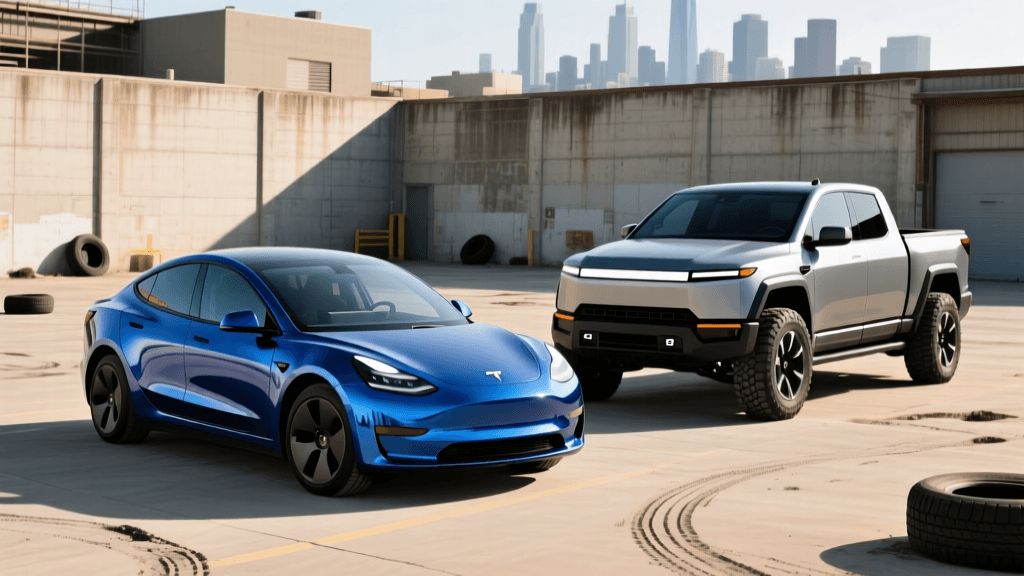
The most immediate difference between these two vehicles is their design language. The Tesla Cybertruck looks like a low-polygon rendering from a 1990s video game. Its exoskeleton is made from ultra-hard 30X cold-rolled stainless steel, which eliminates the need for traditional paint. This makes it highly resistant to dents and scratches, a massive plus for beginners worried about trail pinstriping or parking lot dings. However, its sharp angles and massive footprint can make navigating tight city streets or standard garages a challenge.
Conversely, the Rivian R1T adopts a more traditional, albeit modernized, truck silhouette. It features Rivian's signature stadium headlights and a rounded, aerodynamic profile that blends SUV-like comfort with truck utility. The R1T is painted using high-quality automotive finishes and features clever outdoor integrations, like a built-in air compressor in the bed and a gear guard system to secure cargo. For the beginner who wants a truck that looks at home at a country club or a campsite without drawing aggressive stares, the R1T is the more approachable choice.
The Tale of the Tape: Core Specifications
Let's look at the hard numbers. Below is a comparison of the most popular configurations for both trucks (Tesla Cybertruck AWD vs. Rivian R1T Dual-Motor Large Pack).
| Feature | Tesla Cybertruck (AWD) | Rivian R1T (Dual-Motor Large) |
|---|---|---|
| Starting Price (Est.) | $79,990 | $76,900 |
| EPA Estimated Range | 340 miles | 352 miles |
| 0-60 mph | 4.1 seconds | 4.5 seconds |
| Towing Capacity | 11,000 lbs | 11,000 lbs |
| Max Payload | 2,500 lbs | 1,760 lbs |
| Bed Length | 6-foot (plus vault) | 4.5-foot (plus Gear Tunnel) |
| Ground Clearance | Up to 17.4 inches | Up to 14.4 inches |
According to Car and Driver's comprehensive testing, the Cybertruck's steer-by-wire system and rear-wheel steering give it a surprisingly tight turning radius, making this massive 6,800-pound beast handle like a much smaller sedan in parking lots. The Rivian, while slightly longer in wheelbase, offers a more traditional steering feel that beginners might find more comforting at highway speeds.
Battery Range, Charging, and Road Trips
Range anxiety is the number one concern for EV beginners. Both trucks offer over 300 miles of EPA-estimated range, which is excellent for daily driving. However, highway towing will slash that range by 40% to 50% in either vehicle—a reality of pushing a brick-shaped vehicle and a trailer through the wind.
Where they differ drastically is the charging experience. Tesla's Supercharger network is widely considered the gold standard for reliability and ease of use. You simply plug in, and the car handles the billing. The Cybertruck also supports 800-volt architecture, allowing for incredibly fast charging speeds, adding up to 136 miles of range in just 15 minutes at a V4 Supercharger.
Rivian is building its own exclusive 'Adventure Network' near national parks and outdoor hubs, which is a fantastic perk for off-roaders. For standard road trips, Rivian owners currently rely on the broader CCS public charging network (like Electrify America), which can be hit-or-miss regarding reliability. However, Rivian owners can now use a provided adapter to access Tesla Superchargers, vastly improving the R1T's road-trip viability. As noted in expert reviews from Car and Driver, the R1T's charging curve is highly efficient, making it a capable cross-country traveler now that the Supercharger network is accessible.
Interior Comfort, Technology, and Storage
Stepping inside the Cybertruck is like entering a spaceship. The interior is brutally minimalist, dominated by a massive 18.5-inch front touchscreen that controls almost every function of the truck, including the windshield wipers and glovebox. There are no physical stalks for turn signals; they are integrated into the steering wheel yoke (or optional round wheel). While tech-savvy users may love this, beginners might find the steep learning curve frustrating during their first few weeks of ownership. On the plus side, the Cybertruck offers a massive 6-foot bed that can expand into an enclosed 'vault' by deploying a motorized tonneau cover, effectively turning the bed into a secure, weatherproof trunk.
The Rivian R1T interior feels more like a luxury SUV, such as a Volvo or Range Rover. It features premium sustainable materials, physical buttons for crucial climate and off-road controls, and a beautiful wood-trim dashboard. The R1T's party trick is the 'Gear Tunnel'—a massive, lockable storage compartment that runs horizontally across the width of the truck behind the rear seats. It is perfect for storing golf clubs, camping gear, or skis, keeping the main 4.5-foot bed free for dirtier items. Rivian even offers an optional Camp Kitchen that slides right out of the Gear Tunnel, complete with an induction stove and sink.
Off-Roading and True Truck Utility
Both trucks are remarkably capable off-road, but they achieve this in different ways. The Cybertruck utilizes an adaptive air suspension system that can raise the truck over 17 inches of ground clearance. It also features 'Armor Mode' and stainless steel underbody shielding that can take a beating on rocky trails without cracking.
The Rivian R1T, however, is widely considered the more refined off-roader. Its quad-motor configuration (available in higher trims) allows for 'Tank Turns,' where the left and right wheels spin in opposite directions to pivot the truck on the spot. Even the dual-motor versions feature sophisticated traction control, a hydraulic roll control system that eliminates the need for traditional sway bars, and built-in recovery points. For a beginner looking to explore forest service roads or tackle light rock crawling, the R1T's intuitive off-road software and traditional approach angles make it the more confidence-inspiring choice.
Pricing, Tax Credits, and Ownership Costs
Electric trucks are expensive, but government incentives can help soften the blow. Both vehicles are eligible for the $7,500 federal EV tax credit, provided you meet the income and MSRP caps, and you can now claim this as a point-of-sale rebate, instantly lowering your purchase price. For buyers looking to offset the initial cost, the U.S. Department of Energy outlines the current federal EV tax credit rules, which are essential reading before signing any paperwork.
When considering Total Cost of Ownership (TCO), remember that EVs require far less maintenance than gas trucks. There are no oil changes, no spark plugs, and no transmission fluid flushes. Furthermore, regenerative braking means your brake pads could easily last over 100,000 miles. However, insurance premiums for both the Cybertruck and R1T are currently higher than average due to expensive proprietary parts (like the Cybertruck's stainless steel panels or the Rivian's sensor-laden bumpers). Always get an insurance quote before ordering.
The Final Verdict: Which Truck Fits Your Lifestyle?
Choosing between the Tesla Cybertruck and the Rivian R1T ultimately comes down to your personality and how you plan to use the truck.
Buy the Tesla Cybertruck if: You are a tech enthusiast who wants the absolute latest in automotive innovation. You value the unbeatable convenience of the native Tesla Supercharger network, you need a longer 6-foot enclosed bed for secure cargo, and you don't mind the steep learning curve of a minimalist, screen-heavy interior. It is the ultimate statement vehicle that doubles as a highly efficient daily commuter.
Buy the Rivian R1T if: You are an outdoor adventurer who wants a vehicle that seamlessly blends luxury with rugged utility. You appreciate the clever storage solutions like the Gear Tunnel and the Frunk, you prefer a traditional steering feel and physical buttons, and you want a truck that looks and feels like a premium, purpose-built outdoor tool. It is the more well-rounded, family-friendly option that excels on weekend camping trips just as much as it does on the morning school run.