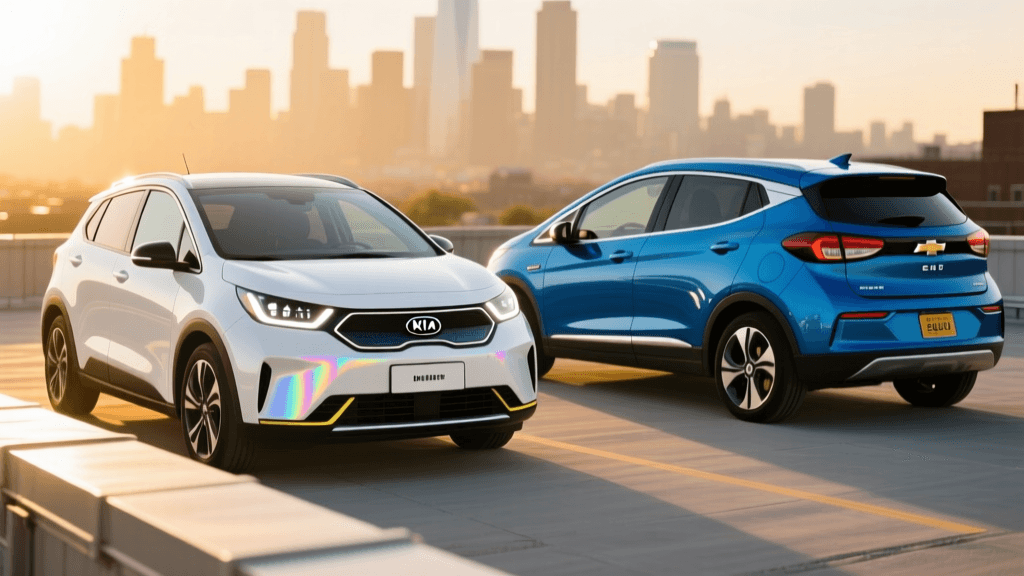
The sub-$40,000 electric vehicle segment is currently undergoing a seismic shift. As automakers pivot toward next-generation architectures and prepare for a unified charging standard, early adopters and budget-conscious buyers are left navigating a complex transitional market. At the center of this storm are two highly capable, yet fundamentally different, contenders: the Kia Niro EV and the Chevrolet Bolt EUV. While the Bolt EUV represents the twilight of GM’s pioneering but aging BEV2 platform, the Niro EV showcases Kia’s modern, dedicated EV strategy. Understanding how these two vehicles fit into the broader industry outlook is critical for anyone looking to maximize long-term value, range, and usability.
The Shifting Landscape of Budget Electric Vehicles
The affordable EV market is no longer just about compliance cars; it is a fierce battleground for market share. General Motors temporarily discontinued the Bolt lineup after 2023 to retool its factories for the Ultium platform, though a next-generation Bolt has been confirmed for the future. This makes the current Bolt EUV a 'legacy bargain'—a vehicle with proven reliability but aging underlying tech. Conversely, Kia has continuously refined the Niro EV, recently updating it with a more sophisticated powertrain, faster charging capabilities, and advanced driver assistance systems (ADAS). Looking ahead, the industry is trending toward Lithium Iron Phosphate (LFP) batteries for budget models to cut costs and improve lifespan, but both the current Niro and Bolt still utilize traditional Nickel Manganese Cobalt (NMC) chemistries. Evaluating them today requires a lens focused on future-proofing, charging infrastructure transitions, and total cost of ownership.
Kia Niro EV vs Chevrolet Bolt EUV: By the Numbers
Before diving into the future outlook, let us establish the baseline specifications of these two budget-friendly crossovers based on their most recent production models.
| Feature | Kia Niro EV (Wind/EX) | Chevrolet Bolt EUV (Premier) |
|---|---|---|
| Base MSRP (Approx.) | $39,600 | $33,295 (Pre-Discontinuation) |
| EPA Estimated Range | 239 miles | 247 miles |
| Battery Capacity | 64.8 kWh (Liquid-Cooled) | 65.0 kWh (Liquid-Cooled) |
| Peak DC Fast Charging | 85 kW (10-80% in ~45 mins) | 55 kW (10-80% in ~60 mins) |
| Charging Port Standard | CCS (Combined Charging System) | CCS (Combined Charging System) |
| Cargo Space (Behind Rear Seats) | 22.8 cu-ft | 16.3 cu-ft |
| Platform Architecture | 3rd Gen Dedicated EV Platform | BEV2 (Modified ICE Architecture) |
Battery Chemistry and the LFP Horizon
Both the Niro EV and Bolt EUV utilize liquid-cooled NMC lithium-ion battery packs, which offer excellent energy density and cold-weather performance compared to the air-cooled packs of early EVs. According to the EPA Green Vehicle Guide, proper thermal management is crucial for long-term battery health and minimizing degradation. However, the future of budget EVs heavily points toward LFP (Lithium Iron Phosphate) batteries. LFP chemistries are cheaper to produce, do not require cobalt, and can be charged to 100% daily without significant degradation. While neither the Niro nor the current Bolt EUV features LFP, buyers should be aware that future iterations in this price bracket likely will. For current owners, this means maximizing the utility of the existing NMC packs by adhering to the 80% daily charge limit rule, reserving 100% charges only for road trips.
The NACS Charging Standard: A Future-Proofing Dilemma
Perhaps the most significant industry trend affecting these two vehicles is the North American Charging Standard (NACS). Originally developed by Tesla, NACS has been adopted by nearly every major automaker, including GM and Kia, for future models. The SAE International J3400 standard officially standardizes the NACS connector, signaling the eventual phase-out of the CCS connector in North America. Both the Niro EV and Bolt EUV are equipped with CCS ports. For current and near-future buyers, this means relying on CCS adapters to access the Tesla Supercharger network. Kia has been proactive in offering NACS adapters to its EV owners, while GM has also rolled out adapter programs for Bolt owners. When purchasing either vehicle today, securing a certified CCS-to-NACS adapter is an absolute necessity for future-proofing your road trip capabilities, as the US Department of Energy notes that charging infrastructure is rapidly consolidating around the NACS ecosystem.
Interior Packaging: Dedicated Platform vs. Clever Conversion
From an engineering standpoint, the Bolt EUV is a marvel of packaging. Built on GM’s older BEV2 platform—which was originally designed to accommodate internal combustion engines—Chevy managed to fit a 65 kWh battery and create a surprisingly spacious cabin. However, the compromise is evident in the tall ride height, the intrusive center tunnel in the rear seat, and the smaller 16.3 cu-ft cargo area. The Kia Niro EV, built on a more modern, EV-optimized iteration of Kia's K-platform, offers a lower center of gravity, a flat rear floor, and a vastly superior 22.8 cu-ft of cargo space. As the industry moves toward dedicated 'skateboard' architectures that maximize interior volume by pushing wheels to the corners, the Niro EV feels much closer to the future of EV spatial design than the Bolt EUV.
Software, ADAS, and the OTA Evolution
The future of the automotive industry relies heavily on Software-Defined Vehicles (SDVs) and Over-The-Air (OTA) updates. Here, Kia holds a distinct advantage. The Niro EV features Kia’s latest infotainment architecture with robust OTA capabilities, allowing for remote updates to battery management systems, navigation, and ADAS features. Its Highway Driving Assist (HDA) is highly refined, offering smooth lane centering and adaptive cruise control. The Bolt EUV made history by offering GM’s hands-free Super Cruise on select models, a massive technological leap for a budget car. However, GM’s older infotainment software in the Bolt lacks the seamless, smartphone-like responsiveness and deep OTA integration found in Kia’s newer systems. As software becomes a primary differentiator in EV ownership, the Niro’s modern digital architecture offers a more future-proof user experience.
Total Cost of Ownership and Resale Value Outlook
When evaluating the long-term financial outlook, the Bolt EUV’s discontinuation creates a unique market dynamic. Because GM halted production, well-maintained, low-mileage Bolt EUVs are holding their value surprisingly well on the used market, driven by enthusiasts who recognize it as the ultimate value proposition in EV history. However, long-term parts availability and software support for a discontinued platform remain a slight risk. The Kia Niro EV, being part of a continuous, global production line, offers a more predictable depreciation curve and guaranteed long-term dealer support. Furthermore, Kia’s industry-leading 10-year/100,000-mile powertrain and battery warranty provides immense peace of mind for buyers planning to hold the vehicle for a decade or more.
Actionable Buyer Advice for the Current Market
- For the Bolt EUV Hunter: If you can find a remaining new or Certified Pre-Owned Bolt EUV with the Super Cruise package, buy it immediately. It is a discontinued collectible that offers unmatched tech-per-dollar, but be prepared to purchase a third-party CCS-to-NACS adapter for future travel.
- For the Niro EV Shopper: Leverage Kia’s frequent lease cash incentives and federal/state tax credits. The Niro is the smarter long-term hold due to its modern platform, better cargo utility, and seamless integration into Kia’s ongoing OTA software ecosystem.
- Charging Strategy: Regardless of your choice, install a Level 2 (240V) home charger. Both vehicles suffer from mediocre DC fast-charging speeds (55kW to 85kW) compared to modern 800V architectures like the Hyundai Ioniq 5. Home charging mitigates this flaw entirely.
Final Verdict: Navigating the Budget EV Transition
The Chevrolet Bolt EUV will forever be remembered as the vehicle that democratized EV range and advanced ADAS for the masses. It remains an incredible bargain if you can secure one, offering 247 miles of range and Super Cruise for a price that no new EV can currently match. However, it is a relic of a bygone engineering era. The Kia Niro EV represents the present and future of the budget EV segment. With its superior cargo capacity, faster charging speeds, modern software architecture, and long-term warranty support, the Niro EV is the more rational, future-proof investment for buyers who plan to keep their vehicles well into the next decade. As the industry transitions to NACS and LFP batteries, the Niro’s dedicated EV foundation positions it to weather the shifting tides of the electric revolution far better than its discontinued rival.