The Electric Truck Revolution: Separating Fact from Fiction
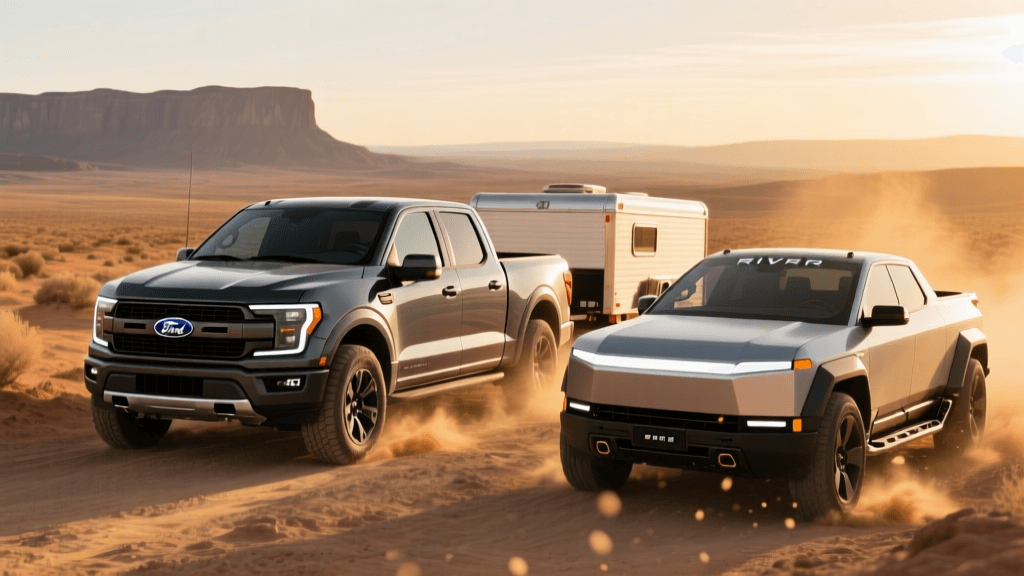
The electric vehicle market has expanded rapidly from commuter sedans into the rugged, high-stakes world of pickup trucks. Leading this charge are two heavyweights: the Rivian R1T and the Ford F-150 Lightning. As early adopters and traditional truck buyers alike consider making the switch, a massive cloud of misinformation has followed these vehicles. From exaggerated towing capabilities to fundamental misunderstandings about their underlying architectures, buyers are often making decisions based on internet rumors rather than engineering facts.
In this comprehensive head-to-head comparison, we are putting on our myth-busting hats. We will dismantle the most common misconceptions surrounding the Rivian R1T and the Ford F-150 Lightning, highlight the critical mistakes buyers make when specing their electric trucks, and provide a clear, data-driven verdict on which rig belongs in your driveway.
Myth #1: The F-150 Lightning is Just a Gas F-150 with Batteries
One of the most persistent myths in the EV space is that the Ford F-150 Lightning is merely a traditional internal combustion engine (ICE) F-150 where the engine has been swapped for batteries. This misconception leads many traditional truck buyers to assume they know exactly how the Lightning will drive, handle, and perform. In reality, this is entirely false.
While Ford did utilize familiar exterior styling and cabin layouts to ease the transition for legacy buyers, the underlying architecture is radically different. According to Ford's official F-150 Lightning specifications, the Lightning features a fully independent rear suspension—a first for the F-150 lineup. This was necessitated by the placement of the massive battery pack within the frame rails, which required a redesign of the rear axle to maintain ground clearance and cargo capacity. The result is a truck that rides significantly smoother when unloaded compared to its solid-axle gas counterparts. Furthermore, the removal of the front engine allowed Ford to introduce the Mega Power Frunk, a lockable, weather-sealed front trunk with 400 pounds of payload capacity and built-in power outlets, fundamentally changing the truck's utility profile.
Myth #2: The Rivian R1T is an Adventure Toy, Not a Serious Work Truck
Because of its sleek, minimalist design, integrated Camp Kitchen options, and premium price tag, the Rivian R1T is frequently dismissed by traditionalists as a lifestyle toy for tech executives rather than a capable work truck. This is a massive disservice to Rivian's engineering team.
As detailed in Rivian's R1T engineering and capability overview, the R1T is built on a highly rigid, reinforced steel skateboard chassis that boasts a maximum towing capacity of 11,000 pounds. To put that in perspective, that matches or exceeds the towing limits of many half-ton gas trucks on the market. The R1T's quad-motor setup (available on specific trims) provides precise torque vectoring to each individual wheel, granting it off-road traction capabilities that rival dedicated rock crawlers. With a maximum ground clearance of 14.9 inches thanks to its adaptive air suspension, and a unique Gear Tunnel that spans the width of the vehicle for secure, out-of-sight storage, the R1T is a highly capable, heavy-duty machine disguised in a luxury lifestyle wrapper.
Common Mistake #1: Ignoring the 'Towing Range Cliff'
The single most expensive mistake new EV truck buyers make is specing their battery size based on unloaded EPA range estimates, completely ignoring the physics of towing. Towing a heavy, aerodynamically inefficient trailer with an electric truck will decimate your range. It is not uncommon to see a 40% to 50% reduction in total range when pulling a large box trailer at highway speeds.
According to data and principles outlined by the U.S. Department of Energy's Alternative Fuels Data Center, electric vehicles are highly sensitive to increased weight and aerodynamic drag. Unlike gas trucks, which operate at peak thermal efficiency under heavy load on the highway, EVs expend exponentially more energy pushing air out of the way of a flat-fronted trailer.
Real-World Towing Range Estimate Chart
Below is a practical comparison chart illustrating how battery size translates to real-world utility when towing. Note that these are estimates based on pulling a 5,000 lb enclosed box trailer at 65 mph.
| Vehicle Model | Battery Configuration | EPA Est. Range (Unloaded) | Est. Range (Towing 5k lb Box Trailer) | Est. Range (Towing 8k lb Boat) |
|---|---|---|---|---|
| Ford F-150 Lightning | Standard Range (98 kWh) | 240 miles | ~110 - 120 miles | ~140 - 150 miles |
| Ford F-150 Lightning | Extended Range (131 kWh) | 320 miles | ~150 - 160 miles | ~190 - 200 miles |
| Rivian R1T | Large Pack (135 kWh) | 352 miles | ~160 - 175 miles | ~210 - 220 miles |
| Rivian R1T | Max Pack (149 kWh) | 410 miles | ~190 - 205 miles | ~250 - 260 miles |
Actionable Advice: If you plan to tow more than a few times a year, do not settle for the Standard Range Lightning or the base Rivian battery. You must upgrade to the Extended or Max packs. Furthermore, map out DC Fast Charging networks along your towing routes, as you will likely need to stop every 90 to 120 minutes when towing heavy loads.
Common Mistake #2: Underestimating Home Charging Infrastructure Costs
Buyers frequently focus on the sticker price of the truck and forget that an EV truck requires a massive influx of electrons. The F-150 Lightning Extended Range and the Rivian R1T Max Pack feature battery capacities hovering around 131 kWh and 149 kWh, respectively. Plugging these behemoths into a standard 120V wall outlet is virtually useless, adding barely 2 miles of range per hour.
Even a standard 32-amp Level 2 home charger will take over 24 hours to charge a depleted Max Pack R1T from 0% to 100%. To properly own an electric truck, you need a high-amperage, hardwired Level 2 charger.
- The 80-Amp Requirement: To utilize the Ford Charge Station Pro (80A) or the Rivian Wall Charger (48A to 80A capable), you need a dedicated 100-amp circuit in your electrical panel.
- Panel Upgrades: Many older homes have 100-amp or 150-amp main electrical services. Adding a 100-amp EV circuit will require a costly upgrade to a 200-amp or even 400-amp electrical service, which can cost anywhere from $2,500 to $5,000+ depending on your municipality and utility provider.
- The NACS Transition: Both Ford and Rivian are transitioning to the North American Charging Standard (NACS / Tesla plug). Buyers must factor in the cost and availability of adapters if purchasing older CCS-equipped models, or ensure their home chargers are NACS-compatible for future-proofing.
Actionable Advice: Before putting a deposit down on an F-150 Lightning or R1T, hire a licensed electrician to perform a load calculation on your home's electrical panel. Factor a potential $3,000 panel upgrade into your total cost of ownership.
Head-to-Head: Technology, Space, and Daily Usability
Beyond the myths and the charging logistics, how do these trucks compare in daily life? The Ford F-150 Lightning wins on pure interior space and traditional truck ergonomics. It offers a full-size rear bench seat that comfortably fits three adults, a massive 5.5-foot bed, and the aforementioned Frunk. It is designed to be a seamless replacement for a contractor's daily driver or a family's weekend hauler.
The Rivian R1T, conversely, wins on innovation and outdoor lifestyle integration. Its bed is slightly shorter at 4.5 feet, and the rear cabin is noticeably tighter, making it less ideal for tall rear-seat passengers. However, the R1T makes up for it with the Gear Tunnel (a massive lockable storage space behind the rear seats), built-in air compressors, and an available pull-out Camp Kitchen that redefines tailgating. The R1T is a purpose-built adventure vehicle, whereas the Lightning is a traditional workhorse that happens to be electric.
The Final Verdict: Which EV Truck Should You Buy?
The choice between the Rivian R1T and the Ford F-150 Lightning comes down to your primary use case, budget, and tolerance for compromise.
Choose the Ford F-150 Lightning if: You need a traditional truck footprint, maximum interior passenger space, and a lower starting price. The Lightning is the ultimate choice for fleet managers, contractors, and families who need a versatile, no-nonsense workhorse that can double as a comfortable daily commuter. Just be sure to spec the Extended Range battery if you plan on hitting the highway.
Choose the Rivian R1T if: You prioritize off-road capability, cutting-edge technology, and outdoor lifestyle features. The R1T is perfect for the avid camper, skier, or overlander who values the quad-motor traction, adaptive air suspension, and clever storage solutions like the Gear Tunnel. It commands a premium price, but it offers a driving dynamics and luxury experience that the Ford simply cannot match.
By avoiding the common pitfalls of towing range miscalculations and home charging oversight, you can ensure that whichever electric truck you choose will be a revolutionary upgrade to your daily drive.