The Evolution of Electric Performance: Beyond Straight-Line Speed
When the first wave of mainstream electric vehicles hit the market, the automotive world was captivated by a single metric: straight-line acceleration. The instant torque of electric motors made supercar-beating 0-60 mph times accessible to everyday sedans. However, as the industry matures, the definition of a true performance EV has fundamentally shifted. Today, the best performance electric vehicles ranked by acceleration and handling are defined not just by their ability to launch, but by their cornering dynamics, thermal endurance, and software-defined agility. We are entering an era where AI-driven torque vectoring, active aerodynamics, and predictive thermal management dictate the hierarchy of electric sports cars.
From an industry outlook perspective, the future of EV performance is moving away from brute-force battery sizing toward intelligent power distribution and weight optimization. Automakers are now focused on reducing unsprung mass, integrating solid-state battery chemistries, and utilizing tri-motor layouts to manipulate the vehicle's yaw center. This guide ranks the current apex predators of the EV world while analyzing the future trends that will dictate the next decade of electric handling and acceleration.
How We Rank: Acceleration, Handling, and Future-Proof Tech
To rank the top performance EVs, we evaluate three core pillars: Acceleration (0-60 mph, quarter-mile times, and 1/8-mile trap speeds), Handling Dynamics (skidpad grip, slalom performance, steering feel, and suspension tuning), and Future-Readiness (thermal management architecture, over-the-air update capabilities, and advanced torque vectoring). A vehicle that can hit 60 mph in two seconds but suffers from severe battery thermal throttling after one track lap will rank lower than a slightly slower car with superior endurance and cornering poise.
The Apex Predators: Best Performance EVs Ranked
1. Porsche Taycan Turbo GT: The Track-Ready Benchmark
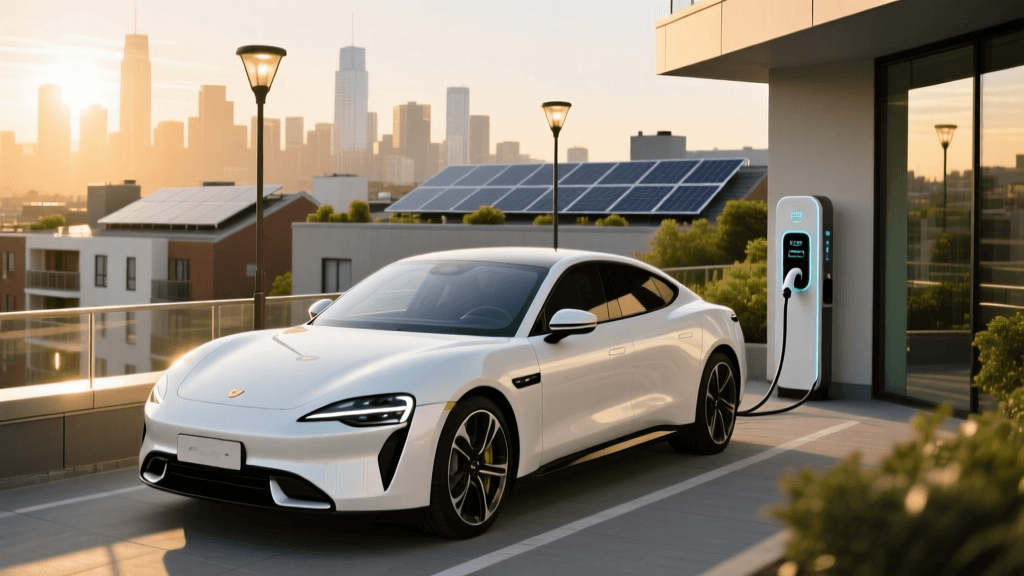
The Porsche Taycan Turbo GT represents the pinnacle of current handling dynamics paired with mind-bending acceleration. Generating up to 1,019 horsepower with the Attack Mode engaged, the Turbo GT with the Weissach Package sprints to 60 mph in an astonishing 2.1 seconds. But its true mastery lies in its handling. Porsche has meticulously engineered the active aerodynamics and the 2-speed rear transmission to provide a mechanical feel that is increasingly rare in the EV space. According to instrumented testing by Car and Driver, the Taycan's ability to maintain consistent lap times without severe thermal degradation sets the benchmark for all other electric sports cars. Looking forward, Porsche's 800-volt architecture and advanced heat pump systems preview the heavy-duty thermal management required for next-gen track EVs.
2. Lucid Air Sapphire: The Tri-Motor Masterpiece
Lucid Motors proved that a luxury sedan could out-accelerate hypercars with the Air Sapphire. Utilizing a three-motor setup (one front, two rear), it produces 1,234 horsepower and achieves a 1.89-second 0-60 mph time. The Sapphire's handling is where the future of EV torque vectoring shines. By independently controlling the torque sent to each rear wheel, the Sapphire rotates through corners with an agility that defies its 5,200-pound curb weight. This software-defined differential eliminates the need for heavy, complex mechanical limited-slip differentials, pointing toward a future where vehicle dynamics are controlled entirely by microsecond electrical adjustments.
3. Tesla Model S Plaid: The Value King of Hypercar Acceleration
The Tesla Model S Plaid remains an anomaly in the performance EV sector, offering 1,020 horsepower and a 1.99-second 0-60 mph time for a fraction of the cost of its European rivals. Its carbon-sleeved rotors allow the tri-motor powertrain to sustain top speeds up to 200 mph without the motors tearing themselves apart at high RPMs. While its handling and steering feedback (especially with the controversial Yoke) do not quite match the analog precision of Porsche, its straight-line dominance and continuous over-the-air software improvements keep it highly relevant in the future performance landscape.
4. Hyundai Ioniq 5 N: The Future of Simulated Engagement
The Hyundai Ioniq 5 N may not win the 0-60 mph drag race (hitting the mark in roughly 3.2 seconds), but it is arguably the most important performance EV for the future of driver engagement. Hyundai's N division has introduced N e-Shift, which simulates the torque interruptions and physical jolts of an 8-speed dual-clutch transmission, complete with simulated rev-matching. As noted in deep-dive analyses by Electrek, the Ioniq 5 N tackles the industry's biggest challenge: emotional connection. By using software to create artificial friction and feedback, Hyundai is pioneering a new category of 'synthetic engagement' that future performance EVs will likely adopt to satisfy enthusiast drivers.
5. Rimac Nevera: The Hypercar Horizon
The Rimac Nevera sits at the absolute ceiling of electric performance. With 1,914 horsepower and a 1.74-second 0-60 mph time, it is a halo car that showcases the extreme limits of battery discharge rates and carbon-fiber monocoque construction. The Nevera's AI-driven All-Wheel Drive system monitors driver inputs and track conditions, adjusting power delivery to all four wheels over 100 times per second. It serves as a rolling laboratory for the extreme-performance EV trends that will eventually trickle down to mainstream sports cars over the next decade.
Data Table: Performance Metrics & Future Tech Integration
| Vehicle | 0-60 mph (sec) | Peak HP | Drive Layout | Key Future-Proof Technology |
|---|---|---|---|---|
| Porsche Taycan Turbo GT | 2.1 | 1,019 | Dual Motor AWD | Active Aero, 2-Speed Rear Axle, 800V Thermal Prep |
| Lucid Air Sapphire | 1.89 | 1,234 | Tri-Motor AWD | Software-Defined Torque Vectoring, Miniaturized Motors |
| Tesla Model S Plaid | 1.99 | 1,020 | Tri-Motor AWD | Carbon-Sleeved Rotors, Predictive OTA Track Modes |
| Hyundai Ioniq 5 N | 3.2 | 641 | Dual Motor AWD | Synthetic Engagement (N e-Shift), Active Sound Design |
| Rimac Nevera | 1.74 | 1,914 | Quad Motor AWD | AI Driver Coach, 100x/sec Torque Adjustments |
Future Trends: What’s Next for EV Handling and Acceleration?
As we look toward the 2026-2030 product cycles, several transformative technologies will redefine how performance EVs accelerate and handle.
- Solid-State Batteries and Weight Reduction: The heaviest penalty for current EVs is battery mass. The transition to solid-state batteries promises higher energy density and reduced physical weight. According to research tracked by the U.S. Department of Energy, advancements in solid-state and advanced lithium-metal chemistries will drastically improve specific energy. A lighter battery pack lowers the vehicle's center of gravity and reduces polar moment of inertia, resulting in sharper turn-in and less tire wear during high-G cornering.
- Predictive AI Torque Vectoring: Future EVs will not just react to wheel slip; they will predict it. By fusing GPS topography data, LiDAR, and forward-facing cameras, the vehicle's ECU will pre-load torque to specific wheels before the driver even initiates a steering input. This will allow heavy EVs to corner with the rotational agility of mid-engine combustion cars.
- Morphing Active Aerodynamics: While active spoilers exist today, the next generation features morphing body panels. Micro-actuators will alter the curvature of the hood, fenders, and underbody diffusers in real-time to balance drag reduction on straights with massive downforce generation in braking zones, effectively eliminating the need for large, drag-inducing fixed rear wings.
Buyer Advice: Investing in Tomorrow's Performance EVs Today
If you are in the market for a performance EV today, but want to ensure your investment remains relevant as the industry evolves, prioritize thermal management over peak horsepower. A vehicle with an advanced heat pump, battery pre-conditioning for track use, and direct oil-cooling for the stators will offer vastly superior long-term value and resale potential compared to air-cooled or standard liquid-cooled systems that suffer from thermal throttling.
Additionally, look for manufacturers with a proven track record of Over-The-Air (OTA) updates that specifically target chassis and powertrain dynamics. Brands that treat the vehicle's handling profile as evolving software—allowing you to download new torque-vectoring maps or track-specific suspension damping profiles—will offer a future-proof ownership experience. Finally, consider the charging architecture; an 800-volt (or higher) system is now mandatory for any serious performance EV, ensuring that high-amperage DC fast charging does not degrade the battery cells during repeated track-day sessions. The future of EV performance is not just about how fast you can go, but how intelligently you can manage the energy that gets you there.