The Evolution of the American Interstate EV Corridor
The landscape of the American road trip is undergoing a seismic shift. For the past decade, electric vehicle (EV) owners planning cross-country journeys had to navigate a fragmented patchwork of charging networks, often facing unreliable hardware, incompatible connectors, and vast 'charging deserts' along rural interstate routes. However, as we look toward 2025 and beyond, the future of interstate highway EV charging corridor coverage is being fundamentally rewritten by massive federal investments, industry-wide standardization, and aggressive private-sector expansion. The days of range anxiety on major U.S. highways are rapidly drawing to a close, replaced by an era of high-speed, ultra-reliable megacharging hubs strategically positioned along the national freight and passenger corridors.
Understanding where these corridors are expanding, which networks are leading the charge, and how new federal mandates are reshaping the map is critical for both current EV owners and prospective buyers. This analysis dives deep into the future trends of interstate charging infrastructure, evaluating the impact of the National Electric Vehicle Infrastructure (NEVI) program, the universal adoption of the North American Charging Standard (NACS), and the technological innovations solving the rural highway bottleneck.
The NEVI Program: Reshaping Highway Charging by 2026
The most significant catalyst for interstate charging expansion is the federal government's NEVI Formula Program, established under the Bipartisan Infrastructure Law. Administered jointly by the Federal Highway Administration (FHWA) and the Department of Energy, this initiative provides $5 billion in funding to states to build out a cohesive national network. According to the FHWA NEVI program guidelines, the mandate is incredibly specific and highly impactful for highway travelers: states must prioritize funding for charging stations located along designated Alternative Fuel Corridors, specifically within one travel mile of an interstate highway exit.
Furthermore, the NEVI requirements dictate that each funded station must feature a minimum of four charging ports capable of delivering at least 150 kW of power simultaneously. This four-port minimum is a game-changer for interstate travel, as it directly addresses the issue of queueing and congestion at highway rest stops during peak holiday travel seasons. By 2026, the NEVI program aims to ensure that drivers can travel along any major U.S. interstate and find a reliable, high-speed charging hub every 50 miles. This standardized spacing effectively eliminates the psychological barrier of 'range gap' anxiety, ensuring that even EVs with smaller battery packs or those towing lightweight trailers can comfortably traverse the national highway system without risking a dead battery in remote areas.
The NACS Revolution: Tesla Superchargers Open the Corridors
No discussion of the future of highway charging is complete without addressing the industry's rapid consolidation around the North American Charging Standard (NACS), originally developed by Tesla. With major automakers including Ford, General Motors, Rivian, Volvo, and Hyundai committing to NACS-equipped vehicles starting in 2025, the Tesla Supercharger network—which has long been the gold standard for highway reliability—is opening its doors to the broader EV market. This transition is dramatically altering interstate corridor coverage.
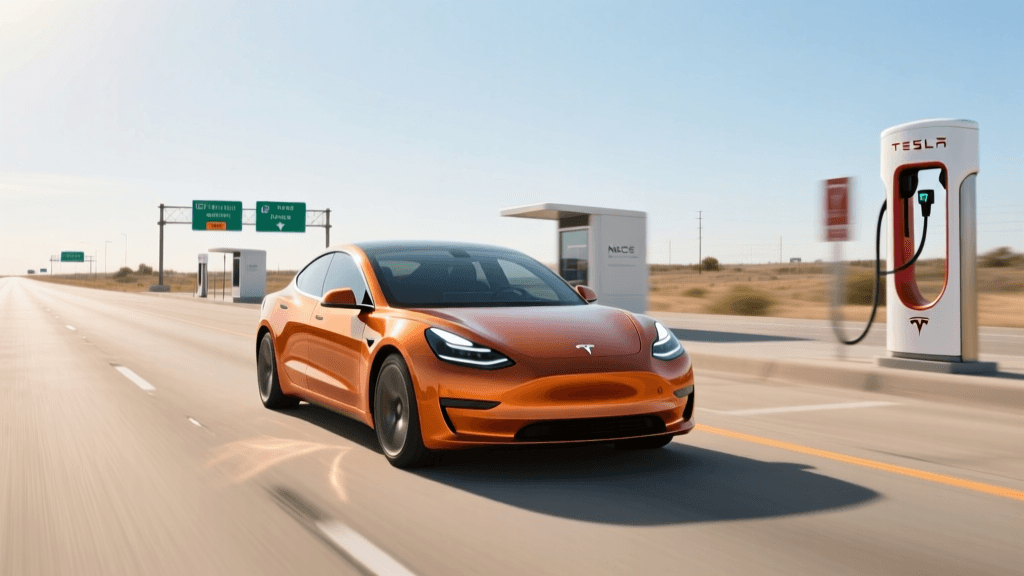
Tesla has begun retrofitting select high-traffic highway Supercharger stations with the 'Magic Dock,' a built-in CCS adapter that allows non-Tesla EVs to charge without needing a separate dongle. More importantly, as native NACS vehicles hit the road, Tesla is deploying its V4 Supercharger cabinets, which support up to 350 kW for passenger vehicles and feature longer cables to accommodate the varied charge port locations of competitor vehicles. For the interstate traveler, this means the most robust and reliable highway charging network in the country is effectively doubling its addressable market, leading to increased revenue for Tesla and, consequently, faster expansion of Supercharger stalls along secondary and tertiary interstate routes that were previously deemed unprofitable.
Major Network Highway Expansion Strategies
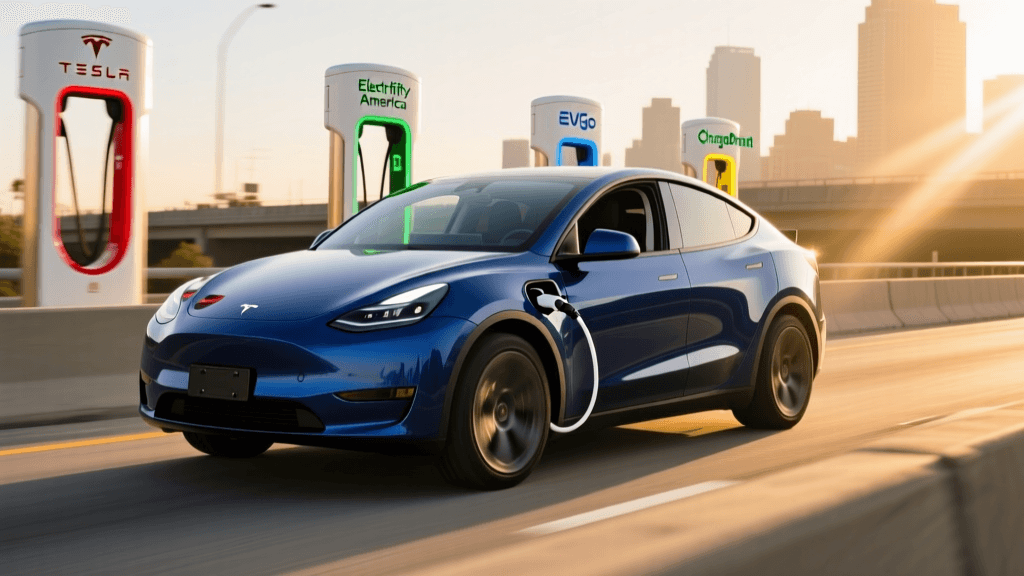
While Tesla dominates the conversation, legacy charging networks are not standing still. Electrify America, EVgo, and ChargePoint are aggressively pivoting their strategies from retail-based destination charging to dedicated highway travel center hubs. Partnerships with major truck stop operators like Pilot, Flying J, and Love's Travel Stops are resulting in the deployment of 'megacharger' plazas. These plazas are designed specifically for the interstate traveler, featuring pull-through lanes that accommodate EVs towing trailers—a massive pain point at older, retail-located charging stations.
To understand how these networks stack up regarding future corridor coverage, review the comparison chart below:
| Network | Primary Highway Presence | Max Charging Speed | Connector Standard | 2025 Corridor Outlook |
|---|---|---|---|---|
| Tesla Supercharger | Nationwide (Dense) | 250 kW (V3) / 350 kW (V4) | NACS | Opening to all EVs via Magic Dock & native cables; expanding rural routes. |
| Electrify America | Major Interstates & Retail | 350 kW | CCS / NACS (Adapters) | Deploying ultra-fast megacharger hubs at travel centers with battery buffering. |
| EVgo | Urban & Highway Corridors | 350 kW | CCS / NACS | Deep partnership with Pilot/Flying J & GM to build 50-mile spaced highway hubs. |
| ChargePoint | Retail & Select Highways | 400 kW (Express Plus) | CCS / NACS | Focusing on modular highway hubs and heavy-duty fleet corridor charging. |
As highlighted by the Joint Office of Energy and Transportation, the collaboration between private networks and federal oversight is ensuring that these expansions are not redundant, but rather complementary, filling in the specific geographic gaps left by competitors.
Overcoming the 'Charging Desert' Bottlenecks
Despite these advancements, specific interstate corridors remain stubbornly challenging. Routes such as I-80 through Wyoming and Nebraska, or I-10 through the vast expanses of West Texas, suffer from weak electrical grid capacity. Upgrading rural utility infrastructure to support four simultaneous 350 kW chargers can take years and cost millions of dollars per site. The industry's solution to this bottleneck is the rapid deployment of Battery Energy Storage Systems (BESS) at charging stations.
By installing large-scale battery banks on-site, networks can trickle-charge the batteries from the local, low-capacity grid over 24 hours, and then discharge that stored energy into EVs at ultra-high speeds when travelers arrive. This 'battery-buffered' charging allows networks to place 350 kW chargers in remote highway locations without waiting for utility companies to upgrade local transformers. Expect to see BESS-integrated highway stations become the standard for rural interstate corridors by 2026, effectively erasing the last remaining charging deserts on the U.S. map.
Actionable Advice for Future Interstate Road Trips
As the infrastructure evolves, so too must the strategies of the EV road tripper. To maximize efficiency and reliability on future interstate journeys, consider the following actionable advice:
- Preconditioning is Non-Negotiable: Modern 800-volt EV architectures (like the Hyundai Ioniq 5, Kia EV6, and Porsche Taycan) can accept speeds over 250 kW, but only if the battery is at the optimal temperature. Always use your vehicle's native navigation system to route to the charger, which triggers the battery thermal preconditioning automatically.
- Target Travel Centers Over Retail: When planning your route via apps like A Better Routeplanner (ABRP) or PlugShare, prioritize chargers located at dedicated travel centers (Pilot, Flying J, Buc-ee's). These locations offer 24/7 access, dedicated EV pull-through lanes, and better lighting and security compared to retail strip malls that may close overnight.
- Monitor NEVI Rollouts: Keep an eye on your state's Department of Transportation announcements regarding NEVI funding awards. New stations are opening monthly along interstate corridors, often providing a year of free or heavily subsidized charging to attract early adopters.
- Carry a High-Quality NACS-to-CCS Adapter: If you drive a legacy CCS vehicle, purchasing an official, high-amperage adapter (such as the Tesla-issued adapter or the Lectron Vortex) is essential for accessing the expanding Supercharger highway network safely without melting connectors.
2030 Outlook: Automated and Wireless Highway Charging
Looking further ahead to 2030, the concept of the interstate charging corridor will expand beyond the physical charging stall. Industry pilots are currently testing inductive (wireless) charging pads embedded directly into highway rest stop parking bays, allowing vehicles to charge without ever plugging in. Furthermore, as autonomous driving features become more sophisticated on highway stretches, we anticipate the introduction of automated valet charging at major interstate hubs. In this scenario, a driver would exit the vehicle at a travel center drop-off zone, and the vehicle would autonomously navigate to an available charging stall, plug itself in via robotic arm or wireless pad, and return to the driver once the journey is ready to resume.
For now, the combination of NEVI funding, NACS standardization, and battery-buffered rural hubs is rapidly maturing the U.S. interstate charging network. The data from the Alternative Fuels Data Center confirms that the density and reliability of highway chargers are scaling exponentially. The future of the American interstate EV road trip is not just viable; it is becoming faster, more seamless, and vastly superior to the legacy gas station model of the past century.