The Great Rural EV Myth: "You Can't Charge Out Here"
When discussing the electric vehicle revolution, the conversation often centers on urban and suburban landscapes. City dwellers debate curbside charging, while suburbanites argue over HOA rules for garage installations. Meanwhile, a pervasive myth has taken root regarding rural America: the idea that driving an EV outside a major metropolitan area is a logistical nightmare fraught with range anxiety and nonexistent infrastructure. This narrative suggests a massive "rural charging gap" that makes EV ownership impractical for those living in agricultural, remote, or low-density regions.
However, this perspective fundamentally misunderstands how EVs are actually fueled. While it is true that public DC Fast Charging (DCFC) density is lower in rural counties, the vast majority of EV charging—over 80 percent—happens at home or at a primary base of operations. For rural residents, the charging gap is rarely about public infrastructure; it is about optimizing private, residential, and agricultural electrical resources. In this guide, we will bust the most common myths about rural EV charging, highlight the critical mistakes new rural EV owners make, and provide actionable, hardware-specific solutions to bridge the gap.
Myth #1: Rural Electrical Grids Can't Support Level 2 Charging
The Myth: Rural power grids are outdated, fragile, and incapable of handling the heavy load of a 240-volt Level 2 EV charger without causing brownouts or requiring tens of thousands of dollars in utility upgrades.
The Reality: Rural electrical infrastructure is actually uniquely suited for high-draw appliances. Unlike dense urban apartments or older suburban homes with 100-amp main panels, rural properties, farms, and homesteads frequently utilize 200-amp to 400-amp services. Why? Because rural life requires heavy machinery. Well pumps, arc welders, large air compressors, grain dryers, and HVAC systems for large outbuildings all demand substantial 240V single-phase or even three-phase power. According to the Department of Energy's home charging guidelines, a standard Level 2 charger drawing 32 to 48 amps is roughly equivalent to running a heavy-duty electric clothes dryer or a moderate-sized well pump. If your rural property can run a welder in the barn, it can almost certainly charge an EV without requiring a utility transformer upgrade.
Myth #2: You Need a Public Fast Charger in Every Small Town
The Myth: To survive in a rural area, you need a Tesla Supercharger or Electrify America station on every Main Street and at every rural crossroads.
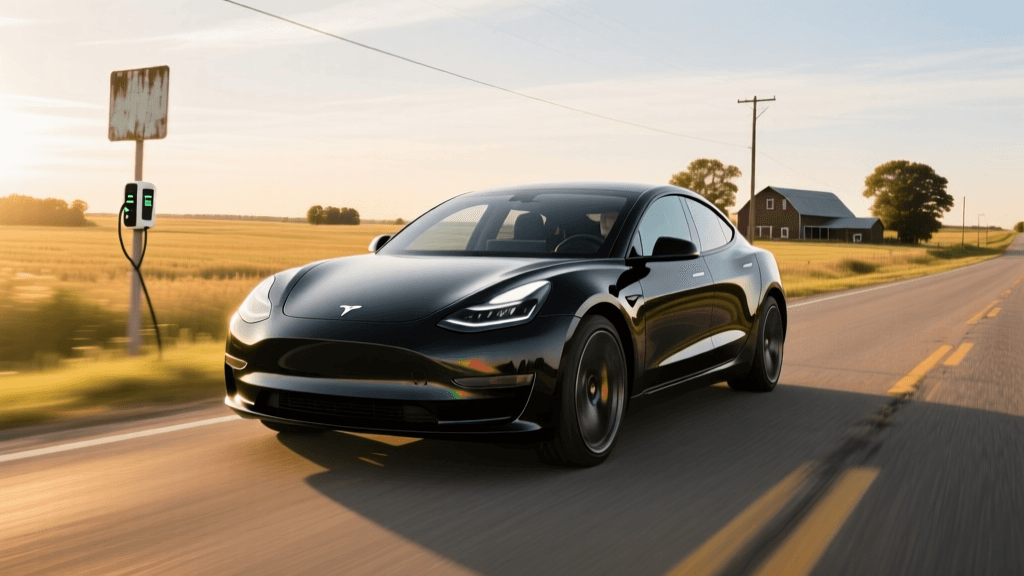
The Reality: Public DCFC networks are designed for highway corridor travel, not daily rural life. Relying on public fast charging is an urban habit born from a lack of home charging options (like street parking). Rural drivers typically have driveways, land, and outbuildings. The real solution to the rural charging gap is robust destination charging and home-base infrastructure. Furthermore, the Federal Highway Administration's NEVI program (National Electric Vehicle Infrastructure) is actively directing billions of dollars to build out fast-charging corridors along designated Alternative Fuel Corridors, ensuring that when rural drivers *do* need to travel cross-country, the highway gaps are rapidly closing.
Common Mistake #1: Settling for the Level 1 "Trickle" Trap
The single biggest mistake rural EV owners make is plugging their vehicle into a standard 120V household outlet (Level 1) and assuming it will suffice for their lifestyle. Level 1 charging typically delivers about 1.2 to 1.4 kW of power, translating to roughly 3 to 5 miles of range per hour of charging.
Consider a rural commuter who drives 45 miles each way to the nearest town for work or supplies—a 90-mile daily round trip. To recover 90 miles of range on a 120V outlet, the vehicle must be plugged in for 18 to 30 hours. This creates an artificial "charging gap" and severe range anxiety. Upgrading to a 240V Level 2 setup delivering 9.6 kW (40 amps) yields roughly 30 to 35 miles of range per hour. That same 90-mile commute is recovered in under three hours. Relying on Level 1 in a rural setting is a mathematical error that turns a highly convenient technology into a daily chore.
Common Mistake #2: Ignoring Detached Garages, Barns, and Pole Buildings
Many rural homeowners assume they must run a trench from their main house to install a charger in the driveway, which can cost thousands of dollars in excavation and conduit. The common mistake is ignoring existing outbuildings. Pole barns, detached workshops, and equipment sheds often already have 240V subpanels installed for power tools and farm equipment. Installing a weatherproof, hardwired Level 2 charger or a NEMA 14-50 receptacle in a detached barn is often significantly cheaper and more practical than modifying the main residential panel.
Actionable Solutions: Gear and Setups for Rural EV Owners
To conquer the rural charging landscape, you need equipment that can handle dust, temperature extremes, and long cable runs. Here are the most effective solutions:
1. Ruggedized Level 2 Chargers for Outbuildings
Standard indoor chargers with delicate touchscreens and thin plastic casings do not survive well in dusty barns or unheated pole buildings. The Grizzl-E Smart is widely considered the gold standard for rural and agricultural installations. It features a heavy-duty aluminum enclosure, an IP67 water and dust resistance rating, and an operating temperature range from -40°F to 104°F. It can be hardwired directly into a barn's 240V subpanel and delivers up to 40 amps (9.6 kW).
2. The Twist-Lock Advantage: NEMA L14-30 and L6-30
In agricultural settings, standard NEMA 14-50 plugs can sometimes vibrate loose or suffer from dust ingress. Many rural workshops utilize twist-lock receptacles like the NEMA L14-30 (30A, 125/250V) or L6-30 (30A, 250V). Purchasing a portable EVSE (Electric Vehicle Supply Equipment) like the Lectron V-BOX Pro or utilizing adapter cords from reputable EV accessory brands allows you to plug securely into existing farm infrastructure without hiring an electrician to install a new dedicated receptacle.
3. Smart Energy Management for Older Panels
If your rural home has an older 100-amp main panel that is already near capacity, you do not necessarily need a costly service upgrade. Devices like the Emporia Vue or the Wallbox Pulsar Plus with Power Meter offer dynamic load balancing. These systems monitor your home's real-time electrical usage and automatically throttle the EV charger's amperage down when heavy appliances (like a well pump or electric oven) kick on, preventing tripped breakers while maximizing charging speed when the house is idle.
Data Table: Rural vs. Urban EV Charging Profile
| Metric | Urban / Apartment Dweller | Rural / Agricultural Dweller |
|---|---|---|
| Primary Charging Location | Public Networks / Workplace | Home / Detached Outbuildings |
| Electrical Panel Capacity | Often limited (100A shared) | High (200A-400A for equipment) |
| Daily Mileage Requirement | 15 - 30 miles | 40 - 100+ miles |
| Level 2 Installation Hurdle | HOA approval, lack of dedicated parking | Trenching distance, subpanel capacity |
| Environmental Hardware Needs | Standard indoor / mild outdoor | IP67 rated, extreme temp tolerance |
Overcoming the Public Gap: Route Planning and Cooperative Power
While home charging solves 95% of rural EV needs, the remaining 5% involves long-distance travel where the public charging gap is most visible. To navigate this, rural drivers must master digital route planning. Apps like A Better Routeplanner (ABRP) are essential. Unlike standard navigation apps, ABRP factors in elevation changes—a critical detail in rural, mountainous, or hilly terrain where climbing a pass can drain a battery twice as fast as driving on flat city streets.
Furthermore, the future of rural public charging lies in Electric Cooperatives. According to data tracked by the Alternative Fuels Data Center, rural electric co-ops are increasingly installing destination chargers at local community centers, co-op offices, and rural grocery stores. These 50kW to 150kW chargers aren't meant for 15-minute highway pit stops; they are designed for rural residents to top up while shopping or attending community events, effectively turning routine errands into charging opportunities.
Conclusion: Reclaiming the Rural Advantage
The narrative that rural America is an "EV desert" is a myth born from an urban-centric view of charging infrastructure. Rural residents actually possess a distinct advantage: space, robust electrical infrastructure, and the ability to install high-capacity Level 2 charging at their home base. By avoiding the Level 1 trickle trap, leveraging existing agricultural outbuildings, investing in ruggedized hardware like the Grizzl-E, and utilizing smart route planning, rural drivers can entirely bypass the public charging gap. The future of rural EV ownership isn't about waiting for a Supercharger to be built in every small town; it's about harnessing the power already sitting in your barn.