Welcome to the Fast Lane: Understanding DC Fast Charging
Transitioning to an electric vehicle (EV) introduces a new vocabulary and a new set of habits, especially when it comes to refueling. While Level 2 home charging is the backbone of daily EV ownership, long road trips require a different solution: DC Fast Charging (DCFC). If you are new to the EV world, navigating the landscape of charging networks, plug types, and power outputs can feel overwhelming. This beginner's complete guide breaks down DC fast charging station speeds by network, helping you understand what to expect when you pull up to a public charging plaza.
Unlike Level 2 chargers that supply Alternating Current (AC) to your vehicle's onboard charger, DC Fast Chargers bypass the onboard charger entirely. They supply Direct Current (DC) straight to your battery pack at much higher power levels. According to the U.S. Department of Energy's FuelEconomy.gov, DC fast chargers can provide anywhere from 50 kilowatts (kW) to over 350 kW of power, potentially adding hundreds of miles of range in just 20 to 30 minutes.
The Charging Curve: Why Speed Isn't Constant
Before comparing networks, beginners must understand the "charging curve." When you plug into a DC fast charger, your EV does not charge at a constant speed. The Battery Management System (BMS) carefully regulates power intake to protect the battery cells from overheating and degradation.
- 0% to 20% State of Charge (SoC): Charging speeds ramp up quickly but may not immediately hit peak power as the battery warms up.
- 20% to 80% SoC: This is the "sweet spot" where your vehicle will accept peak or near-peak charging speeds.
- 80% to 100% SoC: The BMS drastically throttles the charging speed to a trickle to prevent overcharging and cellular damage. Charging from 80% to 100% on a DCFC can take just as long as charging from 10% to 80%.
Beginner Rule of Thumb: Always plan your road trip stops to charge only up to 80%. Unplugging and driving away at 80% is vastly more time-efficient than waiting for that final, agonizingly slow 20%.
DC Fast Charging Speed Comparison by Network
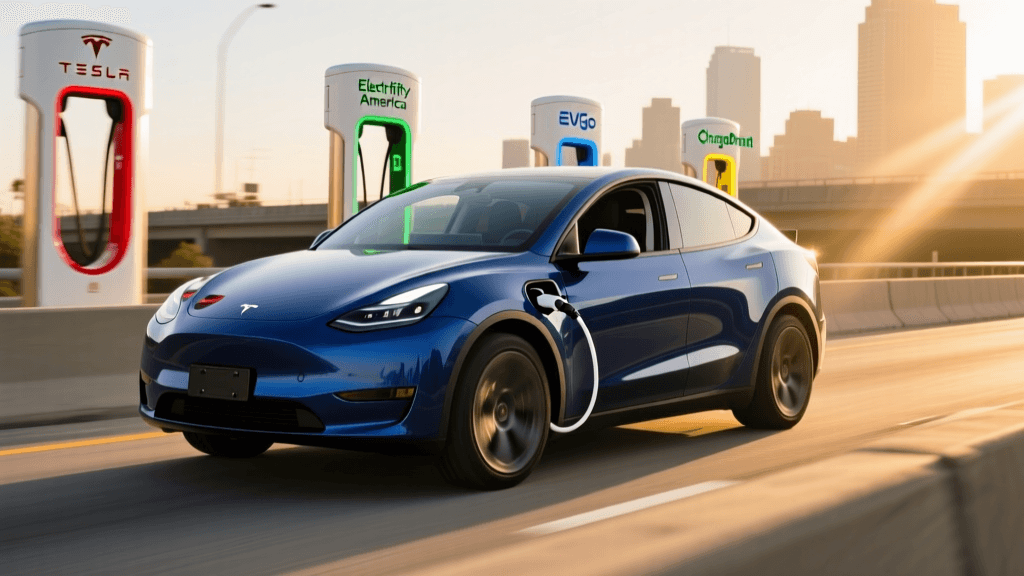
Not all charging networks are created equal. Hardware capabilities, maintenance standards, and maximum power outputs vary wildly across the major providers in North America. Below is a structured comparison of the primary DC fast charging networks.
| Charging Network | Max Advertised Speed | Typical Real-World Speed | Primary Connector Types | Network Reliability Rating |
|---|---|---|---|---|
| Tesla Supercharger | 250 kW (V3) / 350+ kW (V4) | 150 - 250 kW | NACS (Native), CCS (via adapter) | Excellent |
| Electrify America | 350 kW | 100 - 250 kW | CCS, NACS (rolling out) | Good (Improving) |
| EVgo | 350 kW (eXtend) | 50 - 150 kW | CCS, CHAdeMO, NACS | Average to Good |
| ChargePoint | 400 kW (Express Plus) | 62.5 - 125 kW | CCS, CHAdeMO | Average |
Deep Dive: Major Network Speeds and Hardware
1. Tesla Supercharger Network
The Tesla Supercharger network is widely considered the gold standard for EV charging reliability and speed. According to Tesla's official Supercharging guide, the network features multiple generations of hardware. The ubiquitous V3 Superchargers deliver a peak rate of 250 kW, which can add up to 75 miles of range in just 5 minutes for compatible vehicles like the Model 3 and Model Y. Tesla is currently rolling out V4 Superchargers, which feature a redesigned cabinet capable of supporting peak charging rates well over 350 kW for future vehicle architectures. With the North American Charging Standard (NACS) becoming the industry standard, non-Tesla EVs are increasingly gaining access to this ultra-reliable, high-speed network via built-in ports or adapters.
2. Electrify America (EA)
Electrify America boasts some of the most powerful public chargers on the market. As detailed on Electrify America's charging station network page, their plazas frequently feature 350 kW chargers alongside 150 kW units. However, a beginner must understand that a 350 kW charger will only deliver 350 kW if your vehicle is capable of accepting it. Most standard 400-volt EV architectures (like the Ford Mustang Mach-E or Volkswagen ID.4) will peak out around 135 kW to 170 kW, even when plugged into a 350 kW EA stall. To truly utilize EA's maximum speeds, you need an 800-volt vehicle like the Hyundai Ioniq 5, Kia EV6, or Porsche Taycan.
3. EVgo
EVgo operates a massive footprint of fast chargers, heavily concentrated in urban centers and along major highway corridors. While many of their legacy stations operate at 50 kW or 100 kW, EVgo is rapidly deploying their "eXtend" architecture, which includes 350 kW chargers capable of delivering high-speed charges to next-generation EVs. EVgo is also a pioneer in offering Tesla NACS connectors natively on their new high-power stalls, eliminating the need for adapters for Tesla owners who use the EVgo network.
4. ChargePoint
ChargePoint is a giant in the Level 2 destination charging space, but their DC Fast Charging footprint is smaller and more varied. Their premier DCFC hardware is the Express Plus system, which can theoretically scale up to 400 kW per stall. However, in practical application, most ChargePoint DCFC stations you encounter will be older 50 kW units or mid-tier 125 kW units. They are excellent for topping up during a shopping trip, but for high-speed highway corridor travel, Tesla and Electrify America generally offer faster, more consistent throughput.
Real-World Variables That Affect Your Charging Speed
Seeing a "350 kW" sign on a charger does not guarantee you will charge at that speed. Several real-world variables dictate your actual charging experience:
- Vehicle Architecture (400V vs. 800V): As mentioned, vehicles with 800-volt battery architectures can accept much higher power levels without overheating. If you drive a 400V vehicle, your maximum speed is physically capped by your car's hardware, regardless of how powerful the charging station is.
- Battery Temperature: Lithium-ion batteries charge best when they are warm (typically between 70°F and 90°F). If you pull up to a DCFC in freezing winter weather with a cold battery, the BMS will severely restrict charging speeds to prevent lithium plating and permanent battery damage.
- Station Power Sharing: Some older charging plazas "split" power between two stalls (often labeled A and B). If you plug into stall 1A while another EV is actively charging at 1B, the station's total power output is divided between you, reducing your maximum speed.
Actionable Tips for Beginners to Maximize Speed
To get the most out of public DC fast charging networks, adopt these best practices:
- Always Precondition Your Battery: If your EV has a built-in navigation system, set the charging station as your destination. The car will automatically begin "preconditioning" (warming up) the battery pack so it is at the optimal temperature to accept peak DCFC speeds the moment you plug in.
- Use Apps to Check Station Health:Before diverting 20 miles off your route, check apps like PlugShare or A Better Routeplanner. Read recent user check-ins to ensure the high-speed stalls are actually online and not blocked by broken hardware.
- Embrace the 80% Rule: Set your vehicle's charge limit to 80% when using public fast chargers. This saves you time, reduces wear on your battery, and frees up the stall for other waiting EV drivers (practicing good charging etiquette).
- Look for Dedicated Pull-Through Spots:Networks like Tesla and Electrify America are increasingly building pull-through charging spots designed for EVs towing trailers. Even if you aren't towing, these spots often feature newer, longer cables and less congestion.
Conclusion
Understanding DC fast charging speeds is the key to unlocking stress-free, cross-country EV road trips. While networks like Tesla and Electrify America offer the highest peak speeds, your actual charging time will ultimately be dictated by your vehicle's battery architecture, the ambient temperature, and your adherence to the 80% rule. By familiarizing yourself with the hardware capabilities of major networks and utilizing preconditioning features, you can minimize your time spent at charging plazas and maximize your time enjoying the open road.