Welcome to the Beginner's Complete Guide to DC Fast Charging
If you are transitioning to an electric vehicle (EV) or planning your first cross-country road trip, understanding public charging networks is the most critical skill you can develop. While Level 2 charging is perfect for overnight top-ups at home or the office, DC fast charging (DCFC) is the backbone of long-distance EV travel. But with multiple networks boasting massive kilowatt (kW) numbers, how do you know which one will actually get you back on the road the fastest?
In this comprehensive beginner's guide, we will break down the real-world charging speeds of the major public networks, compare their infrastructure, and explain why the highest advertised number isn't always the fastest option for your specific vehicle.
What Exactly is DC Fast Charging?
Unlike the alternating current (AC) power used by home chargers, which requires the car's onboard charger to convert it to direct current (DC) for the battery, DC fast chargers bypass the onboard charger entirely. They feed high-voltage DC power directly into the battery pack. According to the U.S. Department of Energy's Alternative Fuels Data Center, DC fast chargers can provide 60 to 200 miles of range in about 20 minutes, depending on the vehicle and the charger's power output.
However, the speed you experience depends on a delicate dance between the charging station's maximum output and your vehicle's maximum acceptance rate. A 350 kW charger will only charge a car capable of accepting 350 kW at that speed. If your car maxes out at 150 kW, that is the most power it will draw, regardless of how powerful the station is.
Network Speed Comparison Chart
Below is a structured comparison of the top public DC fast charging networks in North America, focusing on their hardware capabilities and typical real-world performance.
| Network | Max Power Output | Typical 10-80% Time | Primary Connector | Best Use Case |
|---|---|---|---|---|
| Tesla Supercharger | 250 kW (V3) / 350 kW+ (V4) | 15 - 30 minutes | NACS | Highway travel, seamless plug-and-charge |
| Electrify America | 150 kW / 350 kW | 18 - 35 minutes | CCS / NACS (Adapters) | Highway corridors, high-speed capable EVs |
| EVgo | 50 kW / 100 kW / 350 kW (eXtend) | 25 - 45 minutes | CCS / CHAdeMO / NACS | Urban hubs, highway stops, mixed fleets |
| ChargePoint | 50 kW / 125 kW / 400 kW (Express) | 30 - 50 minutes | CCS / CHAdeMO | Retail locations, shopping centers, fleets |
Deep Dive: Tesla Supercharger Network
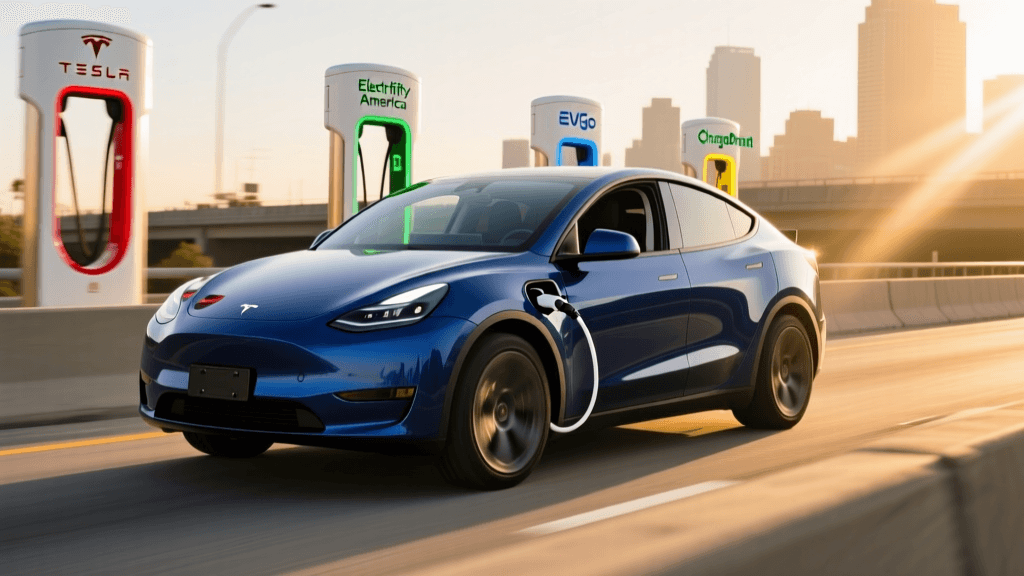
The Tesla Supercharger network remains the gold standard for EV charging reliability and speed. The vast majority of stations utilize V3 Superchargers, which peak at 250 kW. For a vehicle like the Tesla Model 3 Long Range, this translates to a blistering 10% to 80% charge in roughly 18 to 22 minutes under optimal conditions.
Tesla is currently rolling out its V4 Supercharger architecture, which features a redesigned cabinet capable of delivering up to 350 kW for passenger vehicles and even higher outputs for the Tesla Semi. Beyond raw speed, Tesla's greatest advantage is its plug-and-charge ecosystem. There are no screens to tap, no apps to launch, and no credit cards to swipe. You simply plug in, and the car handles the authentication and billing automatically. Furthermore, the J.D. Power EV Public Charging Index consistently ranks Tesla at the absolute top for customer satisfaction, largely due to this frictionless experience and industry-leading station uptime.
Deep Dive: Electrify America (EA)
Electrify America is the largest open DC fast charging network in the United States and the primary alternative to Tesla for highway travel. EA stations are frequently located near major interstate exits and shopping centers. They deploy a mix of 150 kW and 350 kW chargers. If you drive a vehicle with an 800-volt battery architecture, such as the Hyundai Ioniq 5, Kia EV6, or Porsche Taycan, you can take full advantage of EA's 350 kW chargers, achieving a 10% to 80% charge in as little as 18 minutes.
However, EA's user experience can sometimes be a hurdle for beginners. While the Plug&Charge feature works beautifully on supported vehicles like Ford and Mercedes-Benz models, drivers of other EVs often need to use the EA app or an RFID card to initiate a session. Additionally, as the industry shifts toward the North American Charging Standard (NACS), EA is actively retrofitting stations with NACS cables, though CCS remains the dominant native connector on their current hardware.
Deep Dive: EVgo and ChargePoint
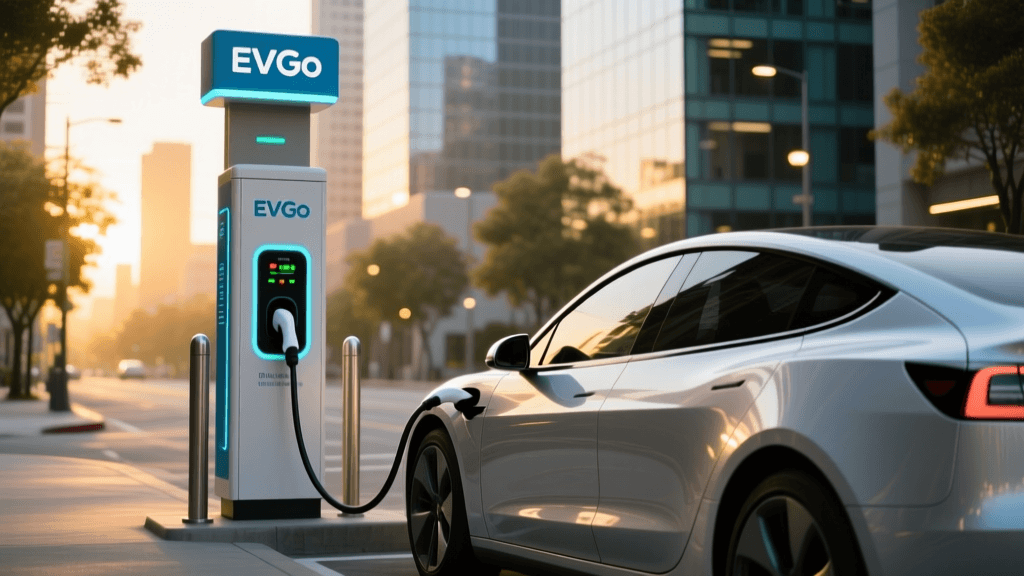
EVgo operates a massive network of over 1,100 public fast charging stations. Historically, EVgo relied heavily on 50 kW chargers, which are quite slow by modern standards (taking 45+ minutes for a 10-80% charge). Today, they are rapidly deploying their 'eXtend' stations featuring 350 kW chargers. EVgo is also unique in offering Tesla connectors natively at many locations without requiring an adapter, making it a versatile choice for mixed-EV households. They also offer 'Reserve' features in their app, allowing you to hold a charger for a few minutes while you navigate a busy parking lot.
ChargePoint is best known for its ubiquitous Level 2 network, but their DC fast charging footprint is growing. Their Express Plus stations can deliver up to 400 kW, though they are less common on highways and more frequently found at retail destinations, grocery stores, and municipal lots. ChargePoint chargers are highly reliable but are generally better suited for topping up while you shop rather than rapid highway pit stops, as many of their DCFC locations cap out at 50 kW to 125 kW.
The Charging Curve: Why Max kW Isn't Everything
As a beginner, it is easy to assume that a 350 kW charger will charge your car twice as fast as a 150 kW charger. In reality, EV batteries follow a 'charging curve.' When your battery is at a low state of charge (e.g., 10%), it can accept power very quickly. As the battery fills up, the battery management system (BMS) deliberately slows down the charging speed to prevent overheating and degradation.
For example, a car might pull 200 kW from 10% to 30%, drop to 120 kW at 50%, and trickle down to 40 kW by the time it hits 80%. Therefore, the 'average' charging speed is much more important than the 'peak' speed. For a deeper dive into how battery architecture and thermal management impact charging, the U.S. EPA's Fuel Economy website offers excellent foundational resources on EV battery technology and efficiency.
Beginner Tips for Maximizing DCFC Speeds
- Precondition Your Battery: If your EV has a battery preconditioning feature, always use it. By entering the charging station into your car's navigation system, the vehicle will automatically heat or cool the battery to the optimal temperature for maximum charging speed before you even arrive.
- Embrace the 80% Rule: Because the charging curve slows down dramatically after 80%, it is almost always faster to unplug at 80% and drive to the next station than to sit and wait for that final 20%. The last 20% can take just as long as the first 60%.
- Check Ambient Temperatures: Extreme cold severely limits charging speeds. If you are traveling in winter, expect your charging times to increase by 20% to 30% unless your vehicle has an aggressive active thermal management system.
- Use PlugShare or A Better Routeplanner: Before embarking on a trip, use these community-driven apps to check the real-time status of chargers. User check-ins will tell you if a specific 350 kW stall is currently broken or if the station is crowded.
Conclusion
Navigating the DC fast charging landscape doesn't have to be overwhelming. Tesla offers the most seamless and reliable high-speed experience, while Electrify America provides the best open-network speeds for 800-volt vehicles. EVgo and ChargePoint offer vital flexibility for urban charging and mixed-fleet households. By understanding your vehicle's charging curve, utilizing battery preconditioning, and sticking to the 80% rule on road trips, you will master public charging networks and enjoy the full freedom of electric vehicle ownership.