Introduction to DC Fast Charging for Beginners
For new electric vehicle (EV) owners, transitioning from the convenience of overnight home charging to the fast-paced world of public road trip charging can feel overwhelming. When you are crossing state lines or embarking on a cross-country adventure, Level 1 and Level 2 chargers simply will not cut it. This is where DC Fast Charging (DCFC), also known as Level 3 charging, becomes an essential part of your EV ownership experience. In this comprehensive beginner's guide, we will break down exactly how DC fast charging works, compare the peak speeds and real-world reliability of the major charging networks, and provide actionable tips to ensure you get the fastest charge possible every time you plug in.
What is DC Fast Charging (Level 3)?
Unlike Level 1 (standard 120V household outlet) and Level 2 (240V home or public chargers) which supply Alternating Current (AC) to your vehicle's onboard charger to be converted into Direct Current (DC) for the battery, DC Fast Charging stations bypass the vehicle's onboard charger entirely. They deliver high-power DC electricity directly to the battery pack. According to the U.S. Department of Energy, DCFC stations can provide anywhere from 50 kW to over 350 kW of power, allowing modern EVs to recharge from 10% to 80% in as little as 15 to 30 minutes. This massive influx of power is what makes long-distance EV travel viable.
Understanding the Charging Curve and Peak kW
One of the most common misconceptions among beginners is that a 350 kW charger will charge your car at 350 kW the entire time. In reality, EV batteries follow a strict charging curve to protect the battery cells from overheating and degradation. When you plug in at a low State of Charge (SoC), typically around 10% to 15%, the battery accepts power at its maximum rate (peak kW). However, as the battery fills up and approaches 80%, the Battery Management System (BMS) intentionally throttles the charging speed down to a trickle. This is why you will often hear experienced EV drivers talk about the '10% to 80% rule.' Charging past 80% on a DC fast charger is not only incredibly slow, but it also hogs the stall from other drivers who might desperately need a quick top-up.
DC Fast Charging Network Speed Comparison Chart
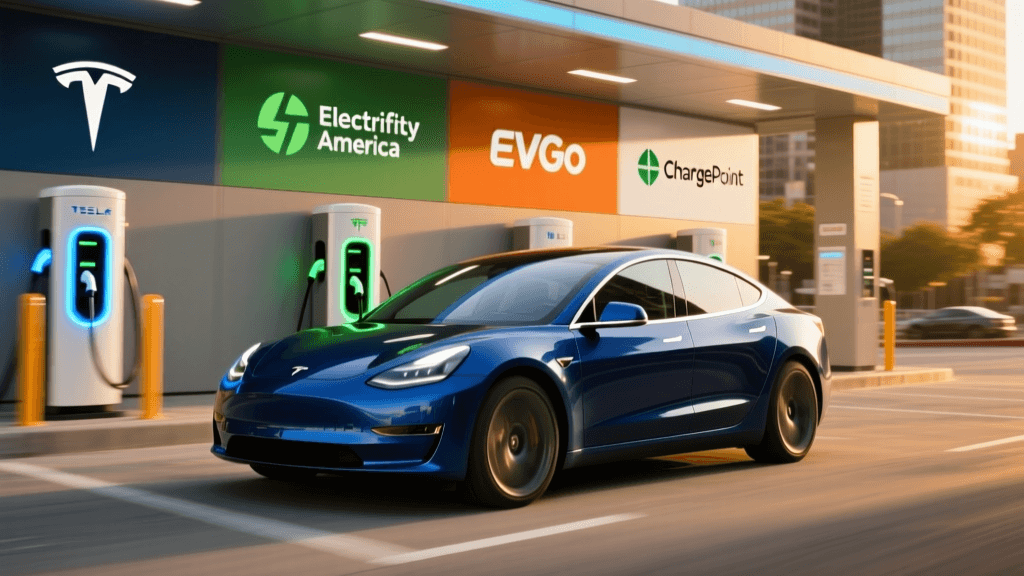
To help you plan your next road trip, we have compiled a comparison chart of the major public DC fast charging networks in North America. This data reflects current hardware deployments and typical real-world conditions.
| Network | Max Peak Speed | Primary Connector | Real-World Reliability |
|---|---|---|---|
| Tesla Supercharger | 250 kW (V3) / 325+ kW (V4) | NACS (CCS via adapter) | Excellent |
| Electrify America | 150 kW / 350 kW | CCS (CHAdeMO limited) | Good (Improving) |
| EVgo | 50 kW (Legacy) / 350 kW (New) | CCS / CHAdeMO | Moderate to Good |
| ChargePoint | 62.5 kW to 400 kW (Express Plus) | CCS / CHAdeMO | Variable by Location |
Deep Dive: Major Network Speeds and Hardware
Tesla Supercharger Network
The Tesla Supercharger network remains the gold standard for EV charging reliability and speed. The vast majority of stations in North America are V3 stalls, which peak at 250 kW. Tesla is currently rolling out V4 Superchargers, which feature a redesigned cabinet and liquid-cooled cables capable of delivering over 325 kW to compatible vehicles. With the North American Charging Standard (NACS) becoming the industry standard, non-Tesla EVs are increasingly gaining access to this network via built-in NACS ports or approved CCS-to-NACS adapters, making it the most critical network for all EV drivers to understand.
Electrify America (EA)
Electrify America boasts some of the fastest individual chargers on the market, with many stations equipped with 350 kW liquid-cooled dispensers. If your EV is equipped with an 800-volt battery architecture (like the Hyundai Ioniq 5, Kia EV6, or Porsche Taycan), you can take full advantage of these 350 kW stalls, potentially adding 200 miles of range in under 10 minutes. While early EA stations suffered from software glitches and broken screens, recent hardware upgrades and the introduction of their 'Charge Forward' initiative have significantly improved network uptime and user experience.
EVgo
EVgo is currently in a transitional phase. Many of their older urban stations are limited to 50 kW, which is considered quite slow by modern standards and is best suited for older EVs or quick top-ups rather than full road-trip charging. However, EVgo is aggressively deploying their new 'ReNew' and 'PowerX' stations, featuring 350 kW chargers. These newer stations are often co-located with amenities like grocery stores and shopping centers, making them highly convenient while you wait for your vehicle to charge.
ChargePoint Express Plus
While ChargePoint is most famous for its ubiquitous Level 2 destination chargers, their DC Fast Charging network, known as Express Plus, is highly modular. These stations use a scalable architecture where power cabinets can dynamically distribute DC power to individual dispensers based on the vehicle's needs. Speeds can range from 62.5 kW up to 400 kW, though the 125 kW and 175 kW configurations are the most common in the wild. You can use the Alternative Fuels Data Center (AFDC) station locator to filter specifically for high-speed ChargePoint Express stalls along your route.
Real-World Factors That Throttle Your Charging Speed
Even if you pull up to a 350 kW Electrify America station, you might not see those peak numbers on your dashboard. Several real-world variables dictate your actual charging speed:
- Battery Temperature: Lithium-ion batteries charge best when they are warm (typically between 70°F and 90°F). If you arrive at a charger with a cold battery, the BMS will severely restrict power to prevent lithium plating and cell damage.
- Battery Chemistry: Vehicles with Nickel Manganese Cobalt (NMC) batteries usually have aggressive charging curves that peak early and taper off quickly. Conversely, Lithium Iron Phosphate (LFP) batteries, found in standard range Tesla Model 3s and Ford Mustang Mach-Es, can often sustain high charging speeds much closer to the 100% mark.
- Station Power Sharing: Some older DCFC stations share a single power cabinet between two dispensers (often labeled 1A and 1B). If another vehicle is plugged into the adjacent stall, the available kW will be split between both cars, cutting your maximum speed in half.
Beginner Tips for Maximizing DCFC Speeds
To ensure you spend less time waiting and more time driving, follow these actionable tips recommended by experts at the Edmunds EV Charging Guide:
- Always Precondition Your Battery: If your EV has a navigation system, always route yourself to the charging station using the car's built-in GPS. This signals the vehicle to automatically begin 'preconditioning' (warming up) the battery pack so it is at the optimal temperature to accept peak kW the second you plug in.
- Unplug at 80%: Because the charging curve slows down dramatically after 80%, it is almost always faster to unplug at 80% and drive to the next station than it is to sit and wait for the final 20% to trickle in. This also adheres to proper public charging etiquette.
- Use Advanced Route Planners: Do not rely solely on your car's native navigation for complex cross-country trips. Use third-party tools like A Better Routeplanner (ABRP) or PlugShare. These apps allow you to input your specific EV model, current battery degradation, and even the weather, providing highly accurate predictions of which network stalls will offer the fastest real-world speeds for your specific vehicle.
- Check Stall Status Before Arriving: Use the network's native app (Tesla, EA, or EVgo) to check if the station is online and how many stalls are currently available before you take the highway exit. This prevents the frustration of arriving at a station only to find all chargers are out of order or occupied by a long queue.
Conclusion
Mastering DC fast charging is the final frontier for new EV owners. By understanding the differences between the Tesla Supercharger, Electrify America, EVgo, and ChargePoint networks, and by respecting the physics of the battery charging curve, you can transform your road trip experience from a stressful chore into a seamless adventure. Always precondition your battery, leverage 350 kW hardware if your vehicle supports it, and remember that the fastest charge is the one that gets you back on the road safely and efficiently.