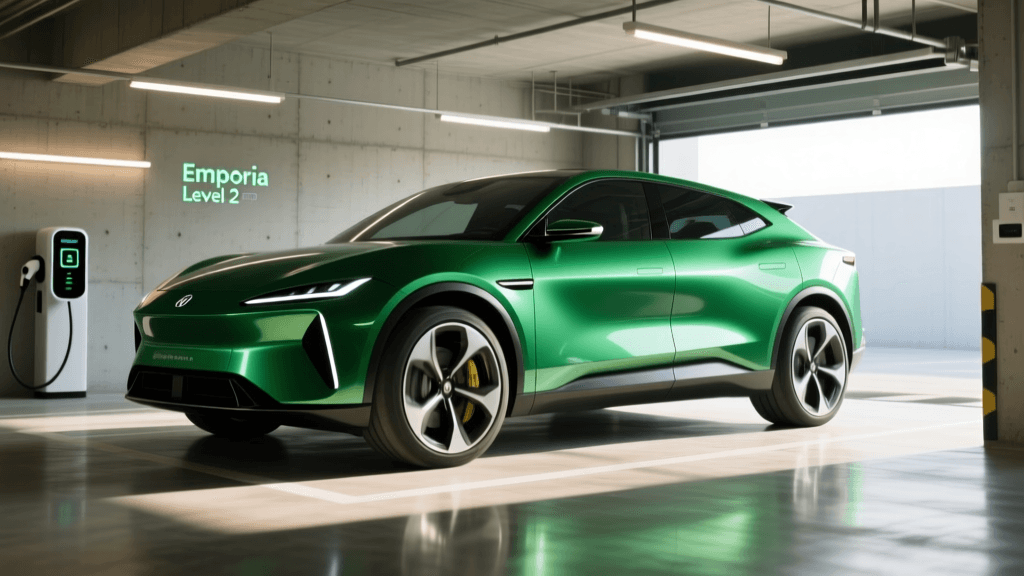
Introduction to the Emporia Ecosystem
When evaluating home electric vehicle supply equipment (EVSE), most buyers focus purely on amperage, cable length, and basic connectivity. However, the Emporia Level 2 Smart EV Charger approaches the market from a fundamentally different angle: whole-home energy management. Priced competitively at around $399, this 48-amp, 11.5-kilowatt charger is designed to integrate seamlessly with the Emporia Vue home energy monitor. For EV owners who are deeply invested in solar arrays, battery storage, or granular utility tracking, the Emporia charger presents a compelling proposition. But does the ecosystem justify the upfront hardware and installation costs for the average EV driver? In this comprehensive cost and value breakdown, we dissect the hardware expenses, installation variables, long-term utility savings, and the tangible return on investment (ROI) that the Emporia Level 2 charger delivers compared to standalone competitors.
Upfront Hardware and Installation Costs
The baseline MSRP for the Emporia Level 2 EV charger hovers around $399, placing it in the mid-tier pricing bracket alongside the ChargePoint Home Flex and slightly below the premium EnelX JuiceBox Pro 48. Out of the box, you receive a robust 24-foot cable, a NEMA 4-rated enclosure suitable for both indoor and outdoor use, and a standard NEMA 14-50 plug. However, the true cost of entry extends beyond the retail price of the unit.
According to the U.S. Department of Energy's Alternative Fuels Data Center, home charging installation costs can vary wildly based on your electrical panel's capacity and local permitting requirements. If you have an available 50-amp circuit or spare capacity for a hardwired 60-amp breaker, a licensed electrician will typically charge between $300 and $600 for the physical installation, conduit routing, and permitting.
However, the Emporia ecosystem often requires the Emporia Vue 2 energy monitor to unlock its most advanced solar and grid-tracking features. If you do not already have the Vue monitor installed in your electrical panel, you must factor in an additional $100 to $150 for the hardware and potentially higher labor costs for an electrician to install current transformers (CTs) on your main breakers. Therefore, the total day-one cost for a first-time Emporia user can easily exceed $800 when combining the charger, the energy monitor, and professional electrical labor.
The True Value: Energy Monitoring and Solar Integration
Where the Emporia charger transitions from a standard hardware expense to a high-value investment is in its software and energy monitoring capabilities. Unlike chargers that simply pull power from the grid, the Emporia app provides real-time visibility into exactly how much energy your vehicle is consuming, cross-referenced with your home's total load and solar production.
For homes with rooftop solar, this is a massive value driver. The Emporia app allows users to configure Solar Only charging modes. This ensures that your EV only charges when your solar panels are producing excess energy that would otherwise be exported to the grid at low wholesale rates. By effectively acting as a battery for your excess solar production, the Emporia charger can reduce your vehicle's fueling cost to near zero. Even without solar, the granular energy monitoring allows you to identify phantom loads and optimize your household energy consumption, indirectly offsetting the cost of the charger over time.
Long-Term Savings: Time-of-Use (TOU) Optimization
The most significant financial benefit of any smart charger is its ability to schedule charging sessions during off-peak hours. Utility companies are increasingly adopting Time-of-Use (TOU) rate structures, where electricity is significantly cheaper late at night and during the early morning hours.
Data from the U.S. Energy Information Administration (EIA) shows that average residential electricity rates vary drastically by region, but TOU differentials can mean the difference between paying $0.08 per kWh at 2:00 AM and $0.35 per kWh at 6:00 PM. The Alternative Fuels Data Center notes that Time-of-Use (TOU) rate plans can significantly reduce the operational costs of EV ownership if managed correctly.
The Emporia app's scheduling interface is intuitive, allowing you to set strict charging windows that align perfectly with your utility's super-off-peak rates. Furthermore, because the charger integrates with your home's total energy profile, it can dynamically throttle the charging amperage if your home's HVAC system or electric oven kicks on, ensuring you never trip your main breaker or incur demand charges.
5-Year Cost of Ownership Comparison
To illustrate the long-term value, we have modeled a 5-year cost of ownership scenario comparing a basic non-smart Level 2 charger against the Emporia Smart Charger utilizing TOU rates and solar integration. This assumes an average annual driving distance of 12,000 miles and an EV efficiency of 3 miles per kWh.
| Cost Metric | Standard Level 2 (No Smart Features) | Emporia Level 2 (With TOU & Solar) |
|---|---|---|
| Hardware & Monitor Cost | $300 | $550 (Includes Vue Monitor) |
| Avg. Electricity Rate | $0.16 / kWh (Blended Avg) | $0.07 / kWh (Off-Peak / Solar) |
| Annual Fuel Cost (4,000 kWh) | $640 | $280 |
| 5-Year Energy Cost | $3,200 | $1,400 |
| Total 5-Year Cost | $3,500 | $1,950 |
As the table demonstrates, the higher initial hardware investment is rapidly eclipsed by the compounding energy savings, resulting in a net positive ROI by the end of year two.
Build Quality, Warranty, and Hidden Costs
A critical component of value analysis is assessing hardware longevity. The Emporia charger features a rugged NEMA 4 enclosure, meaning it is fully protected against windblown dust, rain, and hose-directed water. The 24-foot cable is thick, durable, and remains relatively flexible even in freezing temperatures, a common pain point with cheaper, stiffer alternatives.
Emporia backs the charger with a standard 3-year warranty, which is competitive and matches the industry standard set by brands like ChargePoint. Crucially, there are no hidden subscription fees. While some smart home ecosystems attempt to monetize their user base through premium app features or data harvesting, the Emporia app remains entirely free, and your energy data is kept secure. The absence of a recurring monthly software fee ensures that your ROI calculations remain stable over the lifespan of the vehicle.
Value Comparison: Emporia vs. ChargePoint vs. JuiceBox
To truly understand the Emporia's market position, we must compare its cost-to-value ratio against the industry titans:
- ChargePoint Home Flex: Priced similarly at around $399, it offers excellent build quality and a slightly longer 25-foot cable. However, it lacks native whole-home energy monitoring and solar integration, making it less valuable for users with complex solar setups.
- EnelX JuiceBox Pro 48: Often priced higher (around $449-$499), the JuiceBox offers robust app features and dynamic load balancing. Yet, its historical Wi-Fi connectivity issues and recent corporate restructuring have introduced a layer of risk regarding long-term software support, slightly diminishing its overall value proposition compared to Emporia's stable ecosystem.
- Emporia Level 2: Wins on holistic energy management. If you already use or plan to install the Emporia Vue monitor, the marginal cost of adding the EV charger is minimal, and the unified app experience provides unmatched value for solar and TOU optimization.
Final Verdict: Who is the Emporia Charger For?
The Emporia Level 2 EV Charger is not necessarily the cheapest unit on the market when factoring in the required energy monitoring hardware and professional installation. However, from a strict cost and value breakdown perspective, it is arguably the most financially intelligent choice for a specific demographic: solar-equipped homeowners and those on aggressive Time-of-Use utility plans.
If you simply need a reliable plug-and-play unit for a standard apartment or a home with flat-rate electricity, a simpler charger like the Grizzl-E or a basic ChargePoint may offer a faster path to ROI. But if your goal is to minimize your carbon footprint, maximize your solar investment, and slash your utility bills through granular data tracking, the Emporia Level 2 charger pays for itself, making it a premier value in the smart EV charging landscape.