The Promise of 100% Solar EV Charging
Transitioning to an electric vehicle (EV) is a massive step toward reducing your carbon footprint, but powering that vehicle with fossil fuels from the grid dilutes the environmental benefit. The ultimate goal for eco-conscious drivers is achieving 100% solar-powered EV charging. By integrating a solar-diverting EV charger with your home's photovoltaic (PV) array, you can channel excess solar production directly into your vehicle's battery, effectively driving on sunshine for free. According to the U.S. Department of Energy's Alternative Fuels Data Center, home charging is the most convenient and cost-effective method for EV owners, and pairing it with solar maximizes long-term savings.
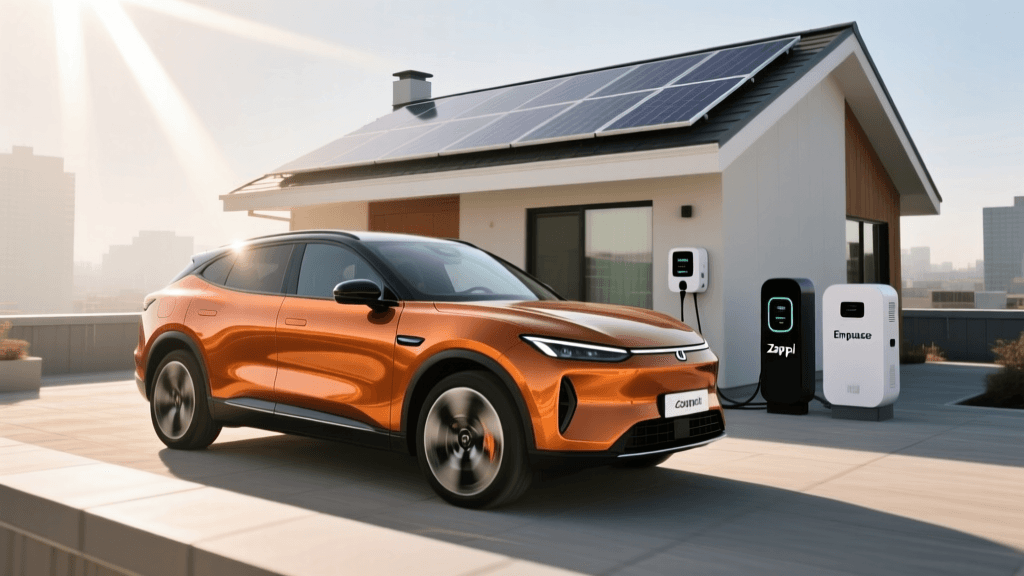
However, not all smart chargers handle solar diversion equally. In this head-to-head showdown, we are pitting the two undisputed heavyweights of solar-integrated charging against each other: the Myenergi Zappi v2 and the Enphase IQ EV Charger. Both promise seamless solar integration, but their underlying technologies, installation requirements, and ecosystem lock-in differ drastically. Let's break down the specs, installation hurdles, and real-world performance to determine which solar EV charger deserves a spot on your garage wall.
Meet the Contenders: Zappi v2 vs. Enphase IQ
Myenergi Zappi v2: Hailing from the UK but globally renowned, the Zappi v2 is widely considered the gold standard for solar EV charging. Its standout feature is its agnostic approach to solar hardware; it doesn't care what brand of solar inverter or panels you have on your roof. It uses physical Current Transformer (CT) clamps to read your home's real-time energy flow and dynamically adjusts the charging rate to absorb only your excess solar export.
Enphase IQ EV Charger: Enphase is a titan in the solar microinverter space. Their IQ EV Charger is designed specifically to integrate flawlessly with the Enphase ecosystem. Instead of relying solely on standalone CT clamps at the main panel, it communicates directly with the Enphase IQ System Controller and Envoy gateway. This allows for incredibly precise, software-driven solar diversion, provided your home is already equipped with Enphase solar hardware.
Solar Diversion Mechanics: How They Capture Excess Energy
The core differentiator between a standard Level 2 charger and a solar charger is diversion logic. Standard chargers pull a fixed amperage (e.g., 32A or 48A) from the grid, regardless of whether your solar panels are producing energy or if your house is consuming it. Solar chargers, however, modulate their output.
Zappi v2: The Three-Mode Master
The Zappi offers three distinct charging modes tailored for solar homes:
- ECO Mode: Modulates charging power to match the exact amount of excess solar generation. If a cloud passes over and solar drops, the charger reduces amperage. If generation stops completely, charging pauses.
- ECO+ Mode: The ultimate solar mode. It diverts all excess solar to the car, but if solar drops, it will supplement with grid power to maintain a minimum 1.4kW (6A) charging trickle, ensuring your car is ready when you need it.
- FAST Mode: Bypasses solar logic entirely, pulling maximum grid power for rapid charging when time is of the essence.
Enphase IQ: The Ecosystem Approach
Enphase utilizes its IQ software suite to manage solar diversion. Through the Enphase App, users can set Green Charging schedules. The system monitors the microinverters' production in real-time. Because the communication happens over the Enphase IQ Mesh network rather than through analog CT clamps alone, the latency is incredibly low. However, the Enphase charger requires you to have an Enphase solar system to unlock these specific solar-diverting features. If you have SolarEdge or string inverters, the Zappi is your only option between the two.
Installation Requirements: CT Clamps, Breakers, and Wiring
Installing a solar-diverting charger is significantly more complex than plugging into a NEMA 14-50 receptacle. Both the Zappi and Enphase IQ require hardwiring and specific sensor installations. The Department of Energy's Homeowner's Guide to Going Solar emphasizes that electrical panel upgrades and proper sensor placement are critical for safety and code compliance when adding high-draw EV loads to solar-equipped homes.
Zappi v2 Installation Specifics
The Zappi requires a 50-amp dedicated breaker and 6 AWG copper wire for a hardwired connection. The most labor-intensive part of the Zappi install is routing the 100A CT clamp. This clamp must be placed on the main service entrance cables (the meter tails) immediately after the utility meter and before the main breaker. This requires opening the main service panel and, in some jurisdictions, pulling the utility meter seal—an act that often requires a licensed electrician and utility coordination. If your main panel is far from the garage, running the CT clamp extension wires through walls can add hundreds of dollars to the labor cost.
Enphase IQ Installation Specifics
The Enphase IQ EV charger also requires a 50-amp breaker and 6 AWG hardwiring. However, if you already have an Enphase IQ System Controller installed for your solar array, the CT clamps are likely already in place on your main service laterals. The electrician simply needs to connect the EV charger to the existing Enphase Envoy communication gateway. This drastically reduces installation time and wall-fishing labor compared to the Zappi, provided your electrical panel has the physical space for the new 50-amp double-pole breaker.
Head-to-Head Specification & Feature Table
| Feature | Myenergi Zappi v2 | Enphase IQ EV Charger |
|---|---|---|
| Max Output | 48 Amps (11.5 kW) | 48 Amps (11.5 kW) |
| Connection Type | Hardwired Only | Hardwired Only |
| Solar Compatibility | Agnostic (Any Inverter Brand) | Enphase Ecosystem Only |
| Sensor Requirement | 100A CT Clamp on Main Tails | Enphase CTs / System Controller |
| Smart Features | Eco, Eco+, Fast Modes, Boost | Green Charging, App Scheduling |
| Cable Management | Tethered (Built-in Cable) | Untethered (Requires separate cable) |
| Average Unit Cost | $950 - $1,050 | $750 - $850 |
Cost Analysis and Solar ROI Timelines
When evaluating the total cost of ownership, you must factor in the hardware, installation, and the value of the solar energy diverted. The Zappi v2 typically retails for around $1,000, while the Enphase IQ is slightly cheaper at roughly $800. However, the installation labor can flip this equation. If you are retrofitting a Zappi into a home with a non-Enphase solar system and the main panel is on the opposite side of the house from the garage, the electrician's time to run the CT clamp wires and 6 AWG charging cables could easily exceed $1,200. Conversely, adding the Enphase IQ to an existing Enphase solar setup might only require a standard 2-hour hardwire installation, keeping labor costs under $600.
Regarding ROI, diverting excess solar that would otherwise be exported to the grid for pennies (due to unfavorable net-metering policies) is highly lucrative. If your system generates 15 kWh of excess solar daily, and your EV consumes 3 miles per kWh, you are gaining 45 miles of free driving every day. Over a year, this can offset thousands of dollars in public charging or grid-electricity costs, meaning the premium paid for a solar-diverting charger pays for itself within 12 to 18 months.
Final Verdict: Which Solar Charger Wins?
The choice between the Myenergi Zappi v2 and the Enphase IQ EV Charger ultimately comes down to your existing solar hardware and your desire for flexibility.
Choose the Enphase IQ EV Charger if: You already own an Enphase solar and battery system. The seamless software integration, lower hardware cost, and simplified installation (leveraging existing CTs and the Envoy gateway) make it a no-brainer. It is the most elegant, ecosystem-locked solution on the market.
Choose the Myenergi Zappi v2 if: You have a SolarEdge, SMA, Tesla, or any other non-Enphase solar inverter. The Zappi's hardware-level CT clamp monitoring guarantees that it will work flawlessly with your setup, regardless of future solar upgrades or inverter replacements. Its Eco+ mode is also arguably the most robust solar-diversion algorithm available, ensuring your car is always charged while maximizing every single ray of sunshine hitting your roof.