Tesla Supercharging V3 and the Charging Ecosystem: What You Actually Need to Know
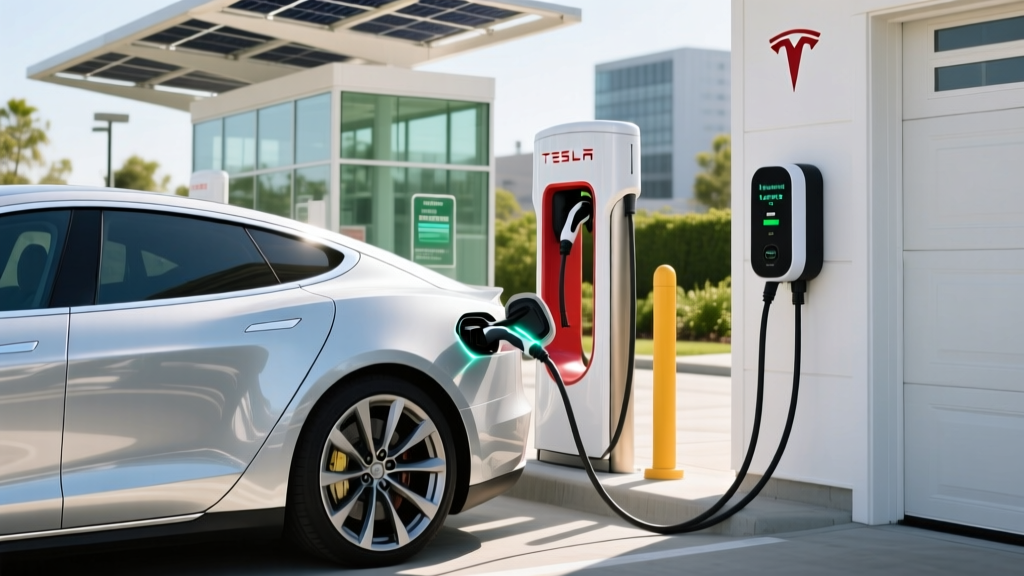
Search "supercharging v3" and you'll find Tesla's 250 kW DC fast-charging architecture — the backbone of the Supercharger network since 2019 and still the most common stall type at Tesla stations in 2026. But how does it stack up against charging at home on Level 2? And if you're buying a non-Tesla EV with NACS access to Superchargers, what changes? This guide breaks down the real numbers: charge speeds, costs per mile, installation requirements, and exactly which equipment to buy.
Before we get into the weeds, one foundational rule: kW (kilowatts) measures power — the rate of energy flow, like water pressure in a hose. kWh (kilowatt-hours) measures energy — the total amount stored in your battery, like gallons in a tank. A 250 kW Supercharger delivers energy fast; an 82 kWh battery holds a fixed amount. Confusing the two is the most common EV mistake, and we won't make it here.
Charging Levels Explained: Level 1, Level 2, and DC Fast (Including Supercharging V3)
Every EV owner uses a mix of these three charging tiers. Here's exactly what each delivers in measurable terms:
| Level | Voltage / Amperage | Max Power (kW) | Miles of Range Added Per Hour | Best For |
|---|---|---|---|---|
| Level 1 (120V outlet) | 120V / 12A | ~1.4 kW | 3–5 mi/hr | Overnight top-ups, PHEVs, emergency |
| Level 2 (240V home/public) | 240V / 32A–48A | 7.7–11.5 kW | 25–44 mi/hr | Daily home charging, workplace |
| DC Fast (CCS/CHAdeMO) | 400V–800V DC | 50–350 kW | 150–300+ mi in 20 min | Road trips, quick top-ups |
| Tesla Supercharging V3 | 400V DC (NACS) | 250 kW peak | ~200 mi in 15 min (peak) | Tesla & NACS-equipped EVs on road trips |
| Tesla Supercharging V4 | 800V DC (NACS) | Up to 350 kW peak | ~250+ mi in 15 min (peak) | Newer deployments, Cybertruck, future models |
The Supercharging V3 reality check: Tesla advertises "up to 250 kW" and "up to 1,000 miles per hour" of charge rate. That peak rate only holds for a narrow state-of-charge (SoC) window — typically between 10% and 30% SoC on a preconditioned battery. Above 50% SoC, the charge curve tapers significantly. By 80%, you're pulling closer to 60–80 kW. This is normal physics: lithium-ion cells resist high-current charging as they fill to prevent overheating and degradation.
- Tesla Model 3 Long Range (82 kWh usable): ~25–28 minutes
- Tesla Model Y Long Range (75 kWh usable): ~22–25 minutes
- Tesla Model S (100 kWh usable): ~32–36 minutes
- Non-Tesla NACS EV (e.g., Ford Mustang Mach-E, 70 kWh usable, limited to ~150 kW on V3): ~30–35 minutes
Note: Non-Tesla EVs accessing V3 Superchargers via NACS may not sustain 250 kW due to battery management system (BMS) differences and vehicle-side charge-rate limits. Always check your vehicle's maximum DC charge rate.
Home Level 2 Charging: Electrical Requirements, Panel Upgrades, and Install Costs
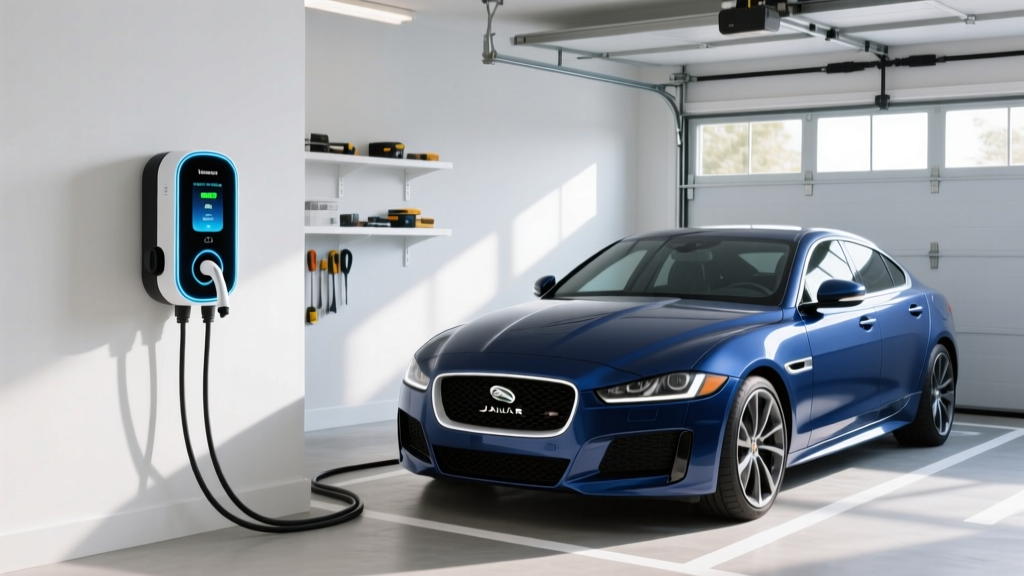
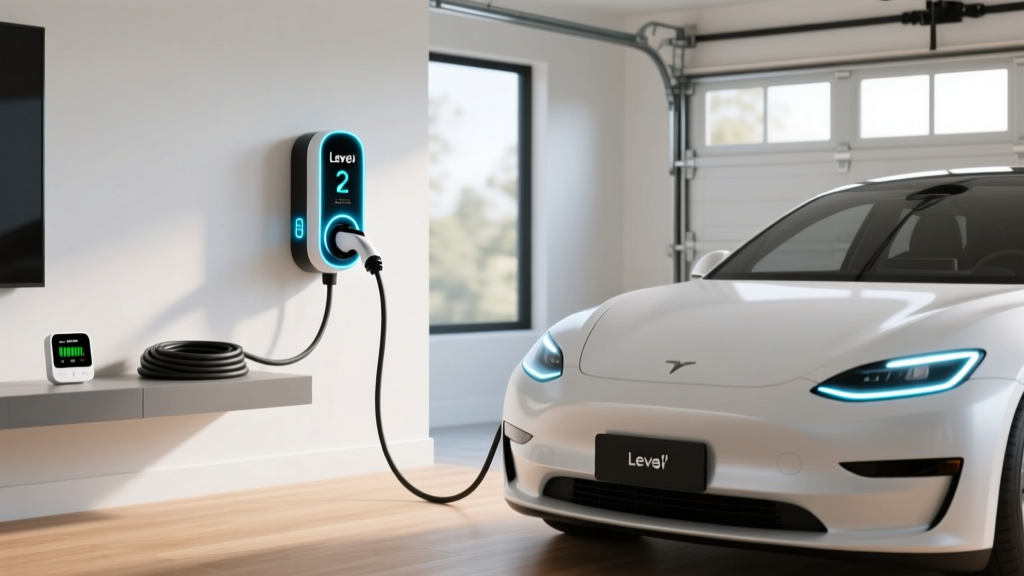
For most EV owners, home Level 2 is where 80–90% of charging happens. A 240V Level 2 charger adds enough range overnight to cover nearly any daily commute, and it costs a fraction of public DC fast charging. But the installation isn't always plug-and-play.
Electrical Requirements
A typical home Level 2 setup requires:
- 240V dedicated circuit (same voltage as an electric dryer or oven)
- 40A or 50A breaker — a 40A circuit supports up to 32A continuous draw (9.6 kW); a 50A circuit supports up to 40A continuous (9.6 kW) or 48A continuous (11.5 kW) with a hardwired unit
- NEMA 14-50 outlet (for plug-in chargers) or direct hardwire to a junction box
- Copper wiring: 6 AWG for 50A circuits, 8 AWG for 40A circuits
Do You Need a Panel Upgrade?
This is the cost variable most online guides gloss over. If your home has a 100A electrical panel (common in homes built before 2000), adding a 40A or 50A EV circuit may exceed 80% of your panel's total capacity when combined with existing loads (HVAC, dryer, oven, water heater). An electrician will perform a load calculation per NEC Article 220. If you're over the threshold, you'll need:
- A panel upgrade to 200A — typical cost: $1,500–$3,500
- Or a smart load-management device (e.g., Emporia Smart Load Center, NeoCharge Smart Splitter) that throttles EV charging when other high-draw appliances run — cost: $300–$700 plus installation
Home Charger Installation Cost Breakdown
| Component | Low-End | High-End | Notes |
|---|---|---|---|
| Level 2 charger (hardware) | $350 | $700 | 32A–48A, NACS or J1772 |
| Electrician labor (standard install) | $500 | $1,500 | Depends on run length from panel to garage |
| Permit and inspection | $50 | $300 | Varies by municipality |
| Electrical materials (wire, conduit, breaker) | $100 | $500 | Longer runs cost more |
| Panel upgrade (if needed) | $1,500 | $3,500 | 100A → 200A service upgrade |
| Total (no panel upgrade) | $1,000 | $3,000 | Most homes with 200A panels |
| Total (with panel upgrade) | $2,500 | $6,500 | Older homes with 100A service |
The IRS §30D clean vehicle credit does not cover charger installation directly. However, the separate §30C Alternative Fuel Vehicle Refueling Property Credit provides up to $1,000 (30% of cost, capped) for home charger installation, subject to income limits and census-tract eligibility. Check irs.gov for current §30C rules and consult a tax professional.
Connector Compatibility: NACS, CCS1, CHAdeMO, and Adapter Needs
The connector landscape shifted dramatically between 2023 and 2026. Tesla's North American Charging Standard (NACS) is now the dominant connector for new EVs sold in the U.S., but legacy CCS1 and CHAdeMO vehicles are still on the road — and still charging.
| Connector | Native Vehicles | Tesla Supercharger Access? | Adapter Needed? |
|---|---|---|---|
| NACS (Tesla) | Tesla (all), Ford (2025+), GM (2025+), Rivian (2025+), Volvo, Polestar, Fisker | Yes — native | None |
| CCS1 | Hyundai/Kia (some 2025+), BMW iX, VW ID.4 (pre-2026), older Ford/GM | Yes — via Tesla CCS-to-NACS adapter (~$250) at V3 stalls with Magic Dock | Tesla adapter or use Electrify America / EVgo CCS stations |
| CHAdeMO | Nissan Leaf (legacy), Mitsubishi Outlander PHEV | No | No NACS adapter available; use CHAdeMO public stations |
Key detail for non-Tesla NACS vehicles at V3 Superchargers: Tesla's V3 stalls use a built-in CCS Magic Dock adapter at select locations, but most V3 stalls require a native NACS plug. If your EV has NACS (e.g., 2025+ Ford F-150 Lightning, 2025+ GM Equinox EV), you plug in directly. If your EV has CCS1, you either need a Tesla-purchased CCS-to-NACS adapter or must seek out Supercharger stalls equipped with the Magic Dock. The Tesla Supercharger map in the Tesla app shows which stations have Magic Dock adapters for non-Tesla vehicles.
Cost to Charge: Home vs. Public DC Fast (Including Supercharging V3)
The economics of EV charging vary enormously depending on where and when you plug in. Here's the real cost picture using 2026 average rates:
| Scenario | Avg $/kWh | Cost for 60 kWh Fill (10–80%) | Cost Per Mile (at 3 mi/kWh efficiency) |
|---|---|---|---|
| Home Level 2 — off-peak utility rate | $0.08–$0.12 | $4.80–$7.20 | $0.03–$0.04 |
| Home Level 2 — standard residential rate | $0.13–$0.18 | $7.80–$10.80 | $0.04–$0.06 |
| Tesla Supercharger V3 (member rate) | $0.25–$0.35 | $15.00–$21.00 | $0.08–$0.12 |
| Tesla Supercharger V3 (non-Tesla / peak) | $0.35–$0.48 | $21.00–$28.80 | $0.12–$0.16 |
| Electrify America / EVgo DC fast | $0.30–$0.45 | $18.00–$27.00 | $0.10–$0.15 |
| Gasoline baseline (28 MPG avg, $3.40/gal) | — | — | $0.12 |
The takeaway: Home charging on off-peak rates is roughly 3–4× cheaper per mile than gasoline. Even Supercharging V3 at member rates undercuts gas on a per-mile basis. But if you rely exclusively on public DC fast charging at peak rates, your cost per mile can equal or exceed a fuel-efficient hybrid. This is why home charging access is the single biggest factor in EV satisfaction.
To put this in annual terms: a driver covering 12,000 miles/year at home off-peak rates spends roughly $360–$480/year on electricity. The same driver using Superchargers exclusively at $0.30/kWh spends $1,200–$1,440/year. A comparable gas car at 28 MPG and $3.40/gal spends $1,457/year.
Recommended Home Level 2 Chargers: Power, Features, and Price
Not all Level 2 chargers are equal. The critical specs are max amperage (which determines kW output), connector type, cable length, and smart features (Wi-Fi scheduling, load management). Here are the top picks for 2026:
Tesla Wall Connector (Gen 4)
- Power: Up to 48A / 11.5 kW (hardwired, 60A circuit)
- Connector: NACS native
- Cable: 24 ft
- Smart features: Wi-Fi, OTA updates, power sharing between two units, Tesla app integration
- Price: ~$475
- Best for: Tesla owners, NACS-equipped EVs
ChargePoint Home Flex (NACS)
- Power: Up to 50A / 12 kW (NEMA 14-50 plug or hardwired)
- Connector: NACS (2025+ model) or J1772 with adapter
- Cable: 23 ft
- Smart features: Wi-Fi, ChargePoint app scheduling, Alexa, load management, ENERGY STAR certified
- Price: ~$550–$650
- Best for: Mixed EV households, renters (plug-in version is portable)
Emporia Level 2 EV Charger
- Power: Up to 48A / 11.5 kW (hardwired)
- Connector: J1772 (use J1772-to-NACS adapter for Tesla/NACS EVs)
- Cable: 24 ft
- Smart features: Wi-Fi, Emporia app, solar integration, real-time energy monitoring, load management with Emporia panel
- Price: ~$400
- Best for: Budget-conscious buyers, solar homes
Adapter note: If you buy a J1772 charger but drive a NACS vehicle, a J1772-to-NACS adapter (Tesla sells one for ~$195; third-party options from Lectron or Autech run $100–$150) works perfectly for Level 2 charging. These adapters do NOT work for DC fast charging — never use a passive adapter at a Supercharger or CCS DC fast station.
Safety, Code, and Permit Considerations
EV charging is a high-draw, continuous electrical load — the National Electrical Code (NEC) treats it differently than intermittent appliances. Key requirements:
- Dedicated circuit: Your EV charger must be on its own breaker — no sharing with other outlets or appliances. A 48A charger requires a 60A breaker (NEC requires 125% overcurrent protection for continuous loads).
- GFCI protection: NEC 2020 and later require GFCI (ground-fault circuit interrupter) protection for all 240V EV outlets. Hardwired units often have built-in ground-fault protection. If using a NEMA 14-50 receptacle, your electrician will install a GFCI breaker (~$50–$100 extra).
- Outdoor rating: If your charger is mounted outside or in an unenclosed carport, it must carry a NEMA 4 or IP65 weather-resistance rating. All three chargers recommended above meet this standard.
- Permit and inspection: Most jurisdictions require an electrical permit for a new 240V circuit. Your electrician typically pulls this. An inspector will verify wire gauge, breaker sizing, grounding, and GFCI compliance before sign-off. Skipping the permit risks voiding homeowner's insurance coverage for electrical fires.
- Utility notification: Some utilities require you to notify them before installing an EV charger, especially if you want time-of-use (TOU) rate plans. Many offer rebates of $200–$500 for Level 2 installation — check with your local provider.
Frequently Asked Questions
How much does it cost to install a home EV charger?
A standard home Level 2 installation (40A–50A circuit, 240V, no panel upgrade) costs between $1,000 and $3,000 including the charger hardware, electrician labor, materials, and permit. If your home needs a panel upgrade from 100A to 200A service, add $1,500–$3,500. The federal §30C tax credit can offset up to $1,000 of the installation cost if you meet income and census-tract requirements.
How fast will each charging level add range?
Level 1 (120V) adds 3–5 miles per hour — adequate only for PHEVs or overnight trickle charging. Level 2 (240V, 48A) adds 35–44 miles per hour, fully recharging most EVs in 7–10 hours. Tesla Supercharging V3 at 250 kW peak can add up to 200 miles in 15 minutes, but expect 10–80% to take 22–35 minutes depending on battery size and preconditioning. Sustained rates above 50% SoC drop significantly due to charge-curve taper.
Which connector/charger is compatible with my EV?
Check your vehicle's charge port: NACS (smaller, Tesla-style) is standard on 2025+ Tesla, Ford, GM, Rivian, Volvo, and Polestar models. CCS1 (larger, with two DC pins below) is on most Hyundai, Kia, BMW, and pre-2025 Ford/GM EVs. CHAdeMO (round, mostly on Nissan Leaf) is being phased out. For home Level 2, a NACS Wall Connector works natively with NACS vehicles; J1772 chargers work with CCS1 and CHAdeMO vehicles, and J1772-to-NACS adapters cover Tesla/NACS cars. For DC fast charging, always use the native connector — passive adapters are not rated for DC fast charging.
How much does charging cost per mile vs. gas?
Home Level 2 charging on off-peak electricity costs roughly $0.03–$0.06 per mile, compared to $0.12 per mile for a 28 MPG gas car at $3.40/gallon. Tesla Supercharging V3 at member rates costs $0.08–$0.12 per mile — still competitive with gas. Public DC fast charging at peak rates ($0.40+/kWh) can push costs to $0.13–$0.16 per mile, which approaches or exceeds gasoline for efficient vehicles. The economic case for EVs depends heavily on access to affordable home charging.
What electrical upgrades might I need?
The most common upgrade is a panel capacity increase. Homes with 100A service often need a 200A upgrade ($1,500–$3,500) to accommodate a 40A–50A EV circuit alongside existing loads. Alternatives include a smart load-management device ($300–$700) that dynamically reduces EV charging when high-draw appliances are running, or a NeoCharge Smart Splitter ($400–$600) that shares an existing 240V dryer outlet between the dryer and EV charger (one runs at a time). Always have a licensed electrician perform a load calculation before committing to a charger amperage.
Is Supercharging V3 faster than other DC fast networks?
At 250 kW peak, Supercharging V3 is competitive with Electrify America's 150–350 kW CCS stations and faster than most EVgo and ChargePoint DC stalls (typically 50–125 kW). However, Tesla's newer V4 Supercharger cabinets support up to 350 kW for 800V-architecture vehicles like the Cybertruck. The real advantage of the Supercharger network isn't peak speed — it's reliability, plug-and-charge simplicity, and geographic coverage. Independent tests consistently show Tesla Superchargers have higher uptime (97%+) compared to third-party CCS networks (75–85% uptime in J.D. Power EV Experience studies).
Does Supercharging V3 degrade my battery faster than Level 2?
DC fast charging generates more heat than Level 2, and sustained high-temperature cycling accelerates lithium-ion degradation. However, Tesla's thermal management system actively cools the battery during Supercharging, and real-world data from Tesla Impact Reports shows Model 3/Y batteries retain approximately 85–90% capacity after 150,000 miles even with frequent Supercharging. The practical impact is modest — but if you have reliable home Level 2 access, there's no reason to Supercharge daily. Reserve DC fast charging for road trips and occasional top-ups to maximize long-term battery health.