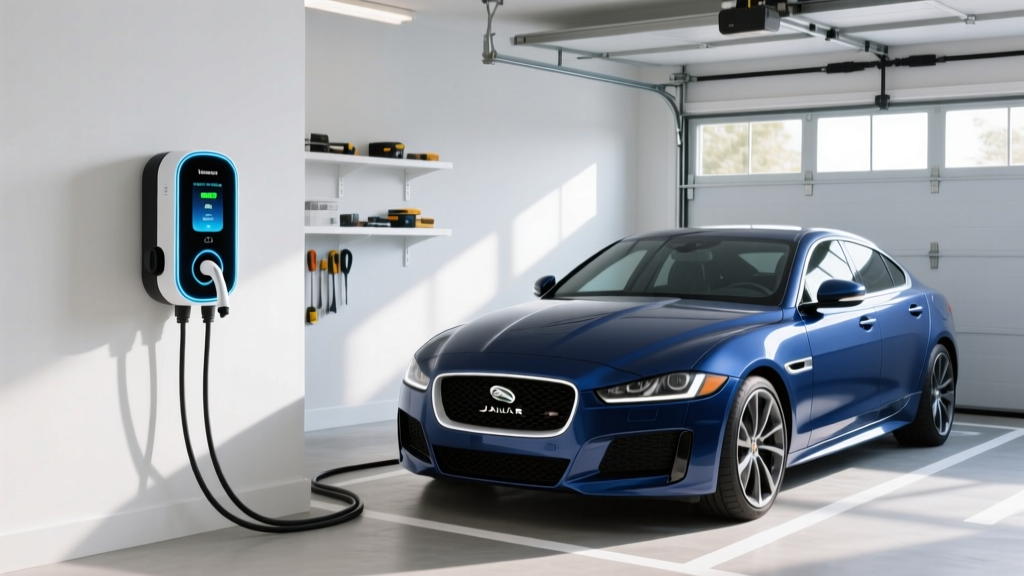
Whether you're pulling into your garage next to a meticulously maintained 2012 Jaguar XF Supercharged or parking beside a brand-new electric vehicle, setting up home charging infrastructure requires understanding electrical requirements, realistic costs, and charging speeds. This guide breaks down everything you need to install a Level 2 home charger in 2026, from panel upgrades to connector compatibility, with exact numbers and real-world expectations.
Understanding EV Charging Levels: Speed and Power Explained
Before budgeting for installation, you need to understand the three charging levels and what each delivers in practical terms. The critical distinction: kW (kilowatts) measures power — how fast energy flows — while kWh (kilowatt-hours) measures energy — your battery's capacity. Confusing these is the most common EV literacy mistake.
| Level | Voltage | Power (kW) | Miles of Range/Hour | Typical Use Case |
|---|---|---|---|---|
| Level 1 | 120V | 1.4-1.9 kW | 3-5 miles | Emergency/overnight trickle |
| Level 2 | 240V | 7.2-19.2 kW | 20-60 miles | Home charging standard |
| DC Fast | 400-800V DC | 50-350 kW | 150-300+ miles | Public highway corridors |
Real-world context: A 75 kWh battery (like a Tesla Model Y Long Range) charging at 11.5 kW (48A Level 2) will go from 10-80% in roughly 5-6 hours. That same session on Level 1 at 1.4 kW would take 40+ hours. For most EV owners, Level 2 is the minimum viable home setup.
Home Installation Costs: Equipment, Electrician, and Permits
Installation costs vary dramatically based on your electrical panel capacity, distance from panel to garage, and local permit fees. Here's the realistic breakdown for 2026:
| Component | Cost Range | Notes |
|---|---|---|
| Level 2 Charger (Equipment) | $400-$800 | 32A-48A smart chargers |
| Electrician Labor (standard install) | $500-$1,500 | 20-50 ft run, accessible panel |
| Permit Fees | $50-$200 | Varies by municipality |
| Panel Upgrade (if needed) | $1,500-$3,500 | 100A to 200A service upgrade |
| Total (no panel upgrade) | $950-$2,500 | Most common scenario |
| Total (with panel upgrade) | $2,450-$6,000 | Older homes, limited capacity |
Panel upgrade gotcha: Homes built before 2000 often have 100A or 150A service. A 48A charger draws ~11.5 kW continuously, which can overload a panel already supporting HVAC, electric range, and dryer. An electrician will perform a load calculation per NEC Article 220. If you're near capacity, you'll either need a panel upgrade or a lower-amperage charger (32A draws 7.7 kW, often sufficient).
Electrical Requirements and Safety Code
Level 2 chargers require a dedicated 240V circuit with proper amperage and safety features. Here's what the National Electrical Code (NEC) and best practices demand:
- Dedicated circuit: Your charger needs its own breaker — no sharing with other appliances
- Amperage sizing: Continuous loads (3+ hours) require 125% overcurrent protection. A 40A charger needs a 50A breaker; a 48A charger needs a 60A breaker
- GFCI protection: 2023 NEC update requires GFCI for outdoor receptacles and garages (Article 210.8)
- Outdoor rating: If your charger is outside, it needs NEMA 4 or 4X weatherproof enclosure and outdoor-rated cable/conduit
- Wire gauge: 6 AWG copper for 50A circuits; 4 AWG for 60A circuits (longer runs may require upsizing to reduce voltage drop)
Pro tip: Hardwired installations (no plug) eliminate the GFCI requirement and reduce failure points. Most quality chargers offer both hardwired and NEMA 14-50 plug options.
Connector Compatibility: NACS, CCS, and CHAdeMO
The connector landscape has consolidated significantly by 2026, but you still need to match your charger to your vehicle:
| Connector | Vehicles (2026) | Adapter Needed? |
|---|---|---|
| NACS (Tesla) | Tesla (all), Ford (2025+), GM (2025+), Rivian (2025+), Volvo/Polestar (2025+), Hyundai/Kia (2026+) | No (native) or CCS-to-NACS adapter for older CCS vehicles |
| CCS1 | Legacy VW ID.4, older Hyundai/Kia, BMW i4/iX (pre-2025) | NACS-to-CCS adapter for Tesla Supercharger access |
| CHAdeMO | Nissan Leaf (discontinued 2025), Mitsubishi Outlander PHEV | Declining infrastructure; no practical adapter |
2026 reality: NACS is now the dominant North American standard. If you're buying a new EV in 2026, it almost certainly uses NACS. For home chargers, buy a NACS connector unless you own a legacy CCS vehicle — and even then, a NACS-to-CCS adapter ($150-$250) future-proofs your setup.
Charging Cost Per Mile vs. Gas
The economics of EV charging depend heavily on where and when you charge. Here's the real cost comparison:
| Scenario | Cost/kWh | Efficiency (kWh/100mi) | Cost Per Mile | vs. Gas (30 MPG, $3.50/gal) |
|---|---|---|---|---|
| Home (off-peak rate) | $0.08-$0.12 | 28 kWh | $0.022-$0.034 | Save $0.08-$0.09/mile |
| Home (standard rate) | $0.14-$0.18 | 28 kWh | $0.039-$0.050 | Save $0.07-$0.08/mile |
| Public Level 2 | $0.25-$0.40 | 28 kWh | $0.070-$0.112 | Save $0.00-$0.05/mile |
| DC Fast Charging | $0.35-$0.60 | 28 kWh | $0.098-$0.168 | Comparable or more expensive |
Bottom line: Home charging at off-peak rates delivers 70-80% fuel cost savings vs. gas. Public DC fast charging erases most of that advantage — it's a road-trip convenience, not your daily charging strategy. For a driver covering 12,000 miles/year, home charging saves $900-$1,100 annually vs. a 30 MPG gas vehicle.
Equipment Recommendations: Best Home Chargers for 2026
Based on reliability, smart features, and value, these are the top home chargers available in 2026:
ChargePoint Home Flex (NACS)
- Power: Up to 50A (12 kW) — adjustable via app
- Connector: NACS (native), 25-ft cable
- Smart features: Wi-Fi, scheduling, energy tracking, Alexa/Google integration
- Price: $699
- Best for: Most EV owners; flexible amperage for panel-constrained homes
Emporia Level 2 EV Charger
- Power: 48A (11.5 kW)
- Connector: NACS or J1772 (legacy), 24-ft cable
- Smart features: Energy monitoring, solar integration, time-of-use scheduling
- Price: $449
- Best for: Budget-conscious buyers; solar panel owners
Tesla Wall Connector
- Power: 48A (11.5 kW)
- Connector: NACS (native), 24-ft cable
- Smart features: Power sharing (multiple units), Wi-Fi updates, load management
- Price: $475
- Best for: Tesla owners; multi-EV households
Grizzl-E Smart (NACS)
- Power: 40A (9.6 kW)
- Connector: NACS, 24-ft cable
- Smart features: OCPP compatibility, basic app control, extreme cold rating (-40°C)
- Price: $599
- Best for: Cold climates; outdoor installations
Charging Time Examples: Realistic Expectations
Charging times depend on battery size, state of charge, and charger power. Here are realistic 10-80% charging times for common scenarios:
- Tesla Model Y (75 kWh battery, 48A Level 2): ~5.5 hours (10-80%)
- Ford F-150 Lightning (131 kWh extended range, 48A Level 2): ~9 hours (10-80%)
- Hyundai Ioniq 5 (77.4 kWh, 48A Level 2): ~5.5 hours (10-80%)
- Chevy Equinox EV (85 kWh, 48A Level 2): ~6 hours (10-80%)
Charge curve reality: DC fast charging doesn't sustain peak speed. A vehicle advertising "250 kW peak" typically holds that rate from 10-30% SoC, then tapers to 150 kW, then 100 kW, then 50 kW as it approaches 80%. A "10-80% in 18 minutes" claim assumes optimal battery temperature and a capable charger. Cold batteries (below 50°F) can double charging times without preconditioning.
Federal Tax Credit for Home Charging Equipment
The IRS §30C Alternative Fuel Infrastructure Tax Credit covers 30% of home charger equipment and installation costs, up to $1,000 maximum. Key 2026 requirements:
- Equipment must be new and installed at your primary residence
- Must be placed in service during the tax year
- No income cap (unlike the vehicle §30D credit)
- Claim on IRS Form 8911 with your tax return
Example: If your total installation (charger + electrician + permit) costs $2,000, you claim $600 (30%). If it costs $4,000, you hit the $1,000 cap. For full eligibility details, consult IRS guidance on §30C.
Frequently Asked Questions
How much does it cost to install a home EV charger?
A standard Level 2 installation (40A-48A charger, 20-50 ft wire run, no panel upgrade) costs $950-$2,500 in 2026. If your home needs a 200A panel upgrade, add $1,500-$3,500. Always get 2-3 electrician quotes and verify they include permit fees.
How fast will each charging level add range?
Level 1 (120V) adds 3-5 miles per hour — insufficient for most EV owners. Level 2 (240V, 48A) adds 30-40 miles per hour, fully replenishing a 300-mile range EV overnight. DC fast charging (150-250 kW) adds 150-250 miles in 20-30 minutes but is expensive and not for daily use.
Which connector/charger is compatible with my EV?
For 2026 vehicles, NACS is the standard for Tesla, Ford, GM, Rivian, Volvo, Hyundai, and Kia. Legacy CCS vehicles (pre-2025 VW, older Hyundai/Kia) need a NACS-to-CCS adapter ($150-$250) for future-proofing. CHAdeMO (Nissan Leaf) has declining infrastructure support.
How much does charging cost per mile vs. gas?
Home charging at off-peak rates ($0.10/kWh) costs $0.03/mile for an efficient EV — a 75% savings vs. a 30 MPG gas car at $3.50/gallon ($0.12/mile). Public DC fast charging ($0.45/kWh) costs $0.13/mile, comparable to gas. Home charging is where EVs deliver economic advantage.
What electrical upgrades might I need?
Homes with 100A or 150A service often need a 200A panel upgrade ($1,500-$3,500) to support a 48A charger alongside HVAC and appliances. An electrician performs a NEC Article 220 load calculation to determine if your panel has capacity. Older homes (pre-2000) are most likely to need upgrades.
Should I get a hardwired or plug-in charger?
Hardwired installations eliminate the NEMA 14-50 receptacle and GFCI breaker requirement, reducing cost and failure points. Plug-in chargers offer portability if you move. For permanent installations, hardwired is preferred by most electricians.