The Hidden Dangers of Outdoor EV Charger Installations
As the adoption of electric vehicles accelerates globally, home charging infrastructure is rapidly transitioning from a luxury to a standard residential requirement. However, installing an Electric Vehicle Supply Equipment (EVSE) unit outdoors introduces a unique set of environmental challenges that indoor installations simply do not face. Rain, snow, ice, ultraviolet (UV) radiation, and extreme temperature fluctuations can severely compromise the safety, efficiency, and lifespan of your charging equipment if proper weatherproofing protocols are not strictly followed.
According to the U.S. Department of Energy, outdoor Level 2 chargers must be specifically rated for exterior use and installed in accordance with local electrical codes to prevent catastrophic failures, short circuits, or ground faults. As a senior installer and EV infrastructure specialist, I have inspected countless outdoor EVSE setups. The most common points of failure are rarely the internal electronics of premium units like the ChargePoint Home Flex or Tesla Wall Connector; rather, failures occur at the installation boundaries where water and moisture infiltrate the conduit, receptacle, or mounting surface. This comprehensive guide details the expert best practices for weatherproofing your outdoor EV charger installation.
Decoding NEMA Enclosure Ratings for EVSE
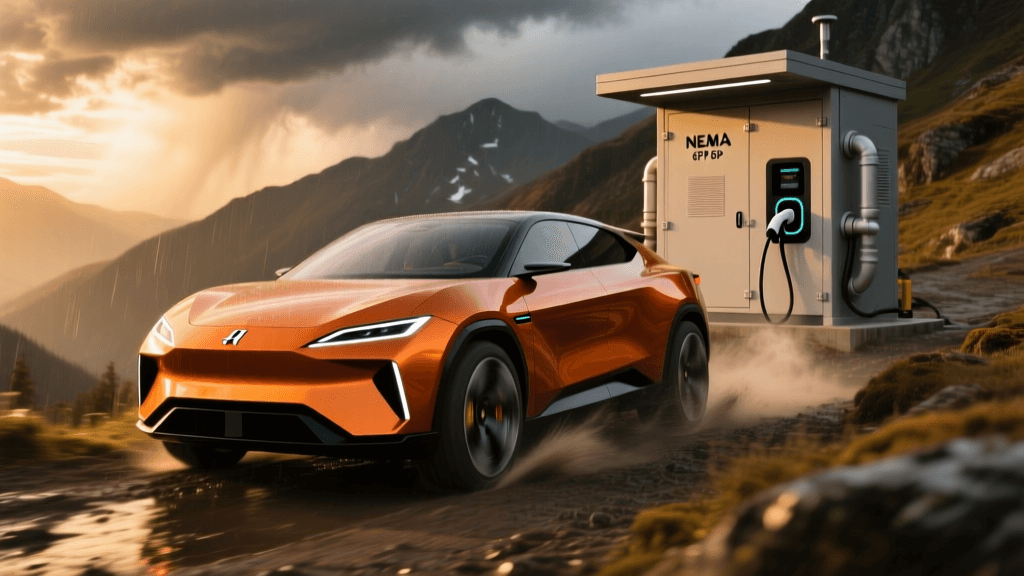
The first line of defense against the elements is the physical enclosure of the EVSE unit itself. The National Electrical Manufacturers Association (NEMA) defines specific enclosure ratings that dictate how well a device can withstand environmental hazards. When shopping for an outdoor EV charger, you must verify the NEMA rating of the unit. Relying on a NEMA 3R rated unit in a harsh coastal or heavy-snow environment is a common amateur mistake that leads to premature corrosion and electrical failure.
| NEMA Rating | Protection Level | Best Use Case for EVSE |
|---|---|---|
| NEMA 3R | Protection against falling dirt, rain, sleet, and external ice formation. | Covered carports or deeply recessed porches where direct hose-down or wind-blown rain is impossible. |
| NEMA 4 | Protection against windblown dust, rain, splashing water, and hose-directed water. | Standard outdoor residential walls, exposed driveways, and commercial parking lots. |
| NEMA 4X | Same as NEMA 4, but with added corrosion resistance (typically stainless steel or specialized polymers). | Coastal regions with salt air, areas where de-icing salts are heavily used, or harsh industrial environments. |
For the vast majority of outdoor residential installations, a NEMA 4 rated enclosure is the minimum acceptable standard. The NEMA 250 Standard provides the rigorous testing frameworks for these enclosures, ensuring that water does not breach the internal contactors or circuit boards during severe storms. If you live within five miles of the ocean, upgrading to a NEMA 4X rated charger is highly recommended to prevent salt-spray corrosion on the mounting brackets and external casing.
Conduit Routing and the Critical Hub Seal
Water intrusion rarely happens through the front face of a well-sealed charger; it almost always enters from the bottom or the back via the electrical conduit. When running wiring to an outdoor EVSE, electricians typically use Liquid-Tight Flexible Metal Conduit (LFMC) or rigid PVC. While the conduit itself is waterproof, the connection point where the conduit meets the EVSE hub is a major vulnerability.
As temperatures fluctuate, the air inside the conduit expands and contracts. This thermal breathing effect can literally suck moisture-laden air or standing water up through the conduit and directly into the charger's electrical terminal block. To prevent this, expert installers use a specialized electrical duct seal compound (commonly known by the brand name Duxseal). This moldable, non-hardening putty is packed tightly into the conduit hub and around the individual wires inside the connector. Duct seal creates an airtight and watertight vapor barrier that completely neutralizes the thermal breathing effect, ensuring that condensation cannot form inside the EVSE enclosure. Never rely solely on the mechanical compression fitting of the liquid-tight connector to keep water out; always pack the hub with duct seal.
Mounting Surface Preparation and Backplate Sealing
The surface to which you mount your EV charger plays a critical role in long-term weatherproofing. Exterior walls are rarely perfectly flat. Vinyl siding, stucco, brick, and wood all present unique challenges regarding water runoff. If an EVSE backplate is mounted flush against a textured surface like stucco or brick, microscopic gaps will remain between the metal bracket and the wall. During heavy, wind-driven rains, water will wick into these gaps, eventually penetrating the building envelope and causing interior water damage or rotting the structural sheathing.
Best practice dictates the use of a high-quality, exterior-grade silicone or polyurethane sealant. Before securing the mounting bracket to the wall, apply a generous, continuous bead of sealant to the top and sides of the backplate. Crucially, leave the bottom edge unsealed. This creates a one-way moisture escape route; if any condensation or water does manage to get behind the plate, it can drain out the bottom rather than being trapped and forced into the wall cavity. For installations on vinyl siding, it is highly recommended to install a flat PVC mounting block or a specialized EV charger backing board to provide a uniform, stable surface that prevents the siding from buckling under the weight of the heavy charger unit.
Hardwired vs. Outdoor NEMA 14-50 Receptacles
Many homeowners prefer the flexibility of installing a NEMA 14-50 receptacle so they can take their portable charger with them if they move. However, from a strict weatherproofing perspective, hardwiring the EVSE is vastly superior. Outdoor receptacles are inherently vulnerable to moisture ingress, especially when a heavy, stiff EV cable is plugged in, which can pull the plug face downward and break the weather seal.
If you must install a NEMA 14-50 receptacle outdoors, the National Electrical Code (NEC) requires the use of an "Extra-Duty" or "in-use" weatherproof cover. These bubble covers are designed to close completely over the plugged-in connector. However, not all bubble covers are created equal. Look for die-cast aluminum covers with robust, UV-resistant gaskets rather than cheap plastic alternatives that become brittle and crack after a single season of sun exposure. Furthermore, the receptacle itself should be mounted in a weatherproof box with a threaded hub, and the connection between the box and the wall must be heavily caulked.
Navigating NEC GFCI Requirements and Moisture Trips
The National Fire Protection Association (NFPA 70 / NEC) Article 625 mandates strict safety protocols for EV charging, including Ground Fault Circuit Interrupter (GFCI) protection for outdoor receptacles. While GFCI breakers are essential for life safety, they are notoriously sensitive to moisture. If even a microscopic amount of humidity or condensation bridges the gap between the neutral and ground prongs inside an outdoor NEMA 14-50 plug, the GFCI breaker will trip, interrupting your charging session.
This phenomenon, known as "nuisance tripping," is the number one complaint from outdoor EV owners during humid summers or freezing, icy winters. To circumvent this issue while maintaining total code compliance and safety, expert installers strongly recommend hardwiring the EVSE directly to a standard breaker. Modern, UL-listed hardwired EV chargers (like the Emporia Vue or Wallbox Pulsar Plus) have built-in, highly calibrated internal ground-fault protection that is specifically designed to handle the minor environmental variances of outdoor charging without triggering false interruptions.
Managing UV Degradation and Cable Strain
Weatherproofing is not just about keeping water out; it is also about protecting the physical integrity of the charging cable from ultraviolet (UV) radiation and mechanical strain. Prolonged exposure to direct sunlight causes the outer thermoplastic elastomer (TPE) jacket of EV cables to dry out, chalk, and eventually crack. Once the outer jacket cracks, the internal high-voltage copper conductors are exposed to the elements, creating a severe shock hazard.
To mitigate UV degradation, always route your charger cable through a dedicated cord management system, such as a wall-mounted holster with a cable retractor or a protective cable sleeve. Never leave the cable coiled on the ground or driveway, where it can be run over, submerged in puddles, or subjected to harsh freeze-thaw cycles. Additionally, ensure that the charging handle is always docked securely in its holster to prevent the connector pins from collecting rainwater, dirt, or insect nests, all of which can cause poor electrical contact and overheating during high-amperage charging sessions.
Expert Weatherproofing Checklist
Before signing off on any outdoor EV charger installation, run through this expert-level weatherproofing checklist to ensure maximum durability and safety:
- Verify NEMA Rating: Confirm the EVSE is rated NEMA 4 (or NEMA 4X for coastal/salty environments).
- Seal the Conduit Hub: Pack the bottom conduit entry point with electrical duct seal compound to prevent thermal breathing and moisture ingress.
- Backplate Caulking: Apply exterior-grade silicone to the top and sides of the mounting bracket, leaving the bottom open for drainage.
- Use Extra-Duty Covers: If using a receptacle, ensure an in-use, die-cast bubble cover is installed and the gasket is fully seated.
- Prefer Hardwiring: Opt for a hardwired connection to eliminate outdoor receptacle moisture risks and GFCI nuisance tripping.
- Implement Cable Management: Install a UV-protective holster and cord organizer to keep the cable off the ground and out of direct, sustained sunlight.
- Check Drip Loops: Ensure the charging cable has a natural drip loop near the connector so that water runs off the cord before reaching the vehicle's charge port.
By adhering to these rigorous weatherproofing standards, you ensure that your outdoor EV charging station remains safe, reliable, and fully operational for years to come, regardless of the environmental extremes your region may throw at it.