The Ultimate Solar EV Charging Showdown
Charging an electric vehicle with 100% rooftop solar is the holy grail of home energy independence. Instead of paying your utility for peak-hour electricity, you can divert your excess solar production directly into your EV's battery. According to the U.S. Department of Energy, over 80% of EV charging happens at home, making solar integration one of the most impactful upgrades an EV owner can make. But how do you actually achieve 'green charging' without draining your home battery or pulling from the grid?
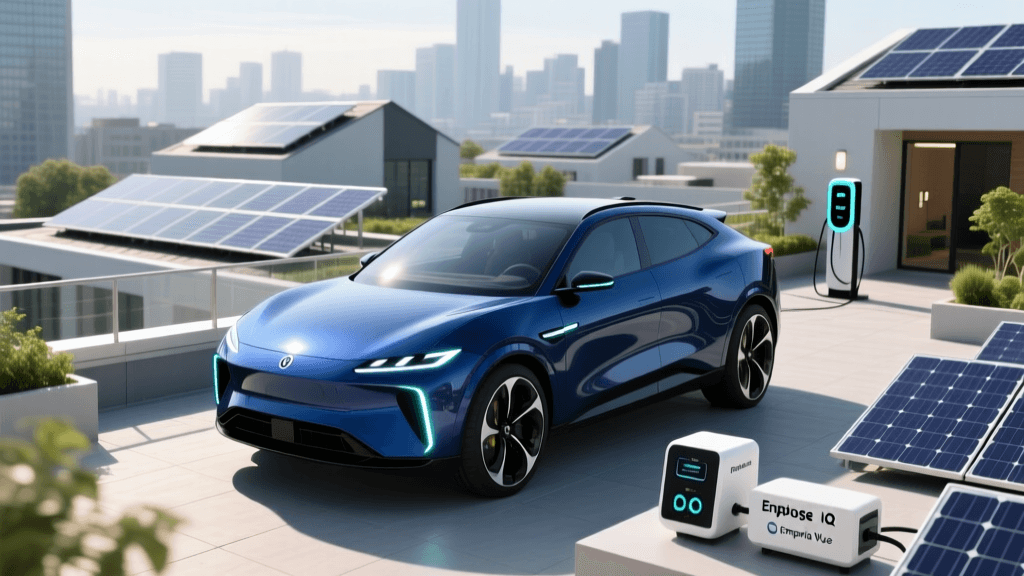
The secret lies in smart EV chargers equipped with solar diversion software. These devices monitor your home's energy production and consumption in real-time, dynamically adjusting the charging amperage to match your excess solar generation. In this head-to-head showdown, we are pitting the two undisputed heavyweights of solar-integrated EV charging against each other: the Enphase IQ EV Charger and the Emporia Level 2 EV Charger. Both offer exceptional hardware, but their approaches to solar integration, installation requirements, and ecosystem compatibility are vastly different.
Contender 1: Enphase IQ EV Charger
The Enphase IQ EV Charger is a premium, rugged, and highly intelligent charging solution designed specifically for homes already invested in the Enphase ecosystem. Capable of delivering up to 40 amps (requiring a 50-amp breaker) or 48 amps (requiring a 60-amp breaker), it is built with an integrated cable management system and a durable NEMA 4 enclosure suitable for harsh outdoor environments.
Solar Integration: The Enphase Advantage
Enphase approaches solar charging through its proprietary IQ Gateway (formerly Envoy). Because the Gateway is already communicating with every individual Enphase microinverter on your roof, it has a flawless, real-time understanding of exactly how much solar energy is being produced. When you enable 'Green Charging' in the Enphase App, the Gateway instructs the EV charger to ramp up when solar production exceeds home load, and ramp down (or pause) when clouds roll in or your home turns on a heavy appliance like an HVAC system.
The major downside? The Enphase IQ EV Charger requires you to have an Enphase solar system. It is not designed to play nicely with third-party string inverters like SolarEdge or SMA.
Contender 2: Emporia Level 2 EV Charger
The Emporia Vue EV Charger is a powerhouse of versatility, offering up to 48 amps of continuous charging current. Unlike Enphase, Emporia built its reputation on universal home energy monitoring. Their EV charger is an extension of the Emporia Vue 2 or Vue 3 energy monitor, a device that tracks energy usage at the circuit level.
Solar Integration: The Universal Approach
Emporia's solar diversion relies on physical Current Transformer (CT) clamps installed inside your electrical panel. By placing a CT clamp on your main service lines and another on your solar inverter's breaker, the Emporia system calculates your net grid flow. The 'EV Smart Charging' feature then modulates the charger's output to ensure your home never pulls from the grid while charging. As highlighted by the National Renewable Energy Laboratory (NREL), coupling rooftop solar with EV charging via smart load management is critical for grid stability and maximizing homeowner ROI. Emporia achieves this universally, meaning it works flawlessly whether you have Enphase microinverters, a SolarEdge string inverter, or a Tesla Powerwall.
Head-to-Head Comparison Matrix
| Feature | Enphase IQ EV Charger | Emporia Level 2 EV Charger |
|---|---|---|
| Max Output | 40A or 48A | 48A |
| Solar Ecosystem | Enphase Only | Universal (Any Inverter) |
| Installation Type | Hardwired Only | Hardwired or NEMA 14-50 Plug |
| Connectivity | Wi-Fi / Ethernet via Gateway | Wi-Fi / Ethernet via Vue Monitor |
| Approx. Hardware Cost | $700 - $800 | $550 - $650 (Bundle with Vue) |
| Cable Length | 24 feet | 24 feet |
Installation Showdown: Wiring, Breakers, and NEC Codes
When it comes to the physical installation, the differences between these two units dictate how your electrician will approach the job. Both units require adherence to the National Electrical Code (NEC), specifically Article 625 for EV charging and Article 705 for solar interconnections.
Enphase IQ Installation Requirements
The Enphase IQ is strictly a hardwired unit. Your electrician will need to run a dedicated 240-volt circuit from your main panel or an Enphase IQ Combiner. If you opt for the 48A version, NEC Article 210.20 requires the breaker to be rated at 125% of the continuous load. Therefore, a 48A charger requires a 60-amp breaker and 4 AWG copper wire (or 3 AWG aluminum). Because it integrates with the Enphase Gateway, the electrician must also ensure the Gateway is updated and properly networked to communicate with the charger via a proprietary radio protocol.
Emporia Vue Installation Requirements
Emporia offers more flexibility. You can hardwire the unit (using the same 60-amp breaker and 4 AWG wire rules as above) or terminate the circuit into a NEMA 14-50 receptacle. The plug-in route is highly favored by renters or those who want the portability to take the charger to a new home. However, the true installation hurdle for Emporia is the energy monitor. Your electrician must install the Emporia Vue monitor box, which involves routing multiple CT clamps into your main service panel. This requires more labor and panel space than the Enphase setup, but it provides whole-home energy visibility that Enphase lacks.
The 120% Busbar Rule and Panel Upgrades
Adding a 60-amp EV charger to a home that already has solar interconnection often triggers the NEC 705.12(B) '120% Busbar Rule'. This rule states that the sum of the main breaker rating and the solar backfeed breaker rating cannot exceed 120% of the panel's busbar rating. For a standard 200-amp panel with a 200-amp busbar, the maximum combined amperage is 240 amps. If your main breaker is 200A, your solar backfeed can only be 40A. Adding a 60A EV charger might require a panel upgrade to 225A or 400A, or a dedicated load-management device to prevent overloading the panel.
Cost Analysis and Tax Incentives
Hardware costs favor Emporia, especially if you already have a compatible smart panel. However, the installation labor for Emporia's CT clamps can narrow the gap. Enphase's hardware is more expensive, but if it is being installed concurrently with a new solar array, the marginal labor cost is minimal.
Regarding incentives, the Alternative Fuel Vehicle Refueling Property Credit (IRS Section 30C) offers a tax credit of up to 30% of the cost of the charger and installation, capped at $1,000. To qualify, the equipment must be placed in service in an eligible census tract. Note that this is separate from the Residential Clean Energy Credit (Section 25D) which covers the solar panels themselves.
The Verdict: Which Solar EV Charger Wins?
The winner of this showdown depends entirely on your existing solar infrastructure and your desire for ecosystem uniformity.
- Choose the Enphase IQ EV Charger if: You already own an Enphase solar system, you prefer a single, unified app for your solar, battery, and EV charging, and you want a premium, hardwired, set-it-and-forget-it aesthetic.
- Choose the Emporia Level 2 EV Charger if: You have a third-party solar inverter (like SolarEdge, Tesla, or SMA), you want the option to use a NEMA 14-50 plug for portability, or you want granular, circuit-level energy monitoring for your entire home alongside your EV charging.
Ultimately, both chargers successfully eliminate grid reliance during peak sun hours. By pairing either of these smart chargers with a properly sized rooftop solar array, you transform your EV from a monthly utility expense into a vehicle fueled entirely by the sun.