The Shift from Simple Charging to Smart Energy Hubs
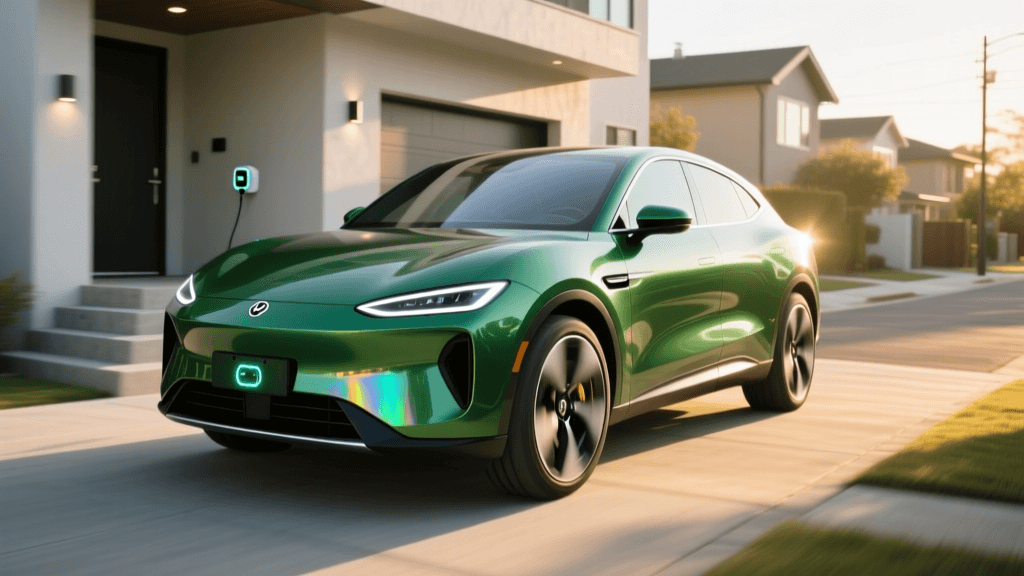
The residential garage is undergoing a radical transformation. It is no longer merely a place to park your vehicle; it is rapidly becoming the central node of your home's microgrid. When conducting a garage electrical wiring assessment before an EV charger install, looking strictly at today's requirements is a strategic mistake. The automotive industry outlook for 2025 and beyond points toward higher amperage demands, bidirectional charging capabilities, and deep integration with solar storage systems.
Most homeowners assess their garage wiring for a standard 40-amp Level 2 charger, such as the popular ChargePoint Home Flex or Emporia Level 2. However, future-proofing your electrical infrastructure requires anticipating 80-amp continuous charging circuits, Vehicle-to-Home (V2H) backup power routing, and smart load management. According to the U.S. Department of Energy, as EV battery capacities expand past 100 kWh, the demand for faster, higher-amperage home charging solutions will surge, making proactive electrical assessments critical for modern homeowners.
Core Garage Wiring Assessment Metrics for 2024 and Beyond
A thorough electrical assessment goes far beyond checking if you have an available breaker slot. It requires a holistic evaluation of your home's electrical ecosystem, from the utility drop to the final termination point in your garage.
Evaluating Your Main Service Panel (MSP)
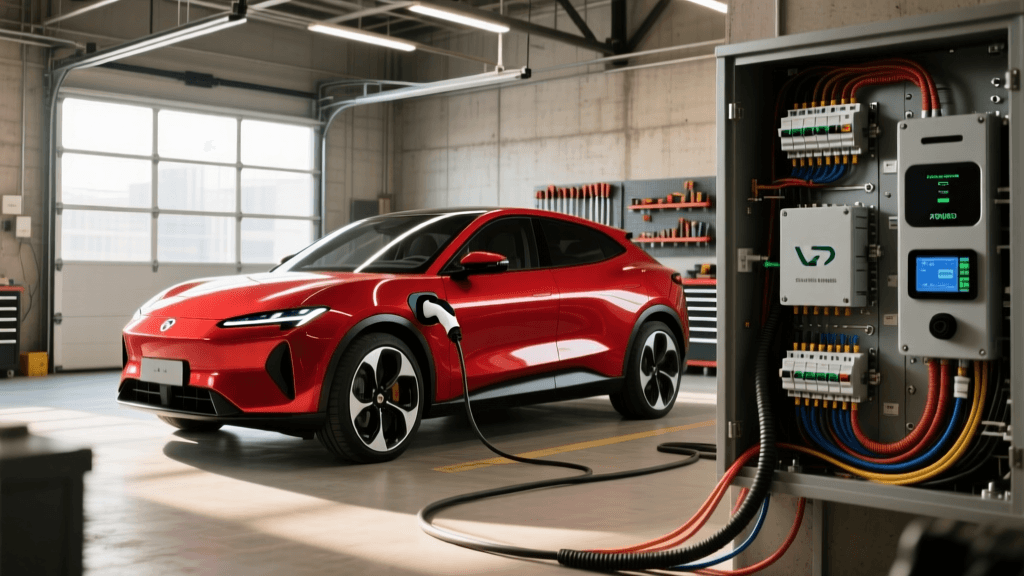
The first step in any installation guide is calculating your existing electrical load. Under the National Electrical Code (NEC) Article 625, EV charging is considered a continuous load, meaning the circuit must be rated for 125% of the charger's maximum draw. A 40-amp charger requires a 50-amp breaker, while a future-proof 80-amp charger demands a 100-amp breaker.
- 100-Amp Service: Common in older homes. Usually insufficient for Level 2 charging without a smart load management system or a panel upgrade.
- 200-Amp Service: The modern standard. Can typically support a 40A to 60A EV circuit, provided HVAC and electric ranges are factored into the load calculation.
- 400-Amp Service: The future-proof standard for luxury homes with multiple EVs, V2H capabilities, and heavy electric appliances.
During the assessment, an electrician will use a clamp meter on the main service conductors to measure peak historical draw. If your home frequently peaks above 160 amps on a 200-amp panel, adding a 50-amp EV circuit will trip the main breaker during peak winter or summer months.
Branch Circuit Wiring and Conduit Sizing
When planning the physical wire run from your panel to the garage, the choice of wire gauge and conduit is where future-proofing truly happens. While 6 AWG copper wire is sufficient for a 50-amp NEMA 14-50 receptacle, pulling this wire through a tight 3/4-inch conduit limits your future options.
Future-Proof Recommendation: Install 1.5-inch or 2-inch PVC conduit and pull 3 AWG or 2 AWG copper THHN/THWN-2 wire. This allows for safe operation on a 100-amp breaker, supporting next-generation 80-amp hardwired chargers like the upcoming high-output Tesla Wall Connector iterations. Furthermore, always leave a nylon pull string inside the conduit. If fiber-optic data cables or additional power lines are required for future smart-home integrations, the pull string saves thousands of dollars in drywall repair.
The Bidirectional Revolution: V2H and V2G Wiring Requirements
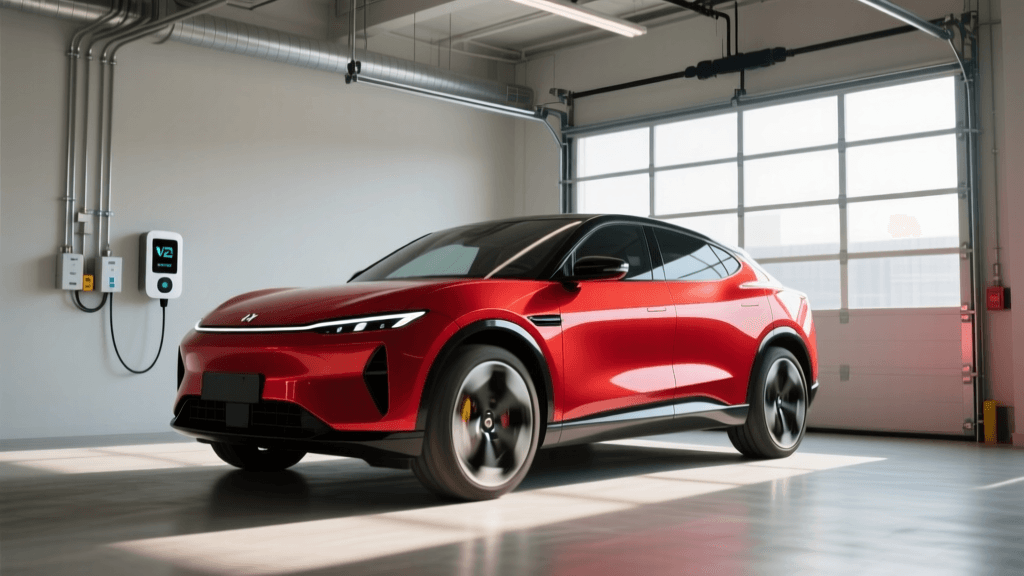
The most significant industry trend impacting garage wiring is bidirectional charging. Vehicles like the Ford F-150 Lightning, Hyundai Ioniq 5, and Chevrolet Silverado EV can push power back into your home during an outage (V2H) or back to the grid for utility credits (V2G). The National Renewable Energy Laboratory (NREL) highlights that V2G and V2H technologies will fundamentally alter residential energy management, turning EV batteries into mobile home backup generators.
Assessing your garage for bidirectional charging requires entirely different wiring topologies:
- Critical Loads Subpanel: V2H systems require a dedicated subpanel that isolates essential circuits (refrigerator, lights, Wi-Fi) from the main grid. Your assessment must identify physical space in or near the garage for this secondary panel and a bidirectional inverter (e.g., the Ford Charge Station Pro).
- 4-Wire Plus Ground Configuration: Bidirectional setups demand strict adherence to 4-wire systems (two hots, one neutral, one ground) with zero neutral-to-ground bonding downstream of the main disconnect. Older garages with 3-wire NEMA 10-50 outlets must be completely rewired.
- Automated Transfer Switches (ATS): The wiring assessment must account for the installation of an ATS, which safely disconnects your home from the utility grid before feeding EV power back into the house, preventing dangerous backfeeding that could harm utility workers.
Smart Electrical Panels vs. Traditional Panel Upgrades
Historically, if a garage wiring assessment revealed an overloaded 100-amp or 150-amp main panel, the only solution was a costly utility service upgrade to 200 amps, often costing between $3,500 and $6,000. Today, the industry is pivoting toward Smart Electrical Panels and Automated Load Management Systems.
Companies like SPAN (with the SPAN Smart Panel) and Emporia (with the Vue Smart Electrical Panel) utilize software and circuit-level monitoring to dynamically shed non-essential loads. If you plug in your EV, the smart panel detects the new 40-amp draw and automatically pauses the electric water heater or reduces the HVAC compressor draw to prevent the main breaker from tripping. The National Fire Protection Association (NFPA) continuously updates NEC Article 625 to accommodate these advanced Energy Management Systems (EMS), recognizing software-based load shedding as a safe, code-compliant alternative to physical panel upgrades.
Comparison: Future-Proofing Strategies
| Strategy | Upfront Cost | Max EV Circuit Capacity | Future V2H / Solar Ready? |
|---|---|---|---|
| Traditional MSP Upgrade (to 400A) | $4,500 - $8,000 | Up to 150A continuous | Yes, with physical space for inverters |
| Smart Panel Install (e.g., SPAN) | $3,500 - $5,500 | Dynamic (up to MSP limit) | Yes, native solar/battery integration |
| Automated Load Sharing (e.g., Wallbox Power Sharing) | $800 - $1,500 | Shared across multiple chargers | No, limited to EV load management |
Step-by-Step Action Plan for Homeowners
To ensure your garage is ready for the next decade of EV innovation, follow this actionable assessment and installation timeline:
Step 1: Hire a Specialized EV Electrician (Week 1)
Do not rely on a general handyman. Hire a licensed electrical contractor certified in EV infrastructure. Expect to pay $200 to $400 for a comprehensive load calculation and physical garage assessment, which should include a thermal scan of your current panel to check for hot spots.
Step 2: Decide on Hardwired vs. Receptacle (Week 2)
While a NEMA 14-50 receptacle offers flexibility, the future of high-power and bidirectional charging is hardwired. Hardwired connections eliminate the risk of receptacle melting under continuous 80-amp loads and are strictly required for most V2H bidirectional inverters. If you must use a receptacle, ensure the electrician installs a high-grade, commercial-specification Hubbell or Bryant 14-50R, torqued to exact manufacturer specifications.
Step 3: Install Oversized Conduit and Pull Strings (Week 3-4)
Even if you are only installing a 40-amp charger today, pay the marginal extra cost (roughly $10 to $20 per linear foot) to install 1.5-inch PVC conduit. This single decision will save you from tearing open drywall or trenching concrete when you upgrade to a dual-EV household or a V2H system in the future.
Step 4: Integrate Sub-Metering for TOU Rates (Week 4)
Work with your local utility to understand Time-of-Use (TOU) rates. Many modern chargers feature built-in sub-metering that is certified by the utility, eliminating the need for a secondary physical utility meter in your garage. Ensure your Wi-Fi network reaches the garage, as smart chargers require a stable 2.4GHz connection to communicate with utility demand-response grids.
Conclusion: Investing in Tomorrow's Grid
A garage electrical wiring assessment is no longer a simple checklist; it is a strategic investment in your home's energy independence. By prioritizing oversized conduit, evaluating smart panel alternatives, and preparing for bidirectional power flows, you insulate your property from the costly retrofitting that will plague early adopters who only planned for today's technology. As the EV landscape accelerates toward ultra-fast home charging and vehicle-to-grid integration, the copper and conduit you lay down today will dictate the efficiency, safety, and capability of your home's energy ecosystem for the next twenty years.