Introduction to EV Charger Ground Fault Protection
When you decide to install a Level 2 Electric Vehicle Supply Equipment (EVSE) at home, safety is the ultimate priority. Charging an electric vehicle requires drawing a massive, continuous electrical load—often 32 to 48 amps for hours at a time. Because EV charging frequently occurs in garages, carports, or driveways where moisture, rain, and snow are present, the risk of electrical shock is a serious concern. This is where ground fault protection becomes the most critical safety mechanism in your home charging setup. For beginners navigating the complex world of electrical codes and charger specifications, understanding ground fault protection is essential for a safe, code-compliant, and frustration-free installation.
What Exactly is a Ground Fault?
A ground fault occurs when electrical current strays from its intended circuit path and finds an unintended route to the ground. In a residential setting, this unintended route could be water on a garage floor, a damp concrete driveway, or even a human body. If you are touching a faulty EV charging cable or a damaged connector while standing on a grounded surface, your body could complete the circuit, resulting in a severe or potentially fatal electric shock. Ground fault protection devices are designed to monitor the electrical current flowing through the hot and neutral wires. If they detect an imbalance as small as a few milliamps—meaning current is leaking somewhere else—the device trips, cutting off power in a fraction of a second to prevent injury.
NEC Article 625: The Core Rules for EVSE
The installation of EV charging equipment in the United States is governed by the National Electrical Code (NEC), specifically Article 625, which is published and maintained by the National Fire Protection Association (NFPA). Article 625 outlines the strict safety requirements for Electric Vehicle Supply Equipment. One of the most heavily debated and updated sections of Article 625 in recent NEC cycles (2017, 2020, and 2023) revolves around ground fault protection. The NEC mandates that all EVSEs must have ground-fault circuit-interrupter (GFCI) protection to ensure user safety. However, how this protection is achieved depends heavily on whether you are using a hardwired charger or a plug-in charger connected to a NEMA 14-50 receptacle.
Class A GFCI and the 6-Milliamp Threshold
The NEC requires 'Class A' GFCI protection for EV charging circuits. A Class A GFCI device is engineered to trip when the ground-fault current reaches a threshold between 4 and 6 milliamps (mA). This ultra-sensitive threshold is specifically chosen because it is well below the level of current that can cause ventricular fibrillation or severe harm to the human heart. Standard circuit breakers, by contrast, only trip during massive overloads or short circuits (e.g., 40 or 50 amps) and will not protect you from the micro-leakages that cause fatal shocks.
Hardwired vs. Plug-In: How GFCI Rules Apply
One of the most confusing aspects for beginners is understanding whether you need a GFCI breaker in your main electrical panel. The answer depends on your installation method and the version of the NEC your local jurisdiction has adopted. Below is a comparison of how ground fault protection is typically applied based on the installation type.
| Installation Type | GFCI Breaker in Panel Required? | Primary Ground Fault Protection Source |
|---|---|---|
| Hardwired EVSE (NEC 2023) | Generally No | Internal CCID inside the EVSE unit |
| Plug-In NEMA 14-50 (NEC 2020/2023) | Yes | GFCI Breaker + Internal EVSE CCID |
| Hardwired EVSE (NEC 2017/2020) | Varies by local inspector | Internal CCID or Panel GFCI |
As noted by the U.S. Department of Energy, hardwiring your Level 2 charger is often recommended by electricians because it eliminates the need for an external GFCI receptacle or breaker in many jurisdictions, provided the EVSE has built-in protection.
The Dreaded 'Nuisance Tripping' Phenomenon
If you browse EV owner forums, you will inevitably encounter complaints about 'nuisance tripping.' This happens when a GFCI breaker in the electrical panel randomly trips in the middle of the night, leaving the driver with an uncharged car in the morning. Nuisance tripping is usually caused by 'double GFCI protection.' Almost all modern, UL-listed EVSEs (like those from ChargePoint, Emporia, or Tesla) have a built-in ground fault sensor called a Charging Circuit Interrupting Device (CCID). The CCID monitors the ground wire and internal circuitry for faults. If your electrical panel also has a highly sensitive Class A GFCI breaker, the two sensors can conflict. EVs and their chargers naturally produce a tiny amount of capacitive leakage current due to the heavy inductors and power electronics inside the car's onboard charger. This harmless micro-leakage can accumulate and trick a hyper-sensitive panel GFCI breaker into tripping, even though there is no actual danger.
Why Hardwiring is the Beginner's Best Friend
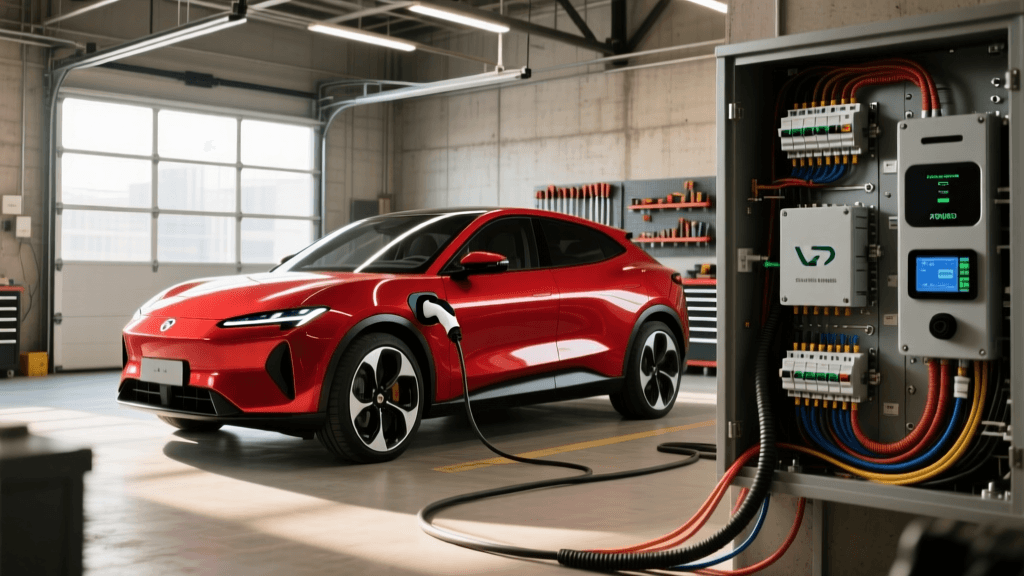
To avoid the headache of nuisance tripping and the high cost of specialized breakers, most master electricians recommend hardwiring your EV charger. When you hardwire a Level 2 charger, the EVSE connects directly to the electrical panel via a junction box, eliminating the 240-volt receptacle. Under NEC 2023 guidelines, if a hardwired EVSE is listed and includes its own internal ground-fault protection (the CCID), an external GFCI breaker in the panel is generally not required. This solves the double-GFCI problem, reduces the cost of the installation, and provides a cleaner, more reliable charging experience. Furthermore, hardwiring removes the physical plug from the equation, eliminating the risk of the plug melting due to loose connections or corrosion over time.
Cost Breakdown: GFCI Breakers and Installation
Understanding the financial impact of ground fault protection is crucial for budgeting your home charging setup. Here is a general cost breakdown for a 50-amp circuit (typically used for a 40-amp continuous Level 2 charger):
- Standard 50-Amp Double-Pole Breaker: $10 to $15. (Used for hardwired setups where internal EVSE CCID satisfies code).
- 50-Amp GFCI Double-Pole Breaker: $100 to $160. (Required for NEMA 14-50 receptacles under NEC 2020/2023).
- NEMA 14-50 Receptacle (Industrial Grade): $40 to $80.
- Labor for Panel Upgrade (if needed): $500 to $2,000+, depending on whether your home needs a service upgrade from 100A to 200A to handle the EV load safely.
As highlighted by the Alternative Fuels Data Center, investing in a proper, code-compliant installation by a licensed professional is vital. Skipping a required GFCI breaker to save $120 is a massive safety violation and can result in failed inspections, voided home insurance policies, or fatal electrical accidents.
Step-by-Step: Ensuring Code Compliance for Your Home
If you are a beginner planning an EV charger installation, follow these actionable steps to ensure your ground fault protection meets all legal and safety requirements:
- Check Your Local Codes: The NEC is a model code. Your city or county may be operating on the 2017, 2020, or 2023 version. Call your local building department to ask which NEC version they enforce for EVSE installations.
- Choose Hardwired Over Plug-In: Unless you need to unplug the charger to take it to a second home, choose a hardwired EVSE. It is safer, cleaner, and avoids the expensive GFCI breaker requirement in most jurisdictions.
- Verify the EVSE's CCID: Ensure the charger you purchase is UL-listed or ETL-listed and explicitly states it has built-in ground fault protection (CCID). Cheap, unbranded chargers from overseas marketplaces often lack proper internal protection and are severe fire and shock hazards.
- Hire a Licensed Electrician: Do not attempt a DIY panel upgrade or 240-volt wiring. A licensed electrician will pull the necessary permits, calculate the load on your existing electrical panel, and ensure the correct torque is applied to all wire connections.
- Schedule the Inspection: Once installed, your local electrical inspector will verify that the correct breaker type was used, the wire gauge is sufficient (e.g., 6 AWG copper for 50A), and the ground fault protection functions correctly.
Conclusion
Ground fault protection is not just a bureaucratic hurdle; it is a life-saving technology that protects you, your family, and your property from the inherent dangers of mixing high-voltage electricity with the unpredictable environments where vehicles are parked. By understanding NEC Article 625, recognizing the differences between hardwired and plug-in requirements, and avoiding the pitfalls of nuisance tripping, you can ensure your home EV charging setup is safe, reliable, and ready to power your electric journeys for years to come.