The Unique Challenge of Detached Garages in the EV Era
As electric vehicle adoption accelerates, homeowners are increasingly facing the logistical hurdles of installing Level 2 EV chargers in detached garages. Unlike attached garages, where a charger can often share the home's main electrical panel with a short wire run, detached structures require crossing the yard, navigating landscaping, and frequently installing dedicated sub-panels. According to the U.S. Department of Energy, the vast majority of EV charging occurs at home, making the reliability and capacity of residential infrastructure paramount. However, the traditional approach to detached garage installations—digging massive trenches and upgrading main service drops to 400 amps—is rapidly becoming obsolete. The future of EV charging installation is shifting toward smart load management, minimally invasive trenching, and bidirectional energy hubs.
Future Trend 1: Smart Sub-Panels and Dynamic Load Management
Historically, adding a 48-amp continuous load (requiring a 60-amp breaker) to a detached garage meant upgrading the entire property's main electrical service if the existing 100-amp or 150-amp panel was near capacity. This upgrade could cost between $3,000 and $8,000 and take months to get utility approval. The industry is now pivoting toward Smart Electrical Panels and dynamic load management systems.
How Smart Panels Change the Game
Companies like SPAN and Leviton are introducing smart sub-panels that can be installed in the detached garage. These panels monitor energy usage at the circuit level and communicate with the EV charger. If the main house turns on the HVAC, electric oven, and dryer simultaneously, the smart panel dynamically throttles the amperage sent to the EV charger in the garage to prevent tripping the main breaker. This eliminates the need for a costly main service upgrade. For detached garages, running a single, heavily monitored feeder line to a smart sub-panel allows homeowners to safely add EV charging, workshop tools, and mini-split HVAC systems without exceeding the home's total electrical capacity.
Future Trend 2: Micro-Trenching and Directional Boring
Running conduit from the main house to a detached garage traditionally required hiring a landscaping crew to dig an 18-to-24-inch deep trench, destroying lawns, driveways, and hardscaping. The future of outdoor EV infrastructure installation borrows from the fiber-optic telecommunications industry: directional boring and micro-trenching.
- Directional Boring: A specialized machine drills a horizontal, underground path from the main house to the detached garage without disturbing the surface. Conduit is then pulled through the bore. This is ideal for crossing paved driveways or pristine landscaping.
- Micro-Trenching: A specialized saw cuts a narrow, 1-to-2-inch wide slit into the earth or asphalt, just deep enough to lay specialized direct-bury armored cable or shallow-conduit. The slit is then sealed with industrial filler.
While directional boring equipment requires specialized contractors, the cost of landscape restoration is virtually eliminated, making the total project cost highly competitive with traditional trenching while saving days of manual labor.
Future Trend 3: The Detached Garage as a Bidirectional Energy Hub
The most exciting trend for detached garages is their evolution into independent microgrids. With the rise of Vehicle-to-Home (V2H) and Vehicle-to-Grid (V2G) technologies seen in vehicles like the Ford F-150 Lightning and GM Silverado EV, the detached garage is no longer just a place to draw power; it is a place to store and distribute it.
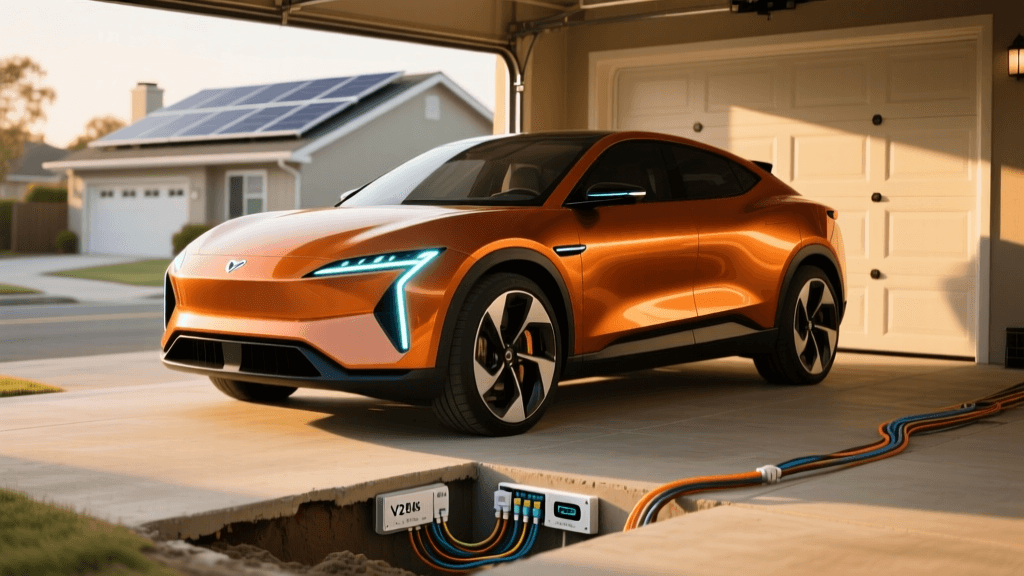
Future installations are pairing detached garage solar canopies with bidirectional chargers like the Ford Charge Station Pro or the Wallbox Quasar. During a grid outage, the EV plugged into the detached garage can route power back through a specialized transfer switch to energize the main home's critical circuits. This requires installing specific communication wiring alongside the heavy-gauge power lines during the initial trenching phase, preparing the garage for seamless V2H integration.
Cost and Technology Comparison: Traditional vs. Future-Ready
To understand the financial and practical implications of these trends, consider the following comparison of installation methodologies for a detached garage located 60 feet from the main electrical panel.
| Feature | Traditional Hardwired Install | Smart Load-Managed Install | Bidirectional Hub (V2H Ready) |
|---|---|---|---|
| Main Panel Upgrade | Often Required ($4,000+) | Rarely Required | Required (w/ Transfer Switch) |
| Trenching Method | Manual / Backhoe (High landscape damage) | Directional Boring (Low damage) | Directional Boring + Cat6/Comm lines |
| Charger Hardware | Standard Level 2 (e.g., ChargePoint Home Flex) | Smart Sub-Panel + Standard Level 2 | Bidirectional Charger (e.g., Wallbox Quasar) |
| Estimated Total Cost | $4,500 - $8,500 | $5,000 - $7,000 | $9,000 - $14,000 |
| Future-Proofing | Low | High | Maximum |
Future Trend 4: Wireless Charging Pads for Driveways
For homeowners who do not want to mount hardware inside a detached garage, or who park on a pad just outside the garage doors, wireless inductive charging is moving from commercial fleets to residential applications. Companies like WiTricity are developing high-efficiency magnetic resonance pads embedded directly into the concrete driveway.
While currently expensive and limited in availability, forward-thinking homeowners pouring new concrete for a detached garage pad are installing empty, capped conduit stubs beneath the slab. This allows for the future installation of a wireless charging pad without jackhammering the new driveway. The pad communicates with the vehicle's receiver, initiating a charge the moment the car is parked, completely eliminating the need to handle heavy, stiff charging cables in freezing or rainy weather.
Actionable Advice: Future-Proofing Your Detached Garage Install Today
If you are planning an EV charger installation in a detached garage this year, you must adhere to current safety standards while preparing for tomorrow's technology. Compliance with the latest National Electrical Code (NEC) Article 625, as outlined by the National Fire Protection Association (NFPA), mandates specific disconnect rules, GFCI protections, and load calculations for EV charging equipment.
Beyond code minimums, follow these actionable steps to future-proof your installation:
1. Oversize Your Conduit
Never bury direct-wire cable in the earth for a detached garage run. Always install rigid or Schedule 40/80 PVC conduit. Even if your current EV charger only requires 6 AWG THHN wire for a 60-amp circuit, install a minimum 2-inch diameter conduit. This allows you to easily pull thicker 2/0 AWG aluminum wire in the future if you upgrade to a dual-charger setup or a bidirectional V2H system that requires much higher amperage.
2. Pull Communication Lines Simultaneously
Alongside your electrical conductors, pull a direct-bury, gel-filled Cat6 ethernet cable and a spare 1/2-inch flexible conduit. Future smart panels, bidirectional chargers, and solar inverters require hardwired, low-latency communication lines to function safely and efficiently. Relying on Wi-Fi across a yard to a detached garage is notoriously unreliable due to interference and distance.
3. Install a Critical Loads Sub-Panel
Instead of just wiring a single NEMA 14-50 receptacle or a hardwired charger directly from the main house, install a 100-amp sub-panel inside the detached garage. This provides the flexibility to add dedicated circuits for future workshop equipment, battery storage systems, or secondary EV charging stations without having to dig a second trench across your property.
4. Consider the NEMA 14-50 vs. Hardwired Debate
While the NEMA 14-50 outlet offers portability, the future of high-amperage and bidirectional charging heavily favors hardwired connections. Hardwired units eliminate the point of failure associated with receptacle wear, thermal expansion, and loose connections over time. If you must use a receptacle for flexibility, ensure your electrician installs a commercial-grade, industrial specification NEMA 14-50R, and ensure the circuit includes a GFCI breaker as mandated by recent NEC updates for outdoor and garage receptacles.
Conclusion
Installing an EV charger in a detached garage is no longer just about digging a ditch and running some copper wire. It is an exercise in modern energy management. By leveraging smart sub-panels, minimally invasive directional boring, and oversized conduit pathways, homeowners can transform their detached garages into resilient, future-ready energy hubs capable of supporting the next generation of bidirectional electric vehicles.