The Shift: Why Standard 240V Assessments Are No Longer Enough
For the past decade, a residential garage electrical wiring assessment for an EV charger was a relatively straightforward exercise. An electrician would check for 50 amps of spare capacity on a 200-amp main service panel (MSP), run some 6 AWG Romex to a NEMA 14-50 receptacle, and call it a day. However, as the automotive industry rapidly transitions toward 800-voltage architectures, massive battery packs exceeding 130 kWh, and bidirectional energy flow, the standard home charging paradigm is shifting beneath our feet.
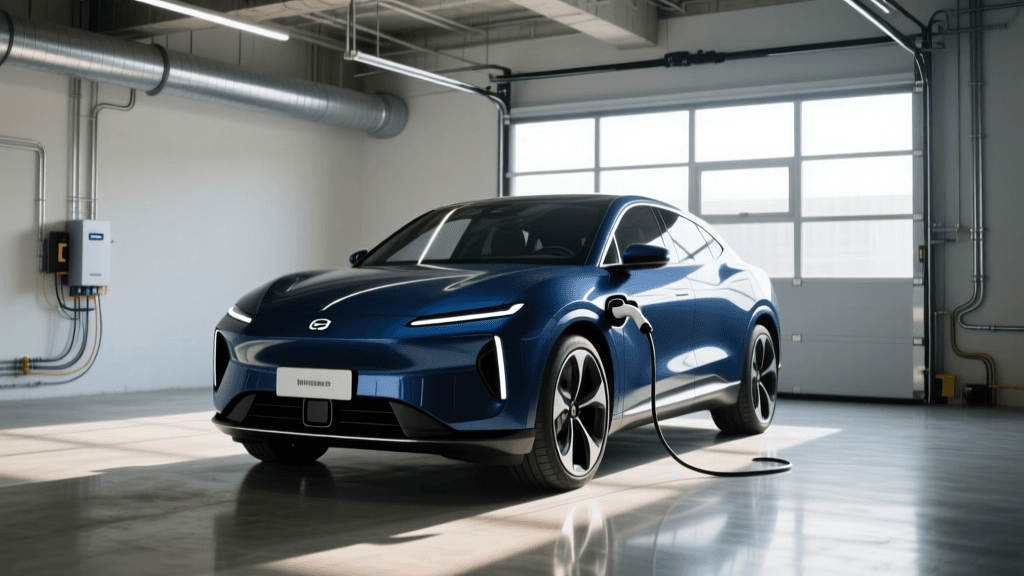
Conducting a garage wiring assessment today requires a forward-looking lens. You are no longer just wiring a car; you are integrating a rolling battery into your home's microgrid. According to the U.S. Department of Energy, the integration of smart home charging and utility-interactive systems is becoming a cornerstone of modern residential energy management. To future-proof your garage, your electrical assessment must account for high-amperage continuous loads, advanced load-shedding software, and the physical infrastructure required for Vehicle-to-Home (V2H) capabilities.
Evaluating Your Main Service Panel for Next-Gen Loads
The first step in any comprehensive wiring assessment is evaluating the Main Service Panel. Most modern homes are equipped with a 200-amp service. Under the National Electrical Code (NEC) Article 220, a standard load calculation often leaves little room for an 80-amp continuous EV charger, especially if the home features electric HVAC, an electric range, and an electric dryer.
The Rise of the Smart Panel
Historically, if your load calculation failed, the only solution was a costly service upgrade to 320 or 400 amps, which can cost upwards of $4,000 to $8,000 and require utility transformer replacements. Today, the industry outlook is pivoting toward software-managed load shedding. Smart electrical panels, such as those developed by Span, replace traditional breakers with solid-state relays and current sensors. During a modern wiring assessment, an electrician will evaluate if your existing panel can be retrofitted with an automated EV energy management system (EVEMS). These systems monitor the home's total real-time load and dynamically throttle the EV charger's amperage to prevent the main breaker from tripping, entirely bypassing the need for a physical service upgrade in many older homes.
Wire Gauge, Conduit, and the 800V Architecture Reality
While vehicles like the Hyundai Ioniq 5, Porsche Taycan, and upcoming electric pickups utilize 800V DC architectures for rapid public charging, home Level 2 charging remains limited to 240V AC. To replenish a 130 kWh battery (like the GMC Hummer EV or Chevy Silverado EV) overnight at 240V, the industry is moving past the 48-amp standard toward 80-amp hardwired Level 2 chargers.
When assessing your garage wiring pathways, the choice between NM-B (Romex) and THHN wire inside conduit is critical for future-proofing. NM-B cable requires a 60°C column ampacity rating, meaning it must be upsized significantly compared to the 90°C rating of THHN wires pulled through conduit. Furthermore, running oversized conduit during the initial installation is a hallmark of a future-proof assessment.
Future-Proof Wire and Conduit Sizing Chart
| Charger Scenario | Max Output | Required Breaker (125% Rule) | Copper Wire (THHN in Conduit) | Copper Wire (NM-B / Romex) | Recommended Conduit Size |
|---|---|---|---|---|---|
| Standard Level 2 (Current Gen) | 48 Amps | 60 Amp | 6 AWG | 4 AWG | 3/4-inch PVC / EMT |
| High-Power Level 2 (Near Future) | 80 Amps | 100 Amp | 3 AWG | 1 AWG | 1-inch PVC / EMT |
| Bidirectional V2H Hub (Next Gen) | 100+ Amps | 125+ Amp | 1/0 AWG or 2/0 AWG | 2/0 AWG | 1.5-inch to 2-inch PVC |
Note: Always consult the latest NFPA 70 (National Electrical Code) and your local AHJ (Authority Having Jurisdiction) for exact ampacity derating requirements based on ambient garage temperatures and conduit fill capacities.
Preparing for Bidirectional Charging (V2G and V2H)
The most significant industry trend impacting garage wiring is bidirectional charging. Vehicle-to-Home (V2H) allows your EV to power your house during a grid outage, effectively replacing a diesel or natural gas standby generator. However, V2H is not as simple as plugging a car into a standard NEMA 14-50 outlet.
Grounding and Transfer Switch Requirements
During your wiring assessment, the electrician must evaluate the home's Grounding Electrode System (GES). Bidirectional hubs require a dedicated, ultra-low-impedance ground path to ensure the inverter inside the vehicle can safely sync with the home's electrical grid when operating in 'island mode.' Additionally, the assessment must identify physical space on your main service panel—or adjacent to it—for an Automatic Transfer Switch (ATS) or a critical loads subpanel. If your garage lacks the physical wall space for a 30-inch wide bidirectional gateway and subpanel, the wiring pathway from the exterior utility drop to the interior garage must be mapped out in advance.
Pro Tip: If you are building a new home or doing a major garage remodel, ask your electrician to install a 'V2H-Ready' critical loads subpanel from day one. Wire your refrigerator, Wi-Fi router, garage door, and select outlets to this subpanel now, so that when bidirectional chargers become widely available and affordable, your home requires zero drywall cutting to integrate the transfer switch.
Upcoming NEC Code Changes and Smart Breaker Integration
The NEC is continually evolving to address the unique thermal and continuous-load challenges presented by EV charging. Article 625 of the NEC specifically governs Electric Vehicle Charging System Equipment. Recent and upcoming revisions are placing heavier emphasis on continuous load management, thermal monitoring of receptacles, and the mandatory use of GFCI protection for all 240V EV receptacles.
Because GFCI breakers for high-amperage 240V circuits are notoriously expensive and prone to nuisance tripping with certain older EVSEs, the industry outlook heavily favors hardwired connections over plug-in NEMA receptacles for any charger exceeding 48 amps. A thorough garage wiring assessment will strongly advise homeowners to abandon the idea of a 'portable' 14-50 setup if they intend to utilize 80-amp chargers or bidirectional hubs in the near future. Hardwiring eliminates the receptacle as a point of thermal failure and satisfies NEC continuous load requirements more elegantly.
The Assessment Checklist for Homeowners
Before signing a contract for a standard EV charger install, ensure your electrician has addressed the following future-proofing metrics during their site visit:
- Thermal Imaging: Did they use a thermal camera on your current MSP under peak load to check for degrading main lugs or busbars?
- Conduit Oversizing: Are they pulling wire through 1-inch or larger conduit, even if current codes only require 3/4-inch, to allow for future 2/0 AWG V2H wire pulls?
- Wi-Fi and Ethernet Mapping: Next-gen chargers and smart panels require robust network connectivity for OTA updates and utility demand-response programs. Have they assessed Wi-Fi signal strength in the garage or planned for a hardwired CAT6a run?
- Utility Meter Collar Space: Is there physical space on your exterior wall for a secondary utility meter or a smart grid-interactive disconnect switch required by some local municipalities for V2G participation?
Conclusion
The era of treating the EV charger as a simple 'appliance' is over. As vehicles evolve into grid-interactive energy storage systems, your garage's electrical infrastructure must evolve in tandem. By conducting a comprehensive, future-focused wiring assessment that prioritizes conduit scalability, smart panel integration, and bidirectional readiness, you can ensure your home is prepared not just for the EV you drive today, but for the mobile power plant you will own tomorrow.