The Nissan Leaf holds a unique place in EV history. Launched in the U.S. for the 2011 model year, it was the first mass-market battery electric vehicle most Americans could actually buy. Over more than a decade of production, Nissan sold hundreds of thousands of Leafs worldwide — and in doing so, generated one of the largest real-world datasets on EV battery longevity available. For current owners, prospective used-EV buyers, or anyone researching long-term battery durability, the Nissan Leaf battery is the single most studied pack in the industry.
This guide covers what the data actually shows: how Leaf batteries degrade over time, what replacement costs look like in 2026, how Nissan's warranty protects you, and the habits that meaningfully extend battery life. We also place the Leaf's lithium manganese oxide (LMO) and NMC chemistry in context with modern alternatives like LFP.
Nissan Leaf Battery Chemistry Explained: LMO, NMC, and What It Means
The Nissan Leaf has never used a single battery chemistry across its production run. Understanding which chemistry your Leaf has matters for predicting longevity, range retention, and charging behavior.
First-generation Leaf (2011–2017): These models used a 24 kWh or (starting in 2016) 30 kWh pack built with lithium manganese oxide (LMO) cathode cells. LMO offered good thermal stability and safety but lower energy density than competing chemistries. Critically, the Gen 1 Leaf used passive air cooling rather than liquid thermal management — a design decision that has had lasting consequences for battery longevity, particularly in hot climates.
Second-generation Leaf (2018–present): Nissan introduced a 40 kWh pack (Leaf S/SV) and a 62 kWh pack (Leaf SL Plus) using NMC (nickel manganese cobalt) chemistry. While still passively cooled in most markets, the larger packs and updated cell chemistry improved both range and degradation behavior. The 62 kWh Leaf SL Plus carries an EPA-estimated 212 miles of range, while the 40 kWh version delivers approximately 149 miles EPA.
| Attribute | LMO (Gen 1 Leaf) | NMC (Gen 2 Leaf, most EVs) | LFP (Tesla Model 3 RWD, others) |
|---|---|---|---|
| Energy Density | Moderate (~100–120 Wh/kg cell-level) | High (~200–260 Wh/kg cell-level) | Lower (~140–170 Wh/kg cell-level) |
| Cycle Life | 500–1,000 cycles to 80% | 1,000–2,000 cycles to 80% | 2,000–5,000+ cycles to 80% |
| Cold-Weather Performance | Moderate loss (~20–30%) | Moderate loss (~15–25%) | Greater loss (~25–35%) |
| Thermal Stability | Excellent | Good (requires management) | Excellent |
| Cost per kWh | Higher (legacy, less produced) | Moderate (~$100–130/kWh pack-level, 2025–2026) | Lower (~$75–100/kWh pack-level) |
| Optimal Daily SoC | 20–80% | 20–80% | Can be charged to 100% daily |
LFP vs. NMC — which is better? It depends on your use case. LFP (lithium iron phosphate) offers dramatically longer cycle life and lower cost, making it ideal for standard-range vehicles and daily commuting. However, LFP has lower energy density (meaning heavier packs for the same range) and worse cold-weather performance. NMC remains the better choice for long-range applications where pack weight and volume matter. The Leaf's older LMO chemistry falls behind both on cycle life and energy density, which is why Nissan transitioned away from it.
Real-World Nissan Leaf Battery Degradation: What the Data Shows
Because the Leaf has been on the road since 2011, we have genuine long-term degradation data from thousands of owners — something almost no other EV can match. Here is what the numbers show:
Gen 1 Leaf (24 kWh, 2011–2015): Owners in moderate climates typically report 10–15% capacity loss over the first 5 years and 60,000–80,000 miles. In hot climates (Arizona, Texas, the Middle East), degradation accelerated significantly, with some owners seeing 20–30% loss within 4–5 years. The lack of active thermal management is the primary culprit — repeated exposure to high battery temperatures accelerates chemical degradation of the cathode.
Gen 1 Leaf (30 kWh, 2016–2017): Paradoxically, the 30 kWh pack showed faster initial degradation in some owner datasets. Nissan acknowledged that the higher energy density cells, packed more tightly without improved cooling, were more susceptible to heat-related capacity loss. Many 30 kWh Leafs showed 15–25% degradation by year 5.
Gen 2 Leaf (40 kWh, 2018+): The revised NMC chemistry and slightly improved pack architecture yielded better degradation curves. Owners commonly report 5–10% loss over the first 3–4 years / 50,000–70,000 miles. The curve tends to flatten after the initial drop — a pattern consistent with most lithium-ion chemistries.
Gen 2 Leaf (62 kWh, 2019+): With the largest pack and lowest average state-of-charge stress for daily driving, the 62 kWh Leaf shows the most favorable degradation data of the lineup. Early reports suggest 5–8% loss over 3–4 years for owners who avoid habitual fast charging and extreme SoC levels.
A useful way to frame degradation: a 2013 Leaf with a 24 kWh pack that has lost 25% of its capacity now holds roughly 18 kWh usable — translating to about 55–60 miles of real-world range instead of the original ~75. That is a meaningful reduction for anything beyond commuting. By contrast, a 2022 Leaf SL Plus with a 62 kWh pack losing 10% still retains about 56 kWh usable, good for roughly 190 real-world miles.
Nissan Leaf Battery Warranty: What Is Actually Covered
Nissan provides two layers of battery warranty coverage for the Leaf, and understanding the distinction matters:
| Warranty Type | Coverage Period | What It Covers | Threshold / Trigger |
|---|---|---|---|
| Lithium-Ion Battery Capacity Coverage | 8 years / 100,000 miles | Capacity loss below threshold | Falls below 9 bars out of 12 on the capacity gauge (approximately 70% of original capacity) |
| Lithium-Ion Battery Defect Coverage | 5 years / 60,000 miles (federal emissions-style) or 8 yr/100k in some states | Manufacturing defects, sudden failure | Any defect not caused by abuse, accident, or improper modification |
The capacity warranty is the one most owners care about. Nissan's bar-based system is straightforward but imprecise: the dashboard capacity gauge shows 12 bars when new, and warranty coverage triggers when you lose the 4th bar (dropping to 8 bars or fewer). This roughly corresponds to 66–70% state of health (SoH), though Nissan does not publish an exact percentage mapping.
Important caveat: The capacity gauge is not a precision instrument. Multiple Leaf owners and independent testers have found that the bar system can lag behind actual measured capacity by several percentage points. For a more accurate SoH reading, use an OBD-II diagnostic tool with Leaf-compatible software (see the monitoring section below).
If your Leaf's battery qualifies under warranty, Nissan will repair or replace the pack. Replacement typically involves a refurbished pack with comparable or better capacity — not necessarily a brand-new unit. In CARB states (California and states adopting California emissions standards), coverage terms may be more favorable.
Nissan Leaf Battery Replacement Cost: What to Budget
If your Leaf's battery degrades beyond acceptable levels outside of warranty coverage — or if you purchase an older Leaf and want to restore its range — replacement is possible but expensive. Here is the current cost landscape:
| Pack Size | Source | Part Cost (approx.) | Labor + Programming | Total Estimated Cost |
|---|---|---|---|---|
| 24 kWh (2011–2015) | Nissan dealer (refurbished) | $5,500–$6,500 | $1,000–$1,500 | $6,500–$8,000 |
| 24 kWh (2011–2015) | Aftermarket / used pack | $2,500–$4,000 | $800–$1,500 | $3,300–$5,500 |
| 30 kWh (2016–2017) | Nissan dealer (refurbished) | $6,500–$8,000 | $1,000–$1,500 | $7,500–$9,500 |
| 40 kWh (2018+) | Nissan dealer | $7,500–$9,500 | $1,200–$1,800 | $8,700–$11,300 |
| 62 kWh (2019+) | Nissan dealer | $9,000–$12,000 | $1,200–$1,800 | $10,200–$13,800 |
Key context on replacement economics: A battery replacement rarely makes financial sense on a Gen 1 Leaf. A 2013 Leaf in good condition might be worth $6,000–$9,000 on the used market; spending $7,000+ on a new battery exceeds the vehicle's value. This is why most Gen 1 Leaf owners either live with reduced range, sell the car, or explore aftermarket used-pack swaps at lower cost.
For Gen 2 Leafs (2018+), the calculus is different. A 2021 Leaf SV Plus with a degraded battery is still a $15,000–$20,000 vehicle, and a $10,000–$12,000 battery replacement restores it to near-original range. Most Leaf batteries, however, do not require replacement during typical ownership. Data from fleet operators and long-term owners suggests that the majority of Leaf packs retain 70%+ capacity through 100,000–150,000 miles when properly maintained.
Factors That Accelerate (or Slow) Leaf Battery Degradation
The Leaf's passively cooled battery makes it more sensitive to owner habits than liquid-cooled EVs. Here are the factors with the strongest documented impact:
1. Frequent DC fast charging. CHAdeMO fast charging (the Leaf's DC standard) generates significant heat. Because the Leaf lacks liquid cooling, repeated fast charging — especially in warm weather — bakes the cells. Owners who fast-charge more than 2–3 times per week consistently show accelerated degradation compared to those who primarily use Level 2 home charging.
2. High ambient temperatures. Leaf batteries in Phoenix, Las Vegas, and similar hot-climate cities degrade noticeably faster than those in Seattle or Portland. Battery temperatures above 95°F (35°C) accelerate electrolyte decomposition and cathode wear. Parking in shade or a garage makes a measurable difference.
3. Sustained high or low state of charge. Storing a Leaf at 100% SoC for extended periods (days to weeks) stresses NMC and LMO cells. Similarly, letting the pack sit near 0% for prolonged periods risks copper dissolution in the anode. The sweet spot for daily use and storage is 20–80% SoC.
4. Deep discharge cycles. Regularly driving the Leaf down to near-empty before recharging puts more stress on cells than shallow, partial cycles. Charging from 30% to 70% daily is gentler than cycling from 10% to 90%.
5. Cold-weather fast charging. Charging a cold battery at high power causes lithium plating on the anode — a permanent form of degradation. The Leaf's lack of battery preconditioning means DC fast charging in freezing temperatures is particularly hard on the pack. If possible, charge at Level 2 speeds when the battery is cold.
Leaf Battery Care Checklist
- Use Level 2 (240V) home charging as your primary method — limit DC fast charging to road trips or when necessary
- Set charge timer to stop at 80% for daily driving (available in Leaf settings); charge to 100% only before long trips
- Avoid leaving the car at 100% SoC for more than a few hours — if you must charge to full, time it so you drive shortly after
- Park in a garage or shaded area whenever possible, especially in summer
- In cold weather, plug in and use the Leaf's charge timer to warm the battery before driving (the car draws grid power to run the heater)
- Minimize fast charging in extreme heat — if you must fast-charge on a 100°F day, do it in the early morning
- Do not let the car sit at very low SoC (below 10%) for more than a day or two
How to Check Your Nissan Leaf Battery Health (State of Health)
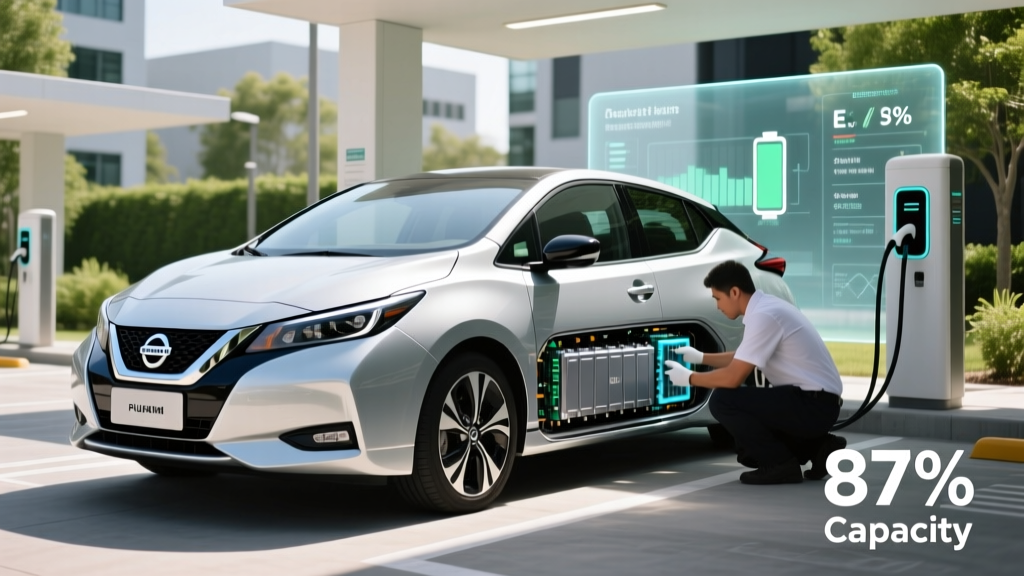
Nissan provides a basic capacity indicator on the Leaf's dashboard: the 12-bar gauge visible on the instrument cluster. As mentioned, this gauge is imprecise and can lag behind actual capacity loss. For a reliable State of Health (SoH) reading, you have better options:
Leaf Spy Pro (recommended): This third-party app, paired with an OBD-II Bluetooth adapter (such as the OBDLink MX+ or LElink), reads the battery management system (BMS) directly. Leaf Spy reports SoH as a percentage, shows individual cell voltages, tracks battery temperature in real time, and logs historical degradation data. It costs roughly $20 for the app and $30–50 for a compatible adapter. This is the gold standard for Leaf battery monitoring and is widely used in the Leaf owner community.
Nissan dealer diagnostic: A Nissan service department can run a battery health check that produces a more precise SoH figure than the dashboard bars. However, dealers do not always share the raw percentage — some will only confirm whether the pack is above or below warranty threshold. Ask specifically for the "battery health report" with the percentage figure.
What to look for when buying a used Leaf: Before purchasing any used Leaf, run Leaf Spy or request a dealer battery report. Compare the SoH percentage to the odometer reading. A 2018 Leaf with 60,000 miles and 88% SoH is in good shape. A 2015 Leaf with 40,000 miles and 72% SoH likely spent time in a hot climate or was fast-charged heavily — proceed with caution.
How Long Do EV Batteries Last? Leaf Data in Broader Context
The Nissan Leaf's long production run gives us the clearest answer to one of the most common EV questions: how long do batteries actually last?
For the Leaf specifically, the data shows that most packs retain 70–85% of original capacity at 100,000 miles and 8–10 years, depending on climate and charging habits. Gen 2 Leafs with NMC chemistry and larger packs are tracking toward 80–90% retention at the same mileage, though fewer have reached the 8+ year mark for definitive data.
Across the broader EV market, liquid-cooled vehicles (Tesla Model 3/Y, Hyundai Ioniq 5, Ford Mustang Mach-E) show even better longevity. Tesla's own impact report has cited an average of roughly 12% degradation at 200,000 miles across its fleet. The Leaf's passive cooling puts it at a disadvantage, but it remains true that the vast majority of EV batteries outlast the vehicles they are installed in — or at minimum, provide usable range for the car's entire practical lifespan.
When is replacement typically needed? For most EVs, including the Leaf, a battery replacement becomes worth considering when capacity drops below 65–70% and the reduced range no longer meets your daily needs. For a Gen 1 Leaf, that might mean 55 miles of range instead of 75 — problematic if your commute is 40 miles round-trip with no charging at work. For a Gen 2 Leaf SL Plus, even at 70% capacity, you still have roughly 150 miles of range, which is sufficient for most drivers.
What Comes Next: Solid-State Batteries and the Leaf's Future
Nissan has been one of the most vocal automakers about solid-state battery development. The company has announced a pilot production line at its Yokohama plant and has stated a goal of bringing solid-state batteries to market by the 2028–2029 timeframe. Solid-state cells promise higher energy density, faster charging, improved safety (no flammable liquid electrolyte), and potentially longer cycle life.
However, several important caveats apply:
- Timeline is uncertain. Solid-state batteries have been "5 years away" for over a decade. Manufacturing scale-up, cost reduction, and durability validation remain unsolved challenges at production volume.
- Cost will be high initially. Early solid-state packs are expected to debut in premium vehicles, not affordable models like a potential future Leaf successor.
- The Leaf's future is itself uncertain. As of 2026, Nissan has not confirmed a direct Leaf successor for the U.S. market. The Ariya crossover has effectively replaced the Leaf in Nissan's U.S. EV lineup. Any future Nissan EV with solid-state technology would likely be a new model, not a refreshed Leaf.
For current Leaf owners, the practical takeaway is this: your existing NMC or LMO pack, properly cared for, will likely provide adequate service for the remaining useful life of the vehicle. Solid-state technology is genuinely promising but is not something to delay a purchase or replacement decision for.
Frequently Asked Questions
How long does a Nissan Leaf battery last in real-world use?
Most Nissan Leaf batteries retain 70–85% of original capacity at 100,000 miles and 8–10 years. Gen 2 Leafs (2018+) with NMC chemistry are tracking toward better longevity. With proper care — primarily Level 2 charging and avoiding extreme heat — many Leaf packs remain functional well beyond 150,000 miles, albeit with reduced range.
How much does it cost to replace a Nissan Leaf battery?
Replacement costs range from approximately $6,500 to $13,800 depending on pack size and source. A 24 kWh pack replacement runs $6,500–$8,000 through a Nissan dealer; a 62 kWh pack costs $10,200–$13,800. Aftermarket and used-pack options can reduce costs for older models to $3,300–$5,500. On Gen 1 Leafs, replacement cost often exceeds the vehicle's market value.
What does the Nissan Leaf battery warranty cover?
Nissan covers battery capacity loss below approximately 70% (shown as 8 bars or fewer on the 12-bar dashboard gauge) for 8 years or 100,000 miles. Manufacturing defects are covered for 5 years / 60,000 miles (longer in CARB states). The warranty does not cover damage from accidents, improper modifications, or abuse.
How do I check my Nissan Leaf battery health?
The most accurate method is using the Leaf Spy Pro app with a compatible OBD-II adapter, which reads the battery management system directly and reports State of Health as a percentage. Nissan dealers can also run a battery health diagnostic. The dashboard 12-bar capacity gauge provides a rough indicator but is imprecise.
Is LFP better than NMC for EV batteries?
It depends on the application. LFP (lithium iron phosphate) offers longer cycle life (2,000–5,000+ cycles vs. 1,000–2,000 for NMC), lower cost, and better thermal stability. However, LFP has lower energy density (heavier packs for the same range) and worse cold-weather performance. LFP is ideal for standard-range daily drivers; NMC is better for long-range vehicles. The Leaf uses LMO (Gen 1) and NMC (Gen 2) — neither is LFP.
Does fast charging damage the Nissan Leaf battery?
Frequent DC fast charging does accelerate degradation in the Leaf, more so than in liquid-cooled EVs. The Leaf's passive air cooling cannot dissipate the heat generated during 50 kW (or 100 kW on Plus models) CHAdeMO charging as effectively. Occasional fast charging on road trips has minimal impact, but daily fast charging — especially in hot weather — measurably shortens battery life.
Sources: EPA range and efficiency data from fueleconomy.gov. Nissan Leaf warranty terms from Nissan USA owner documentation. Battery degradation data aggregated from Leaf Spy community datasets and NHTSA vehicle reliability filings.