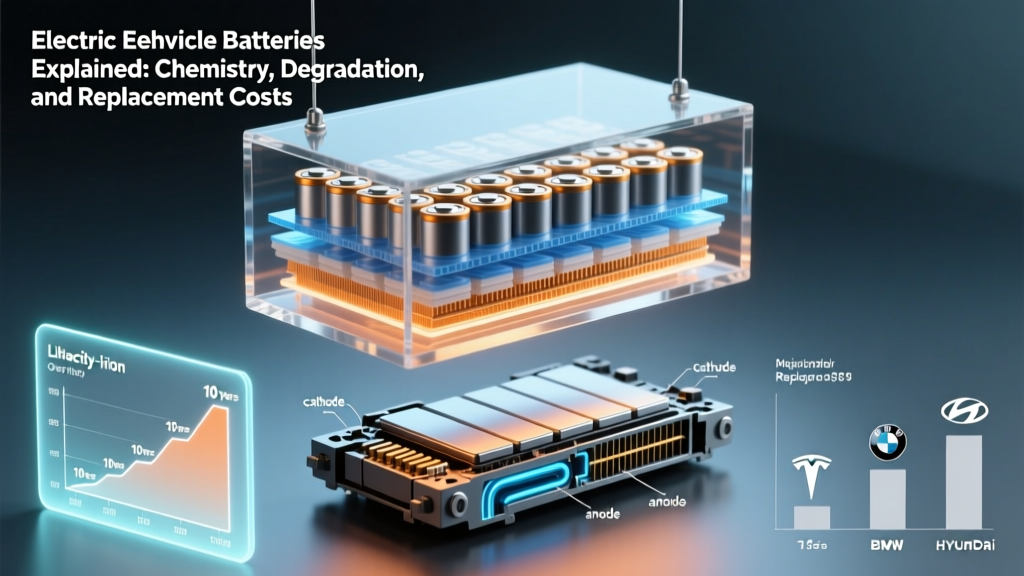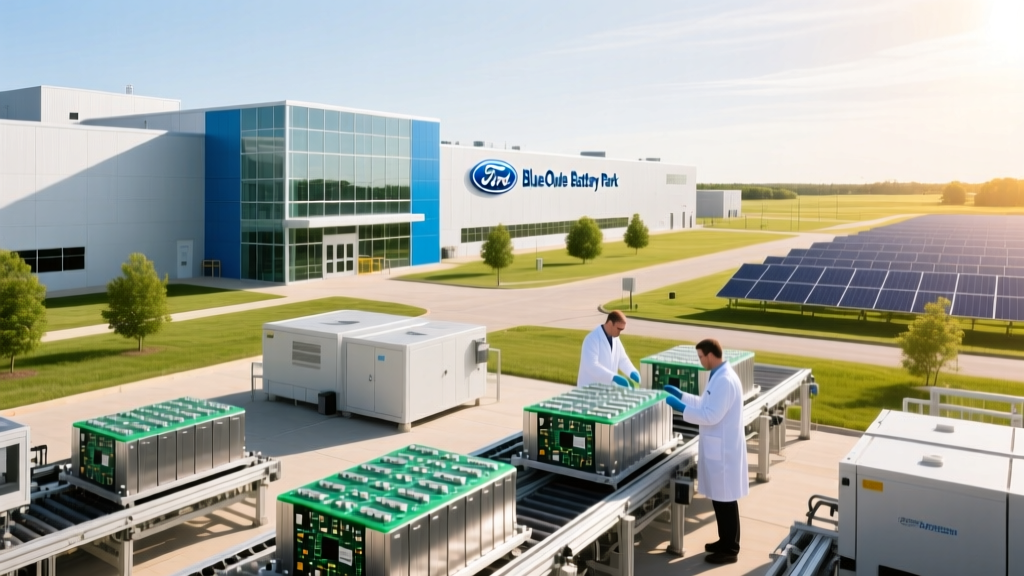
The electric vehicle battery is the single most expensive component in your car — and the one buyers worry about most. Will it last? What if it needs replacing? Which chemistry is actually better for daily driving? These questions are becoming more urgent as domestic battery manufacturing scales up, with facilities like the Ford BlueOval Battery Park in Michigan signaling a major shift in how and where EV batteries are made for the U.S. market.
But manufacturing location is only part of the story. The chemistry inside the pack — whether lithium iron phosphate (LFP) or nickel manganese cobalt (NMC) — determines your real-world range, charging behavior, degradation trajectory, and long-term cost. This guide breaks down everything you need to know about EV battery technology in 2026, using the BlueOval Battery Park as a lens for where the industry is headed.
What Is Ford BlueOval Battery Park in Michigan?
BlueOval Battery Park is Ford's dedicated lithium iron phosphate (LFP) battery manufacturing facility located in Marshall, Michigan. Announced as part of Ford's broader electrification strategy, the plant is designed to produce LFP cells domestically, reducing reliance on imported battery materials and helping Ford vehicles meet IRS §30D federal tax credit sourcing requirements.
The strategic significance here is twofold. First, it brings LFP production — previously dominated by Chinese manufacturers like CATL — to American soil. Second, it signals that LFP chemistry is no longer a budget compromise; it's a mainstream choice for high-volume models. Ford has integrated LFP packs into variants of the Mustang Mach-E and F-150 Lightning, and BlueOval Battery Park is intended to secure that supply chain for years to come.
For buyers, this matters because domestic LFP production can translate into more affordable EV trims, better tax credit eligibility, and battery packs engineered for long cycle life rather than maximum range.
LFP vs NMC/NCA: The Chemistry Trade-Offs That Matter
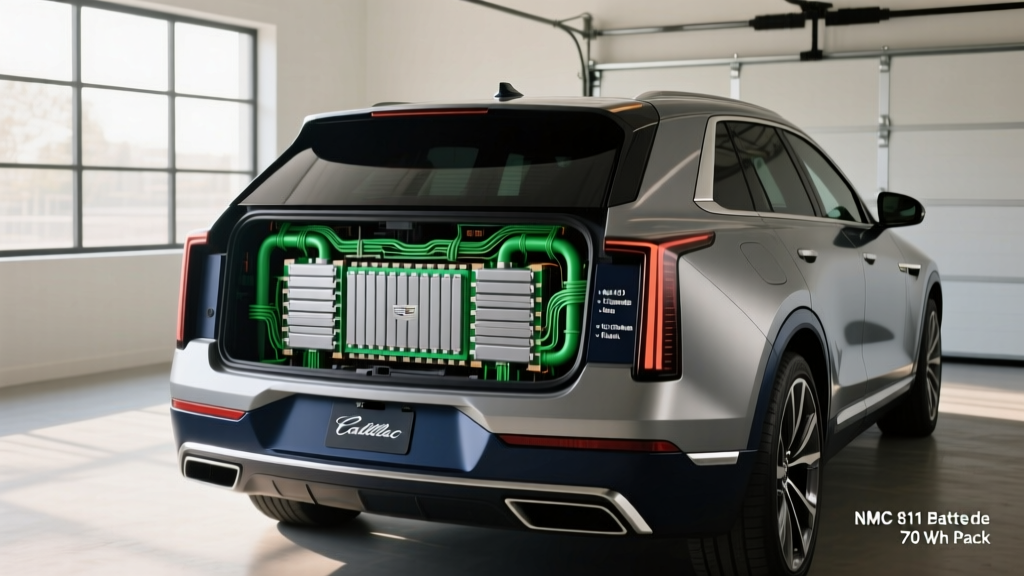
Every EV battery uses a specific cathode chemistry, and the two dominant options in 2026 are lithium iron phosphate (LFP) and nickel manganese cobalt (NMC), with nickel cobalt aluminum (NCA) used primarily by Tesla and a few others. The choice isn't about one being universally "better" — it's about matching chemistry to your driving pattern.
| Attribute | LFP (LiFePO₄) | NMC / NCA |
|---|---|---|
| Energy Density | ~160–180 Wh/kg (lower) | ~220–300 Wh/kg (higher) |
| Typical Cycle Life | 3,000–5,000+ cycles | 1,000–2,000 cycles |
| Cold-Weather Performance | Moderate; more range loss below 32°F | Better low-temperature discharge |
| Thermal Stability | Excellent; very low thermal runaway risk | Good but requires more active cooling |
| Cost per kWh | ~$80–$100 (lower) | ~$120–$150 (higher) |
| Recommended Charge Habit | Can charge to 100% regularly | Best kept 20–80% for daily use |
| Cobalt Content | Zero | Contains cobalt/nickel |
| Best For | Daily commuters, high-mileage drivers, budget trims | Long-range needs, cold climates, performance models |
The practical takeaway: If you drive 30–50 miles daily and can charge at home, LFP is arguably the superior choice — it lasts longer, costs less, and you don't need to baby it with charge limits. If you regularly take 300+ mile road trips or live in northern Minnesota, NMC's higher energy density and cold-weather edge make more sense.
Facilities like Ford's BlueOval Battery Park in Michigan are specifically scaling LFP production because the data increasingly shows that most American drivers fall into the daily-commute category where LFP excels.
How Long Do EV Batteries Actually Last?
The short answer: longer than most buyers expect. Modern EV traction batteries are engineered to outlast the useful life of the vehicle itself in the majority of cases.
Typical lifespan data points:
- NMC packs: Expect 10–15% capacity loss over 150,000 miles under normal use. Tesla's 2025 Impact Report showed their fleet averaging ~12% degradation at 200,000 miles.
- LFP packs: Typically 5–10% capacity loss over 200,000+ miles. The higher cycle life means LFP degrades more slowly per charge cycle.
- Calendar aging: Even a garage-kept EV with low miles will see ~1–2% capacity loss per year from chemical aging alone.
Typical Degradation Curve (NMC, 75 kWh pack, average use):
- Year 1 / 15,000 mi: ~3–5% loss (initial formation drop)
- Year 3 / 45,000 mi: ~7–9% total loss
- Year 5 / 75,000 mi: ~9–12% total loss
- Year 8 / 120,000 mi: ~12–15% total loss
- Year 10 / 150,000 mi: ~14–18% total loss
Note: Degradation is non-linear — the steepest loss occurs in the first year, then flattens into a gradual decline. Source: aggregated fleet data from fueleconomy.gov EV technology resources and manufacturer warranty disclosures.
The critical threshold for most owners is 70–80% of original capacity. Below 70%, you'll notice meaningful range reduction on longer trips. Most modern packs don't hit that threshold until well past 200,000 miles under normal conditions.
What Does the EV Battery Warranty Actually Cover?
Federal law mandates a minimum battery warranty of 8 years / 100,000 miles for EVs sold in the U.S. Many manufacturers exceed this, and California Air Resources Board (CARB) states require 10 years / 150,000 miles. Here's how major warranties compare:
| Manufacturer | Warranty Term | Capacity Retention Threshold | Coverage Type |
|---|---|---|---|
| Ford (Mach-E / F-150 Lightning) | 8 yr / 100,000 mi | 70% of original capacity | Repair or replace to meet threshold |
| Tesla (Model 3/Y RWD — LFP) | 8 yr / 100,000 mi | 70% of original capacity | Repair or replace |
| Tesla (Model 3/Y LR — NMC) | 8 yr / 120,000 mi | 70% of original capacity | Repair or replace |
| Hyundai (Ioniq 5/6) | 10 yr / 100,000 mi | 70% of original capacity | Repair or replace |
| GM (Ultium-based EVs) | 8 yr / 100,000 mi | 70% of original capacity | Repair or replace; module-level service |
| CARB States (all brands) | 10 yr / 150,000 mi | Varies; typically 70% | Enhanced coverage for CA, NY, WA, etc. |
Key warranty fine print:
- "Repair or replace" usually means the manufacturer can replace individual modules rather than the entire pack — reducing cost and downtime.
- The warranty covers capacity loss below the threshold, not cosmetic issues or damage from accidents, flooding, or improper modifications.
- Excessive DC fast charging (defined differently by each OEM) can sometimes be cited as a factor in warranty disputes, though this is rare.
- If you live in a CARB state, you likely have enhanced coverage regardless of where you bought the car.
How Much Does an EV Battery Cost to Replace?
This is the question that generates the most anxiety — and the most misinformation. Let's ground it in actual numbers.
| Vehicle | Battery Size (kWh) | Chemistry | Full Pack Replacement Cost | Typical Need Timeline |
|---|---|---|---|---|
| Ford Mustang Mach-E (SR) | 70 kWh usable | LFP / NMC | $12,000–$16,000 | Rarely needed; 200,000+ mi |
| Ford F-150 Lightning (ER) | 131 kWh usable | NMC | $22,000–$30,000 | Rarely needed; 150,000+ mi |
| Tesla Model 3 (RWD) | 57.5 kWh usable | LFP | $10,000–$14,000 | Rarely needed; 250,000+ mi |
| Hyundai Ioniq 5 | 77.4 kWh usable | NMC | $14,000–$18,000 | Rarely needed; 200,000+ mi |
| Chevrolet Equinox EV | 85 kWh usable | NMC (Ultium) | $15,000–$20,000 | Rarely needed; 200,000+ mi |
Critical context: Full pack replacement is exceedingly rare under normal ownership. Most battery issues involve individual module failures, which cost $1,500–$4,000 to repair. The prices above represent worst-case scenarios for out-of-warranty, full-pack replacement — a scenario that fewer than 2% of EV owners ever face according to industry warranty claim data.
Also worth noting: domestic LFP production from facilities like the Ford BlueOval Battery Park in Michigan is expected to push replacement costs lower over time. LFP cells are inherently cheaper to manufacture, and as U.S. production scales, aftermarket and OEM replacement pricing should follow.
What Factors Accelerate Battery Degradation?
Battery wear isn't just about mileage — it's about how you use and store the pack. These are the factors that measurably accelerate capacity loss, ranked by impact:
Battery Care Checklist — Maximize Your Pack's Life
- ☐ Avoid sustained 100% SoC (NMC only): For NMC/NCA packs, daily charging to 80% reduces stress. LFP packs can be charged to 100% regularly — in fact, periodic 100% charges help the BMS calibrate.
- ☐ Minimize DC fast charging frequency: Occasional road-trip fast charging is fine. Daily reliance on 150+ kW DCFC adds cumulative thermal stress. Aim for Level 2 home charging as your primary method.
- ☐ Precondition before fast charging: Battery preconditioning (available on most modern EVs) warms the pack to optimal temperature before a DCFC session, improving charge speed and reducing thermal degradation.
- ☐ Avoid extreme heat storage: Parking in direct sun in 100°F+ weather with a full battery accelerates calendar aging. A shaded or garage-parked EV in Phoenix will show measurably less degradation than one stored outdoors.
- ☐ Don't let SoC sit at 0%: Leaving an EV unplugged at very low state of charge for weeks can cause irreversible cell damage. If storing, set charge limit to 50% and leave it plugged in.
- ☐ Use scheduled charging: Set your EV to finish charging right before you leave — this minimizes time spent at high SoC and keeps the pack in its comfort zone.
- ☐ Drive it regularly: Batteries prefer regular, moderate use over long periods of inactivity. A daily-driven EV often shows less calendar degradation than a weekend-only car.
Following these practices, real-world data consistently shows NMC packs retaining 85–90% capacity at 100,000 miles and LFP packs retaining 90–95% over the same distance.
How to Monitor Your Battery's State of Health (SoH)
State of Health (SoH) is the metric that tells you how much of your original battery capacity remains. Most 2026 EVs provide this data through the infotainment system or companion app, though the level of detail varies by manufacturer.
How to check SoH by brand:
- Ford (FordPass app): Navigate to Vehicle Health → Battery. Shows estimated range vs. original and a general health indicator.
- Tesla (in-car or app): The car displays projected range at 100% charge. Compare this to the original EPA range to estimate SoH. Third-party tools like Tessie or Teslalogger provide more granular degradation tracking.
- Hyundai/Kia (Bluelink/Kia Connect): Battery health reports available in the app under Vehicle Diagnostics.
- GM (myChevrolet/myCadillac app): OnStar diagnostics include battery health status for Ultium-based EVs.
- OBD-II scanners: Devices like the OBDLink SX paired with apps such as EVbatMon or ABRP can pull real SoH percentages directly from the BMS for most brands.
When to be concerned: If your SoH drops more than 3% in a single year after the initial break-in period, or if you notice sudden range drops (not explained by cold weather), schedule a dealer diagnostic. Sudden cell imbalance can sometimes be corrected with a BMS reset or module-level service under warranty.
Emerging Battery Tech: Solid-State and Beyond
The next frontier in EV battery technology includes solid-state batteries (replacing liquid electrolyte with a solid conductor) and silicon-anode cells (boosting energy density by using silicon instead of graphite). Here's where these stand as of 2026:
- Solid-state batteries: Toyota, Samsung SDI, and QuantumScape have demonstrated prototype cells with 500+ Wh/L energy density and 10-minute fast-charge capability. However, mass production remains announced for 2028–2030 timelines, with initial deployment likely limited to premium models. Cost per kWh is currently 3–5x that of conventional lithium-ion.
- Silicon anode: Companies like Sila Nanotechnologies and Group14 are supplying silicon-dominant anode materials to manufacturers including Mercedes-Benz and Panasonic. Expect incremental adoption starting in 2027 model-year vehicles, offering ~15–20% energy density improvement over current graphite anodes.
- Sodium-ion: CATL and BYD have begun producing sodium-ion cells for budget EVs in China. U.S. availability is not yet announced and may be limited to stationary storage initially.
Realistic timeline: For buyers shopping today, current LFP and NMC chemistries are mature, well-understood, and backed by robust warranties. Next-generation technologies are 3–5 years from mainstream U.S. vehicle availability. There is no compelling reason to delay an EV purchase waiting for solid-state — the packs in today's vehicles will serve reliably for 15+ years.
What BlueOval Battery Park Means for Your Next EV Purchase
The Ford BlueOval Battery Park in Michigan represents more than a factory — it's a bet on LFP as the volume chemistry for American EVs. For buyers, this translates into several practical benefits:
- Lower-cost EV trims: LFP packs cost $20–$40/kWh less than NMC, enabling more affordable base models without sacrificing battery longevity.
- Tax credit eligibility: Domestically produced battery cells and modules help vehicles meet the IRS §30D battery component and critical mineral requirements, potentially qualifying buyers for up to $7,500 in federal credits (subject to MSRP caps, income limits, and sourcing thresholds that vary by model year).
- Supply chain resilience: U.S.-made batteries reduce exposure to trade disruptions, shipping delays, and geopolitical supply risks that have historically affected EV availability and pricing.
- Replacement cost trajectory: As domestic LFP production scales, aftermarket battery replacement costs should decline — making long-term ownership economics even more favorable.
If you're evaluating a Ford EV with an LFP pack sourced from BlueOval Battery Park, the data supports confidence: LFP chemistry offers the best cycle life in the industry, the warranty covers you for 8 years / 100,000 miles at 70% retention, and real-world degradation data consistently shows these packs exceeding 200,000 miles before reaching meaningful capacity loss.
Frequently Asked Questions
How long do EV batteries last in years and miles?
Most modern EV batteries last 15–20 years or 200,000+ miles before degrading to 70–80% of original capacity. LFP batteries (like those produced at Ford's BlueOval Battery Park in Michigan) typically outlast NMC packs by a significant margin, with documented cases exceeding 300,000 miles with less than 15% degradation.
How much does it cost to replace an EV battery?
Full pack replacement costs range from $10,000 to $30,000 depending on battery size and chemistry. However, full replacement is rare — most battery service involves individual module replacement at $1,500–$4,000. The vast majority of EV batteries outlast the vehicle's useful life and never need replacement.
What does the EV battery warranty cover?
Federal minimum is 8 years / 100,000 miles with a 70% capacity retention threshold. CARB states extend this to 10 years / 150,000 miles. The warranty covers capacity loss below the threshold due to normal use, with repair or replacement at the manufacturer's discretion. Damage from accidents, flooding, or unauthorized modifications is excluded.
How do I check my EV battery's health?
Most EVs display battery health or projected range through the infotainment system or companion app (FordPass, Tesla app, Bluelink). For precise SoH percentages, OBD-II scanners with EV-specific apps can read data directly from the battery management system. Compare your current 100% range estimate to the original EPA rating for a quick SoH approximation.
LFP vs NMC — which battery chemistry is better?
Neither is universally better. LFP offers longer cycle life (3,000–5,000 cycles vs 1,000–2,000), lower cost, zero cobalt, and the ability to charge to 100% daily — making it ideal for commuters and high-mileage drivers. NMC provides higher energy density and better cold-weather performance — making it better for long-range needs and cold climates. Ford's investment in LFP production at BlueOval Battery Park in Michigan reflects the industry view that LFP is the optimal chemistry for the majority of American drivers.
Does frequent DC fast charging damage the battery?
Occasional DC fast charging (road trips, a few times per month) has minimal impact on battery health. Daily reliance on high-power DCFC (150+ kW) does accelerate degradation over time due to sustained thermal stress. For optimal longevity, use Level 2 home charging as your primary method and reserve DCFC for trips. Most manufacturers' battery preconditioning features help mitigate fast-charging stress when used.
Will solid-state batteries make current EVs obsolete?
Not in the near term. Solid-state batteries remain in pre-production as of 2026, with mass-market availability projected for 2029–2031 at the earliest. Current LFP and NMC batteries are mature, reliable, and backed by strong warranties. There is no practical reason to delay an EV purchase for solid-state technology.