If you've searched for "rad battery replacement" or any variation of EV battery replacement costs, you've likely encountered a spectrum of information ranging from reassuring to terrifying. The truth, as usual for electric vehicle ownership, lives in the data. Most EV batteries on the road today will outlast the vehicles they power, but understanding degradation curves, warranty thresholds, and the actual cost of out-of-warranty replacement is essential for anyone buying or keeping an EV long-term.
This guide breaks down exactly what modern EV battery technology delivers in 2026, what replacement actually costs when it's needed, and how to monitor and maximize your pack's state of health (SoH) over hundreds of thousands of miles.
How Long Do EV Batteries Actually Last?
The short answer: far longer than most buyers assume. Data aggregated from fleet operators, manufacturer warranty claims, and independent testing organizations like Recurrent Auto shows that the average EV battery pack retains roughly 90-95% of its original capacity after 5 years and 100,000 miles. By year 10 and 150,000 miles, most packs still hold 80-88% of their original capacity.
The key metric here is not sudden failure — EV batteries don't "die" the way a 12V auxiliary battery does. They degrade gradually, losing capacity over time and charge cycles. A pack that started with 310 miles of EPA range might deliver 260-280 miles after a decade. That's still entirely functional for daily driving.
Typical EV Battery Degradation Curve (NMC Chemistry):
- Year 1 / 15,000 mi: ~97-99% capacity retained (initial settling)
- Year 3 / 45,000 mi: ~94-97% retained
- Year 5 / 75,000 mi: ~91-95% retained
- Year 8 / 120,000 mi: ~86-92% retained
- Year 10 / 150,000 mi: ~82-88% retained
- Year 15 / 200,000 mi: ~75-82% retained
Note: LFP (lithium iron phosphate) packs typically show slower degradation, often retaining 95%+ after 5 years. Cold-climate owners and frequent DC fast-chargers may see slightly accelerated loss.
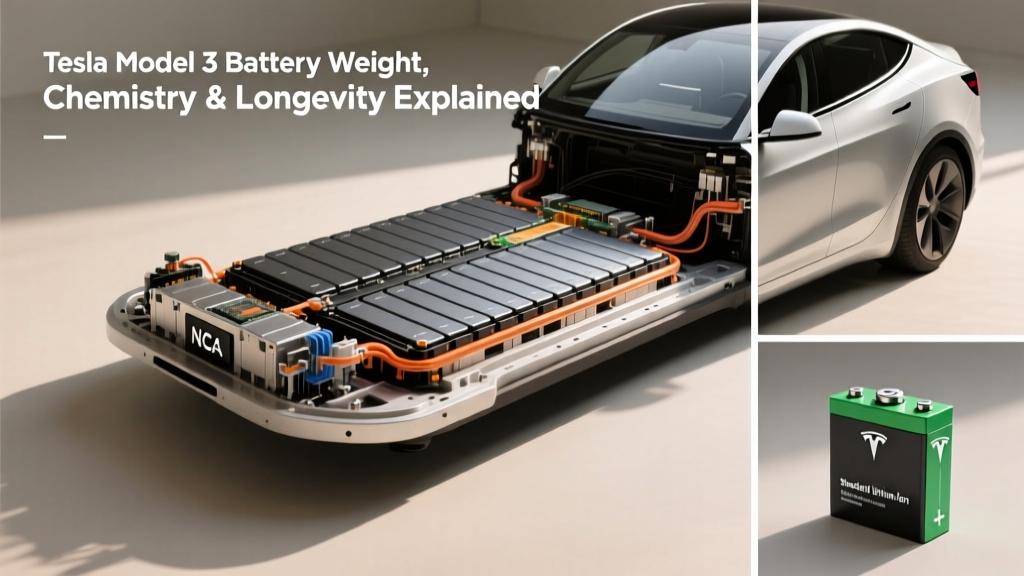
Real-world outliers exist. Tesla's 2025 Impact Report noted that Model 3/Y battery packs retain an average of 85% capacity at 200,000 miles. Meanwhile, some Nissan Leaf owners from the early 2010s — with passively cooled packs — experienced 30-40% degradation by year 8, underscoring how thermal management design matters enormously.
LFP vs NMC/NCA: Which Battery Chemistry Is Better?
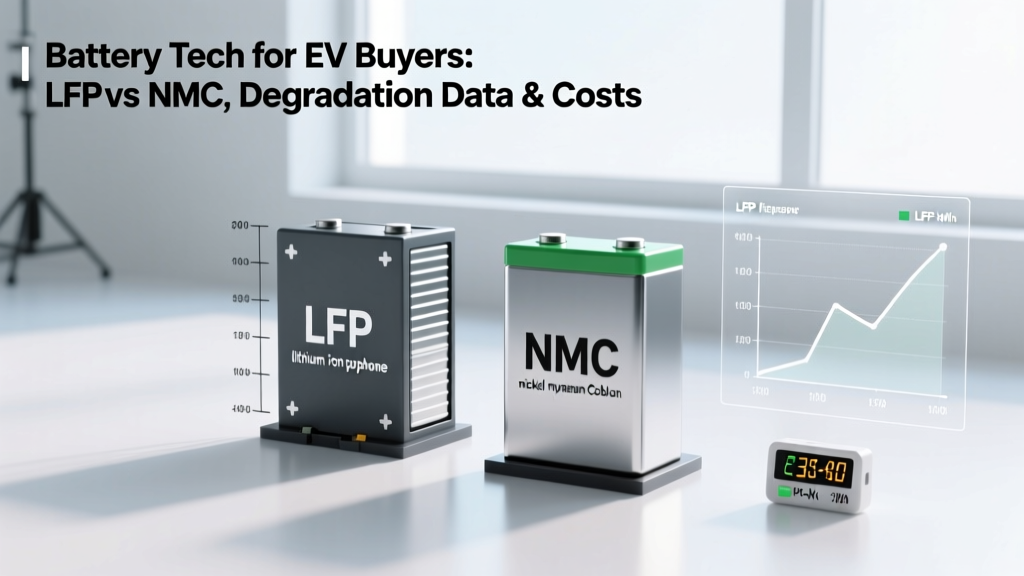
The two dominant lithium-ion chemistries in 2026 EVs are LFP (lithium iron phosphate) and NMC/NCA (nickel manganese cobalt / nickel cobalt aluminum). Each has distinct trade-offs that affect range, longevity, cost, and real-world usability.
| Attribute | LFP (Lithium Iron Phosphate) | NMC / NCA (Nickel-based) |
|---|---|---|
| Energy Density | Lower (~160-180 Wh/kg cell-level) | Higher (~220-280 Wh/kg cell-level) |
| Cycle Life | 3,000-5,000+ cycles | 1,000-2,000 cycles |
| Calendar Life | 15-20+ years typical | 10-15 years typical |
| Cold-Weather Performance | Weaker — greater range loss below 32°F | Better low-weather energy delivery |
| Cost per kWh | ~$80-100/kWh (2026 pack-level) | ~$110-140/kWh (2026 pack-level) |
| Charging to 100% | Recommended regularly for SoC calibration | Better kept at 80% daily; 100% for trips only |
| Typical Applications | Tesla Model 3 RWD, base Model Y, BYD models, standard-range EVs | Long-range AWD models, performance trims, large SUVs/trucks |
Which is better? It depends on your use case. If you prioritize maximum cycle life, lower replacement cost risk, and don't need the absolute longest range, LFP is the superior longevity play. If you need the most miles per charge, tow heavy loads, or live in extreme cold, NMC/NCA's energy density and cold-weather advantage make it the practical choice. Neither is universally "better" — they're engineering trade-offs.
What Does the EV Battery Warranty Actually Cover?
Federal law mandates that EV battery packs carry a minimum warranty of 8 years / 100,000 miles. In California and states adopting CARB standards, that minimum extends to 10 years / 150,000 miles. Most manufacturers exceed these minimums or match them with a capacity retention guarantee.
| Manufacturer | Warranty Term | Capacity Threshold | Notes |
|---|---|---|---|
| Tesla (Model 3/Y LFP) | 8 yr / 120,000 mi | 70% retention | Long-range NMC: 8 yr / 120,000 mi |
| Hyundai / Kia | 10 yr / 100,000 mi | 70% retention | Among the longest terms in the industry |
| Ford (Mustang Mach-E, F-150 Lightning) | 8 yr / 100,000 mi | 70% retention | Covers battery components + capacity |
| GM (Ultium platform) | 8 yr / 100,000 mi | 70% retention | Modular pack allows partial replacement |
| BMW / Mercedes-Benz | 8 yr / 100,000 mi | 70% retention | Some models offer extended purchase options |
| Rivian | 8 yr / 175,000 mi | 70% retention | Higher mileage cap for truck/adventure use |
What triggers a warranty claim? If your battery's state of health (SoH) drops below the stated threshold — typically 70% of original capacity — within the warranty period, the manufacturer must repair or replace the pack at no cost. In practice, this means a vehicle that originally delivered 300 miles of EPA range would qualify if it fell below ~210 miles of range due to battery degradation alone.
Warranties generally do not cover damage from accidents, flooding, improper modifications, or use of non-approved charging equipment. They also typically exclude the 12V auxiliary battery, which is covered under a separate, shorter warranty (often 3 years / 36,000 miles).
How Much Does an EV Battery Replacement Cost?
This is where most anxiety concentrates — and where context matters most. Out-of-warranty battery replacement is expensive, but it's also rare within the first 15 years of ownership. Here's what the numbers look like in 2026:
| Vehicle / Battery Size | Chemistry | Battery Capacity | Replacement Cost (Parts + Labor) |
|---|---|---|---|
| Tesla Model 3 RWD | LFP | 60 kWh | $12,000 - $16,000 |
| Tesla Model Y Long Range | NMC | 82 kWh | $16,000 - $22,000 |
| Hyundai Ioniq 5 | NMC | 77.4 kWh | $14,000 - $20,000 |
| Ford F-150 Lightning Extended Range | NMC | 131 kWh | $25,000 - $35,000 |
| Chevrolet Equinox EV | NMC (Ultium) | 85 kWh | $15,000 - $20,000 (modular repair possible) |
| Nissan Ariya | NMC | 91 kWh | $16,000 - $22,000 |
When is replacement actually needed? The vast majority of EV owners will never need a full battery replacement. Data from Consumer Reports and fleet analyses show that fewer than 5% of EV battery packs require replacement within the first 200,000 miles, and most of those are covered under warranty. The packs most likely to need out-of-pocket replacement are those in older, high-mileage vehicles purchased used — or early-generation EVs with passive thermal management (like the 2011-2017 Nissan Leaf).
An emerging cost-saving option is modular battery repair. GM's Ultium platform and some newer architectures allow technicians to replace individual battery modules rather than the entire pack, reducing costs to $3,000-$8,000 for a partial replacement. This is a significant shift from older monolithic pack designs.
Factors That Accelerate (or Preserve) Battery Health
Battery degradation isn't random — it's driven by specific, controllable factors. Understanding these lets you extend your pack's usable life by years.
Battery Care Best Practices for Maximum Longevity:
- Limit DC fast charging frequency: Occasional road-trip fast charging is fine, but daily use of 150+ kW DC chargers accelerates degradation. Aim for Level 2 home charging as your daily routine.
- Avoid extreme state of charge: For NMC/NCA packs, keep daily SoC between 20-80%. LFP packs can (and should) be charged to 100% regularly for calibration.
- Precondition in cold weather: Use your EV's preconditioning feature before driving or charging in sub-40°F weather. This warms the battery, reducing lithium plating risk and improving charge acceptance.
- Don't let the battery sit at 0% or 100% for days: Extended storage at extreme SoC stresses cells. If storing an EV for weeks, set SoC to ~50%.
- Use scheduled charging: Set your EV to finish charging just before you leave, rather than sitting at full charge overnight.
- Park in shade or a garage when possible: Prolonged exposure to 95°F+ ambient temperatures accelerates calendar degradation, especially at high SoC.
The single biggest factor most owners control is fast-charging frequency. Research from the Idaho National Laboratory showed that packs charged exclusively via DC fast charging degraded roughly 10% more over 50,000 miles compared to packs charged primarily via Level 2. That's not catastrophic, but it's measurable — and avoidable for most drivers with home charging access.
How to Check Your EV Battery's State of Health (SoH)
Monitoring your battery's health isn't as straightforward as checking your tire pressure, but 2026 EVs offer more transparency than ever:
- In-vehicle displays: Many EVs (Tesla, Hyundai/Kia, BMW, Rivian) now include a battery health or degradation estimate in the settings or service menu. This is typically shown as a percentage of original capacity.
- Manufacturer apps: Tesla, Ford, Hyundai, and others surface battery SoH data in their companion smartphone apps, sometimes with historical trend graphs.
- OBD-II diagnostic tools: Third-party tools like the OBDLink MX+ paired with apps such as EVNotify or LeafSpy (for Nissan) can read detailed cell-level data including individual cell voltages, pack temperature, and precise SoH percentages.
- Dealer diagnostic reports: Request a battery health report during routine service visits. Most dealerships can print a detailed SoH readout that's useful for warranty claims or resale negotiations.
- Third-party services: Companies like Recurrent offer battery health scoring based on your telematics data, which can be shared with prospective buyers during a private sale.
If you're buying a used EV, always request a battery health report before purchase. A pack at 85% SoH with 60,000 miles is very different from one at 85% with 140,000 miles — the degradation trajectory matters.
What's Next: Solid-State, Silicon Anode, and Beyond
Next-generation battery technologies are frequently cited in headlines, but realistic timelines matter more than lab breakthroughs:
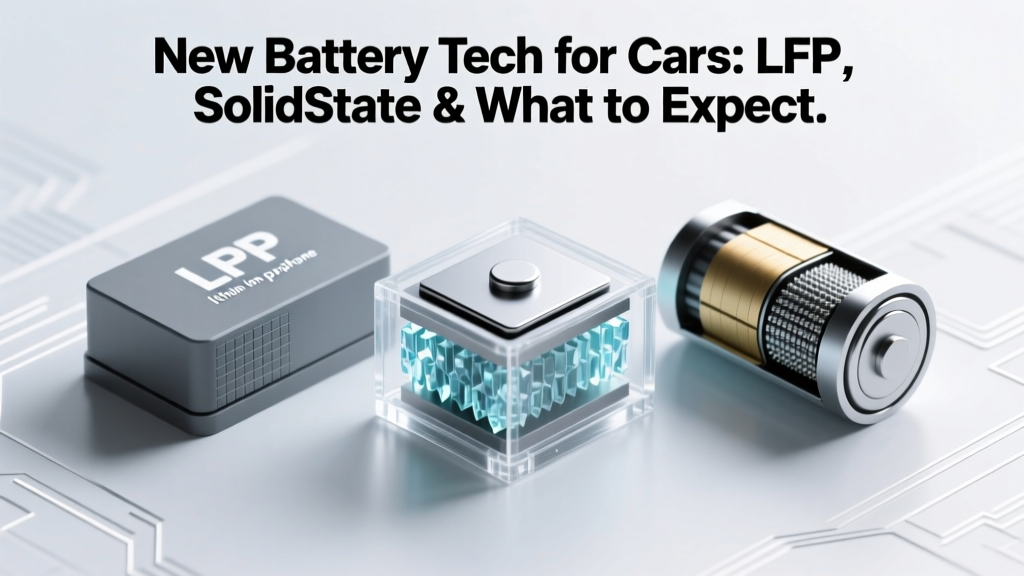
- Solid-state batteries: Toyota, Samsung SDI, and QuantumScape are targeting limited production in 2027-2029 vehicles. Solid-state cells promise 30-50% higher energy density, faster charging (potentially 10-80% in under 10 minutes), and dramatically improved cycle life. However, manufacturing scale-up and cost remain significant hurdles. Expect solid-state to debut in premium, low-volume models first — not mainstream EVs — and don't delay a 2026 purchase waiting for it.
- Silicon anode batteries: Companies like Sila Nanotechnologies and Group14 are already shipping silicon-dominant anode materials that boost energy density by 15-25% over graphite anodes. These are appearing in 2025-2026 model-year EVs incrementally, including some Mercedes-Benz and Panasonic-supplied packs. This is real, available technology — not a future promise.
- Sodium-ion batteries: CATL and BYD have begun producing sodium-ion packs for lower-cost, shorter-range EVs in China. These offer lower energy density but eliminate lithium, cobalt, and nickel entirely, reducing cost and supply-chain risk. US-market availability remains limited and is expected primarily in budget-focused models post-2027.
The practical takeaway: current LFP and NMC batteries are mature, well-understood, and demonstrably long-lasting. Waiting for next-generation chemistry is rarely a sound financial strategy when today's packs already outlast most ownership periods.
EV Battery Replacement FAQ
Will I need to replace my EV battery during ownership?
Statistically, probably not. Fewer than 5% of EV battery packs require replacement within 200,000 miles, and most failures that do occur happen within the warranty period. If you plan to own your EV for 8-12 years and under 150,000 miles, the warranty almost certainly covers you.
Does fast charging ruin my EV battery?
"Ruin" is too strong, but exclusive reliance on DC fast charging does measurably accelerate degradation. A pack that's DC fast-charged daily may lose 3-5% more capacity over 100,000 miles compared to one charged primarily on Level 2. For road trips, fast charging is perfectly fine — it's daily habit that matters.
How is the EV battery warranty different from the bumper-to-bumper warranty?
The battery warranty specifically covers the high-voltage traction battery pack against capacity loss below a defined threshold (typically 70%). The bumper-to-bumper warranty (usually 3-5 years / 36,000-60,000 miles) covers other vehicle components. The battery warranty runs independently and is always longer.
Can I replace just one battery module instead of the whole pack?
On some newer platforms — notably GM's Ultium architecture and the BMW Neue Klasse — yes. Modular replacement can reduce costs to $3,000-$8,000 instead of $15,000+. Older monolithic pack designs (most pre-2022 EVs) typically require full-pack replacement.
Does cold weather permanently damage my EV battery?
No. Cold weather causes temporary range loss (typically 20-30% below 20°F) due to reduced electrochemical efficiency, but this recovers when temperatures rise. The permanent risk comes from charging a freezing-cold battery at high power without preconditioning, which can cause lithium plating. Always precondition before winter fast charging.
How do I know if my battery qualifies for a warranty replacement?
Have a dealer or qualified EV technician perform a battery health diagnostic. If the SoH reading falls below your manufacturer's stated threshold (usually 70%) within the warranty mileage and time limit, you qualify for a free repair or replacement. Keep records of all diagnostics.
Is a used EV with 100,000 miles risky for battery health?
Not inherently. A well-maintained pack at 100,000 miles typically retains 88-93% of its original capacity. Request a battery health report, verify the SoH percentage, check the remaining warranty coverage, and review the vehicle's charging history if available. High mileage with LFP chemistry and primarily Level 2 charging is often a safer bet than lower mileage with heavy DC fast-charging history.