Tesla Model 3 Battery Weight and Why It Matters
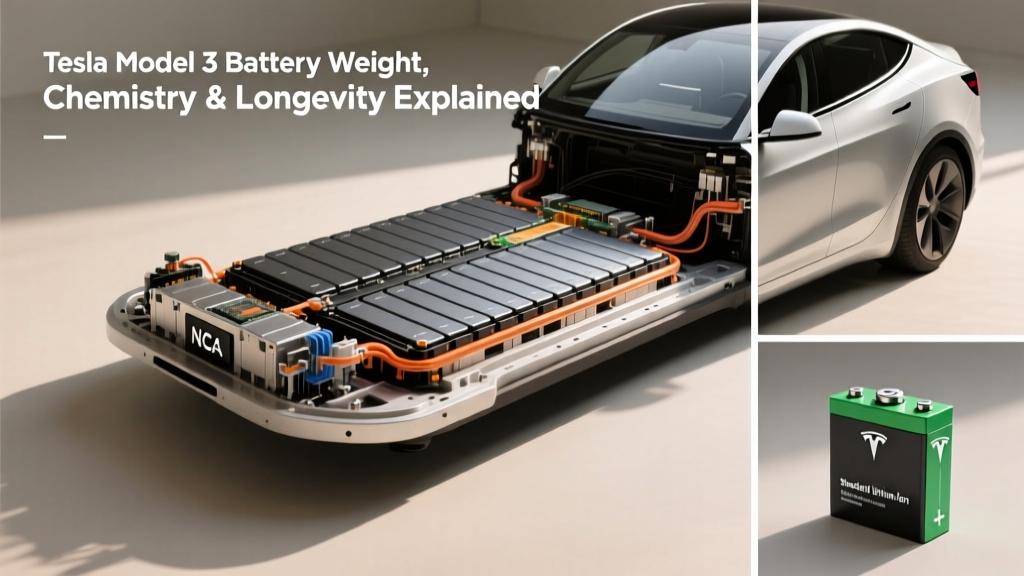
If you've ever searched for Tesla Model 3 battery weight, you've probably noticed that Tesla doesn't publish a single spec-sheet line item for it. That's because the Model 3 has shipped with multiple battery packs over the years, and the mass varies by chemistry, capacity, and model year. What we do know from EPA test data, teardowns, and homologation filings is the approximate range:
- Rear-Wheel Drive (RWD, LFP, ~60 kWh usable): roughly 1,050–1,100 lb (476–499 kg) for the pack itself.
- Long Range / Performance (NMC/NCA, ~75–82 kWh usable): roughly 1,200–1,300 lb (544–590 kg).
That mass sits low in the chassis as part of the structural "skateboard" and is a major reason the Model 3 posts a low center of gravity and confident cornering, but also why curb weights land between 3,860 and 4,250 lb depending on trim. Battery weight is only one piece of the ownership equation, though. Chemistry, degradation behavior, warranty coverage, and real-world care habits matter far more over a decade of driving.
LFP vs NMC/NCA: Which Chemistry Is Inside Your Model 3?
Tesla currently sells the Model 3 with two distinct lithium-ion chemistries, and the choice affects range, charging habits, longevity, and price.
| Attribute | LFP (Lithium Iron Phosphate) | NMC / NCA (Nickel-based) |
|---|---|---|
| Typical in Model 3 | RWD (Standard Range) trims | Long Range, Performance, Long Range RWD |
| Energy density | Lower — heavier pack for same kWh | Higher — lighter pack for same kWh |
| Cycle life | Higher (often 2,000–3,000+ cycles) | Moderate (roughly 1,000–1,500 cycles) |
| Cold-weather performance | Weaker — larger range loss below freezing | Better retained range in cold |
| Recommended daily SoC | Tesla recommends charging to 100% regularly | Tesla recommends ~80% daily, 100% for trips |
| Cost | Lower — no nickel or cobalt | Higher — nickel/cobalt exposure |
| Thermal stability | Excellent — less prone to thermal runaway | Good, but more active cooling required |
Which is better? Neither, universally. LFP wins on longevity, cost, and daily charging simplicity — ideal if you can charge at home nightly and don't need maximum range. NMC/NCA wins on range-per-pound and cold-weather usability — better for long highway commutes or northern climates. Tesla's own guidance reflects this: LFP owners are told to charge to 100% at least weekly to keep the battery management system (BMS) calibrated, while NMC owners are steered toward 80% for daily use.
How Long Do Tesla Model 3 Batteries Last?
Based on aggregated fleet data and Tesla's own impact reports, most Model 3 packs retain roughly 85–90% of original capacity after 150,000 miles. That is meaningful because it aligns with the point at which many owners trade vehicles in — meaning a large share of Model 3 batteries will outlive their first ownership cycle.
Tesla has reported that Model 3/Y packs show approximately 15% degradation at 200,000 miles across their global fleet, with the curve flattening after the initial ~20,000–30,000 mile break-in period. Independent trackers like Tessie and Recurrent, which sample thousands of vehicles, corroborate a pattern of steeper early loss followed by a long, shallow tail.
- 0–20,000 miles: ~3–5% loss (initial formation)
- 50,000 miles: ~7–9% loss
- 100,000 miles: ~10–12% loss
- 150,000 miles: ~11–14% loss
- 200,000 miles: ~13–17% loss
Source: Tesla Impact Reports, Recurrent Auto battery health studies.
Outliers exist. High-mileage ride-share vehicles that fast-charge daily and operate in hot climates can degrade faster, while garage-kept, LFP-equipped cars charged to 80–100% on Level 2 tend to sit at the better end of these bands.
What Does the Tesla Battery Warranty Actually Cover?
Tesla's high-voltage battery warranty is one of the stronger mainstream EV warranties, but the details matter — especially the capacity-retention threshold.
| Model 3 Trim | Warranty Period | Mileage Cap | Minimum Capacity Retention |
|---|---|---|---|
| RWD (LFP) | 8 years | 100,000 miles | 70% |
| Long Range AWD / RWD, Performance | 8 years | 120,000 miles | 70% |
In plain language: if your pack falls below 70% of original capacity within the term, Tesla will repair or replace it to bring retention back above the threshold. The warranty also covers defects in materials and workmanship. It does not cover cosmetic corrosion, damage from accidents, flood, or improper modifications. Always check Tesla's official warranty page for the exact terms on your model year, as language can shift.
Tesla Model 3 Battery Replacement Cost — and When You'd Actually Need It
The fear of a $20,000 battery swap is the single biggest psychological barrier to EV adoption. Context matters: most Model 3 batteries will never require an out-of-warranty replacement, because degradation at 200k miles is typically in the 13–17% band — well above the 70% retention threshold that would define a "failed" pack.
| Pack Type | Approximate Capacity | Estimated Out-of-Warranty Cost (parts + labor) |
|---|---|---|
| RWD LFP | ~60 kWh usable | $12,000–$16,000 |
| Long Range / Performance NMC/NCA | ~75–82 kWh usable | $15,000–$22,000 |
These ranges reflect recent service invoices and third-party EV shop quotes; Tesla does not publish a fixed price list. Refurbished packs can lower cost by several thousand dollars. Module-level repair (replacing a handful of bad modules rather than the whole pack) is increasingly available at independent EV specialists for $3,000–$7,000 when a single module group is at fault.
When is replacement actually needed? Almost never due to simple wear within the first 10–12 years. Replacement typically follows physical damage (collision, flood), manufacturing defects caught within warranty, or rare cases of severe accelerated degradation on high-utilization fleet vehicles.
Factors That Actually Affect Model 3 Battery Life
Degradation is not a single-variable problem. The biggest levers you control as an owner:
- State of charge habits: For NMC/NCA packs, avoid parking at 100% SoC for days; set daily charge to 80% and use 100% only when departing on a trip. For LFP, charge to 100% regularly as Tesla recommends to keep the BMS accurate.
- DC fast charging frequency: Occasional Supercharging is fine — Tesla's thermal management is robust. But daily 250 kW sessions, especially in hot climates, will accelerate wear versus predominantly Level 2 home charging.
- Temperature extremes: Parking in a garage in summer and using preconditioning in winter reduce stress. The Model 3's heat pump (standard since the 2021 refresh) significantly cuts cold-weather energy waste compared to older resistive heating.
- Storage: If the car will sit for weeks, aim for ~50% SoC for NMC and ~60–70% for LFP. Avoid leaving any pack at 100% or near 0% for extended periods.
- Regen and driving style: Heavy acceleration and frequent hard regen don't materially harm the pack, but smooth driving does reduce cumulative kWh throughput, which is the real wear metric.
How to Check Battery Health (State of Health) on a Model 3
Tesla does not surface a clean "State of Health" percentage in the car's UI the way some competitors do. Here's how owners actually monitor it:
- In-car range estimate method: Charge to 100% (especially important on LFP for BMS calibration), then compare the displayed range to the original EPA rating. A Long Range AWD that originally showed 341 miles at 100% and now shows 310 miles is sitting around 91% SoH, give or take BMS estimation noise.
- Tesla app / service mode: Recent software updates have exposed more health telemetry in Service Mode, which owners can access through the service menu. Readings fluctuate, so track trends over months, not single data points.
- Third-party apps: Tessie, Stats (iOS), and Teslamate (self-hosted) log charge sessions and calculate SoH from energy-in versus range-gained, often more accurately than the dashboard guess-o-meter.
- OBD-II dongles: Devices like the OBDLink SX paired with apps such as Scan My Tesla can read pack voltage, cell imbalance, and nominal full-pack kWh directly from the BMS CAN bus.
For buyers evaluating a used Model 3, a PPI (pre-purchase inspection) at a Tesla Service Center or qualified EV shop that includes a BMS health report is worth the ~$200–$300 fee.
What's Next: Solid-State, Silicon Anodes, and Realistic Timelines
The battery lab pipeline is full of promising tech, but timelines for consumer availability are measured in years, not press-release cycles.
- Silicon-dominant anodes: Already in limited use (Porsche Taycan, some GM Ultium cells) to boost energy density. Expect broader Tesla adoption in the 2027–2030 timeframe as cost and cycle-life challenges are resolved.
- Semi-solid-state cells: NIO has deployed 150 kWh semi-solid packs in China on a limited, rental-basis basis. Mass-market availability outside China is not expected before 2028–2029.
- True solid-state batteries: Toyota, Samsung SDI, and QuantumScape target 2027–2029 for initial production, but at low volumes and premium price points. Widespread, cost-competitive solid-state packs in a vehicle the price of a Model 3 are realistically a 2030+ proposition.
For anyone shopping today, the practical takeaway is that current LFP and NMC chemistries are mature, well-understood, and backed by warranty structures that protect buyers through the highest-risk ownership years.
Frequently Asked Questions
How much does the Tesla Model 3 battery weigh?
Approximately 1,050–1,100 lb for the LFP pack in the RWD trim, and 1,200–1,300 lb for the NMC/NCA packs in Long Range and Performance trims. Exact weight varies by model year and supplier (CATL, Panasonic, LG Energy Solution).
How long do Tesla Model 3 batteries last in years and miles?
Fleet data shows roughly 85–90% capacity retention at 150,000 miles and around 83–87% at 200,000 miles. In years, most packs will function well beyond 12–15 years of typical use before reaching a point where range loss is noticeable on daily drives.
How much does it cost to replace a Tesla Model 3 battery?
Out-of-warranty replacement typically runs $12,000–$16,000 for the RWD LFP pack and $15,000–$22,000 for Long Range / Performance NMC/NCA packs, including labor. Refurbished packs and module-level repairs can reduce this significantly.
What does the Model 3 battery warranty cover?
8 years / 100,000 miles (RWD) or 8 years / 120,000 miles (Long Range / Performance), with a guaranteed minimum of 70% capacity retention. Defects in materials and workmanship are covered; damage from accidents, flooding, or modifications is not.
Is LFP or NMC better for a Model 3?
LFP is better for buyers who want lower cost, longer cycle life, and the simplicity of regular 100% charging. NMC/NCA is better for buyers who prioritize maximum range per charge and stronger cold-weather performance. Neither is universally superior — it depends on your climate, commute, and charging access.
Does frequent Supercharging damage the Model 3 battery?
Occasional DC fast charging is well within design tolerances. Daily Supercharging, especially in hot climates without preconditioning, will accelerate degradation modestly. Owners who charge primarily on Level 2 at home and Supercharge only on road trips typically see the best long-term retention.
How can I check my Model 3's battery State of Health?
Charge to 100% and compare displayed range to original EPA figures, use third-party logging apps like Tessie or Teslamate for trend data, or request a BMS health readout via Service Mode or an OBD-II CAN-bus tool. For used purchases, a Tesla Service Center PPI is the most reliable option.
Sources: Tesla New Vehicle Limited Warranty, fueleconomy.gov EV technology overview, Tesla Impact Reports, Recurrent Auto battery degradation studies.